
Turbo Lag Explained: Why Your Car Hesitates
39sMany drivers experience turbo lag but don't understand it; this clip explains the phenomenon in a relatable way.
▶ Play Clip"Title accurately describes the core comparison; video delivers clear, factual differences."
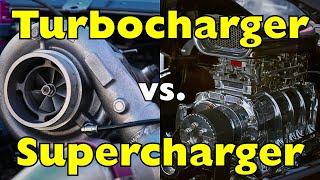
Turbochargers and superchargers both force more air into an engine to boost power, but they operate differently: turbos use exhaust gases (efficient but with lag), while superchargers are belt-driven (instant power but less efficient). The choice depends on whether you prioritize efficiency or immediate throttle response.
Both turbochargers and superchargers compress air entering the engine, allowing more fuel and bigger explosions for more horsepower and torque.
Uses exhaust gases to spin a turbine, which drives a compressor. Recycles waste energy but suffers from turbo lag—a delay while the turbine spools up.
Mechanically driven by the engine via a belt, delivering instant boost with no lag. Common types: roots, twin screw, centrifugal.
Turbos are more efficient (use waste exhaust) and popular in modern cars for fuel economy. Superchargers draw power from the engine, offering linear, predictable power—favored in drag racing and muscle cars.
Turbos operate under high heat/pressure, requiring more complex plumbing (intercoolers, blow-off valves). Superchargers are simpler and more durable but can stress the engine. Turbos are often cheaper to add; superchargers are bulkier.
What is the main difference between a turbocharger and a supercharger?
A turbocharger uses exhaust gases to spin a turbine; a supercharger is mechanically driven by the engine via a belt.
01:48
What is turbo lag?
A delay in power delivery while the turbo waits for enough exhaust pressure to spool up.
03:02
Why are superchargers favored in drag racing?
They deliver instant boost with no lag, providing quick, consistent power.
03:51
Name three common types of superchargers.
Roots, twin screw, and centrifugal.
04:04
Which forced induction system is generally more fuel-efficient?
Turbochargers, because they recycle exhaust energy that would otherwise be wasted.
04:51
What is 'twin charging'?
Using both a turbocharger and a supercharger on the same engine.
08:17
Turbocharger recycles waste energy
Explains the core efficiency advantage of turbos over superchargers.
01:48Supercharger delivers instant boost
Highlights the key benefit of superchargers—no lag—critical for certain applications.
03:26Efficiency vs. instant power trade-off
Summarizes the fundamental decision point when choosing between the two systems.
04:51[00:00] Have you ever heard a car whiz by with a thrilling roar and wondered what gives it that extra punch of power? Maybe you've come across the terms turbocharger and supercharger and thought they were the same thing.
[00:16] After all, they both make engines faster, right? Well, not quite. While both of these components are designed to increase the performance of a car's engine, they do it in very different ways.
[00:29] Today, we're diving deep into the world of forced induction to break down the key differences between turbochargers and superchargers. If you're a car enthusiast or just someone curious about how high performance engines
[00:45] work, this video is for you. Let's explore, right here on History of Simple Things.
[01:00] Before we get into the turbo versus supercharger debate, let's quickly talk about what both of these devices are designed to do. At their core, both turbochargers and superchargers are forced induction systems.
[01:16] That means they compress the air that enters the engine. Why compress the air? because when you squeeze more air into the combustion chamber, you can add more fuel,
[01:28] and the result is a bigger explosion and more power. It's like turning up the volume on your engine. Normally, a car engine draws in air naturally, and that's called naturally aspirated.
[01:42] But when you force more air in with a turbo or supercharger, the engine becomes capable of delivering much more horsepower and torque than it could otherwise.
[01:57] A turbocharger uses the engine's exhaust gases to power a turbine, which then drives a compressor that forces air into the engine. The key idea here
[02:09] is that it recycles energy that would otherwise be wasted Think of your car exhaust like wind coming out the back Instead of letting it just escape the turbo captures it to spin a small turbine
[02:23] That turbine is connected to a shaft which drives the compressor on the other side. It's like a windmill and a fan connected back to back. The windmill is spun by the exhaust
[02:35] and the fan blows fresh, compressed air into your engine. Since it uses exhaust gases, a turbo doesn't directly suck power from the engine itself. This makes it highly efficient, but it does have a catch, turbo lag.
[02:55] Turbo lag is that slight delay you sometimes feel when you press the accelerator and the power doesn't come immediately. That's because the turbo needs time to spool up.
[03:07] It's waiting for enough exhaust pressure to get spinning fast enough to make a difference. But once it kicks in, boom, massive acceleration.
[03:22] Now let's talk about superchargers. These devices are mechanically driven by the engine itself, usually via a belt connected to the crankshaft. So instead of waiting for exhaust gases like a turbo,
[03:37] the supercharger gets its power directly from the engine's rotation. Because of this, it delivers instant boost. There's no lag. When you hit the gas, the power is right there, ready to go.
[03:51] This makes superchargers a favorite in drag racing and other scenarios where quick, consistent power is critical.
[04:03] There are several types of superchargers, roots, twin screw, and centrifugal being the most common. The roots type pushes large volumes of air in bursts, creating strong low-end torque.
[04:17] Twin screw types are more efficient and compress air internally, while centrifugal superchargers look and behave a bit like turbos but are still belt Regardless of type the key is that superchargers are always on which can be both an advantage and a drawback
[04:41] So now you're probably wondering which is better. It really depends on what you value more, efficiency or instant power. Turbochargers tend to be more efficient because they utilize
[04:55] exhaust gases that would otherwise go to waste. This makes them popular in modern vehicles aiming for a balance between performance and fuel economy. That's why
[05:07] you'll find turbos and everything from hot hatchbacks to luxury sedans and even pickup trucks. Superchargers, on the other hand, are less efficient because they
[05:21] draw power directly from the engine. Think of it like this. The engine is doing extra work to spin the supercharger, so some of the power gain is offset by the energy it takes to run it. However,
[05:35] because they provide boost immediately, superchargers offer a more linear and predictable power curve. There's no waiting around for them to kick in. That's why muscle cars and performance
[05:48] vehicles often use them. They deliver that satisfying surge of power right off the line. Another thing to consider is maintenance. Turbochargers operate under extremely high
[06:05] heat and pressure, which can lead to more wear and tear over time if the engine isn't properly maintained. They also tend to be more complex with additional plumbing like intercoolers and
[06:18] blow-off valves. Superchargers are generally simpler in design and tend to be more durable, though they can still wear out, especially the belt system or bearings. However, because they're
[06:32] mechanically driven, they can place more consistent stress on the engine, which may shorten engine life in some setups From a cost perspective it often cheaper to add a turbo charger to an existing engine because the components can be smaller and more compact
[06:53] Turbos are also often stock equipment on modern engines, which helps reduce manufacturing costs. Superchargers are bulkier and can be more difficult to fit into a tight engine bay,
[07:05] making them more common in high-performance aftermarket builds or factory-tuned performance vehicles. The installation process for either can be complex, especially if you're retrofitting a naturally aspirated engine.
[07:22] But in general, superchargers may require fewer changes to the exhaust system, while turbos may demand more rerouting and cooling upgrades.
[07:35] So to sum it all up, both turbochargers and superchargers are designed to make your engine breathe better and work harder. But they do it in very different ways.
[07:49] Turbos use exhaust gases to spin a turbine, offering higher efficiency and better fuel economy, though at the cost of a bit of lag. Superchargers use mechanical power from the engine to deliver instant throttle response, trading off some fuel efficiency for raw, immediate power.
[08:10] Your choice between the two really comes down to what you prioritize. Responsiveness or efficiency, simplicity or complexity, low-end torque or top-end power.
[08:24] And in many high-performance setups, you might even see both. Yes, twin charging is a real thing. Thank you for watching.
[08:36] If you have suggestions for our next video, feel free to share them in the comments below. We'll be sure to give you an acknowledgment for your contribution.
[08:48] Thank you for joining us on this journey through the history of simple things. Don't forget to like, subscribe and stay tuned for more stories woven through the smallest details. .
⚡ Saved you 0h 09m reading this? Transcribe any YouTube video for free — no signup needed.