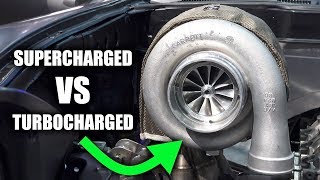

Why Turbochargers Are More Efficient
56sExplains how turbos use wasted exhaust gas, appealing to efficiency-focused car enthusiasts.
▶ Play Clip"The title is accurate; the video directly compares turbochargers and superchargers, discusses pros and cons, and the presenter gives a reasoned personal preference."
The video compares turbochargers and superchargers at a high level, outlining how each device increases engine horsepower. It details their differing power sources (exhaust gas vs. engine-driven), and discusses key pros and cons like efficiency vs. immediate throttle response. The presenter ultimately shares a personal preference for superchargers' instantaneous power delivery.
The video provides a high-level overview of the differences between superchargers and turbochargers, discussing pros and cons of each.
Both superchargers and turbochargers dramatically increase horsepower by providing 'boost' (added pressure) to the engine.
A turbocharger uses exhaust gas to spin a turbine, which then powers a compressor to force more air into the engine. It is not directly driven by the engine.
A supercharger is mechanically driven by the engine (e.g., belt or gear), which rotates a compressor to supply boost. It is dependent on engine RPM.
Turbochargers are more efficient because they utilize otherwise wasted exhaust gas energy, whereas superchargers do not.
Manufacturers use turbochargers to downsize engines for better fuel economy when not at full throttle, while still achieving high horsepower.
Superchargers have no lag because they are directly driven by the engine, providing immediate power when the throttle is pressed.
Certain supercharger types (twin-screw and roots) can provide wide, linear boost across the RPM range, especially low-end grunt.
Turbochargers suffer from lag and a boost threshold, meaning there is a delay between throttle input and power delivery, which can affect throttle control.
Turbochargers require engine oil lubrication for the turbine shaft and bearings, which can degrade oil faster due to high temperatures.
Superchargers take energy directly from the engine to operate, making them less efficient than turbochargers, though they regain some power from increased air.
After driving many vehicles, the presenter prefers superchargers for their immediate throttle response and the feeling of being connected to the car.
While turbochargers are more efficient and allow for engine downsizing, superchargers provide immediate, lag-free power and a more connected driving experience. The presenter personally finds supercharged cars more enjoyable to drive despite the efficiency trade-off.
How does a turbocharger generate power?
It uses exhaust gas to spin a turbine, which then powers a compressor to force more air into the engine.
1:01
How is a supercharger powered?
It is mechanically driven by the engine (e.g., belt or gear driven).
1:10
What is the main efficiency advantage of a turbocharger?
It uses otherwise wasted exhaust gas energy, making it more efficient than a supercharger.
1:29
What is the primary disadvantage of a turbocharger related to response?
Turbo lag and a boost threshold, causing a delay between throttle input and power delivery.
4:10
What is the main disadvantage of a supercharger regarding efficiency?
It takes energy directly from the engine to operate, creating parasitic loss.
6:05
Wasted Energy Recovery
Explains the core efficiency advantage of turbochargers by using exhaust gas that would otherwise be lost.
1:29Instant Throttle Response
Highlights the key benefit of superchargers: immediate power with no lag, improving driver connection.
2:48Turbo Lag Explained
Clearly defines turbo lag and boost threshold, explaining why throttle control differs from supercharged cars.
4:10Driver Enjoyment vs. Efficiency
Personal preference based on feel and connection to the car, illustrating a trade-off between efficiency and driving pleasure.
7:23[00:00] Hello everyone and welcome in this video we're going to be talking about the differences between
[00:04] superchargers and
[00:06] turbochargers more at a high-level standpoint and discussing the pros and cons of each now
[00:11] i've got a bunch of different videos on very specific types both turbochargers probably about six or so different types out there
[00:18] which I've discussed and three different types of superchargers which I've discussed in detail
[00:23] but I wanted to do kind of a high-level comparison of why a might you want to select one
[00:27] versus another and then from there you can start looking diving deeper into those individual options that you think makes sense for whatever
[00:35] application it may be now both superchargers &
[00:38] turbochargers by design help you increase horsepower
[00:42] dramatically so they give you a huge boost
[00:45] literally boost being the pressure that is added from the device whether it's a supercharger or a
[00:51] turbocharger to your horsepower
[00:52] so you're going to have an improvement in horsepower significantly more power using turbochargers and superchargers they go about it in very different ways a
[01:01] turbocharger uses your exhaust to spool up a turbine which then
[01:05] powers a compressor which pulls in air to feed more air to your engine a
[01:10] supercharger on the other hand is dependent on the engine to rotate it so whether it's gear driven or belt driven or some other form
[01:18] ultimately the engine is what is powering it?
[01:20] and so it's going to be some form driven by the engine which will rotate a
[01:25] compressor and that compressor will supply boost to the engine now
[01:29] why what are the advantages of going with that turbo realm?
[01:32] well, there are a lot of advantages from an efficiency standpoint because what you're doing is you're taking that exhaust gas
[01:38] which is otherwise going to be wasted and turning it into something useful and
[01:43] allowing you to pull in more air as a result of taking advantage of using that wasted exhaust gas
[01:48] so a supercharger will not do it
[01:50] it'll act very similar to a naturally aspirated engine, and then it can't do anything useful with those exhaust gases once
[01:57] they're leaving the engine now
[01:59] manufacturers often take advantage of turbochargers to downsize their engines so they can still make high levels of horsepower
[02:06] but then it allows them to use a small engine so when you don't want horsepower you've got less reciprocating mass
[02:12] you've got less rotating mass you've got a smaller engine. That's sitting there
[02:16] whether it's idling or cruising on the highway, and it's taking less energy to do it
[02:20] it doesn't necessarily mean you'll get better fuel economy when you're flooring it when you're trying to make peak power
[02:25] you're going to use a lot of fuel, but by downsizing that engine pulling weight out of the car using a smaller engine
[02:31] there's a lot of advantages from a fuel economy standpoint
[02:34] why which is why it's so popular with
[02:36] manufacturers currently so the biggest advantage of a turbocharger being of course it adds power
[02:41] and it does so efficiently so why might you want to go with a supercharger option? What are the advantages of a supercharger?
[02:48] well a supercharger is going to have no lag
[02:51] it's not dependent on exhaust gases in order to provide boost for the engine
[02:56] it's instead purely dependent on the engine's rpm so as a result when you put your foot down with a
[03:02] supercharged car you get that power immediately rather than waiting for it like you do in a turbocharged
[03:08] application the other advantages superchargers can be tuned and so can turbochargers to an extent
[03:14] but superchargers can be made so that they give you a wide nice linear boost
[03:20] across the engines rpm range now not this style here. Which is a centrifugal supercharger?
[03:25] which tends to be top-end heavy as far as adding boost and adding power
[03:30] but twin screw and root style superchargers give you a lot of power early on you get a lot of low-end grunt whereas a
[03:36] turbocharger you really have to choose
[03:38] where you want that power to come on you can have a ton of high end power you can have a decent mid-range,
[03:43] that levels out on both sides
[03:45] or you can have that early low end torque if that's what you want makes a lot of sense in diesel applications
[03:51] which are low revving get that low end grunt and and so but from a you know an entire curve standpoint,
[03:57] you can generally have a wider range using a supercharger of
[04:02] effective boost so another reason why they may be chosen
[04:05] so what are the disadvantages of a turbocharger well as we mentioned, there's lag.
[04:10] So there's turbo lag, and then there's also the boost threshold, so there's a certain exhaust
[04:15] there's a certain engine speed at which you produce enough exhaust gas to actually produce boost
[04:20] that's your exhaust threshold
[04:21] then once that's been overcome it takes a certain amount of time to pull in that air
[04:26] have it passed through and go through the intercooler into the engine from spooling up that exhaust
[04:32] so there's there's a lag associated with it so when you put your foot down the power is not immediate like it is with a
[04:38] supercharger you have to wait for it the other
[04:40] disadvantage there is that throttle control so you ask for a certain amount of power, and you wait a bit
[04:45] and so you've asked for a certain amount amount of power you may assume okay,
[04:49] that's what I've gotten and then later on more comes with it
[04:52] so your foot hasn't changed its position
[04:53] but the amount of power that you're receiving has so the
[04:57] communication through the throttle pedal is a bit different with a turbocharged car than with a supercharged car and finally
[05:04] turbochargers of course require engine oil lubrication at a minimum, and so you've got that engine oil
[05:09] and that's an extra demand which you know is going to be used to lubricate that
[05:14] turbine shaft as well as the bearings within the turbo and so that's an extra demand on your engine oil
[05:20] that's going to get very hot from the turbocharger and it's high temperatures
[05:24] so that's just another thing you have to consider is that your engine oil?
[05:28] you know will degrade faster using a turbocharger versus for example a naturally aspirated
[05:33] engine or in some instance instances supercharged cars
[05:37] which don't have oil lubrication which include root style superchargers &?
[05:44] twin-screw supercharger x' you probably don't have to have lubrication for those these centrifugal style
[05:49] superchargers will have oil lubrication, so it does again put another demand on the engine oil
[05:53] but it's not reaching the temperatures that a turbocharger is so really the big disadvantage with engine oil comes with turbochargers
[06:01] not with superchargers, so what are the disadvantages of a supercharger?
[06:05] well
[06:05] you're taking energy from the engine to make more power so rather than taking energy from the exhaust
[06:11] like a turbo you're taking energy from the engine directly so it takes a certain amount of horsepower to spin up at or a
[06:18] supercharger and as a result you lose that horsepower
[06:21] now you gain it back with pulling in more air but from an efficiency standpoint
[06:25] it's not the most logical thing to do so from an efficiency standpoint
[06:30] turbochargers make a lot of sense from a response standpoint
[06:34] superchargers make a lot of sense now
[06:36] which do I prefer well if you would asked me that question before?
[06:40] I had driven a bunch of the different cars out
[06:42] there as a result of being an automotive journalist and getting into a bunch of different press cars
[06:46] I would have told you that I preferred
[06:48] turbochargers, and I would have told you that because they are so much more efficient
[06:52] and I think that makes a lot of sense from a logical standpoint
[06:55] turbochargers make a ton of sense there. They're good today in which you can get very little lag
[07:01] you can get wide rpm ranges of effective areas with different technologies like twin-scroll turbo
[07:07] variable geometry turbos, so there's cool technology out there that kind of reduces their
[07:13] drawbacks
[07:14] but
[07:15] after having driven a bunch of the different vehicles out there and after having driven many numerous turbocharged and supercharged vehicles
[07:23] What I find is that I find
[07:25] superchargers far more enjoyable and the reason is because there's zero lag and so when you put your foot down
[07:31] you get exactly what you asked for and I think the thing that you come to appreciate
[07:36] after you start to drive a bunch of different vehicles out
[07:38] there is having a throttle pedal that does exactly what you ask it to do so with the supercharger
[07:44] you give it 50 percent you get 50 percent and your your pedal does exactly what you're asking of it in real time
[07:52] with the turbocharged car you could take that pedal mash it in real quick and
[07:56] nothing's going to happen at all because it doesn't have enough time to spool up that throttle pedal
[08:01] so you mash it in you wait and the amount of torque that you get it doesn't correlate
[08:06] perfectly with where you've positioned it with respect to time and so I think that's the big difference is that
[08:12] pedal you could be all over the place with your foot and the response that you're getting at the wheels as far as torque is
[08:17] also all over the place and not matching it versus a
[08:21] supercharger as you're changing that position of the throttle pedal
[08:24] you're getting you're feeling that change immediately
[08:26] so it's responding
[08:27] exactly how you ask it to and that response makes you feel really connected to the vehicle so me personally
[08:33] I have enjoyed more driving supercharged cars rather than driving turbocharged cars that said there are many great
[08:41] turbocharged cars out there that do a phenomenal job of you know
[08:45] mapping the throttle very consistently making it seem like there's not a huge amount of lag that there's not a huge torque
[08:51] discrepancy depending on where it you know you're putting your foot on that pedal, so I like the way that some cars out there
[08:56] I've done it just overall from a feel perspective. I feel like superchargers are more fun to drive
[09:02] so thank you all for watching and of course feel free to check out the many different types of superchargers and turbochargers.
[09:08] I will include links in the video description if you have any questions or comments feel free to leave them below.


⚡ Saved you 0h 09m reading this? Transcribe any YouTube video for free — no signup needed.