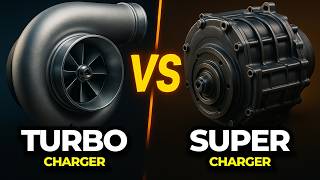

Turbo vs Supercharger: The Core Difference
43sClearly explains the fundamental mechanical difference, satisfying curiosity for car enthusiasts.
▶ Play Clip"The title accurately reflects the content: it explains the difference and debate between turbo and supercharger, though the final verdict is subjective."
This video compares turbos and superchargers, two methods of forced induction that increase engine power by compressing air into the cylinders. The key difference lies in how they drive the compressor: turbos use exhaust gas energy, while superchargers are mechanically linked to the engine's crankshaft.
Two main paths to increase engine power: turbo and supercharger, both force more air into the engine to burn more fuel.
Combustion engines burn air and fuel; more air allows bigger explosions and more power per cycle.
Uses exhaust gas energy to spin a turbine connected to a compressor, forcing compressed air into the engine. Revolutions can exceed 150,000 RPM.
Uses waste energy (exhaust gas), making it more fuel efficient than naturally aspirated or supercharged engines. Can deliver high peak power from small engines.
Turbo lag occurs due to time needed for exhaust flow to spin the turbine. Modern tech reduces lag but it can still be noticeable.
Connected directly to the engine's crankshaft via belt or gear, providing boost instantly from low RPM.
Types include Roots (rotating lobes) and centrifugal. Advantage: instant response and linear power delivery without lag.
Consumes engine power to drive itself, making it less energy efficient than a turbo. Also adds a distinct whine or whistle sound.
Variable geometry turbos and efficient superchargers blur lines. Some engines use both systems for best results.
Turbos favor efficiency and high-rev power, while superchargers provide instant torque. Modern technology reduces the gap, and some engines combine both for optimal performance.
What is the fundamental principle of forced induction?
It forces more air into the engine, allowing it to burn more fuel and produce more power.
00:31
What drives the compressor in a turbocharger?
The energy from hot exhaust gases spinning a turbine connected to the compressor.
01:00
What is the main advantage of a turbocharger?
It uses waste energy from exhaust gases, making it more fuel efficient.
01:53
What is turbo lag?
A slight delay between pressing the accelerator and feeling full boost due to time needed for the turbine to spool up from exhaust flow.
02:10
How does a supercharger get its power?
It is mechanically connected to the engine's crankshaft via a belt or gear system.
02:42
What is the main advantage of a supercharger?
Instant response and immediate boost from low RPM without lag.
03:12
What is the main drawback of a supercharger?
Parasitic loss: it consumes some engine power to drive itself, making it less energy efficient than a turbo.
03:37
Two Paths to Power
Sets up the core debate between turbo and supercharger.
Turbo Uses Exhaust Energy
Explains a unique efficiency advantage of turbos.
01:00Turbo Lag Explained
Key historical disadvantage clearly described.
02:10Supercharger Direct Drive
Fundamental difference in power source highlighted.
02:42Modern Blending of Technologies
Shows how lines are blurring—some engines use both.
04:14[00:00] In the world of high-performance engines, there are two main paths to unleash explosive power, ways to make an engine breathe harder than it was originally designed to force induction. And within that technology, the debate is legendary, almost as old as the systems themselves.
[00:17] Turbo or supercharger, both aim for the same ultimate goal, to push more air into the engine, allowing it to burn more fuel and thus produce more power. But it both seek to increase power by injecting extra air.
[00:31] What is the fundamental difference between a turbo and a supercharger? And which one is truly better? Force induction is based on a simple but effective principle. A combustion engine generates power
[00:43] by burning a mixture of air and fuel. The more air you can force into cylinders, the bigger the explosion, and the more power generated in each cycle, force induction systems use a compressor to force that extra air in. This is where turbos and superchargers take different paths
[01:00] in how they drive that compressor. Let's first talk about the turbocharger or simply turbo. This is an ingenious system that makes use of energy that would otherwise go to waste, the energy from hot exhaust gases exiting the engine. A turbo consists of two main components
[01:16] connected by a shaft, a turbine and a compressor. The turbine sits in the path of the exhaust gases. As these gases rush out of high speed and temperature, they spin the turbine blades at extremely high
[01:29] speeds, often exceeding 150,000 revolutions per minute. Since the turbine is connected to the compressor, the latter, located at the fresh air intake of the engine, is driven at the same speed.
[01:41] The compressor acts like a high speed fan that draws an air compresses it and forces it into the engine cylinders at a pressure higher than atmospheric. The key advantage is that it uses a free
[01:53] energy source. The exhaust gas as the engine has already produced. The turbo's greatest strength is its efficiency. By using waste energy, it enables an engine to be more powerful and potentially more fuel efficient than a naturally aspirated engine a similar output, or even a supercharge one.
[02:10] Turbos can deliver high peak power from relatively small engines. However, their biggest historical drawback is the infamous turbo lag. Turbine needs time to spool up from the exhaust flow,
[02:26] which means there's a slight delay between pressing the accelerator and feeling the full boost. While modern technology has greatly reduced this lag, it can still be noticeable. If you want to learn more about turbo lag, we've already made a video on that. You'll find it in the comments.
[02:42] Now, let's move on to the supercharger. This is also a compressive design to force extra air into the engine, but its method of operation is fundamentally different. It's directly connected to the engine's crankshaft, usually via belt or gear system. This means that unlike a turbo,
[02:59] the supercharger draws power directly from the engine. As soon as the engine starts spinning, the supercharger spins with it, compressing air from very low RPM.
[03:12] There are various types, such as roots type, with rotating lobes or centrifugal, similar to a turbine but mechanically driven. The supercharger's main advantage is instant response.
[03:24] Since it's mechanically linked to the engine, it delivers boost immediately, even from idle. This results in a very linear and predictable power delivery. Without the turbo's characteristic lag,
[03:37] mechanically, they are simpler in concept, though not always in design, since they don't deal directly with hot exhaust gases. Its main drawback is parasitic loss. Because it takes power from the engine
[03:49] to drive itself, a supercharger consumes some of the crankshaft's output to compress air. While the power adds is far greater than what it consumes, it's not as energy efficient as a turbo,
[04:01] which runs on waste energy. Superchargers also tend to add a distinct sound, often described as a wine or whistle, so which is better. Traditionally, turbos have been favored for high rev efficiency and
[04:14] maximum power, while superchargers have been preferred for aggressive response and instant torque at low rpm. However, modern technologies like variable geometry turbos, more efficient superchargers, have blurred some of those lines. In fact, some high performance engines even use both systems to
[04:31] combine the best of both worlds. And you, which one do you think is better?
⚡ Saved you 0h 04m reading this? Transcribe any YouTube video for free — no signup needed.