
3 Types of Hybrids Explained
50sQuick breakdown of parallel, series, and plug-in hybrids is highly educational and easy to understand.
▶ Play Clip"The title 'How Do Hybrid Vehicles Work?' accurately describes the video's content, which provides a clear, detailed explanation of hybrid operation, types, and benefits."
This video explains how hybrid vehicles combine an internal combustion engine with an electric motor to maximize fuel efficiency and reduce emissions. It covers the three main types of hybrid systems—parallel, series, and plug-in—along with key components like batteries and regenerative braking. The video also discusses common misconceptions and future advancements in hybrid technology.
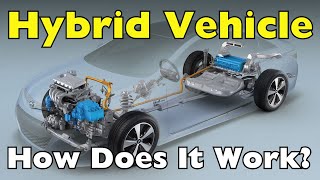
A hybrid vehicle combines an internal combustion engine and an electric motor for better fuel economy and lower emissions.
Most common type (e.g., Toyota Prius, Honda Insight). Both engine and motor connect to transmission, can work together or separately.
Gasoline engine acts as a generator to charge battery or power electric motor; wheels driven only by the motor (e.g., BMW i3 with range extender).
Larger battery can be charged externally, allowing longer electric-only range (e.g., Mitsubishi Outlander PHEV, Toyota RAV4 Prime).
Uses a high-voltage lithium-ion or nickel-metal hydride battery, charged via regenerative braking and sometimes the engine.
Captures kinetic energy during braking and converts it to electricity stored in the battery, increasing efficiency.
Combines electric and gasoline power to consume less fuel, produce fewer emissions, and save money at the pump.
Higher upfront cost due to technology, offset by government incentives and long-term fuel/maintenance savings.
Despite myths, modern hybrids can be quick thanks to electric motor torque, e.g., McLaren P1 sports car.
Ongoing improvements in battery life, electric range, regenerative braking, and solid-state batteries. Expanding into trucks, buses, and boats.
Hybrid vehicles are a smart blend of efficiency, performance, and sustainability, offering a practical middle ground between conventional cars and full electric vehicles. They save fuel, reduce emissions, and come with lower long-term maintenance costs.
What are the three main types of hybrid vehicles?
Parallel hybrids, series hybrids, and plug-in hybrids.
1:18
How does a parallel hybrid powertrain work?
Both the gasoline engine and electric motor are connected to the transmission and can work together or separately to power the wheels.
1:32
In a series hybrid, what is the role of the gasoline engine?
It acts as a generator to produce electricity for the battery or electric motor; it does not directly power the wheels.
2:22
What distinguishes a plug-in hybrid (PHEV) from other hybrids?
It has a larger battery that can be charged from an external power source, allowing longer electric-only driving range.
3:01
What is regenerative braking?
A process that captures kinetic energy during braking, converts it to electricity, and stores it in the battery for later use.
4:01
Name two battery chemistries used in hybrid vehicle batteries.
Lithium-ion and nickel-metal hydride.
3:44
Why do hybrids have lower maintenance costs?
The electric motor shares the workload with the engine, reducing wear on engine components, brake pads, and transmissions.
6:02
Give an example of a high-performance hybrid sports car mentioned in the video.
McLaren P1.
6:39
What future battery technology could improve hybrid performance?
Solid-state battery technology.
7:04
Besides cars, which other vehicles are adopting hybrid systems?
Buses, trucks, and boats.
7:16
Hybrid Definition
Provides a clear, concise definition of a hybrid vehicle combining two power sources.
0:47Parallel Hybrid Explanation
Describes the most common hybrid architecture, making it foundational for understanding how hybrids work.
1:32Regenerative Braking
Explains an innovative efficiency technology that recaptures energy normally lost as heat.
4:01Misconception: Hybrids Can Be Fast
Cites the McLaren P1 to debunk the myth that hybrids are slow, highlighting electric torque.
6:39Future Solid-State Batteries
Points to a promising technology that could significantly improve hybrid performance and range.
7:04[00:04] welcome back to history of simple things
[00:06] today's topic comes from one of our
[00:08] viewers David S thanks for the
[00:11] suggestion you asked how do hybrid
[00:14] vehicles work if you've ever wondered
[00:16] how these cars seamlessly switch between
[00:18] electricity and gasoline to maximize
[00:20] efficiency you're not alone hybrid
[00:24] vehicles are like The Best of Both
[00:25] Worlds offering fuel savings and reduced
[00:28] emissions without sacrif iing
[00:30] convenience but how exactly do they pull
[00:33] off this Balancing Act stick around as
[00:36] we break it all down right here on
[00:38] history of simple
[00:47] things a hybrid vehicle as the name
[00:50] suggests is a combination of two
[00:52] different power sources an internal
[00:55] combustion engine and an electric motor
[00:58] instead of solely relying on gas like
[01:00] traditional cars hybrids use both
[01:02] electricity and fuel to get you from
[01:04] point A to point B the key Advantage
[01:08] better fuel economy and lower emissions
[01:10] compared to regular gas-powered
[01:13] cars the way hybrid cars function
[01:16] depends on the type of hybrid system
[01:18] they use there are three main types
[01:21] parallel hybrids series hybrids and
[01:23] plug-in hybrids each one works
[01:26] differently but ultimately aims to
[01:27] maximize efficiency
[01:32] the most common type of hybrid is the
[01:34] parallel hybrid which includes popular
[01:36] models like the Toyota Prius and Honda
[01:39] Insight in these vehicles both the
[01:41] gasoline engine and the electric motor
[01:44] are connected to the transmission
[01:45] meaning they can work together or
[01:47] separately to power the
[01:51] wheels at low speeds the car might run
[01:54] purely on electricity using energy
[01:56] stored in its battery when you
[01:58] accelerate or need more power the
[02:00] gasoline engine kicks in either working
[02:02] alongside the electric motor or taking
[02:05] over
[02:06] entirely this smooth transition is what
[02:08] makes hybrids so fuele efficient
[02:11] additionally when you hit the brakes the
[02:13] car captures some of that energy and
[02:16] stores it in the battery a process
[02:18] called regenerative
[02:22] braking unlike parallel hybrids series
[02:25] hybrids such as the BMW i3 with a range
[02:28] extender work a little different
[02:30] in this system the gasoline engine
[02:32] doesn't directly power the wheels
[02:34] instead it acts as a generator that
[02:36] produces electricity to either charge
[02:38] the battery or Supply power to the
[02:41] electric motor which ultimately drives
[02:43] the wheels this means the car runs more
[02:46] like an electric vehicle most of the
[02:47] time only using the gasoline engine when
[02:50] the battery needs extra juice the result
[02:54] a quieter and smoother Driving
[02:55] Experience especially in City traffic
[03:01] plug-in hybrids take things a step
[03:03] further these cars have a larger battery
[03:05] that can be charged from an external
[03:07] power source just like a fully electric
[03:10] vehicle because of their increased
[03:12] battery capacity phevs can travel longer
[03:15] distances purely on electricity before
[03:17] switching to gasoline take the
[03:19] Mitsubishi Outlander phev or the Toyota
[03:22] Rav 4 Prime for example if you charge
[03:25] them regularly you might barely use any
[03:28] gasoline for short commutes making them
[03:30] a great choice for eco-conscious
[03:35] drivers a crucial component of any
[03:37] hybrid car is the battery unlike
[03:40] traditional cars that rely on a standard
[03:42] 12volt battery hybrids use a larger high
[03:45] voltage battery pack typically made from
[03:48] lithium ion or nickel metal hydride this
[03:51] battery stores and provides power to the
[03:53] electric motor but it also gets charged
[03:55] in real time through regenerative
[03:57] braking
[04:01] so what is regenerative braking think of
[04:04] it like this in a normal car when you
[04:06] hit the brakes all the kinetic energy
[04:08] that was moving the car forward gets
[04:10] wasted as heat in a hybrid that energy
[04:14] is captured and converted back into
[04:16] electricity which is then stored in the
[04:18] battery for later use this process helps
[04:22] increase efficiency and extends the
[04:24] vehicle's electric driving
[04:28] range one of the most most impressive
[04:30] things about hybrids is how seamlessly
[04:32] they switch between power sources modern
[04:35] hybrid systems are designed to make the
[04:38] transition from Electric to gasoline
[04:40] power as smooth as possible if you've
[04:43] ever driven a hybrid you might have
[04:45] noticed how quiet and effortless the
[04:47] transition feels that's because
[04:49] sophisticated computer systems
[04:51] constantly monitor speed battery charge
[04:54] and driving conditions to determine the
[04:56] most efficient power source at any given
[04:59] moment
[05:02] the biggest selling point of hybrid
[05:04] vehicles is their fuel efficiency by
[05:06] combining electric power with gasoline
[05:09] hybrids consume less fuel than
[05:10] traditional cars saving drivers money at
[05:13] the pump this also means they produce
[05:15] fewer greenhouse gas emissions which
[05:18] helps reduce their environmental impact
[05:21] while hybrids still burn fuel they do so
[05:23] more efficiently making them a great
[05:25] middle ground between conventional cars
[05:28] and full electric vehicles
[05:32] hybrids often cost a little more upfront
[05:35] than their gasoline only counterparts
[05:37] mainly due to the additional technology
[05:39] and Battery system however many
[05:42] governments offer incentives and tax
[05:44] breaks for hybrid and electric vehicle
[05:46] buyers helping offset the initial Cost
[05:49] Plus with better fuel economy and fewer
[05:51] trips to the gas station drivers can
[05:54] recoup some of that extra expense over
[05:56] time
[05:59] additionally hybrids typically require
[06:02] less maintenance since the electric
[06:04] motor shares the workload with the
[06:06] engine there's less wear and tear on the
[06:08] engine components resulting in longer
[06:10] lifespans for things like brake pads and
[06:13] Transmissions less maintenance means
[06:15] fewer repair costs making hybrids a
[06:18] smart long-term
[06:22] investment despite their growing
[06:24] popularity hybrids still face some
[06:26] misconceptions some people assume
[06:28] hybrids are slow
[06:30] but modern Hybrid models can be
[06:31] surprisingly quick the instant Torque
[06:34] from the electric motor provides strong
[06:36] acceleration and some hybrid sports cars
[06:39] like the McLaren P1 prove that hybrids
[06:42] can be both fuele efficient and high
[06:47] performance as technology continues to
[06:50] improve hybrid vehicles are becoming
[06:52] even more efficient and accessible many
[06:55] automakers are developing new Hybrid
[06:57] models with better battery life
[06:59] increased electric range and improved
[07:01] regenerative braking with advancements
[07:04] in Solid State Battery Technology on the
[07:06] horizon we may see hybrids with even
[07:08] greater performance and longer
[07:13] lifespans additionally hybrid technology
[07:16] is expanding Beyond cars buses trucks
[07:19] and even boats are starting to adopt
[07:21] hybrid systems helping reduce fuel
[07:23] consumption across different
[07:28] Industries so
[07:30] there you have it the inner workings of
[07:32] hybrid vehicles explained in a way that
[07:34] makes sense they're not just about
[07:36] saving fuel they're a smart blend of
[07:39] efficiency performance and
[07:41] sustainability whether you're looking to
[07:43] cut down on gas costs or just want to
[07:46] drive something that's a little better
[07:47] for the planet hybrids offer a practical
[07:50] and Innovative
[07:53] solution thank you for watching if you
[07:56] have suggestions for our next video feel
[07:58] free to share the in the comments below
[08:01] we'll be sure to give you an
[08:02] acknowledgement for your
[08:08] contribution thank you for joining us on
[08:10] this journey through the history of
[08:11] simple things don't forget to like
[08:13] subscribe and stay tuned for more
[08:16] stories woven through the smallest
[08:17] details
[08:20] [Music]
⚡ Saved you 0h 08m reading this? Transcribe any YouTube video for free — no signup needed.