Why You Believe Everything Online
46sRelatable hook about blindly believing online content, prompting self-reflection.
▶ Play Clip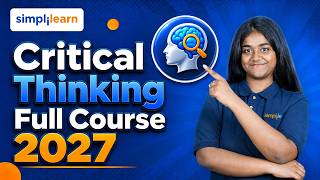
"The title promises a 'Full Course' and 'Mastery', and the content delivers a structured, multi-lesson course with practical frameworks, though it includes a sponsor segment and some repetitive filler."
This course on critical thinking, presented by Simplilearn, aims to equip viewers with practical skills to navigate the modern information landscape. It covers the definition of critical thinking, the traits of a critical thinker, the difference between fast and slow thinking, and provides a four-question framework for everyday use. The course also delves into argument analysis, logical fallacies, cognitive biases, and practical applications for verifying information, using AI, and making better decisions.
The course opens by highlighting how often we accept information from headlines, forwarded messages, or AI tools without questioning its validity, especially given the overwhelming volume of daily information.
Critical thinking is defined as the habit of thinking carefully before believing or deciding something. It involves pausing, examining facts, asking smart questions, and making decisions based on evidence rather than assumptions.
Unlike 20-30 years ago, information now comes from numerous unvetted sources. The real problem is not a lack of information but an excess of it, much of which is unreliable. AI tools can sound confident but be wrong, making the skill of knowing what to trust crucial.
Three common myths are debunked: critical thinking is not about being negative, not about doubting everything, and not exclusive to smart people or experts. It is a learnable skill for everyone.
The five key traits are: curiosity (always asking why and how), open-mindedness (listening to different ideas), looking for evidence (asking for proof), being okay with being wrong (changing your mind when presented with better evidence), and being aware of your own biases.
Using the bat-and-ball problem, the course explains Daniel Kahneman's concept of fast (automatic, gut-feeling) and slow (effortful, accurate) thinking. The brain often uses fast thinking when slow thinking is needed, especially in important, emotional, or urgent situations.
A practical framework for everyday thinking: 1) What's being claimed? 2) What is the proof? 3) What is missing? 4) What else could explain this? This habit helps slow down and evaluate information effectively.
An argument consists of three parts: the claim (main point), the reasons (because statements), and the evidence (proof behind the reasons). Identifying these parts helps in evaluating the strength of any argument.
A technique to visually map an argument by drawing boxes for the claim, reasons, and evidence, with arrows pointing upward. This helps in seeing the structure and identifying weak spots or missing evidence. Adding objections next to reasons provides a balanced view.
These are unstated beliefs that an argument depends on. To find them, ask 'For this argument to work, what else has to be true?' Checking these assumptions can reveal if the argument is shaky.
The course covers six fallacies: straw man (twisting an argument), personal attack (attacking the person), either/or trap (false choice), slippery slope (extreme chain of events), bandwagon (everyone's doing it), and hasty generalization (jumping to conclusions from little evidence).
Three biases are highlighted: confirmation bias (favoring information that confirms existing beliefs), anchoring (over-relying on the first piece of information), and availability bias (judging likelihood based on how easily examples come to mind).
The course demonstrates how to break down a social media post about college degrees using the learned tools: identifying the claim, reasons, evidence, hidden assumptions, and fallacies, showing how quickly the picture changes.
A four-question method (Who, What, When, Why) is introduced to verify information. This includes checking the source, looking for proof, verifying the date, and understanding the purpose behind the content. A simple search can often confirm or debunk a claim.
AI tools can hallucinate and sound confident while being wrong. The course advises checking any numbers, dates, or quotes from AI with proper sources, clicking links to verify, and asking AI for counterarguments. The four questions from lesson one apply to AI as well.
A structured approach to making decisions: 1) Figure out the real problem, 2) Gather facts, 3) List at least three options, 4) Weigh pros and cons (especially looking for weaknesses in your favorite option), 5) Make the decision, and 6) Look back later to learn from the outcome.
Key strategies include listening to understand rather than reply, repeating the other person's point back to them, focusing on the idea not the person, and pausing when the conversation gets heated.
Practical habits to integrate critical thinking into daily life: a 5-second pause before sharing, running one thing through the four questions daily, exploring a different view weekly, reflecting on decisions, and being honest about uncertainty.
The course concludes by emphasizing that critical thinking is a practical, learnable skill that helps you evaluate information, identify biases, and make better decisions. By applying the frameworks and habits taught, you can navigate the modern information world with more confidence and clarity.
Critical thinking is a practical skill
It reframes critical thinking from an abstract academic concept to a practical, everyday skill for making better decisions.
01:01Information overload is the real problem
It identifies the core challenge of the modern era: not lack of information, but an excess of unreliable information.
05:11The bat-and-ball problem demonstrates fast thinking
It provides a concrete, memorable example of how fast thinking can lead to incorrect answers, illustrating the need for slow thinking.
13:38The four-question habit is a practical tool
It offers a simple, actionable framework that viewers can immediately apply to evaluate any claim.
16:39AI can hallucinate and sound confident
It highlights a critical pitfall of using AI tools: they can invent facts while sounding authoritative, emphasizing the need for verification.
42:27[00:06] course on critical thinking. Now let me start with a very simple question. How many times have you read something online, watched a video or heard someone make a statement and immediately believed it without questioning whether
[00:20] it was really true. Maybe it was a headline that caught your attention, a message forwarded in a family group, a confident answer from an AI tool or an advice from someone you trust. It happens to all of us and the interesting
[00:33] part is that we often don't realize we are doing it. Now think about it how much information we deal with every single day. We scroll through social media, read news updates, attend meeting, make decisions at work and have
[00:47] conversation with people who may have completely different opinions from ours. In the middle of all these, it's easy to accept information at face value, jump to conclusion or make decision based on our first impression. And that's where
[01:01] thinking isn't about questioning everything or disagreeing with everyone or trying to prove that you are always right. It's about learning to pause, look at the information in front of you, ask the right question and make decision
[01:15] based on evidence rather than assumptions. It is also about recognizing your own biases, understanding different perspective and being comfortable saying I am not sure. Let me look into that. Now before we
[01:28] move on, let me share something exciting with you guys. If you are serious about management, then the PMP certification training in collaboration with simply learn can be a great next step for you. This course is designed to help you
[01:41] understand project management in a practical, structured and exam focused way. You will learn important concepts like project planning, work breakdown structures, resource allocation, grant chart, risk and issue management,
[01:53] stakeholder communication, cost and budget planning, schedule management, governance and value based project delivery. What makes this course even more useful is that it also covers modern project management skills like
[02:07] genai in project management, sustainability, business value and real world decision-m. So whether you are a project manager, team lead, software developer, project executive, engineer or someone who wants to move into
[02:19] project management, this course can help you build the confidence, structure and skills needed to manage project better and grow in your career. So without wasting any further time, let's get started.
[02:34] critical thinking matters in today's information world. what it really means trait of a critical thinker. We'll understand the difference between a fast and slow thinker. Learn how to break them down, evaluate evidence, recognize
[02:49] assumption and biases, and apply practical for question habit to we'll discover how to approach information more thoughtfully.
[03:03] first lesson of this course. Before we get into anything, let me ask you a quick question. How many times today have you read something online and just have you read something online and just believed it? Maybe it was a headline or
[03:15] a forwarded message in a family group, an answer from Chad GPT, or a review that said best product ever. If you be honest, the answer is probably more than once. And that's completely normal because we all do it. We see so much of
[03:31] information every single day that's there. No way we can stop and check all of it. So our brain quietly takes shortcut. It trust whatever feels right and it goes with whatever sounds the most confident. Most of the time that
[03:45] works out just fine. But every now and then it doesn't. Sometime it leads us to bad decision, a wrong opinion or a mistake that we could have easily avoided if we had just paused for a moment. And that pause is exactly what
[04:00] this lesson is all about. Over the next 20 minutes, we are going to walk through five things together. First, we'll talk about why critical thinking matters so much in today's world. Then we will look at what critical thinking really is and
[04:14] just as importantly, what it isn't. After that, we will go through the traits that make something a strong critical thinker. We'll also explore the difference between fast thinking and slow thinking and why our brain sometime
[04:28] tricks us. And finally I will give you a simple four question habit that you can start using today. There is no heavy theory here and no complicated words just practical ideas you can actually use in in your daily life. So let us get
[04:42] started coming to the very first thing with a very big question. Why should you even care about critical thinking right now? To answer that think about how things were maybe 20 or 30 years ago. If you wanted information back then you
[04:56] only had a few places to get it. You had newspaper, a couple of TV channels, your library. There wasn't a lot of information around and most of it went through some kind of checking before it even reached you. Now compare that with
[05:11] today. You wake up, pick up your phone and within 5 minutes you have already seen all the news, memes, ads, opinion, short videos and messages from 10 different group chats. Some of it is true, some of it only half true and some
[05:25] of it is completely made up. The real problem today isn't that we don't have enough information. The problem is that we have far too much of it and not all of it deserves our trust. It gets even more interesting when you add AI to the
[05:40] picture. We now have tools like chart GPD that can answer almost any question in just few seconds. That's honestly very amazing and I use these tools myself. But there are the thing you need to remember. AI can sound very sure of
[05:54] it and still be wrong. It can mix up facts, miss important context, or give you an answer that sounds perfect but doesn't really fit for your situation. If you don't stop to think, you will simply take that answer and run with it.
[06:07] So, the skills that matter today isn't finding information because anyone can do that. Now, the real skill is knowing what to do with the information once you have it. It's knowing what to trust, what to question, and what to simply
[06:20] ignore. And this skill shows up in almost every part of your life. At work, someone who just follows instruction and someone who spots a problem before it turns into a disaster. Companies know this very well, which is why critical
[06:35] thinking keep showing up near the top of almost every list of skills employees are looking for. In your personal life, it is the difference between falling for a money scam and walking away from it. It is the difference between buying
[06:49] something just because an influencer said so and buying it because it actually fits your needs. And in everyday conversation, it is the difference between arguing in circles and actually understanding each other.
[07:04] So here's the simple truth. Critical thinking isn't just some fancy academic skill that only matter in classroom. It is practical everyday skill for the world we live in right now. Okay. So now that we know why it matters but what
[07:18] exactly is critical thinking? Now thinking is and what isn't. So if you search online for a definition of critical thinking you will find plenty of long and complicated ones. So let us keep it very simple. Critical thinking
[07:31] is the habit of thinking carefully before you believe it something or decide something. That's really all it is. It means you don't just accept thing the moment they reach you. Instead you pause. You look at the facts. You ask a
[07:45] few smart question and only then you make your mind. Now let me give you an everyday example to make this clearer. Imagine a friend sends you a message that says drinking hot water with lemon every morning burns belly fat. Doctors
[07:58] are shocked. A quick reaction would be something like oh nice I'll start this tomorrow and maybe you would even forward it to your family group. A critical thinker on the other hand would pause for a second and wonder about a
[08:10] few things. Who actually said this? Which doctors are we talking about here? Is there any real study behind it or is it just a catchy message designed to get shared? Now, it's the same message in both the cases, but it's handled in a
[08:24] completely different way. Now, here's where a lot of people get a little confused because the word critical sounds negative. Many people believe critical thinking means things it actually doesn't. So, let us clear up
[08:37] three common myth before we move on. The first myth is that critical thinking means being negative. That's not true at all. Critical thinking isn't about criticizing everything or finding fault in other people. It's about seeing
[08:51] things clearly. Sometime that means you notice a problem that other missed and sometime it means you realize that an idea actually makes a lot of sense. Now both of those are good outcomes and both come from thinking carefully. The second
[09:06] myth is that critical thinking means doubting everything again. That's not the case. If you doubted every single thing around you, you would never get anything done. You would be wondering whether the sun will really rise
[09:19] tomorrow. Critical thinking is about doubting the right thing at the right time, especially when the stakes are high or when something sounds too good or too shocking to be true. And finally, the third myth and probably the biggest
[09:32] one is that critical thinking is only for smart people or experts. In reality, critical thinking has nothing to do with how many degrees you have or how high your IQ is. Plenty of very smart people make terrible decisions simply because
[09:46] they don't stop to think. And plenty of everyday people make great decisions because they ask good questions. Critical thinking is a skill and just like another skill, anyone can learn it
[09:59] like another skill, anyone can learn it and can get better at it with practice. So to sum it up, critical thinking isn't about being negative. It isn't about doubting everything and it definitely isn't about experts. It's simply about
[10:11] thinking carefully before you believe or decide. So now that we understand what it is, let us look at what it looks like in real person. What are the trait of someone who thinks critically? When you imagine a great critical thinker, you
[10:24] might picture a detective, someone like Shellcoms, who notice tiny details that everyone else misses. But in real life, critical thinkers don't look that dramatic at all. They're just a regular people who have built a few strong
[10:37] habits over time. Let us go through five of those habits one by one. The first trait is curiosity. Critical thinker always ask why and how. Why did this happen? How do we actually know that? That's what's really going on here. They
[10:53] don't stop at the first answer they hear because they want to understand things properly. You have probably seen this in young kids. A 5-year-old will happily ask why 10 times in a row. Somewhere along the way, most of us stop doing
[11:06] that as we grow up. Critical thinkers simply never stop. The second trait is being open-minded. This mean being willing to listen to ideas that are different from your own. A critical thinker doesn't shut someone down just
[11:21] because they disagree with them. Instead, they think, "Okay, let me hear this person out. Maybe they can see something that I can't." Being open-minded doesn't mean you have to agree with everybody. It just means you
[11:34] give an idea a fair chance before you judge it. The third trait is looking for evidence. A critical thinker doesn't rely on gut feeling alone. Before believing something, they ask, "What's the proof? Is there any data behind it?"
[11:47] Are there any reliable source or is just someone's opinion dressed up to look like a fact? For example, imagine a coworker says, "Our customer hate the new feature." A critical thinker would gently ask, "How do we know that? Did we
[12:01] get complaints? How many?" Because it's quite possible that it was just two-way loud customers and not the majority. The fourth trait is being okay with being wrong. And honestly, this one is hard for most of us. We don't like being
[12:15] wrong. So we often defend our opinion even when we know deep down that they are weak and wrong. Critical thinkers sees that differently. When they find better evidence they change their mind and they don't feel embarrassed about
[12:27] it. To them being wrong for movement is far better than staying wrong for effect. The fifth trait is being aware of your own biases. Every single one of us has biases. We naturally like ideas that match what we already believe and
[12:41] we tend to trust people who are similar to us. That's just how human brain works. Critical thinkers don't pretend that they are free of biases. Instead, they keep an eye on it. Every so often they ask themselves, "Am I believing
[12:55] this because it is true or because I want it to be true?" Now, let us quickly wrap those five traits. A critical thinker is curious, open-minded, looks for evidence, is okay with being wrong, and stays aware of their own biases.
[13:09] Now, here's a small challenge for you. Think about which of these five comes naturally to you and which one you would like to work on. There's no wrong answer here. Just being aware of it is already a big step. Now, here's something
[13:23] interesting. Even people who have all five traits still fall into thinking trap from time to time. That's not because they are careless. It's because of the way the brain is wired. And that brings us to the next topic. Now, let us
[13:38] start with this part with a fun little test. Don't overthink it. Just answer as quickly as you can. A bat and a ball cost $110 in total. The bat cost $1 more than the ball. How much does the ball cost? Take
[13:53] ball. How much does the ball cost? Take a second and lock in your answer. Now, if you said 10 cent, you're in very good company because that's what most people say. It just feel right, but it is actually wrong. If the ball cost 10
[14:06] cent, that bat would cost $110 and together they would add up to $120. The correct answer is 5. The ball cost 5 cents and the bat cost $15
[14:19] cents and the bat cost $15 and together they make exactly $110. So what just happened there? Your brain used something called as fast thinking. The idea comes from a well-known psychologist named Daniel Canaman who
[14:34] explained our brain works in two different modes. Let's simply call them fast thinking and slow thinking. Now fast thinking is quick, automatic and based on our gut feeling. It's what you have use when you recognize a friend's
[14:47] face in a crowd. Read a stop sign or answer 2 + 2. It take almost no effort at all. And honestly, it is a great thing to have. Without it, you would be completely exhausted by lunchtime. Slow thinking is the opposite. It's carefully
[15:03] focused and takes real effort. It's what you use when you are solving a tricky problem, comparing two different job offers or checking a bill line by line. It's slower, but it is also much more accurate. Now, the catch here is our
[15:17] brain loves fast thinking because it is easy. So, it often uses fast thinking even in situations where we really need slow thinking. That's exactly what happened with the bat and ball question. And in real life, this shows up all the
[15:31] time. You see a 70% off today only sale and end up buying something you don't need. You read a scary hard headline and start panicking before you have even read the full story. Or you judge a new coworker based on the awkward first
[15:45] meeting. None of this make you a bad thinker. It just means fast thinking took over at that moment when slow thinking should have stepped in. So the goal here isn't just to stop fast thinking. That's impossible and you
[15:59] wouldn't want to anywhere. The real goal is to notice when a situation needs you to slow down. A simple rule of thumb is to slow down whenever the decision is important. Whenever money or your health is involved, whenever you're feeling
[16:12] strong emotions like anger or excitement, or whenever something feels very urgent, those are exactly the moments when fast thinking is most likely to trick you. So how do you actually slow down in the moment when
[16:24] everything is moving fast? You need a simple tool and you can reach for and that's exactly what our last topic of this lesson is all about. The four question habit for everyday thinking. Now let us make all of this practical. I
[16:39] want to give you a simple habit that you can use anytime and anywhere. It's just four question and once you get used to them they will start coming to you naturally. So the very first question here is what's being claimed. Before
[16:53] anything else, get clear on what someone is actually saying. Strip away the drama, the big words and the emotion and ask yourself what the main point really is. Very often you will realize the message is saying a lot less than it
[17:06] seemed to be at the first glance. The second question is what is the proof? So once you know the claim, look at what's backing it up there. Is there real data? Is there a trusted source? Are there actual examples or is it just the
[17:21] confidence and impressive language? A strong claim with weak proof is clear sign to slow down. Now coming to the third question is what is missing? This is one of the most people skip and it is often the most powerful one. Ask
[17:35] yourself what you are not being told. Is there any side of the story? Is someone leaving out details that might completely change the picture? Sometimes what's left out matters most than what is being said. And finally the fourth
[17:49] question is what else could explain this? Here you think about other possibilities. Is there a different reason this might be happening? Is the obvious answer really the only answer? This question keeps you from jumping to
[18:03] conclusions too quickly. Now let us try all four on a quick example. Imagine you come across a post that says this new app helped me earn 50,000 rupees in one week. Download now. So what is being claimed? The app can help you earn a lot
[18:19] of money very fast. What's the proof? Just one person post with no real details at all. What is missing? We don't know how they earned it. How many people tried it and lost money or whether they are being paid to promote
[18:33] it? And what else could explain this? Maybe it's paid ad, maybe it's a scam, or maybe it worked for the lucky person and nobody else. See how quickly the
[18:45] whole picture changes. That took maybe 30 seconds and it could save you a lot of money and stress. So, here are the four question one more time. What's being claimed? What is the proof? What's missing? And what else could explain
[19:00] this? Write them down. Stick them onto your decks or save them on your phone. The more you use them, the more natural they will feel. And that brings us to the end of this lesson. So let us take a quick look back at everything we have
[19:15] covered. We started with why critical thinking matters so much today, especially with all the information and AI answers coming at us every single day. Then we cleared up what critical thinking really is, which is simply
[19:30] thinking carefully before you believe or decide. And we saw that it's not about being negative or doubting everything we see. After that, we looked at five traits of a critical thinker. They are curious, open-minded, look for evidence,
[19:45] and are okay with being wrong and stay aware of their own biases. We also saw how fast thinking can trick us and when it's smart to slow down. And finally, you picked up the four question habit that you can start using right away.
[20:00] Now, here's a small task before the next lesson. Pick one thing you see online today. It could be a post, headline, or an answer from an AI tool. Run it through the four question just once and notice what you discover. In the next
[20:14] lesson, we will go one step deeper. We'll learn how to break down any argument into small parts and how to spot the common thinking mistake that people makes all the time. So, I'll see you in the next lesson.
[20:34] something. Did you try the small task from the last lesson? Did you pick one post, headline or AI answer and run it through the four questions? If you did, you probably notice something
[20:47] what's being claimed and what is the proof, a lot of messages that looked convincing suddenly start to look a bit shaky. And if you didn't get a chance to try it, that's completely fine. You will get plenty of practice in this
[21:02] particular lesson. In lesson one, we built the foundation. We talked about what critical thinking really means, the traits of a good critical thinker, and how fast thinking can sometime trick us. Today, we are going one level deeper. We
[21:15] are going to learn how to take any argument whether it's a news, a sales pitch, a debate in a meeting or a heated discussion in your family group and break it down into its part. Once you can see the parts, it's become much
[21:31] easier to tell a strong argument from a weak one. Here's what we'll cover. We'll start with the basic parts of an argument. Then I will show you a simple way to draw an argument out so you can see how it holds together. After that,
[21:44] we'll learn how to spot hidden assumptions, which are the things people take for granted without saying them out loud. We'll go through six common logical fallacies, which are mistakes in reasoning that you will start noticing
[21:58] everywhere once you know them. Then we will turn the spotlight onto ourselves and look at the biases in our own thinking. And finally, we'll put everything together by breaking down a real world style post step by step. Grab
[22:12] a pen and paper if you have one nearby because this lesson is a hands-on. The parts of an argument, claim, reason, and evidence. When most people heard the word argument, they picture two people shouting at each other. But in critical
[22:24] thinking, an argument means something much calmer. An argument is simply someone trying to convince you that something is true by giving you enough reasons. Every time someone says you should do this because of that, uh they
[22:38] are making an argument. ads make an argument. Your manager makes argument. Your friends make arguments about which restaurant to pick. And yes, you make them too all day along. The good news is that almost every argument, no matter
[22:53] how long or complicated it looks, is built from the same three parts. The main point, the thing the person wants you to believe or do. The second part is the reasons. These are the because statement that is supposed to support
[23:07] the claim. And the third part is the evidence. This is the proof behind reasons like facts, numbers, examples or expert sources. Now let us look at a simple example. Imagine a colleague says we should move our team meeting from
[23:21] Monday to Tuesday because half of the team is usually still catching up on the weekend emails or the Monday mornings. Last month four out of six Monday meetings started late. The claim here is that meeting should move to the Tuesday.
[23:36] The reason is that people are busy catching up on Monday mornings. And the evidence is that four out of six Monday meetings started late last month. See how neat that is when you pull it apart. And here's why it matters so much. When
[23:50] an argument is missing, one of these parts, it gets very weak quickly. A claim with no reason is just convenient. A claim with reasons but no evidence is a guess that sounds confident. You'll be surprised how many arguments around you
[24:04] are only a claim wrapped up in a strong emotion or big words with nothing solid underneath. A quick tip for finding the claim, look for words like so, therefore, that's, why, or you should. The claim usually sits right next to
[24:18] them. And to find the reason, look for the words like because, since, or the reason is. Once you start noticing these little signal words, you'll be able to spot the structure of an argument in just a few seconds. Now simple argument
[24:31] mapping. Now that you know the three parts, let us learn a really useful trick called argument mapping. It sounds technical but it is actually very simple. Argument mapping just means drawing an argument out on a paper. So
[24:43] you can see how the pieces connect. Our brain is much better at understanding picture than long paragraphs. So when you draw an argument, it's strong and you draw an argument, it's strong and weak spot just jump out at you. Here's
[24:55] how you do it. Take a sheet of paper. At the top, draw a box and write the claim inside it. Below that, draw a box for each reason and draw an arrow from each reason pointing up to the claim. Then, under each reason, draw smaller boxes
[25:09] for the evidence that supports it. Again, with an arrow pointing up, that's it. You end up with something that looks like an upside down tree with the claim at the top and everything else holding it from the below. Just like you can see
[25:22] example. Say a friend tells you you should buy this phone. It has the best camera on the market. The battery lasts two full 2 days and it's on the sale this week. At the top, you should write the claim. Buy this new phone. Below it,
[25:36] you would draw three reason boxes. One says best camera on the market. One says battery last 2 days and one says it's on the sale. Now comes the interesting part. Look under each reason and ask what evidence is holding this up for the
[25:50] camera. Is there a review or a comparison test or is it just what the company ad says for the bad? Did your friend actually test it or did they read it on the box? And for the sale, is it a really good piece or was the price
[26:03] raised last month and then discounted back down? Suddenly you can see which parts of the argument are standing on the solid ground and which part are just floating there with the nothing underneath. There's one more thing you
[26:15] can add to your map and it's what separate a good thinker from a great one. Next to that reason, add a box just like this for objection. These are the points that push against the claim. In our phone example, my objection could be
[26:29] my current phone works perfectly fine for me or I really don't use the camera much. When you put the reasons and the objection side by side, you're no longer just reacting to the sales pitch. You're making a real decision. You don't need
[26:43] to draw a map for every little thing in your life. But for major important decision or argument that feels confusing, spend 2 minutes with a pen and paper and that can save you from lot of regret. So far we have looked at the
[26:57] part of an argument that people say out loud. But some of the most important part of an argument are the ones nobody says at all. These are called the hidden assumption. A hidden assumption is something like the person takes for
[27:10] granted, something they believe is true without stating it or proving it. And very often the whole argument quietly depends on it. Now let us go back to the meeting example discussed earlier. Your colleague said we should move the
[27:22] meeting to Tuesday because people are catching up on emails on Monday morning. it? They're assuming Tuesday mornings will be free and calm. They're assuming the late starts were caused by emails and not by something else like traffic
[27:37] or another meeting running over. If either of those assumptions turns out to be wrong, moving the meeting won't fix anything. Now, here is another one you have probably heard. This course cost 50,000 rupees, so it must be really
[27:50] good. The hidden assent here is that a higher price always means high quality. And we have all known that it's not always true. Some expensive things are great and some are just expensive. Or think about a line like everyone in our
[28:04] office is learning AI so you should also. The hidden assumption is that what's right for everyone else is automatically right for you also. Maybe it is but maybe your role, your goal or your timings are completely different.
[28:18] So how do you find hidden assumptions? The easiest way is to ask yourself simple question for this argument to work. What else is true? Then just list often find two or three things the person never mentioned. Once you have
[28:32] found them, check each one. If the assumption holds up, great. The argument is stronger than you thought. But if even one important assumption is shaky, the whole argument starts to wobble. This skill is incredibly useful at work.
[28:45] When someone pitches a plan in a meeting, the people who ask, "What are we assuming here?" are usually the ones who catch the problem early. It's simple question but it makes you sound thoughtful and it often saves the whole
[28:59] team a lot of trouble later. Now that we get to one of the most fun part of this course. A logical fallacy is a mistake in reasoning. It's a argument that might sound convincing on the surface but falls apart when you look at it closely.
[29:12] There are dozens of fallacies out there but you really need to know a handful to start spotting them everywhere. Let us go through six of the most common ones. The first is the straw man. This is when someone twists your argument into a
[29:25] weaker or sillier version and then attacks that version instead of what you actually said. Imagine you say, "I think we should spend a little less time on social media." And someone replies, "Oh, so you want to ban phone completely and
[29:39] said that. They built a fake version of your point because it's easier to knock down. Whenever you notice someone arguing against something, nobody actually said you're looking at a straw man. The second is the personal attack.
[29:53] Instead of responding to the argument, the person attacks the one who made it. For example, why should we listen to his idea about the budget? He can't even manage his own time. Maybe he really is bad with time, but that has nothing to
[30:05] whether his budget is good or not. A strong argument stands or fall on own no matter who says it. The third is either or trap. Sometimes called a false choice. This is when someone presents only two option as if nothing else
[30:19] existed. Either you work your weekends or you are not serious about your career. In reality, there are plenty of other options in between. Whenever someone squeeze a big decision into just two choices, pause and ask, is that
[30:32] really all there is? The fourth is the slippery slope. This is when someone claims that one small step will lead to a chain of extreme events without showing why. If we let employees work from home one day a week, soon nobody
[30:46] will come to the office. the team will fall apart and the company will shut down. Each step sounds a little scarier than the last, but there's no real proof that one leads to another. The fifth is that everyone's doing it argument, also
[31:00] known as bandwagon. This is when something is said to be true or good simply because lots of people believe it too. Millions of people use this supplement, so it must work. Popular doesn't always mean correct. Plenty of
[31:14] popular ideas of history turns out to be completely wrong. And finally, the sixth is jumping to conclusion or what's often called a hasty generalization. This is when someone draws a big conclusion from very little evidence. I ordered from a
[31:30] app choice and both time the food was cold. The tap is credible. Two bad orders might just be bad luck. To make a fair judgment, you would need a lot more than two example. So those are the six straw man personal attack that either or
[31:44] trap slippery slope the bandwagon and jumping to conclusion over the next few days. Keep your eyes open. You will start hearing these in TV debates, social media comments, office meeting and maybe even in your own argument and
[31:57] noticing them is the first step to not getting fooled by them. Up to now we getting fooled by them. Up to now we have mostly been looking at other people arguments. But critical thinking isn't only about catching mistake in what
[32:09] others say. It is also about catching the mistake in our own heads and that's a lot harder because our own biases feel completely normal to us. A biasis is a mental shortcut that nudges our thinking in certain direction often without us
[32:22] even noticing. Let us look at three of the most common ones. The first is a confirmation bias. This is a natural habit of looking for information that agrees with what we have already believe and ignoring information that doesn't.
[32:35] Say you have already decided a certain phone brand is the best. When you read reviews, you'll naturally pay attention to the good ones and brush off the bad ones as fake or exceptions. Social media makes this even stronger because app
[32:49] tends to show you more of what you already like and agree with. Before long, it feels like the whole world agrees with you. Just really you are just seeing one side. The second is anchoring. This is when the first piece
[33:02] of information we see stick onto our mind and shape every decision. After all shop use all this time a jacket show an original price of 8,000 crossed out with original price of 8,000 crossed out with new price of 3,000. Suddenly 3,000 feels
[33:16] like a steal even with the jacket was never really worth 8,000. That first number became your anchor. The same thing happens in salary negotiation, house prices and even in how we judge people after a first impression. The
[33:30] third is what called as availability bias. This is when we judge how likely something is biased or on how easily example comes to mind. For instance, after seeing several new stories about a plane crash, many people feel flying has
[33:45] become dangerous. In reality, flying is still one of the safest way to travel. But because those traumatic stories are fresh in our memory, they feel more common than they really are. So, how do you really protect yourself from your
[33:58] own biases? You can't switch them off completely because they are part of how your brain works. But you can slow them down with a few simple habits. When you feel very sure about something, go looking for only one good argument from
[34:12] the other side. When you see a price or number, ask yourself whether you would still feel the same if you would have seen a different number first. And when something feels very common or very scary, ask whether that's based on real
[34:25] numbers or just on what you have seen recently. The goal isn't to become perfectly unbiased. Nobody is. The goal is to notice your biases more often so they don't quietly make your decision for you. All right. Now, it's time to
[34:39] put everything together. Let's take a post that kind of you have probably seen post that kind of you have probably seen on many social media and break it down learned. Here's the post. Stop wasting money on the college degree. I dropped
[34:52] out and I run a business that makes lags every month. Every successful person I know skipped college. So if you would go to college, you'll still end up stuck in a boring job for the rest of your life. Smart people are already quitting. Don't
[35:06] be left behind. Let us start with the parts of an argument. What's the game? The college degree are a waste of money and you shouldn't get one. What is the reason the person dropped out and became successful? Every successful person they
[35:20] college leads to a boring job. And what's the evidence really? It's just their own story and the people they know. There's no data, no research and no wider picture. Now let us quickly map it into our heads. At the top sits the
[35:35] claim don't go to college. Below it's the three reasons. But when you we look under each reason for evidence, we almost find nothing. one personal story and a vague everyone I know that's a very shaky foundation for such a big
[35:48] life decision now let us look for the hidden assumptions for this argument to hidden assumptions for this argument to work what else has to be true it assumes that what worked for this one person will work for everyone assumes success
[36:01] only means making money and it assumes college has no other value like skills friendship or opportunities field like medicine or engineering where a degree is actually required now Let's spot the fallacies. Every successful person I
[36:14] know skipped college is jumping to conclusion because it's based on a tiny and probably handpicking picked group. If you go to college, you'll be stuck in a boring job forever. Is a slippery slope and also an either on trap as
[36:27] there is only two parts in life. Smart people are already quitting. Don't be left behind. Is bandwagon pushing you to follow the crowd. Finally, let us check our own biases. If you already dislike college, this post might feel very
[36:41] satisfying to agree with. That's confirmation bias at work. And if you have recently seen a lot of dropout success stories online, they might feel more common than they really are, which is availability bias. So what's our
[36:54] final verdict? It doesn't just mean college is right for everyone. That's Doesn't gives us good reason to decide either ways. It's one personal story dressed up with the confident words and a few realistic fallacies. And notice
[37:08] how quickly we figured out that once we knew what to do for. And that brings us to the end of this lesson. You have learned a lot today. You know that every argument is built from a claim, reasons, and evidence. You can draw a simple
[37:20] argument map to see what's holding up an idea. You know how to dig out hidden assumptions by asking what else has to be true. You can spot six common fallacies. and you're more aware of the biases that live in your own thinking.
[37:34] Now, here's your task before the next lesson. Find one argument this week. Maybe an in an ad, a news article, a meeting, or a family chat. Draw a quick map of it. Find at least one hidden assumption and see if you can spot a
[37:47] fallacy. It doesn't have to be perfect. The goal is just to practice seeing arguments in a new way. In the next and final lesson, we'll take all of these skills into everyday life. We'll learn how to check if information is reliable,
[37:59] how to think critically about an AI answer or simple method for making better decision and how to disagree with people without it turning into fight. So that's all for this particular lesson. I'll see you in the next one.
[38:17] been looking forward to this one because the first two lessons were a lot of ideas. Today we finally get to use them. I'll tell you why this part matters so much. When I first started reading about critical thinking, everything made sense
[38:31] on paper, claims, evidence, fallacies, biases. I would m along and think, "Yeah, I get it." Then I would open WhatsApp and 10 minutes later, I would be believing some post about a new tax rule or a miracle type. Or I would buy
[38:44] something online at midnight because it said only two left in stock. So clearly understanding it and actually doing it were not the same thing for me. I have a feeling it might be the same for you. That's why today isn't about theory.
[38:57] your uncle forwards every morning. The answer GPT gives you that sounds very sure itself. That decision you have been putting off for months. That one colleague you just cannot seem to agree with. We will go through five things.
[39:11] First, how to quickly check if something you read is actually true. Then how to use AI tools without getting fooled by them. After that, a very simple way to make decisions you won't regret. Then how to disagree with someone without it
[39:24] turning ugly. And finally, how to make all of this a habit so it doesn't fade away a week after you finish this course. Okay, so let's get into it. So how to check if the information is reliable. Okay, let me start with
[39:37] something embarrassing. A few year back, I forwarded a message to my family group about a new government rule that was supposed to start the very next day. It had a logo on a date, even an official looking signature at a bottom. I didn't
[39:50] think about toys. About an hour later, my cousin replied with a fact check said anything mean. But I remember sitting there feeling pretty silly because if I would have searched it for 30 seconds, I would have known.
[40:05] I'm guessing you have had a moment like this too. Maybe you shared something or maybe you just believed it for a day or two before finding out. It happens to all of us and it's not because we are careless. It's because one phone screen,
[40:18] a properly researched news report and something someone typed in just 5 minutes can look almost exactly the same. Same font, same photo, same believe or share anything important, I run through four quick question in my
[40:32] mind. Who, what, when, and why? That's all. Who is saying this? I look at where it's coming from. Is it the actual news outlet, a government website, a doctor, or is it a page called something like
[40:46] daily truth bomb with no clue who's behind it and I try to remember that a about accuracy. Some of the most followed pages out there post most rubbish. So what is the proof? This is
[40:58] the same question from lesson one. If something says doctor confirm or study shows I want to know which doctors in which study. If nobody's named and nothing is linked, that's a warning sign for me. Then when was it posted? This
[41:10] one catches people all the time. an old news story from three or four years ago suddenly starts going around again and again and everyone react as it if it happened in the morning prices change uh rule change research gets updated so I
[41:24] always check the date and why was it made everything you see online was made for a reason sometime it's to inform you often it is to sell you something or just to make you angry enough to share it I have noticed this about myself when
[41:37] a post makes me really angry or really shocked my first reaction is to forward it right way and that's exactly the moment I've learned to stop. There's one more thing I do and it's so simple and I almost feel silly saying it. If
[41:49] something sounds surprising, I just open a new tab and search for it. If it is real and it's important, more than one trusted sources will be covering it. If the only place I can find it is one random website or a forwarded image, I
[42:01] leave it alone. So, let us try it on something you have probably seen. Congratulation, your number has won 25 lakh rupee in a lucky draw. Click here to claim your prize. Who sent it? An unknown number. What is the proof?
[42:13] Nothing. When? Doesn't matter. Why was it made to get you click a link and hand over your details? Four question about 5 seconds and you have just avoided a scam. It really does take less than a minute and awkward moments in family
[42:27] group and trust me on that. Now let us talk about AI because I'm pretty sure most of you are using it by now. I use it almost every day. GPT, Gemini, Claude, whichever one you prefer. I use it to write the first draft of an email
[42:41] to understand a topic I know nothing about or just to throw ideas around when I'm stuck. It's really use and I'm not here to tell you to stop. But let me tell you about the time it caught me off guard. I was putting together a
[42:54] presentation and I needed a statistic to back up one of my point. So I asked an and even mentioned the name of the report it came from. I was happy it looked perfect right before the meeting. something made me want to double check.
[43:10] couldn't find it anywhere. Not on the website of the organization it named, not on any news article, nowhere. It simply didn't exist. The AI had more or less invented it and it had said it like
[43:24] it was most obvious fact in the entire world. If I hadn't checked it, I would have stood up in the front of my team and quoted something completely made up. That still makes me a bit comfortable. So why does this happen? The simplest
[43:37] way I can put it this the simplest way I can put it this this tool don't go and look up the truth the way we imagine they have learned from a huge amount of predicting what a good answer should sound most of the time a good sounding
[43:50] answer is also correct one but not always and when they get something wrong they don't sound unsure they just sound as confident as when they are right people call this hallucination on top of that they can pick up biases from the
[44:04] text they have learned form and depending on the tool they might know about things that happened recently. Now, none of this means you should stop using AI. It just means you should use it with your eyes open. The way I think
[44:17] about it now, AI is like a really clever friend who sometimes get a little carried away. Great to brainstorm with, great for a first draft, but I wouldn't hand in their work without root. So, here's what I actually do. If an AI
[44:31] gives me a number, I a date, a law, a quote, or anything to do with, I check it with a proper source before I use it. Anyway, if it gives me a link, I click it and see if it really says what the AI claimed and I argue with it a bit. I'll
[44:44] ask what's the other side of this or what might be wrong with what you just said. It's surprising how often it will come back with something like good point. I should clarify. That's alone tell you why it is worth asking. Now,
[44:57] let me give you one more example. Let's say you're about to negotiate a job offer and you ask an AI what's the average salary for a data analyst in Bangalore. It gives you a nice specific figure feels useful but you don't know
[45:09] if that number is from this year or 3 years ago or it's even for your experience level. So use it as a rough starting point. Then look at two or three recent job portal or salary reports before you walk into that
[45:23] conversation with the number. And you know what's nice? You already have the tools for these those four questions from lesson one work just as well as on AI as they do on a WhatsApp call forward. What's being claimed? What's
[45:36] the proof? What's the missing? And what else could explain this? The AI can help you think faster. It just shouldn't be doing the thinking for you. Now before we start this part, I want you to do something for me. Think of one decision
[45:48] you have been stuck on lately. It could be anything. Changing job, signing up for a course, buying a car, moving cities, even something like whether to have a difficult conversation with someone. Got one? Good. Keep it in your
[46:00] back of the mind because we are going to use it. I used to be terrible with big decisions. I had two settings. Either I would think about something for weeks, make list in my head, talk to 10 people and still do nothing or I would get fed
[46:12] up one night usually when I was tired and just decide on the spot. And wasted month. The second one gave a couple of decision. and I really wish I following a simple set of steps. It's not fancy and you have probably heard
[46:26] best part of it. But putting it in order made a real difference for me. The first step is figuring out what the real problem is. This sound most obvious, but it's where most of us slip away. We say I need a new job and then jump straight
[46:39] into updating our resume. But is the job really problem? Maybe it's salary. Maybe it's to our commute every day. Maybe it's your manager. Maybe you just feel like you have stopped learning anything new. Each of those has a complete
[46:51] different answer. A new job might fix one of them and make the other worse. So spend some time here. Write it down if it helps. The second step is gathering the facts. Talk to people who have actually been through what you are
[47:04] thinking about. If you're thinking about a career switch, find someone who made that switch and ask them what they wish they had known. Look up real numbers and use the who, what, when, and why from earlier because a lot of advice online
[47:17] is from people who have no idea about your situation. Third step is listing your opinions. And this is where I will push you a little. Don't stop at two. Remember the either or trap from listen to. We love making decision into this or
[47:30] that. Stay or leave, buy or don't buy. Try to come up with at least three. For the job example, maybe you could switch companies or talk to your manager about building a new skill and then decide. Suddenly, you have more room to breathe.
[47:44] The fourth step is weighing the pros and cons. Take each opinion and write down what's good and what could go wrong. And here's a tip that helped me a lot. If you already have a favorite option and you probably do spend extra time looking
[47:58] for its weakness, that's your confirmation bias. trying to make the thought it through. And the fifth step is to actually decide. I know this is hard part but critical thinking does not mean thinking forever. You will never
[48:13] have every piece of information. Nobody does. At some point you have to make the call except that there's some risk and move forward. And the next step is to look back later. A few week or month after the decision ask yourself did this
[48:26] work out the expected? What surprised me? What would I differently do next time? Almost nobody does that step, but it's the one that turns every decision, even the bad ones, into something useful. So, go back to the decision you
[48:39] had in the mind at the start. Which of these six steps are you stuck on? For a lot of people, it's just step one. They're trying to solve a problem they haven't really named yet. Sometimes just seeing where you are stuck is enough to
[48:51] get things moving again. Now, how to disagree without fighting. This next part is one I really care about most because I used to be so bad at. You know the kind of argument I'm talking about. It starts off normal, then someone's
[49:03] voice goes up a little, then the other person's voice goes up a little more. anymore. Everybody is just waiting for the other person to stop so that they can make their point again. I have had this arguments in office meetings with
[49:17] friends and more than once at a dinner table during family function. And afterwards, I would always think why can't they see what I'm saying? It took me so long time to notice that I wasn't really trying to see what they were
[49:30] saying either. So here's a few things that genuinely changed how these conversation go for me. The first is to listen to understand, not just to reply. This is easy to say and really hard to do. When someone says something we
[49:43] disagree with, our brain immediately start building a counterargument. We're not listening anymore. We are loading a response. So next time try asking a simple question like what makes you see it that way and then actually listen to
[49:57] the full answer without planning what you will say. Very often they've got a reason you hadn't considered. You might still disagree but now you are think. The second is to repeat their point back to them before you respond.
[50:12] understanding you right, you are worried almost too simple but it changes the mood of the whole conversation. People calm down when they feel hurt and it stops you from arguing against something
[50:25] they never said. Then is explain their side fairly and then focus on the idea not on the person. Avoid you always you never do this kind of situations. Pause when it gets heated like when the moment gets heated like just say give me a
[50:40] into your daily routine. What are the practices? You have to do a 5-second pause before ask sharing. Ask, "Do I actually know if this is true?" One question a day. Run one thing through four questions. Read the other side
[50:54] also. Once a week explore a view different from yours. Then nightly look back, reflect. Was today's decision based on fast or slow thinking. Were you taking pause or were you aggressively replying to somebody's else's opinion?
[51:08] And then say, "I'm not sure." Be honest about you don't know what to build trust. So that is all for this particular course. I'll see you in the particular course. I'll see you in the next one.
[51:21] able to evaluate information instead of accepting it, face value, identify your thinking, distinguish between facts and opinions, and assess arguments using evidence. You'll also learn how when to pause and think more carefully before
[51:36] making decisions, and use a simple four question framework to build everyday better decisions. Ultimately, you will develop the confidence to question information constructively, make informed choices and approach problems.
The video opens with a direct, relatable question that immediately engages the viewer's self-awareness, creating a curiosity gap about their own behavior. This personal connection makes the viewer want to learn more about the solution.
How many times have you [ACTION] without [QUESTIONING]? [RELATABLE SCENARIO]. It happens to all of us. In this [VIDEO TYPE], you'll learn [SOLUTION] to [OUTCOME].
AI-generated clip ideas for Shorts based on the transcript
Relatable hook about blindly believing online content, prompting self-reflection.
▶ Play ClipInteractive brain teaser that reveals fast thinking bias, encouraging engagement.
▶ Play ClipPractical framework with a scam example that viewers can immediately apply.
▶ Play ClipHighlights a common AI pitfall with a personal story, resonating with AI users.
▶ Play ClipAddresses a universal pain point with actionable communication tips.
▶ Play ClipSnapshot 2026-11-23
Every observation TubeSum recorded, plotted as measured.
Based on 5 observations · last observed Nov 23, 2026 · solid lines connect consecutive measurements (≤2 days apart); dashed lines span days TubeSum did not measure. · vertical axis from zero
Exact daily observations; gaps mean no observation was taken that day.
| Date | Views | Avg views / hour | Channel median |
|---|---|---|---|
| 2026-11-23 | 4,187 | 46.5 | 2,222 |
| 2026-11-22 | 3,998 | 61.5 | 2,222 |
| 2026-11-21 | 3,434 | 83.8 | 2,222 |
| 2026-11-20 | 2,651 | 155.9 | 2,222 |
| 2026-11-19 | 136 | 136.0 | — |
Audience reaction — separate from the performance metrics above.