
The $40K Mistake That Sank a Bank
44sA real-life trading error that led to a bank's collapse is inherently dramatic and surprising, perfect for hooking viewers with a story of catastrophic overconfidence.
▶ Play Clip"The title accurately reflects the video's deep dive into the psychology of overconfidence, using compelling examples."
This video explores the psychology of overconfidence, using the story of Nick Leeson and the collapse of Barings Bank as a case study. It examines how overconfidence leads to poor decision-making, the cognitive biases behind it, and strategies to calibrate confidence more accurately.
A junior trader makes a $40,000 error, which Nick Leeson hides in an obscure error account, hoping to recover the loss.
Overconfidence leads to risky decisions, from the Titanic to the Challenger disaster. 93% of people think they are better drivers than average.
A quiz shows that when people are 90% certain, they are only right 51% of the time. This overconfidence is replicated across domains.
Leeson bets on the Nikkei rising, but it falls. He doubles down, and losses grow from $40,000 to $3 million, then to $30 million by end of 1993.
Motivated egocentric bias: we want to feel good about ourselves and pretend to be well-informed. Also, limited cognitive capacity leads to shortcuts.
The classic Dunning-Kruger graph is often misinterpreted. The actual effect shows poor performers are overconfident, but experts are slightly underconfident.
Engineers warned about O-ring failure in cold weather, but data was scattered. Management overruled them, leading to the explosion.
Studies show that people with worse short-term memory are more overconfident. Confidence estimates become less accurate under cognitive load.
Overconfidence can improve social status. Confident individuals are more likely to be chosen as leaders, even if their abilities are average.
In interviews and politics, expressing confidence earns trust, regardless of actual competence. This creates a perverse incentive.
Reliable feedback helps calibrate confidence. Chess players with feedback are well-calibrated, but political pundits often lack such feedback.
The Kobe earthquake devastates Japan, and Leeson's bets fail. Barings Bank collapses with $2.8 billion in losses.
To combat overconfidence, seek feedback, consider the wisdom of the crowd, and listen to dissenting opinions. True wisdom lies in uncertainty.
Overconfidence is a pervasive bias that can lead to catastrophic failures, but by seeking feedback and embracing uncertainty, we can make better decisions.
What percentage of people think they are better drivers than average?
93%
01:39
When people are 90% certain, how often are they actually correct?
51% of the time
03:37
What was the name of the error account Nick Leeson used?
Account 88888 (the five eights account)
06:34
What event caused the final collapse of Barings Bank?
The Great Hanshin Earthquake (Kobe earthquake) in 1995
19:44
How much did Barings Bank lose due to Leeson's trades?
$2.8 billion
19:59
What is the 'motivated egocentric' version of overconfidence?
We want to feel good about ourselves and pretend to be well-informed, so we overestimate our abilities.
07:18
What did the 2012 study on overconfidence and status find?
Overconfident individuals were more likely to be chosen as leaders, even when their actual abilities were average.
14:11
What is the best medicine for overconfidence according to the video?
Feedback and listening to people who disagree with you.
21:30
Overconfidence as a dangerous bias
Establishes the core theme that overconfidence leads to catastrophic failures.
01:12Calibration gap
Quantifies the disconnect between confidence and accuracy, a key scientific finding.
03:37Challenger disaster example
Illustrates how scattered data and overconfidence can lead to fatal decisions.
10:28Evolutionary advantage of overconfidence
Explains why overconfidence persists despite its risks, due to social benefits.
14:11Solution: seek feedback and dissent
Provides actionable advice to mitigate overconfidence.
21:30[00:01] Amidst the chaos of the trading floor one of the junior traders makes an expensive mistake. she sold them instead,
[00:15] costing Barings Bank nearly $40,000. a young trader keen to make his mark, He puts it in an obscure error account,
[00:28] It's used by banks to solve small discrepancies and trades. by the central office immediately,
[00:40] convinced he can win back the loss - I'm operating in the belief that I can get it back. I mean, I'm confident I can get it back at that stage.
[00:57] would create a debt of gargantuan proportions and lead to one of the biggest collapses in banking history. as the most dangerous of the human biases.
[01:12] Overconfidence gets us into all sorts of trouble. It leads us to take risks, make commitments, enter contests, try things that will ultimately fail,
[01:26] sometimes in costly, embarrassing, and dangerous ways. from the sinking of the Titanic to the loss of the space shuttle Challenger.
[01:39] for just a few reckless individuals. For example, 93% of us think we are better drivers The scale of the problem was identified
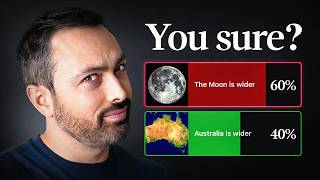
[01:54] with a set of simple quiz questions. - Oh! - It looks small on a map, but it's huge.
[02:07] - Are there more or less stars in the Milky Way - One teaspoon of pure olive oil, contains more chemical potential energy
[02:22] than an equivalent four and a half gram amount of TNT. (Derek laughs) - The energy density of butter
[02:36] is 10 times that of lithium batteries, right? Just run your car on butter, I say. than the average solar panel at absorbing the sun's energy.
[02:51] - Now, these aren't the exact questions but the specifics don't really matter. how confident are you that you are right?
[03:05] - I think it's true. - 100%? - Yeah. This was very early on in the research
[03:21] but we didn't really know what we would find. between how accurate someone thinks they are When people are 90% certain, they are right,
[03:37] In fact, we ran our own version of this online We asked the Veritasium community a bunch Our results showed that those
[03:53] as 91 to 100% sure were only correct 51% of the time. these results have been replicated again and again
[04:05] in all areas from general knowledge to motor skills, - I have a paper where we analyze the survey These are chief economists at various corporations
[04:19] of the economy on a quarterly basis. too sure that they know what's going to happen, say there's something like 53% sure
[04:34] what's gonna happen to inflation, for instance, - How well what you think you know matches So, if you're perfectly calibrated and, say, 80% confident,
[04:50] but most of us are not well calibrated. in the Milky Way, - [Group] Oh!
[05:03] False! (laughs) - Most of the time, being overconfident isn't a huge issue, but for Nick Leeson, the stakes soon became very high.
[05:17] was to bet that the Japanese stock market would go up, the Nikkei 225. the Nikkei had been dropping from 38,000 to 16,000,
[05:35] would soon bottom out and start rising, Over the next few weeks, it dropped to a low of 14,000, with ever bigger and riskier bets,
[05:50] so the next win would bring him back above water. This strategy should work when the next win comes along, and his losses ballooned from $40,000 to around $3 million.
[06:06] In spite of this, Leeson remained confident, In the spring of 1993, the market rebounded up to 20,000, and by the summer, that account was back in credit.
[06:21] drinking and dancing on tables, finally free of the hole he had dug himself into. he made another trading error on the futures market,
[06:34] so he put the loss back into account 88888, he could do it again. and as the losses mounted in the five eights account,
[06:51] to cover the last loss. By the end of 1993, his losses exceeded $30 million. but this tendency to overestimate our abilities
[07:06] So, the question is why? that is we wanna feel good about ourselves
[07:18] and pretend like we're well-informed, from being able to say, And so, we pretend to ourselves and others
[07:35] That is the motivated egocentric version - [Narrator] Reichelt had faith than the idea, - But what if it's something more uncomfortable, stupidity?
[07:50] Franz Reichelt was a tailor with no formal scientific with solving the problem of aviation safety. which repeatedly failed during testing,
[08:04] was that he didn't have enough height for it to work. and rather than using a dummy to test it, he jumped himself.
[08:17] Do you recognize this graph? - Are you confident that this that this is not the Dunning-Kruger graph.
[08:31] - This is what people call the Mount Stupid Curve, for the Dunning-Kruger effect into Google images. that says that when you know very little about it,
[08:46] your confidence sinks until you become a master at it. is, like, a little bit more fuzzy than this. This graph doesn't actually show the Dunning-Kruger effect.
[09:02] and it became conflated with the effect. on tasks like grammar, logic and humor, how well they performed.
[09:17] You can see that those who performed worse They were the most overconfident. were actually slightly underconfident.
[09:30] to how much we know. but to me, this effect looks a little I asked students some physics questions
[09:45] And when I looked at the results, from nearly 0% to 100%, but confidence varied over a much narrower range.
[09:59] This meant that poor performers were the most overconfident were actually slightly under confident. so maybe overconfidence isn't entirely
[10:13] but also because most of us express But there is another factor at play here, are capable of processing.
[10:28] it's 5:45 PM at the Kennedy Space Center in Cape Canaveral, who made the Challenger space shuttle's rocket boosters predicting temperatures overnight will plummet
[10:44] far colder than any previous shuttle launch. in the boosters become less flexible create charts, and present their case.
[10:58] on O-ring temperature, hot gas erosion, But the data is scattered, incomplete, They'd never tested below 53 degrees Fahrenheit,
[11:13] to track historical O-ring data, erosion patterns, pressure differentials, and more. So, overwhelmed by seemingly contradictory data
[11:28] Thiokol management overruled their own engineers At 11:38 the next morning, 73 seconds after launch,
[11:41] all seven crew members were killed. - Calibrating your certainty requires thinking and that's hard for finite, fallible agents like us
[11:58] - How many chunks of novel information you can hold In 2008, Hansson, Juslin, and Windmann was linked to accuracy and overconfidence.
[12:13] for factual questions like the length of a river People's ranges were consistently too narrow, and those who had worse short-term memory
[12:26] Another study conducted by Conte in 2023 asked participants while they judged their own performance. confidence estimates became less accurate,
[12:41] Together, these studies suggest that assessing your accuracy So, overconfidence isn't necessarily about arrogance. of what it can track and hold.
[12:56] And because of this, your brain can start using shortcuts. these mental shortcuts as heuristics, that together, One shortcut we use a lot is substituting hard questions
[13:10] how happy they were in their life Unsurprisingly, these two questions did not correlate. at least for most people.
[13:25] suddenly, the correlation jumps to 0.66. is a difficult question. So, when you're primed
[13:39] you're very likely to substitute that hard question, with, how many dates have I recently had? like this can be disastrous.
[13:53] I mean, you might expect natural selection but there is evidence that overconfidence Overconfidence can massively improve your status.
[14:11] scientists in 2012 compared participants' own assessments They placed them in group tasks to see who is chosen tracking status over multiple sessions
[14:25] to exaggerate their abilities. overconfident individuals were more likely to lead, even when their actual abilities were mid.
[14:39] to confident individuals. measured brain activity of people and those who listened to the confident advice
[14:53] in the ventromedial prefrontal cortex. and expected satisfaction. to be influenced by confident individuals.
[15:07] - But recognizing that dynamic highlights a potentially problematic incentive for anyone who's contending for positions that they want.
[15:21] People who express more confidence in employment interviews or political campaigns, for instance, do earn the confidence of interviewers and potential voters,
[15:34] They can't actually deliver. but they can talk a good line to impress others, They know the audience
[15:51] Well, they should express maximal confidence. While he was secretly racking up he was publicly posting huge profits
[16:05] - They come in and they don't test any records, They didn't test one record. he requested huge sums from head office
[16:18] Barings management, barely understanding futures they granted his requests - Every day that I make one of these requests
[16:31] "Look, mate, what the hell's going on?" the account was nearly $260 million in the red. inflating his perceived profits further.
[16:47] Barings received two awards, largely credited to Leeson. seemingly responsible for $44 million that these kinds of profits could be made
[17:03] But management's faith in Leeson's talent was unshakeable, Barings' overconfidence in Leeson would be the bank's downfall.
[17:17] it seems like the ultimate confidence trick, for the delusion on both sides. by the complexity and unpredictability of the market
[17:30] It's sort of an issue of feedback. and guaranteed outcomes like in a chess match,
[17:42] With reliable feedback, professional chess players with more accurate confidence. or timely consequences for predictions,
[17:56] Whether our confidence is accurate or misplaced It's especially problematic for political pundits. I think Romney's gonna win by quite a bit.
[18:10] or an 80% favorite. had accurately predicted the winner of nine using his 13 keys to the White House method.
[18:24] - Kamala Harris will be a precedent-breaking president. Is this crazy? (crowd cheering)
[18:36] of disinformation that misled the electorate. to discern key issues like the actual state of the economy. He was making some bad trades,
[18:51] and this significantly clouded his judgment, By 1995, Leeson's losses were in the hundreds of millions, and Barings had unwittingly sent him $1 billion.
[19:05] For a bank with around $700 million in capital base, but no one questioned it. At this point, his positions were so big,
[19:18] of the entire Nikkei futures market, and hope that the market went his way. The economy was stable and he couldn't see anything
[19:31] But then disaster struck. and of shock. (siren wailing) the Great Hanshin Earthquake struck Japan
[19:44] With the magnitude of 6.9, it devastated the city, This devastation spread to the stock market. Leeson, attempting to double down again,
[19:59] He bet heavily that the Nikkei would make a rapid recovery, Leeson had lost $2.8 billion.
[20:12] And three days later, Barings, in the world, collapsed. for its downfall.
[20:24] Leeson fled to Malaysia and then Thailand, He was eventually arrested in Germany marking the end of a spectacularly destructive gamble.
[20:36] He was just 28 years old. but we are all vulnerable to overconfidence. where our brains are overwhelmed,
[20:50] And we all too often end up thinking So, what can we actually do about this? - I try to get better at calibrating my confidence judgments
[21:03] So, when a colleague asks me, to get me comments on this paper draft we're working on?"
[21:15] I'm much more likely to say something like, They'll often react with a quizzical look or a laugh.
[21:30] is the obvious way to improve, - I think that the best medicine for overconfidence
[21:42] and I get plenty of that. (laughs) that sometimes I do have a little bit of overconfidence. we should capitalize on the wisdom of the crowd
[21:57] to people who disagree with us. understanding what information is very helpful for making better decisions.
[22:11] - The best calibrated people aren't those who know the most. So, true wisdom lies not in being certain, And that's an idea that's inspired our latest project.
[22:27] (Hannah laughs) It's called "Elements of Truth." science trivia questions with a twist.
[22:40] depends on how confident you are. If you're not sure, you can play a low number who you think should know the answer.
[22:55] teachers, and students, and what we've found that go way beyond the initial questions. and there are five additional packs on specific topics
[23:12] like physics, technology, engineering, and astronomy. in many of our most popular videos. to give you the opportunity to shape it with us.
[23:26] for a special community pack. with a credited question in the game. use this QR code or the link in the description
[23:41] It is only because of you that I've been able so as always, I wanna thank you for your support and thank you for watching.
⚡ Saved you 0h 24m reading this? Transcribe any YouTube video for free — no signup needed.