[00:00]
(mellow music) Well, to a reasonable person, But what if you needed to do it for a scientific experiment? a top secret project known as MKUltra,
[00:15]
how drugs like LSD could be used to change human behavior. because elephants are normally quite docile, And the hypothesis was
[00:29]
by the release of an LSD-like substance So if that's true, then administering LSD So the real question was how much LSD should you give
[00:45]
to cause a psychological reaction, Well, the researchers didn't know, LSD had never been given but they did know that the safe dose in cats
[01:00]
Now, since an elephant has around they figured we'll give it a thousand times the dose. an Indian elephant at the Lincoln Park Zoo in Oklahoma.
[01:16]
with nearly 300 milligrams of LSD. But within five minutes, Tusko trumpeted, collapsed, and went into status epilepticus.
[01:30]
but Tusko died shortly thereafter. that safe drug dosage scales linearly with mass.
[01:42]
And it turns out there are a lot of things like this For example, take the smallest mammal by mass, and the largest land mammal, the African bush elephant.
[01:57]
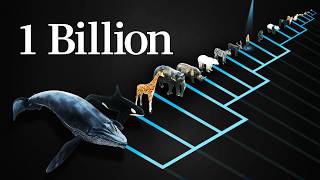
over the course of its entire life? around a billion heartbeats in its lifetime, heartbeats in its lifetime.
[02:11]
A two-toed sloth? what environment they live in, how large they are, they all get around a billion heartbeats
[02:27]
Why not a million? - That is every mammal except one. Scale by Geoffrey West.
[02:41]
What's even more curious is that you can predict a staggering number and reproductive output to its total lifespan.
[02:56]
If you know the population and location, and patent filings to crime rates, disease prevalence, and even the literal speed at which pedestrians walk.
[03:10]
of Tusko the Elephant. is proportional to mass. But it turns out that the speed at which an animal
[03:23]
doesn't depend directly on its mass. That is the number of calories it uses Your heart is pumping, that takes energy.
[03:38]
Digestion takes energy. Everything that you do requires energy. they require roughly 250 kilocalories of energy,
[03:53]
But there is nothing special about a cat's cells. you'll find they're a similar size, similar makeup,
[04:05]
The same is true for other animals. of animals are always roughly the same. has about a thousand times as many cells.
[04:18]
times as much energy. So 250,000 kilocalories per day. - So what's the issue here?
[04:30]
that energy is radiated out in the form of body heat. through our skin, to the environment.
[04:43]
and do the standard physicist thing. Let's assume our animals are perfect spheres. but it does make everything a lot easier to follow.
[04:56]
our 3000 kilogram elephant has a volume a thousand times So its radius must be 10 times larger. That's because volume is proportional to radius cubed.
[05:10]
So the elephant's surface area Generating a thousand times as much heat to radiate it away would end very
[05:23]
If this were the case, it would boil alive. French scientists proposed a different scaling law. and that heat is radiated through the surface,
[05:36]
to the surface area, A, instead. Now, we can rewrite this to see Surface area is proportional to radius squared,
[05:51]
and if mass is proportional to radius cubed, Plugging that in for R, - Really familiar example would
[06:04]
Maybe you want to make a big turkey for Thanksgiving. But that you realize is linear thinking. or the roast, because the heat is coming in
[06:21]
and it's got to do thermal diffusion into the meat. like the characteristic length, It'll go like the dimension squared,
[06:37]
whereas volume of the meat is going to be like length cubed, So when you put those things together, to cook the roast will go like its mass
[06:51]
- So if I'm thinking about cooking a roast Is that two to the two-thirds the time? then you only have to cook it about 60% longer,
[07:06]
- [Host] Similarly, according to this scaling, should only burn a hundred times as many calories. And the appropriate dose of LSD for Tusko
[07:22]
These two wildly different predictions come from different scales as a function of mass. to mass raised to some power.
[07:36]
and all power laws have a special property. you get a straight line. to the exponent of the power law.
[07:49]
If the slope is one, that's just everyday linear scaling. that is called sublinear scaling. that is known as superlinear scaling.
[08:04]
that the two-thirds exponent But then in 1932, Swiss biologist, Max Kleiber,
[08:16]
of different animals from a small dove at 150 grams to a large steer at 680,000 grams, And as expected, all the data did fall on a straight line.
[08:32]
Instead, it was about three quarters. It implies that if you double an animal's mass, an increase of 68% instead of the 59%,
[08:49]
So according to Kleiber's Law, as many calories as a cat, or about 45,000 kilocalories. was 53 milligrams, which is around a sixth of the dose
[09:06]
So that explains the dosing catastrophe Kleiber's original work was based on a small data set, But if you plot the data for a larger range of mammals,
[09:21]
you find that they all follow Now, they don't all fit perfectly onto the same line than for cold-blooded ones,
[09:34]
mass raised to the three-quarters. to single cells and the molecular machines inside of them. spanning more than 25 orders of magnitude.
[09:51]
if an elephant has so many more cells to a cell in a smaller creature, and yet it's using proportionately less energy,
[10:05]
or per kilo or per cell, are functioning with much less energy. and it's hard to understand why.
[10:20]
What is it that the cells are providing to each other, - I just put in my calculator 100 to the three quarters, then according to this, only 31.6
[10:35]
So it seems like a big savings. It's a biological fact, but people have been arguing now for a century
[10:48]
- In the decades following Kleiber's observation, Researchers discovered that brain size also roughly scales and the amount of blood pumped per minute.
[11:04]
- If you ask how long a creature will live, a mammal, to the one quarter power. - [Host] So that means if you double the mass of a mammal,
[11:20]
then on average, its lifespan is around 19% longer. as roughly mass to the one quarter, while breathing rate They're not all three quarters power laws,
[11:35]
So the question on everyone's mind was - One popular theory emerged in the 1990s.
[11:47]
- Most of the biology classes then that you take, and then you have to memorize all the different parts - [Henry] But then one day he took a zoology class
[12:03]
- [Brian] I just couldn't believe it. You know, this is kind of like something fundamental And there I knew immediately that I wanted
[12:17]
kind of plant physiology research - [Henry] So Enquist started studying for his PhD, who had been thinking about scaling laws for years.
[12:31]
there's some form of self-similarity So they wondered, what could that self-similarity be? with the way resources are transported through the body,
[12:44]
They had the biological intuition, they needed a formal mathematical framework. - And at the time, Jim was associated
[12:58]
and he started asking around with, biological scaling relationships? I know of this physicist who's up at Los Alamos
[13:12]
And so we met Geoffrey and it was like immediately, for like years. someone who's been like speaking your language,
[13:27]
to try and find a compelling explanation for Kleiber's Law. - They started by assuming three simple premises. that distribute resources are space-filling,
[13:41]
The second premise is that the terminal units on the outer periphery of the delivery system, That is the outermost blood vessels that carry nutrients
[13:56]
as the ones in a mouse. And the third premise is that over time, toward an efficient design.
[14:08]
Well, intuitively, to get fuel from one place to another So basically a straight line. you would also need many different paths.
[14:23]
the networks inside need to One way to do this is to stretch all the paths In this case, the volume of the animal
[14:35]
Or if we rearrange that, internal path length should scale just like the overall length of the animal does. Take these two regions.
[14:49]
go through almost the same path in the body, before they reach their destinations. and split it only when the paths needed to diverge,
[15:02]
and a lot less blood to fill the vessels. and you end up with a much more efficient design But now we run into another issue
[15:17]
for some of the blood to bounce back, that is reflect. energy to pump blood around. that minimize reflections.
[15:31]
if the cross-sectional area of the vessels So if you've got a cross-sectional area then each of the two branches need to have an area
[15:43]
of one centimeter squared each, for large vessels at least. to allow blood to slow down If you keep repeating this pattern across the network,
[15:57]
you end up with this, a branching self-similar fractal. of the circulatory system, it has this geometry. - But how do you get from this
[16:11]
Well, mathematician Felix Hausdorff discovered (mellow music) Take a straight line segment. Hausdorff assigned this line segment a value of 1.0.
[16:26]
and more bends to those bends. and more fractal-like. that one-dimensional line segment fills up
[16:40]
Hausdorff assigned these space-filling fractal curves The same ideas apply to a 2D surface. Two-dimensional.
[16:55]
that sheet of paper, and it effectively fills So you can now describe that sheet of paper as a sphere instead of a two-dimensional sheet of paper.
[17:09]
at smaller and smaller scales, and a 2D surface In the mathematical limit, it becomes space filling - [Brian] You know, biologically, I said,
[17:22]
That enables an organism for a given size to pack in more of these metabolic surface areas And it's because of this fractal-like structure
[17:35]
and convolutions and on top of each other - As a result, the Hausdorff dimension of the surface
[17:47]
meaning its surface area doesn't scale And since the metabolic rate hinges on well, it must also scale like length cubed.
[18:03]
wanted to explain Kleiber's Law. So they needed to know how metabolic rate scales with mass. around the network should be proportional
[18:17]
And since volume is just surface area times length that means both volume and mass which can be rewritten to show that length is proportional
[18:30]
And if you plug that into the equation must be proportional to mass to the three-quarters, West, Brown and Enquist published their work in 1997,
[18:46]
as WBE Theory, after their initials. It makes very specific predictions. This is sticking your neck out,
[18:59]
(mellow music) - [Derek] Take a look at this table These are the scaling exponents WBE theory predicts, but all follow from the same theory.
[19:12]
should scale with its mass to the three-eighths or .375. to the 11-12ths or about 0.92.
[19:24]
Now, these are the observed data. Lung area, 0.95. They had a table with something like, I don't know,
[19:39]
20 or 30 predictions of exotic exponents, for the three-quarters power of metabolism, that biologists have measured.
[19:53]
once you've got the three-quarters law for metabolism. Heart rate is equal to the blood flow rate The volume of blood per beat has been found
[20:08]
And the blood flow rate? how nutrients get distributed around the body. proportional to one another.
[20:22]
Swapping in the scaling law Kleiber had found, meaning bigger animals should have slower And this is exactly what we observe in nature.
[20:36]
has an extraordinary heart rate of 1200 beats per minute. Whereas the biggest land mammal, the African bush elephant, And we can do something similar for lifespan.
[20:53]
the accumulation of metabolic damage. processes nutrients over time, and that over time causes the animal to die.
[21:08]
is its metabolic rate per unit of mass, If damage accumulates faster, it dies sooner. So lifespan is proportional to M over B,
[21:23]
or substituting in Kleiber's Law, M to the one quarter. And you do see this in nature. while a mighty African elephant can live up to 70 years.
[21:38]
but you live a relatively short life. your heart beats much slower and you live a lot longer. - So it's the, you know, live fast and burnout
[21:52]
Or spend it frugally and live a really long life. Heart rate scales as B over M. And lifespan scales as M over B.
[22:08]
They scale in equal and opposite directions. is just the heart rate multiplied by the lifespan. leaving you with just a constant.
[22:22]
what mammal you're talking about, You can find that number by just plugging in some examples. The shrew's 1200 beats per minute multiplied by a lifespan
[22:37]
around 950 million heartbeats Meanwhile, an African elephant's 30 beats per minute gives you a little over a billion heartbeats.
[22:51]
you keep landing at the same figure of This is why nearly every mammal from a tiny field mouse to a gazelle, from a cheetah to a hippopotamus,
[23:05]
between the day they're born and the day they die. that gets significantly more than a billion heartbeats.
[23:18]
We are the lucky ones. to the standard value of one billion heartbeats. and better sanitation methods became widespread,
[23:33]
and deaths from disease. And with it, the average number of heartbeats in a lifetime. If you look closely, you can also see some significant drops
[23:46]
or over here, what appears to be But overall, the trend is clear. of heartbeats we get in our lifetime to the point
[23:59]
heartbeats before they die. and technology than this. more than a full extra life.
[24:13]
to have much longer lives in captivity when they're away from the hazards they would naturally encounter in the wild. we now have the lifespan of a much larger mammal,
[24:27]
somewhere between an elephant and a whale. (mellow music) Take a look at this graph. In fact, if you overlay them, they look remarkably similar.
[24:41]
Have you got your answer? For these two charts, we're using data from parts goes back several centuries,
[24:56]
Of course, that doesn't mean but it goes against the perception of cities as being full of pollution and breeding grounds for disease.
[25:09]
"The poisonous germs and pollutions of the city, and endless nuisances." Or more specifically, is there any quantitative data
[25:25]
- It turns out this is something that Geoffrey West pursued He and collaborators like Luis Bettencourt and others
[25:37]
- [Host] They looked at how different properties as the population of the city increases, the data clusters around a straight line
[25:50]
meaning crime grows faster than linear or super linear. you get around 2.2 times as many criminal cases
[26:02]
or around 120% more crime as opposed to the 100% that the same general pattern and even the number of AIDS cases.
[26:16]
but overall, as cities grow larger, So it seems like that medical doctor was onto something. if we all lived in small towns instead,
[26:31]
(mellow music) In 2006, Dirk Helbing, Christian Kuhnert, of gas stations scales as a function of population. as many gas stations?
[26:45]
but energy, gas, for all those cars. you're going to need to double the amount of fuel, they plotted the data on a log log plot
[27:01]
But the exponent wasn't one, it was about 0.8. This means that for every doubling, you only need around 74% (mellow music) The amount of roads and electrical cables
[27:17]
The rough figure that West gives in his book - It is interesting that some of the things on the road, but so can I.
[27:29]
cities can be surprisingly green. than you might think than living out - But cities have even bigger benefits.
[27:42]
and the number of patents all scale superlinearly, with exponents that cluster somewhere around 1.15, you get around 120% more of each.
[27:57]
when you compare a small town of say 50,000 people because infrastructure needs only need to go up by a factor of about 50 while total wages, GDP, patents and inventions,
[28:11]
Unfortunately, disease and crime also go up Or look at it this way, on a per person basis, while you get double all the socioeconomic factors.
[28:27]
they might actually be one of our best inventions and technological progress. that life in the city feels faster.
[28:41]
how fast people walk in cities of different sizes. faster in larger cities. It's not just that the sidewalks are congested or not.
[28:57]
They move faster in cities. but that may come at a cost because as one person put it, "everything nowadays is ultra.
[29:11]
No one knows himself any longer. and then carried away in the world of the times. Could it be that life is accelerating so fast
[29:26]
Well, probably not by Wolfgang von Goethe. For the past 200 years and probably longer,
[29:38]
And yet every generation has managed. to adapt indefinitely. all of us will continue to reap the benefit
[29:52]
that mammals benefit from being larger. where the exponents in biological scaling laws come from, explanatory theory yet.
[30:06]
and 1.15 come from is one of the big goals for theorists. Although even WBE Theory is not universally accepted. doesn't necessarily mean the theory itself is correct.
[30:22]
some of the same scaling exponents, - There's a lot of discussion. And personally, I tend to think it is very impressive.
[30:35]
at University of Vermont, is either not done exactly right that you shouldn't really take this so seriously.
[30:49]
itself might not be true. (mellow music) - In the 1960s, there's a symposium on energy metabolism, and at the end of it, they vote 29 to zero
[31:04]
Because, you know, you got to set some rules. the data does not work. - [Henry] This is a graph of metabolic rate
[31:17]
that looked at 391 species of mammals, And it looks like the three-quarter slope fits quite well. the biggest mammals.
[31:30]
to fall on a line that's closer to two-thirds. you also find a slope that appears closer Could it be that those French scientists
[31:44]
just scale with surface area? (mellow music) For one, many recent studies that are significantly higher than two-thirds.
[31:56]
It generally involves putting animals in a container of their heat production or oxygen consumption, low activity resting state.
[32:10]
to pull off with large animals. where the error bars include both Today, the research community is split.
[32:24]
while others think it's two-thirds. that there is no universal scaling exponent that the metabolic rate of larger mammals
[32:37]
while for smaller ones, it's their mass to the two-thirds. that there are people arguing, and that's good. would be someone to really measure it,
[32:49]
has to be not just one elephant at one zoo, is that scaling laws are real. There are deals to be had.
[33:04]
There's often in real life departures from proportionality, Sometimes things punch above their weight, Sometimes there are detriments to size.
[33:18]
Clearly from an energy efficiency perspective, Similarly, all of us potentially stand It could lead to more discoveries and inventions,
[33:34]
for all of us, which might even give us more heartbeats in our lifetimes. From the surface law to Kleiber's law to WBE theory,
[33:48]
has been one of biology's biggest debates for centuries. there's a good chance to finally put this debate to rest.
[34:00]
It could be one of you watching or a student that you know. to train the next generation of researchers, Brilliant is a cutting edge personal tutor
[34:13]
that helps any student excel in math, science, and coding. one-on-one tutoring really is the gold standard, As a substitute, students often turn to AI for guidance.
[34:28]
by simply just giving away the answers. to their own aha moments by asking probing questions For instance, check out what happened when I launched one
[34:44]
and told its tutoring tool that I was struggling. and even labeled relevant points on the graph Brilliant is an excellent aid for the young math
[34:58]
It's the kind of tool I wish I had when I was in school. to get started with Brilliant's tutor for free, And right now, Veritasium viewers can save 20% off
[35:14]
an annual subscription at brilliant.org/veritasium. and I want to thank you for watching.