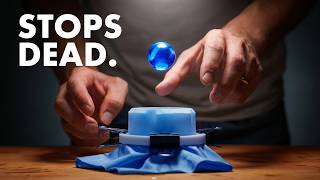

Why Bouncy Ball + Bouncy Surface = No Bounce?
45sThe counterintuitive failure of two bouncy objects creates a compelling mystery.
▶ Play Clip"The title promises an explanation of a counterintuitive bounce phenomenon, and the video delivers exactly that with detailed experiments, simulations, and a clear conclusion."
The video explores a counterintuitive phenomenon where combining two highly bouncy objects results in a poor bounce. Through experiments and simulations, the creator investigates the physics of bouncing, focusing on the interplay between the stiffness and mass of a ball and a surface.
A very bouncy ball on a very bouncy surface can result in a dead stop, contrary to intuition.
A poor bounce occurs when the ball and surface have similar flexibility. A good bounce requires a mismatch in flexibility (e.g., hard ball/flexible surface or vice versa).
A research paper models the bounce using four key factors: mass and stiffness of the ball, and mass and stiffness of the club/surface.
The quality of the bounce oscillates in a counterintuitive pattern as mass and stiffness are varied, showing multiple points of optimal and terrible bounces.
A perfect bounce occurs when the club's spring returns to its rest length and the club mass is at rest at the exact moment of ball separation, transferring all energy to the ball.
A good bounce requires the club to go through a whole number of oscillations plus a half. A bad bounce results from a whole number of oscillations during the ball's half-oscillation.
Heat maps of bounce quality show complex, fractal-like patterns when multiple parameters are varied.
The quality of the bounce is very sensitive (spiky) to small changes in parameters, which matches the real-world data collected by the creator.
For combinations like a squishy ball on concrete or a stiff ball on a squishy surface, the period-matching effect is negligible, and dissipation is the primary factor.
The problem of bouncy combinations is compared to cartridge razors, where adding complexity (more blades) stems from an inability to fix the fundamental issue (holding a single blade firmly).
To maximize bounce, you cannot simply combine two high-bounce materials; you must carefully tune their vibrational frequencies. This principle is also a metaphor for solving problems at their root cause rather than piling on complexity.
[00:00] What happens when you combine a really
[00:02] bouncy ball with a really bouncy
[00:04] surface?
[00:05] It stops dead. But look, if I tweak it
[00:08] slightly,
[00:09] now it's a really good bounce. This is
[00:11] when I realized I don't really
[00:13] understand bouncing. Because it turns
[00:16] out if you want to maximize bounce, it's
[00:18] not enough to just combine two really
[00:21] bouncy things. But what I found really
[00:23] surprising was that when I tried to find
[00:26] the optimum bounce using math, I ended
[00:29] up generating fractals. First, I want to
[00:32] be clear about what we're doing in this
[00:33] video. Like I've shown you really bouncy
[00:36] things before, like the atomic
[00:37] trampoline and well, maybe you've seen
[00:39] an advert for the world's bounciest ball
[00:43] or whatever, but that type of
[00:44] optimization isn't what we're dealing
[00:46] with here. Like those examples are about
[00:49] avoiding energy loss during the bounce.
[00:52] So, the atomic trampoline minimizes
[00:55] plastic deformation, the super bouncy
[00:58] balls minimize internal friction during
[01:01] the collision. But the thing is, this
[01:03] bouncy ball and this bouncy surface are
[01:06] both really good at retaining energy.
[01:08] So,
[01:09] what went wrong here? Well, look at this
[01:12] ball bearing on this rubber sheet. The
[01:15] ball is really hard and the surface is
[01:18] really flexible and that gives you a
[01:20] really good bounce. And with the super
[01:22] bouncy ball, the ground is really hard,
[01:25] but the ball is really flexible and that
[01:27] gives you a good bounce as well. The
[01:30] problem seems to arise when you have a
[01:32] ball and a surface that are similarly
[01:35] flexible. For example, Orbeez are really
[01:37] flexible and so is this rubber sheet.
[01:40] And right now, the combination is super
[01:42] bouncy. But if I add a little bit of
[01:44] weight to the rubber sheet, well,
[01:46] suddenly it all goes wrong. And that's
[01:48] why I built this contraption to try and
[01:50] figure out what's going on. See, it's
[01:52] when I change the weight that it goes
[01:55] from a good bounce to a bad bounce. It's
[01:59] weird, isn't it? Actually, this
[02:00] particular configuration is quite fun
[02:02] because when gravity pulls the ball back
[02:04] down, it gets a kind of second kick,
[02:08] which is such an odd behavior. By the
[02:10] way, this is somewhat related to how
[02:11] children typically injure themselves on
[02:14] a trampoline. A child can often get an
[02:15] unexpected second kick if there are
[02:18] other people on the trampoline. Before I
[02:20] show you what I figured out with this
[02:21] device, I also had a good chat with the
[02:23] professor of the author of this paper.
[02:26] In the paper, they're thinking about it
[02:27] in terms of a golf ball and a golf club.
[02:30] And basically, they do a whole lot of
[02:31] simulations where they simplify it down
[02:33] to four things: the mass of the ball,
[02:35] the stiffness of the ball, the mass of
[02:37] the golf club, and the stiffness of the
[02:39] golf club. And when I say stiffness, I
[02:41] mean in the spring sense. So, like, if a
[02:44] spring is hard to stretch, then it's a
[02:47] stiff spring. If it's easy to stretch,
[02:49] then it's a less stiff spring. And a
[02:51] golf ball and a golf club are in some
[02:53] sense springy. So, we talk about
[02:56] stiffness. Anyway, when they run a whole
[02:57] lot of simulations where they kept three
[02:59] things constant and varied the fourth
[03:02] thing, they discovered something really
[03:03] surprising. See, in this graph, they're
[03:05] varying the mass of the golf club while
[03:08] keeping everything else fixed. And the
[03:10] height of the curve is how good the
[03:13] bounce was. Specifically, it's the
[03:15] velocity of the ball when it leaves the
[03:17] club. And you can see how the quality of
[03:19] the bounce well, it goes up and down as
[03:22] the mass varies. So, you get an optimal
[03:24] bounce for these masses. But, if you
[03:27] change the mass of the ball to one of
[03:29] these masses, well, you'd actually get a
[03:31] terrible bounce. To see what's going on,
[03:33] I built this simulation that represents
[03:36] the model that they were using in the
[03:38] paper, and it means we can see actually
[03:41] what's physically going on with
[03:43] different examples. So, this is the mass
[03:45] of the ball. This spring represents the
[03:47] stiffness of the ball. This is the mass
[03:49] of the club. And this spring represents
[03:51] the stiffness of the club. Let's see
[03:53] what happens if we set the mass of the
[03:57] club to be about twice the mass of the
[03:59] ball. So, the ball engages with the
[04:01] club, it starts to squish, but also the
[04:04] club is being pushed now, so that starts
[04:06] to squish as well. Crucially, look, the
[04:08] ball disengages from the club when the
[04:11] club is at almost maximum squish, but
[04:13] keep watching because but maybe the club
[04:16] will catch up with the ball and it'll
[04:17] give it a second kick.
[04:23] No, it just missed.
[04:25] Crucially though, look, see how much
[04:27] vibrational energy there is in the club.
[04:30] That vibration is energy locked away in
[04:33] the club that could have been given to
[04:36] the ball but wasn't. So, this represents
[04:39] a bad bounce. Let's compare that to when
[04:42] the mass of the club is about 2/3 of the
[04:45] mass of the ball. So, again, the ball
[04:47] starts to squish, and then the club
[04:50] starts to squish as well. Right, the
[04:52] club is now at maximum squish. The ball
[04:54] didn't disengage this time because the
[04:57] spring is still compressed. So, as the
[04:59] club spring is re-expanding, it's
[05:01] actually working hard against the mass
[05:04] of the ball because the spring is still
[05:06] compressed, and that's slowing it down
[05:09] at just the right rate so that when the
[05:11] ball finally disengages, look, the club
[05:13] mass is at rest at its rest length. That
[05:17] means there's no vibrational energy left
[05:19] in the club. So, all of the energy went
[05:22] into the kinetic energy of the ball.
[05:24] This is a perfect bounce. But if you
[05:26] look at the graph in the paper, you can
[05:27] see that actually there are lots of
[05:30] points of maximum bounce. So, let's also
[05:33] look at when the club mass is about 1/6
[05:37] of the mass of the ball. So, really it's
[05:39] the same situation except if you watch
[05:41] the club mass, actually it goes through
[05:43] multiple oscillations before that
[05:46] perfect separation that we saw before.
[05:49] And it turns out that when you do the
[05:50] math, you get quite a simple result that
[05:53] actually, hopefully, makes some
[05:56] intuitive sense. So, it's all about the
[05:59] natural oscillation of the club. See,
[06:01] the club naturally oscillates like this
[06:03] over time. But because it's being pushed
[06:06] by the ball throughout the whole
[06:08] collision, this graph of position gets
[06:10] skewed like this. Now, what I'm showing
[06:12] you is a perfect bounce. Because, look,
[06:15] the club is back at its rest position at
[06:18] the end of the collision. That tells us
[06:20] that there's no energy stored in the
[06:21] spring at the end of the collision. But
[06:23] also notice that the graph of position
[06:26] is flat at the end. So, we know there's
[06:29] no kinetic energy in the club mass,
[06:32] either. Now, you'll notice that the club
[06:34] mass has gone through two and a half
[06:36] oscillations. But let's stiffen the
[06:39] spring so it oscillates faster.
[06:41] It's still a perfect bounce, but now
[06:43] it's gone through three and a half
[06:45] oscillations.
[06:47] And there's a perfect bounce at four and
[06:49] a half oscillations, and so on. And
[06:51] look, if you go through a whole number
[06:53] of oscillations, that's when you get a
[06:54] perfectly bad bounce. How does that
[06:57] compare to the natural oscillation of
[06:58] the ball? Well, the ball always goes
[07:01] through exactly half an oscillation
[07:03] during the collision because
[07:05] well, it's not sticky. So, here's the
[07:07] simple rule. The club needs to go
[07:09] through a whole number of oscillations
[07:11] plus a half in the time it takes the
[07:13] ball to go through half an oscillation
[07:16] if you want to get a good bounce. If you
[07:18] want a bad bounce, just go for a whole
[07:20] number of oscillations. In general,
[07:22] though, the surface needs to jiggle
[07:23] faster than the ball for interesting
[07:26] things to happen. But in reality, it's
[07:28] hard to find a combination of ball and
[07:31] surface where the surface vibrates
[07:33] faster than the ball, but not loads
[07:36] faster. In my setup, the ball always
[07:38] vibrates faster than the surface.
[07:40] Doesn't matter what I tried in terms of
[07:42] springs and everything, but clearly
[07:44] interesting things still happen. I think
[07:46] that's because we made some simplifying
[07:49] assumptions, but actually there is
[07:50] another issue. See, in the simulation
[07:53] some energy can be left behind in the
[07:55] oscillating surface as we've seen, but
[07:57] you can see in this footage that you can
[07:59] also end up with oscillation energy left
[08:02] in the ball. But actually because of the
[08:04] way this simulation is put together,
[08:06] there's no way to account for
[08:08] oscillation energy left behind in the
[08:10] ball because the spring doesn't have any
[08:12] mass, so it can only oscillate when it's
[08:15] in contact with another mass. In other
[08:17] words, during the collision. So I
[08:19] decided to make my own simulation. In
[08:22] this version, the mass of the ball is
[08:25] split in two. So the ball can now
[08:29] oscillate on its own. Honestly, I'm not
[08:31] sure whether it's a reasonable model of
[08:34] reality, but I just want to show you
[08:36] what happens when you explore it because
[08:39] some of it's really interesting. So
[08:40] yeah, I can vary the stiffness of the
[08:43] springs and the masses or I can sweep
[08:47] through one of those values to get a
[08:49] plot. So look,
[08:51] you can see here this is a lot like the
[08:53] graph from the paper. So look, I can
[08:55] select a maximum and then play that.
[09:02] Oh. [sighs]
[09:03] That's satisfying, isn't it? Let's look
[09:05] at a bad one. Actually, look at the
[09:06] worst one over here.
[09:10] Oh, that's awful.
[09:13] In the plot, you can also see the number
[09:15] of collisions. So it's interesting,
[09:16] isn't it? The collisions go up and up.
[09:18] This is the internal vibrational energy
[09:21] of the ball after the collision. It
[09:23] doesn't actually get that high. So what
[09:25] we can do is sweep two things at once if
[09:28] we want to try and say optimize the
[09:30] amount of jiggle in the ball after the
[09:32] collision. We'll vary the mass of the
[09:33] golf club and the spring constant of the
[09:37] golf club. So, here's a heat map showing
[09:39] how good the bounce is. If I go here,
[09:42] this is a good bounce. See what that
[09:43] looks like.
[09:47] That's getting it. And then here's a
[09:49] really bad bounce, let's say.
[09:54] And if we switch to the internal energy,
[09:58] there's a high point right here. So,
[10:00] this is where we end up with lots of
[10:03] internal energy in the ball at the end.
[10:05] Look at that.
[10:07] That is a terrible bounce. Most of the
[10:09] energy is in the ball. But
[10:11] interestingly, there's some structure
[10:14] down here. Let's do a different sweep
[10:16] with the mass of the club and the
[10:19] stiffness of the club.
[10:21] Look at that. Almost like a fractal.
[10:23] Maybe it is a fractal. Like if I zoom in
[10:25] here,
[10:26] isn't that weird?
[10:28] But anyway, an unexpected fractal
[10:31] appears. Something else I discovered
[10:33] that matches real life. Like if there
[10:36] are several collisions within a bounce,
[10:38] are you only looking at what happens
[10:40] after the first collision, or do you
[10:42] count all the collisions? This is a
[10:43] perfect example.
[10:45] It stops dead. It's a terrible bounce.
[10:47] But then on the second kick, it's an
[10:48] amazing bounce. And I got something like
[10:50] this in my studio. Look at that. It's a
[10:53] terrible bounce. The ball stops dead,
[10:56] but moments later it gets a second kick.
[10:59] So, how does this compare to reality? To
[11:01] compare to the model, I don't need to
[11:02] worry about weighing things or
[11:05] calculating the stiffness, because I can
[11:07] just measure the period of oscillation
[11:10] from the video. Okay, so we're
[11:11] interested in how many times does the
[11:13] surface oscillate during half an
[11:15] oscillation of the ball. The model from
[11:17] the paper predicts good bounces at 1 and
[11:20] 1/2, 2 and 1/2, 3 and 1/2, and so on.
[11:23] But I was never able to get the surface
[11:24] to oscillate fast enough to explore
[11:27] that, though I did get quite close. In
[11:28] our data, the surface only ever goes
[11:30] through a fraction of an oscillation
[11:33] during the collision. This is where the
[11:34] model from the paper predicts the good
[11:36] and bad bounces will be, and these are
[11:37] our good and bad bounces marked in green
[11:40] and red. We never get into the
[11:41] interesting region because my surface is
[11:43] too slow. But clearly the data doesn't
[11:45] match what's going on at the boring end
[11:47] either. But here's the cool thing. In my
[11:49] version of the simulation, interesting
[11:50] things can happen when the surface
[11:53] oscillates slower than the ball. In
[11:55] fact, it's basically a mirror image when
[11:57] you look at it on a log scale so that
[11:59] you get bad bounces when the surface
[12:01] oscillates faster than the ball and good
[12:04] and bad bounces when the ball oscillates
[12:06] faster than the surface. In reality,
[12:08] it's more complicated than that for
[12:09] several reasons, and our data doesn't
[12:12] really fit this model either. But what's
[12:14] clear is the model is very spiky. Like,
[12:17] you don't have to change very much for
[12:19] the quality of the bounce to change
[12:21] drastically. And our data is also very
[12:24] spiky. So our data has roughly the right
[12:27] character, but I'm not sure we can claim
[12:29] much more than that. One cool thing
[12:30] about both of these models is they
[12:32] predict what should happen for a really
[12:35] bouncy ball on concrete or a steel ball
[12:38] bearing on a rubber sheet. See, this is
[12:40] a plot of how good the bounce is as the
[12:42] stiffness of the surface increases. And
[12:45] the line still goes up and down in that
[12:48] counterintuitive way, but as the
[12:50] stiffness increases, actually that
[12:52] effect gets less and less until it
[12:55] eventually just flattens out. In other
[12:57] words, if you've got a squishy ball and
[12:59] a concrete floor, you don't need to
[13:01] worry about comparing their periods of
[13:04] oscillation. And then you're back to
[13:06] just worrying about dissipation through
[13:09] internal friction and things like that.
[13:10] And the same is true if you've got a
[13:12] stiff ball and a squishy surface. So if
[13:15] you want to find the bounciest
[13:17] combination of ball and surface, you
[13:20] can't just combine the two bounciest
[13:23] things you own. You have to tune their
[13:25] vibrations as well. Otherwise, you could
[13:28] end up with a dud. I messed up while
[13:31] making this video and I want to share
[13:33] the story with you as a cautionary tale.
[13:35] So, I wanted this surface to vibrate
[13:37] faster than the ball vibrates. So, I end
[13:40] up buying like stiffer and stiffer
[13:42] springs, but nothing was working. The
[13:46] frequency of this thing barely shifted
[13:49] at all. It got to the point where I had
[13:50] to print this part in a stronger plastic
[13:54] and I was using these nuts to tension
[13:57] the springs, which just took ages. I
[14:01] eventually realized the problem. The
[14:03] stiffer springs were heavier and so
[14:05] adding mass to the oscillator, which was
[14:09] counteracting the additional stiffness
[14:12] of the oscillator. The thing that
[14:14] eventually worked was ungluing this part
[14:16] so I could slide it up and down and then
[14:18] clipping it in place at different spring
[14:21] extensions. But, the surprising thing is
[14:24] that this is an almost perfect analogy
[14:26] for cartridge razors. I want to be clear
[14:28] that's a segue, not a crowbar. The
[14:30] difference being that the link is
[14:31] actually really strong. It's a good
[14:33] link. It's a strong link. I mean, you be
[14:35] the judge. Okay, here's the thing. The
[14:37] problem with plastic cartridges is
[14:38] there's always going to be a little bit
[14:40] of give in the blade, so you get an
[14:42] inconsistent shave. To counteract that,
[14:44] manufacturers just add more blades in
[14:47] the hope of catching more hairs during
[14:50] each pass. But, the first blade will cut
[14:52] some hairs, so the subsequent blades
[14:55] will be scraping against skin in certain
[14:57] places leading to irritation. So, then
[15:00] they have to make the blades
[15:01] deliberately more springy, which makes
[15:03] the shave worse. So, they add even more
[15:05] blades. Gets to the point where there
[15:07] are so many blades, you have to add a
[15:09] lubricating strip to overcome the
[15:11] friction and people over time learn to
[15:13] press really hard and so you also have
[15:16] to add a post-shave balm and things like
[15:19] that. Complexity piled on top of
[15:20] complexity just because the
[15:22] manufacturers weren't able to implement
[15:25] the simple fix at the very beginning of
[15:28] just holding a single blade really
[15:31] family because you can never do that
[15:33] with plastic. The solution is to not buy
[15:36] cartridge razors. Instead, buy a
[15:38] precision engineered aluminum handle
[15:41] that holds a single blade firmly in
[15:44] exactly the right position at exactly
[15:46] the right angle. And if you're going to
[15:48] do that, may I humbly suggest the
[15:50] sponsor of this video, Henson Shaving.
[15:52] With a Henson AL13, the training wheels
[15:54] are off. You don't press hard. You can
[15:56] learn the shape of your face because you
[15:58] can actually feel it.
[16:00] And you end up with an actually
[16:02] enjoyable shave. No lubricating strip,
[16:05] no aftershave balm. The handle is more
[16:07] expensive, but you only ever buy it
[16:10] once. And the blades are pennies. So, it
[16:14] actually ends up being cheaper after
[16:15] just a few months. Go to
[16:17] hensonshaving.com/steve
[16:18] mold and use code steve mold at checkout
[16:21] to get 100 free blades with your
[16:23] purchase of a Henson AL13. That's
[16:25] equivalent to about 3 or 4 years of
[16:27] irritation-free shaving. The link is
[16:29] also in the description, so check out
[16:31] Henson Shaving today. I hope you enjoyed
[16:33] this video. If you did, don't forget to
[16:35] hit subscribe. And the algorithm thinks
[16:37] you'll enjoy this video next.


⚡ Saved you 0h 16m reading this? Transcribe any YouTube video for free — no signup needed.