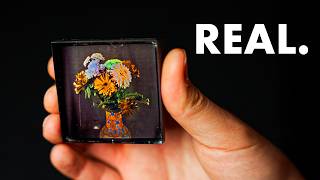

Color Photography Is a Lie
55sReveals that standard color photography doesn't reproduce true wavelengths, sparking curiosity about how we see color.
▶ Play Clip"The title is slightly exaggerated—few people have heard of Lippmann plates, but the video itself delivers on the extraordinary nature of the process."
The video explores the 135-year-old Lippmann plate photography technique, which captures the full spectrum of light instead of faking colors like standard RGB photography. It explains how the plate achieves structural color via interference, similar to soap bubbles and chameleon skin, and highlights the plate's ability to produce spectrally accurate images.
Standard photography uses only red, green, and blue to fool the eye, while Lippmann plates capture the actual wavelengths.
The plate works via interference of light reflected from a mercury layer, creating standing waves that expose silver halide crystals.
The breathing demonstration shows the gel expanding and shifting the structural color, analogous to chameleon skin.
Structural color comes from interference, not pigments, as seen in soap bubbles, DVDs, and chameleons.
The final developed plate contains silver mirrors spaced according to the original light's wavelength, forming a diffraction grating.
What is the core principle behind a Lippmann plate?
Lippmann plates record the full light spectrum via interference in a photographic emulsion backed by mercury.
10:10
What does a spectrum analyzer show from a standard color display?
Three peaks for red, green, and blue, matching the three cone types in human eyes.
1:40
What causes the rainbow colors in a soap bubble?
Constructive and destructive interference of light reflecting from multiple surfaces.
4:25
How does the development process turn a Lippmann plate into a diffraction grating?
It compressively creates silver mirrors in the emulsion, spaced according to light's wavelength.
11:17
What determines the color seen in a Lippmann plate?
The spacing between silver layers (mirrors) determines which color is reflected.
12:17
Standard Photography Is a Scam
Reveals how digital cameras fake colors by mixing three primaries, unlike the full-spectrum capture of Lippmann plates.
0:34Breath Changes Color
Demonstrates structural color shifting when the plate absorbs moisture, analogous to chameleon skin.
2:57Standing Waves in Emulsion
Explains how interference patterns from a mercury reflector create sub-wavelength mirrors that encode color.
10:10Diffraction Grating from Silver Flakes
Shows how the developed plate becomes a reflective diffraction grating, reconstructing original wavelengths.
12:45[00:00] This video is sponsored by Incogn. I
[00:02] made this rubber band that changes color
[00:04] when you stretch it. It's cool, isn't
[00:05] it? It starts off blue, then goes green,
[00:08] and then red, and then when I let go, it
[00:11] returns back to blue. And it's the same
[00:13] mechanism that's used in this
[00:15] 135year-old photography technique that's
[00:18] halfway between a hologram and a
[00:20] photograph. It's the same chemistry as
[00:23] black and white photography. But look,
[00:25] when I change the viewing angle, it
[00:27] bursts into color. And this isn't just
[00:29] any color image. It's arguably the
[00:32] truest color image you'll ever see. And
[00:34] that's because standard color
[00:36] photography is a lie. That's a bit
[00:38] inflammatory, isn't it? Helps with the
[00:40] views. All right. Here's why standard
[00:43] color photography is a scam. So, when
[00:45] you take a picture of something yellow,
[00:47] let's say, then you've got yellow light
[00:50] hitting the sensor of the camera. And
[00:53] that light has a wavelength of about 580
[00:56] nanome. But when you look at the
[00:58] resulting image, you're not getting that
[01:01] wavelength coming from the image.
[01:04] Instead, you're getting some red
[01:05] wavelengths and some green wavelengths
[01:08] that your brain interprets as yellow.
[01:11] And that's because we don't have
[01:12] dedicated cone cells in our eyes for
[01:16] yellow wavelengths of light. Whereas,
[01:18] when I look at this image, all the
[01:20] wavelengths of light that were hitting
[01:22] the plate when the picture was taken are
[01:24] now hitting my eyes as I look at it. And
[01:27] that's because it's basically a hologram
[01:29] except it's encoding color information
[01:32] instead of depth information. For the
[01:34] vast majority of people, you'd never be
[01:35] able to tell, but we can use this
[01:37] spectrum analyzer to see it. So look,
[01:40] this is my phone screen through a
[01:41] spectrum analyzer. And as I move around
[01:44] the image, what you're seeing is just
[01:46] three peaks changing in height. That's
[01:49] red, green, and blue. And they match up
[01:51] with the three types of cones in our
[01:53] eyes. But when I point it at the Litman
[01:55] plate, you can see this complex
[01:57] distribution of wavelengths. And because
[01:59] there are flowers in this image, we're
[02:01] even getting a bit of ultraviolet there
[02:03] as well. Actually, that's a good point.
[02:05] Standard photography doesn't work for
[02:06] other animals, like bees, for example,
[02:09] because they have a different
[02:11] distribution of cones in their eyes. And
[02:14] actually, even for a tiny minority of
[02:16] humans that have four different cone
[02:18] cells and the neurological machinery to
[02:21] use the extra one, the yellow in this
[02:23] Litman plate will look like the yellow
[02:25] they see in real life, whereas yellow in
[02:27] standard photographs would look wrong.
[02:29] So, how is it that this black and white
[02:31] film can reproduce the full spectrum of
[02:34] colors from the real world? Well,
[02:36] they're called Litman plates, and they
[02:38] were made for me by an amazing
[02:39] photographer called John Hilty. I really
[02:42] hope you'll check out his stuff. I'll
[02:44] leave a link to it in the description.
[02:46] And once I had them in my hands, I just
[02:48] thought, well, I have to show this to
[02:49] the world. So, here we are. We're going
[02:51] to figure out together why color seems
[02:54] to magically emerge from this plate.
[02:57] Here's a clue to start with. Watch what
[02:59] happens when I breathe on this plate.
[03:02] See how the whole rainbow seems to shift
[03:05] to the left? Why the heck does it do
[03:07] that? Well, surprisingly enough, it's
[03:09] for the same reason that chameleons
[03:11] change color. Watch this.
[03:16] Yeah, that didn't work. I don't know why
[03:18] I thought that would work. Anyway, we'll
[03:20] get back to chameleons later, I promise.
[03:22] But let's use this rubber band of mine
[03:25] first. We'll call it synthetic chameleon
[03:27] skin because it too changes color for
[03:30] the same reason that a Lipman plate
[03:32] changes color when it's breathed on. So,
[03:34] the way I made this rubber band is I
[03:36] pulled the DVD apart and poured some
[03:39] silicon on this exposed surface inside.
[03:42] In other words, I used that surface as a
[03:44] mold. The surface looks really flat, but
[03:47] it's actually covered in tightly packed
[03:48] grooves. So, now my rubber band also has
[03:51] these tiny grooves in it. And it's these
[03:54] tiny grooves that bring the colors out.
[03:57] So, again, it's not color pigment like
[04:00] the silicon doesn't have any color of
[04:02] its own. It's transparent. Instead, the
[04:04] color comes from the structure of the
[04:06] surface. That's why it's called
[04:08] structural color. And that means if you
[04:10] can change the structure by stretching
[04:13] it, for example, then you can change the
[04:15] color. How cool is that? How a Lithuan
[04:18] play ends up with structural color is
[04:20] amazing. But first, what is structural
[04:22] color? Well, my favorite example is
[04:25] bubbles. Why do you get rainbows in
[04:27] bubbles? Well, let's zoom right in on
[04:30] the bubble film and see what happens
[04:31] when light shines on it. Some light gets
[04:34] reflected and some light gets
[04:35] transmitted from that top surface. Then
[04:38] some gets reflected and some gets
[04:39] transmitted from that bottom surface.
[04:42] And then some gets reflected and some
[04:44] gets transmitted from the top surface.
[04:46] Again, suppose this is red laser light
[04:48] we're shining here. And this is the
[04:50] wavelength. Now, it just so happens that
[04:52] this distance here is exactly one full
[04:55] wavelength of the red light. So you can
[04:58] see that the peaks and the troughs line
[05:00] up perfectly. So when you add them
[05:02] together, you get an even bigger wave.
[05:04] That's called constructive interference.
[05:06] But what if we switch to a blue laser?
[05:08] Well, now this distance is one full
[05:11] wavelength and a half. So now the peaks
[05:14] of this wave line up with the troughs of
[05:17] this wave and vice versa. So when you
[05:19] add them together, they exactly cancel
[05:21] out and you get no light coming out.
[05:24] That's called destructive interference.
[05:26] Now, for in between wavelengths, you
[05:29] wouldn't get perfectly constructive
[05:31] interference or perfectly destructive
[05:33] interference. So, you'd get a brightness
[05:35] in between for intermediate wavelengths.
[05:39] Except what's actually happening here is
[05:41] the light is bouncing up and down inside
[05:44] this soap film multiple times. What does
[05:48] that mean for those in between
[05:49] wavelengths? Well, when you add up loads
[05:52] of offset waves like this, it ends up
[05:55] looking like complete destructive
[05:57] interference anyway. In other words,
[05:59] when you have lots of reflections, the
[06:01] interference becomes really selective
[06:03] and it gets tighter the more reflections
[06:06] there are. So, you end up seeing only
[06:08] that one perfect wavelength of red light
[06:11] that exactly matches and a little bit
[06:13] either side. And the reason you see
[06:15] rainbows is because the angle that the
[06:19] light enters the film at changes this
[06:22] length. So here red light is reflected
[06:25] and here blue light is reflected and you
[06:28] get the full spectrum between these two
[06:30] points. So that also explains why DVDs
[06:33] have rainbows in them except that
[06:35] instead of the light bouncing up and
[06:37] down inside a thin film of soapy water,
[06:40] you've got light that's reflecting off
[06:41] closely packed ridges. So actually the
[06:44] same thing is true for my rubber band.
[06:45] You see different colors at different
[06:47] angles. The difference is that I can
[06:49] shift the rainbow by stretching it. And
[06:51] that makes sense because when it's
[06:53] stretched those ridges become more
[06:55] spread out and so the wavelengths that
[06:57] constructively interfere become longer.
[07:00] And the same thing happens when a
[07:02] chameleon changes color. So a chameleon
[07:04] has these special cells called
[07:05] iridaphors that are packed full of these
[07:09] tiny regularly spaced crystals of
[07:12] guanine. When the crystals are tightly
[07:14] packed, they cause constructive
[07:15] interference for blue light and
[07:17] destructive interference for all the
[07:20] other wavelengths. But a chameleon is
[07:21] able to engorg these cells by changing
[07:24] the osmotic pressure. When the cells
[07:26] expand, the crystals move further apart
[07:30] from each other. This causes the
[07:32] crystals of guanine to spread out so
[07:34] that they constructively interfere
[07:37] longer wavelengths of light. That's not
[07:40] the whole story though. Like chameleons
[07:42] also have a pigment layer. So the final
[07:44] color that you see is a mixture of
[07:47] structural color that the chameleon can
[07:49] tune and this pigment color. Real
[07:52] chameleon skin differs from my synthetic
[07:54] chameleon skin in a couple of ways. The
[07:56] first is that with my synthetic
[07:58] chameleon skin, the interference is
[07:59] happening because of surface ridges.
[08:01] Whereas with real chameleon skin, the
[08:03] diffraction is happening through deeper
[08:05] and deeper layers into the skin. The
[08:07] other difference is that real chameleon
[08:09] skin isn't iridescent, which is actually
[08:11] really impressive. Like, if there's
[08:12] diffraction going on, why don't I see
[08:14] the color change when the viewing angle
[08:17] changes like it does with this mother of
[08:20] pearl or this peacock feather? It's
[08:23] actually a bit easier to see how moro
[08:25] butterflies do it. That incredible blue
[08:28] is also structural color. And just like
[08:31] the chameleon, it looks blue from all
[08:33] angles. To see why, you have to look
[08:36] under an electron microscope. This is a
[08:38] cutaway through the wing. Here's a
[08:40] diagram of it for simplicity. So, the
[08:43] interference comes from these ridges
[08:45] here. So, if light comes directly down,
[08:48] it interferes with this stack of
[08:50] branches, and they're spaced for blue
[08:53] light. Now, if all the branches from the
[08:55] neighboring trees lined up like this,
[08:58] we'd get iridescent. Because look, when
[09:01] light comes in at an angle, it can
[09:03] bounce off this top branch, then the
[09:06] second from top branch on this
[09:08] neighboring tree and so on. And each gap
[09:10] is the same distance. So you've got
[09:13] constructive interference for say red
[09:16] when viewed at this angle. But cleverly,
[09:18] the moro butterfly has all these trees
[09:21] offset randomly at different heights
[09:23] from each other. So when light comes in
[09:25] at an angle, it doesn't see regularly
[09:28] spaced reflectors. it sees a random
[09:30] mess, so constructive interference is
[09:33] impossible. So, you only get reflected
[09:35] light when it's coming straight down,
[09:36] and that's always blue. Chameleons do a
[09:39] similar thing with those guanine
[09:41] crystals, but it's not as easy to
[09:43] visualize. But anyway, we finally come
[09:45] full circle back to the Litman plate.
[09:48] So, when I breathed on the back of this
[09:49] Lipman plate, the gel on the back
[09:51] absorbed some of the moisture from my
[09:53] breath and expanded. And so just like
[09:55] the crystals inside the chameleon skin,
[09:58] the structures inside this plate
[10:00] expanded and separated when engorged
[10:03] with water. And that separation causes
[10:06] the color to shift. But what are these
[10:08] structures inside the Litman plates? And
[10:10] how did they get there? To figure it
[10:12] out, let's look at how one of these
[10:14] pictures is taken. First, take a sheet
[10:16] of glass and coat it in a photographic
[10:19] emulsion. This emulsion is made of
[10:21] gelatin with lots of teeny tiny crystals
[10:24] embedded in it. These are tiny grains of
[10:27] silver haloid, meaning a latis of silver
[10:30] and something like broomemide. You then
[10:32] put the plate face down in a bath of
[10:35] mercury. I don't have any mercury, so
[10:37] you'll have to use your imagination.
[10:38] Now, let's see what happens when the
[10:39] plate is put in a camera and exposed to
[10:42] light. In particular, we'll zoom right
[10:44] in and see what happens when yellow
[10:46] light hits this little section of the
[10:49] plate. First, it passes through the
[10:51] emulsion from the front and then it gets
[10:53] reflected off the mercury bath and then
[10:56] it passes back through the emulsion from
[10:59] the back. And crucially, the reflected
[11:01] light interferes with the incoming light
[11:04] and that creates a standing wave. You
[11:06] know, standing waves, right? The
[11:08] important thing is you've got light
[11:09] energy here at the antinodeses and no
[11:12] light energy here at the nodes. And so
[11:15] these crystals here at the antinodeses
[11:18] start to absorb photons. And eventually
[11:21] as a result, some of the atoms in those
[11:23] crystals break away from the halite
[11:25] atoms and form metallic silver flakes.
[11:28] Just over here, the plate is maybe being
[11:31] exposed to blue light instead. Blue
[11:33] light has a shorter wavelength. So these
[11:35] bands of exposed crystals are closer
[11:38] together. In other words, the color of
[11:40] the light is encoded into the spacing
[11:42] between these bands. After the image is
[11:44] exposed, the plate is developed. And
[11:46] this bit is really clever. So you've got
[11:48] this emulsion with silver haly crystals
[11:51] in it. And some of these crystals have
[11:53] little silver flakes in them from the
[11:55] exposure. And these silver flakes act
[11:58] like a catalyst during development. so
[12:01] that any crystal that contains even a
[12:03] tiny amount of metallic silver becomes
[12:06] entirely metallic silver by the end.
[12:09] There's a final step that flushes away
[12:11] all the silver haly that didn't get
[12:14] converted into metallic silver and what
[12:17] you're left with is lots of tiny silver
[12:20] mirrors embedded in gelatin. Then to
[12:23] view the plate, you just shine white
[12:25] light onto it. And every time the light
[12:27] hits one of the mirrors, some gets
[12:29] reflected and some gets transmitted down
[12:32] to the next mirror and so on. And just
[12:34] like with the soap bubble and the
[12:37] chameleon and the butterfly, the
[12:39] resulting interference produces a
[12:41] specific color that depends on the
[12:43] spacing of the mirrors. In other words,
[12:45] the Litman plate contains a defraction
[12:48] grating that encodes all of the spectral
[12:52] information from the original scene. So
[12:54] why does it only work when it's
[12:56] illuminated from certain angles? Well,
[12:59] with normal pigments, you have light
[13:02] scattering. So white light can hit the
[13:04] pigment from any direction. Some of it
[13:07] gets absorbed, some of it gets
[13:08] scattered, and some of that scattered
[13:10] light reaches your eyes. But when light
[13:13] scatters off a Litman plate, you don't
[13:15] get interference. So you see it as black
[13:17] and white. It's only when the light
[13:19] reflects off the surface that you see
[13:22] the color. Which is why when I shift the
[13:24] focus of my camera lens here, you can
[13:26] see that the light source is reflected
[13:29] there in the plate. You know, Litman
[13:31] plates have their drawbacks. Reprints
[13:34] are basically impossible. Exposure times
[13:38] run to minutes. the restricted viewing
[13:41] angle is less than ideal and they can
[13:45] get a bit washed out if you don't get
[13:47] the process exactly right which is
[13:50] probably why pigment-based RGB
[13:53] photography eventually came to dominate.
[13:56] So, Lipman plates might feel like a
[13:58] historical culde-sac, but it turns out
[14:01] that holograms like this one that can be
[14:04] viewed with reflected white light are a
[14:07] direct descendant of Litman plates. So,
[14:11] you know, thank you, Gabriel Litman. You
[14:14] deserved that Nobel Prize. Right,
[14:16] massive tangent. I love scams. What I
[14:19] mean is, well, I'm interested in
[14:21] everything, including scams. So, when I
[14:24] get a scam phone call, I try and keep
[14:26] them on the phone as long as possible
[14:27] because I'm interested to know like what
[14:29] are their tactics and stuff like that. I
[14:30] don't particularly recommend it cuz you
[14:32] could end up giving away something
[14:34] unintentionally. But let's have a look
[14:36] at an example. This is a phone call from
[14:38] my bank. So, you're
[14:42] >> Yes, you
[14:46] wigs. I thought you'd know my address.
[14:48] >> No, I can send you over a text message
[14:50] now.
[14:52] Yeah. Okay. It's interesting to see how
[14:54] they socially engineer their way around
[14:57] various safety features built into the
[14:59] banking app. For example, there's a big
[15:00] banner in the app that basically says
[15:03] we're not calling you. So like if the
[15:05] bank isn't calling me, who the hell are
[15:07] you?
[15:07] >> Yeah, it's just Okay, I'm just telling
[15:09] you now. It says here, you've never
[15:11] spoke we've never spoken to you on the
[15:12] phone.
[15:13] >> Yeah, that's correct, sir. That's what
[15:14] we've got added onto your account cuz if
[15:16] somebody else has logged in, they can
[15:18] see when's the last time you've been on
[15:19] the call with us here, sir. Maybe you're
[15:21] seeing some red flags here. But the
[15:23] thing that gave it away perhaps more
[15:24] than anything was just how frustrated he
[15:27] was getting with me. Anyway, carry on.
[15:28] So, what what what do you need me to do?
[15:31] >> Are you recording the call, you
[15:34] >> I'm not recording it. Are you genuinely
[15:38] >> Are you sure you're not recording?
[15:41] >> This guy that wasn't very convincing. I
[15:43] just don't think my bank would speak to
[15:45] me like that. It became clear from the
[15:47] call that they had my bank details,
[15:49] which was worrying. And I actually
[15:51] figured out how they must have got it
[15:52] because while he was trying to persuade
[15:54] me of his legitimacy, he read out my
[15:56] email address, but the email address was
[15:58] wrong. It's not the one from the
[16:00] account. It's a random one that I hardly
[16:01] ever use. But I remember I did use it
[16:04] recently for a specific transaction on a
[16:07] camping website. So my guess is that the
[16:09] caller must have used something like SQL
[16:11] injection on that camping website to get
[16:13] my car details. But anyway, every time
[16:15] you put your details into an online
[16:17] form, you're hoping that the company
[16:18] behind it has good security. Obviously,
[16:22] that's not always the case. So, it's a
[16:24] good idea in general to try and minimize
[16:28] how many companies have our data. The
[16:30] good news is that our data has been
[16:32] consolidated to a large extent by these
[16:34] middleman companies. So, if you can get
[16:36] your data off their databases, it can't
[16:38] trickle down to all the others. Not only
[16:40] would you be less vulnerable to data
[16:42] breaches, you'd also get fewer spam
[16:44] calls. The bad news is there are
[16:47] hundreds of these middleman companies
[16:49] called data brokers. And they all have
[16:51] different procedures for requesting data
[16:53] removal. Honestly, if one person could
[16:55] just sit down and do all the hard work
[16:58] of figuring out how to interact with all
[17:01] of these different companies to remove
[17:02] their data, well, I'd happily pay them a
[17:05] little bit of money to do the same thing
[17:06] for my data since they've already done
[17:09] all the research. And of course, that's
[17:11] exactly what I've done. I'm talking
[17:13] about Incogn, the sponsor of this video.
[17:16] It's super easy. You give them your
[17:18] details, you give them permission to act
[17:19] on your behalf, and then they just go
[17:21] away and do it. They also do people
[17:23] search sites, which is reassuring. And
[17:25] on the unlimited plan, you can do custom
[17:27] removal requests if you find your data
[17:30] anywhere out there in the wild. I did it
[17:33] because it turns out that past Steve was
[17:35] doxing future Steve. So, while you might
[17:37] not be able to protect yourself from
[17:39] every camping website that hasn't
[17:41] sanitized its inputs, you can protect
[17:43] yourself from data brokers and people
[17:45] search. If you're interested, the offer
[17:47] on this one is really good. Go to
[17:48] incognite.com/science
[17:50] and use code science at checkout to get
[17:53] 60% off an annual membership. The link
[17:56] is also in the description, so check out
[17:58] Incogn today. I hope you enjoyed this
[18:00] video. If you did, don't forget to hit
[18:01] subscribe and the algorithm thinks
[18:03] you'll enjoy this video next.
[18:07] What's that?


⚡ Saved you 0h 18m reading this? Transcribe any YouTube video for free — no signup needed.