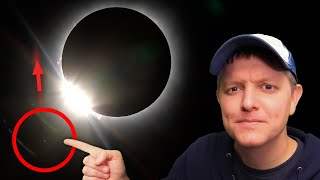

Mysterious Object Caught During Eclipse
45sThe opening mystery of an unidentified flying object during a solar eclipse immediately hooks viewers with curiosity and potential conspiracy.
▶ Play Clip"The title accurately reflects the mystery of the unknown object, though the 'accidentally' part is slightly exaggerated since the main goal was the film photo."
Destin from Smarter Every Day recounts his ambitious attempt to photograph the total solar eclipse on a single piece of slide film, a technique not used in decades. He also captures an unidentified object transiting the sun during totality, which he investigates with satellite experts.
Destin captures a fast-moving object crossing the solar disk during the eclipse, which he initially cannot identify.
Dr. Gordon Telepun challenges Destin to photograph the entire eclipse sequence on one piece of slide film, requiring a camera with multi-shot mode that doesn't advance the film.
Destin's friends at the Kamera Store in Finland provide a camera and detailed instructions for the multi-shot technique.
Destin's family and Dr. Telepun set up multiple cameras and experiments, with strict timing for each exposure.
Totality lasts 4.5 minutes; Destin captures exposures, kisses his wife, and enjoys the moment.
Reviewing footage, Destin spots the object and consults satellite expert Jonathan McDowell to determine if it's a satellite or bug.
Another YouTuber, Jeff, also captured the object from a different angle, ruling out a bug near the lens.
Destin tries to identify the satellite as Starlink 30323 but simulations don't match; he appeals to Space Force for help.
The single-film photo is developed successfully, showing the entire eclipse sequence with 10 partial phases on each side.
Dr. Telepun is amazed, calling it the best one-film sequence he has ever seen.
Destin successfully captures the eclipse on a single piece of film, a feat not accomplished in years, and documents an unidentified satellite crossing the sun, leaving its identity a mystery.
What was the main photographic challenge Destin attempted during the 2024 eclipse?
To photograph the entire eclipse sequence on a single piece of slide film without advancing the film between exposures.
03:02
What special camera feature was required for the single-film eclipse photo?
Multi-shot mode that allows multiple exposures without advancing the film.
04:41
How long did totality last during the 2024 eclipse?
Four and a half minutes.
09:35
What evidence ruled out the unknown object being a bug near the lens?
The object appeared in footage from two cameras 130 meters apart, with a 0.1 degree offset, making a bug at both lenses impossible.
16:32
What was the angular velocity of the unknown object, and how did it compare to a satellite?
About 7.8 km/s, consistent with low-orbiting satellite velocity.
13:47
Who challenged Destin to attempt the single-film eclipse photo?
Dr. Gordon Telepun.
02:47
What was the outcome of the single-film photo?
It was successful, showing 10 partial phases on each side of totality, and Dr. Telepun called it the best one-film sequence he had ever seen.
20:53
Which satellite did Destin initially think the object might be, and why was it ruled out?
Starlink 30323; simulations using NORAD data did not match the object's path.
17:33
The Challenge Accepted
Dr. Telepun's idea to combine old-school film photography with modern eclipse chasing sets the stage for the entire video.
02:47Mystery Object Discovered
The accidental capture of an unknown object adds a layer of scientific mystery to the project.
11:54Object Confirmed by Second Camera
Cross-referencing with another YouTuber's footage proves the object is real and not a lens artifact.
16:32Film Development Success
The successful development of the single-film photo is a triumphant moment after weeks of preparation.
18:57Dr. Telepun's Reaction
The emotional payoff of impressing the person who inspired the project highlights the human element of science.
20:53[00:00] I captured something I haven't been able to identify. [Other people talking] Coming out. [Other people cheering in the background] <Lady Squeeling> "WHEEWWW!"
[00:17] Focus on this band of the sky right here. What is this? And what is this?
[00:34] This video is about something I love, and so I don't feel any pressure to make a video that will perform for the algorithm. about a thing that happened to me, and it's something I love.
[00:48] So by now, we're about a month after the total solar eclipse here in America. videos, and people have been asking me, Hey, what did you do for the eclipse? And I haven't been able to tell anybody what I did because it has taken until now.
[01:02] I just now figured out if I succeeded or failed with the thing I tried to do. A long time ago, a guy named Dr.
[01:16] Gordon Telepun told me I would love total solar eclipses, and I kinda didn't believe him. This is going away from you and to the side. But I took his word on it, and I totally fell in love with it.
[01:31] I did the math with a friend named Trevor, and we decided to go to Wyoming to try to capture the International Space Station transiting the total solar eclipse. I had ever done with photography, and we got it.
[01:47] Two, one, transit. Oh, it happened. I totally saw it. eclipses so much that two years later in 2019, we went to Argentina and we
[02:05] in the middle of the desert overlooking the Andes Mountains. was this composite of a bunch of different digital photos that I took.
[02:17] I had strung them all together and laid them over the same image, and you can see the solar eclipse setting over the Andes Mountains. It's got multiple images in the same image, and I did that with Photoshop.
[02:30] So when we realized there was going to be a total solar eclipse in 2024, Tara had the idea, We've got to watch an eclipse with Dr. Telepun It would be amazing to see him see a total solar eclipse.
[02:47] And then Dr. Telepun impossible to me, but it combined all the different technical things that I love. Yeah, just regular ectachrome, whatever they used to call it back then.
[03:02] You don't want too many. about six after on the same piece of slide film like they used to do a long time ago. To be clear, this is what Dr. Telepun
[03:17] He said, you could do what you did on the Andy's shot where you stitched it But what if you did it on one piece of film? and then you have to develop it, and whatever happens, happens.
[03:33] and then I aim at the eclipse, and then I put my filter on in the partial phases. and then I do that every 10 minutes or so, and then I take the filter off,
[03:49] The problem is most cameras will advance the film. So you have to get a special camera
[04:02] exposure on one piece of film, which means we get one chance to focus, one chance to take 20 something shots, and then one chance to develop it.
[04:15] but you could get a really, really cool photo, So that was the challenge.
[04:27] So I started trying to find cameras that that you could take this photo and not advance the film, and I couldn't find one. a photo without moving the film and then taking a photo again,
[04:41] So what I needed was a camera with multi-shot mode, and I had no idea where to find it. to the Eclipse time, I realized I wasn't going to be able to figure this out.
[04:54] So I called my friends at the kamera store in Finland, Youhoe and Niko. You go to sleep because we're in Finland. We're going to still be awake. And when they did, I opened my email and they had a video
[05:11] of Niko explaining everything that I needed to do. I put together what I think should work for your needs. And he explained everything about how to do it.
[05:25] So about a week out from the Eclipse, I set up the solar tracker for the video camera and the still camera that my son was going to run. All right, seven minutes.
[05:38] Yeah, it's really fun. is he genuinely loves things, and he's unapologetic about it. He loves eclipses, and he wants you to love eclipses.
[05:51] it was just very clear that he wanted everyone to have a great experience. First of all, he's teaching them how to graph things.
[06:05] the temperature during the eclipse, and it is adorable. Another cool thing about this is I got to take my family. We played some Mario Kart the night before.
[06:18] You're going to try to beat Papa, Omi, and Mommy. started setting up his stations, He brought it all and he set it up,
[06:34] He was in teacher mode the whole time. He loved people. His son and my son started working together. And so my son started taking photos
[06:48] Dr. Talebun asked my daughter to run this specific experiment and show people that they could see the eclipse indirectly. So we had a line of cameras and tripods.
[07:03] Solar eclipse timer, and we're getting ready for C1, first contact when the moon touches the sun. Five, four, three, two, one.
[07:16] A couple of minutes later, it was time for the first photo of our sequence. Once I set this camera in position, you can't move it. could, and I was quite scared that I was going to bump it.
[07:31] Three, two, one, zero. One of the things I messed up in Argentina in 2019 is I just randomly took photos,
[07:45] and so my photos are not spaced out correctly. Dr. Telepun did the math with his app to tell me exactly when to take photos. we were very strict about taking that photo down to the second if we could
[07:59] And one thing that was funny is you had all this fancy electronic equipment, people tracker, amounts, all this stuff, computerized, whatever you have you. And I'm out there with this big box film camera.
[08:13] Three, two, One, take. and smaller, the sharp and fuzzy shadows experiment started to show up. The light got really eerie and icky feeling.
[08:28] Doesn't this feel gross? I took some 3D wiggle grams with this Nashika film camera.
[08:40] If you put them together, you can get a 3D effect on film, which is awesome. childlike joy started to come out.
[08:54] I heard the call out for shadow bands, which means we're almost at totality. Oh, they're happening. 30 seconds. I saw shadow bands with my eyes, but I couldn't get them on camera.
[09:09] see shadow bands. And then, totality happened, and it was awesome. [Telepun] Look at Venus.
[09:23] Dude. Oh, diamond ring. [Telepun] Let's wait a little bit. Wait a little bit.
[09:35] [D] Did you get the shots, brother? I got a lot of them. The beautiful thing about Totality being four and a half minutes is I had plenty I like to kiss Tara during Totality. It's a thing I love to do.
[09:52] I got to go say something to all the kids, and I got to go try to get the shot. taking that exposure, knowing that there were 10 shots ahead of it.
[10:04] right on the shutter speed, because with totality, you have to guess. Wow. Before I knew it, people were talking about the sun coming back.
[10:20] Oh, baby. Oh, It comes back fast.
[10:39] It's too fast. [D] It is, isn't it? [D] After that, you just walk around and talk we've got more photos to take in order to get this sequence shot.
[10:55] Okay, so we have done 11 exposures on this one piece of film. What's about to happen is my daughter is going to take the last picture, right? And this is the last photo, correct? Last one.
[11:09] Great. Okay, the dark slide is in. And the photo should be in this.
[11:23] On the way back from Missouri, my dad drove and it started raining like crazy. I started looking at all the photos and videos, and I looked at my son's photos, and he got some amazing shots,
[11:38] and I'm super happy that he's going to have shots from this eclipse that he took. He was taking photos, but this camera over here was shooting 4K video. When I started looking at this footage, I wanted to see C2 and C3, Bailey's beads,
[11:54] So I started looking at it, and then I realized there is something flying across the sky, like right at C3. It could be a bug, it could be a plane, or it could be a satellite.
[12:08] look at the right side of the screen just as the lady yells. You already did it.
[12:21] I'll rewind it and we can watch it again. This time, I'll put an arrow up so you can see it. Baby, she.
[12:33] one happens immediately after this, except this one's on the solar disk. Now, the cool thing is once the sun
[12:47] During totality, I couldn't see bugs flying around, and I'm assuming that's their backlit wings and stuff like that. So I went to the smartest satellite person I know.
[12:59] He runs planet4589.org website that's just pure satellite information. I started by showing him the video and asking for his gut reaction.
[13:16] [J] Okay. I think that's a bug. [D] Okay. [J] I mean, it's not impossible. I guess I wasn't thinking about how zoomed in that image is.
[13:29] the math to figure out if it was traveling at orbital velocities. [J] We can figure out the angular velocity of this little thing as it crosses The sun is about half a degree across, and it took about half a second.
[13:47] Let's say 500 kilometers away. Let's see if I divide 500 by 60. [J] It's not very different from the 7.
[13:59] 8 kilometers a second of a low-orbiting satellite. And so that is not inconsistent with the speed of a satellite going overhead.
[14:12] was a satellite, It doesn't mean it was for sure a satellite, but it's intriguing. So it's possible that it was. So if this was a bug, it would be just above my camera fluttering around, right?
[14:26] So one One way to test to see if it was is to see if anybody in my area of operation there saw the same thing.
[14:39] And there just happened to be a YouTuber set up at my same location. I met him earlier that day, and you might recognize this guy. And what's the name of your YouTube channel?
[14:52] My son and I set the camera up here We were about 130 meters apart. Just after C3, I saw something fly by the sun.
[15:05] [J] I saw it in your video, and it does look like a satellite going like that. Also, it was difficult to synchronize his footage to mind in time because at one
[15:20] Is it okay if I use this to try to figure this out? If people want to check out your YouTube channel, where do they go? [D] There you go.
[15:35] You didn't spell it Girling like a lot of people do. And I will go compare these videos and see what I can come up with. in the camera footage, and I corrected it all in Adobe Premiere.
[15:50] His was filmed at a different angle than mine, so I indexed off of Bayly's beads to make sure they were at the same rotation. And then I was more zoomed in, so I adjusted the scale.
[16:02] Okay, I think I've got it to where it's about as clear as it can be. on the left, and I can turn it on and off like that. And you can see I've indexed the sun on the prominences
[16:17] right there on that spot in that spot, so I can turn it on and off like that. Okay, so you got Jeff's footage on the left, you have mine on the right. This is the object as it enters mine.
[16:32] It's there. It's in both of our views. So if the the solar disk is about half a degree, it looks like ours is a 10th
[16:48] of a degree offset, the object in his versus my frame. it can't be a bug in both of our lenses unless the bugs at 100,000 feet.
[17:00] And so you can work all the geometry. [inaudible background talk]
[17:17] That's got to be a satellite or something like it. and if you go to the right frames, you can see the object is there as well. you can still see something zipped by in a couple of different places.
[17:33] My next question was, what satellite? I thought I had narrowed it down to Starlink satellite 30323, but when I submitted the NORAD category ID number 57634 to celestrack.
[17:50] sometimes called a two-line element or a three-line element. with the ability to simulate all this stuff, and it doesn't seem like Starlink I So here's the question,
[18:04] if it was a satellite, and I think it was, what satellite was it? You know where I was, where I was pointing What satellite do you think this was?
[18:17] Space Force, I'm just going to say it. mechanics, and then give them permission to tell us what they learned.
[18:29] and I'm excited to see where the answer comes from. on that piece of film we shot to see what's in there. Somebody could have bumped the tripod.
[18:44] There's no way that we nailed this shot, but I'm just going to go ahead and tell myself I'm excited to have tried it because it was fun.
[18:57] Moment of truth. [J] Lets see it. [G] Let's check it out. [D] I don't think it's going to work, dude. It's there.
[19:10] [G] That's so cool. [D] It's going to work. Okay.
[19:23] Watching Garret and Josh put this slide film into the Noritsu scanner was legitimately terrifying because I knew we Were the exposures the correct color?
[19:38] We were about to figure this out. That's so cool. That is so cool. I just did a quick adjustments to it.
[20:15] and I love the fact that they're doing stuff here in Montgomery, Alabama. If you want your film scanned, send it to indiefilm.com. Josh even took the print, cropped it for me,
[20:27] and made a printout because we know that there's one person in this world whose mind will be blown by this image, and we've got to go show it to him. [T] That one?
[20:40] [T] Are you kidding me? That's unbelievable. Is that it?
[20:53] [T] Nobody has done that for years. can you see really close? I need to get a magnifier.
[21:07] [T] That's amazing. [T] This is the best one film sequence that I've ever seen.
[21:27] The other ones I've seen, and I can't find them again, they only took maybe four partials on each side, and they had them spread out a lot.
[21:40] Doing 10 in a row, and nailing it is unbelievable. I did not think we were going to get it. [T] Oh, no.
[21:52] This is the way they used to do it. [D] So check this out. [T] I I'm telling you, I don't know the last time that that was done. [D] It was pretty fun, right?
[22:08] [T] Wow. [T] You already printed it. You've been keeping me in suspense.
[22:22] The Indie Film Lab did it for us. I've always thought that interested people are interesting. Dr.
[22:35] Telepun is not only a good friend, but he's an interesting character in this It was a blast to be able to watch this with him and my family. Also, I'm just grateful that you're here.
[22:50] If you want to consider subscribing to Smarter Every Day, that'd be awesome. I'm Destin. You're getting Smarter Every Day. If you support Smarter Every Day at Patreon, first of all, you're awesome.
[23:04] Secondly, be on the look out for a post about this image. But yeah, I want to share this with you. So patreon.com/smartereveryday.
[23:19] Oh, wow. That's really cool. Okay.
[23:31] Thank you very much for this. I'm grateful.

⚡ Saved you 0h 23m reading this? Transcribe any YouTube video for free — no signup needed.