
Do We Really Understand Quantum Physics?
45sBrian Greene directly addresses a common question with a clear, engaging answer that challenges intuitive thinking.
▶ Play Clip"Delivers exactly what the title promises: a physicist answering quantum physics questions with clarity and depth."
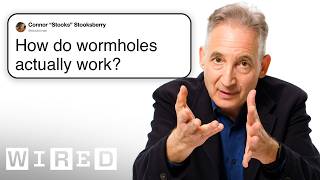
In this video, physicist Brian Greene answers a series of questions about quantum physics, covering topics such as quantum mechanics, wormholes, the multiverse, time travel, teleportation, the nature of reality, black holes, quantum computers, entanglement, and the fate of the universe. He provides accessible explanations and addresses common misconceptions.
We understand the core ideas of quantum physics, but it requires reorienting our thinking about how the universe behaves.
Wormholes are hypothetical warps in space that could connect distant locations, but we don't know if they exist.
Particles like electrons can pass through barriers via quantum tunneling, but for macroscopic objects like humans, the probability is exponentially small.
The Big Bang may not have been a one-time event; mathematics suggests a multiverse of expanding universes, possibly testable via bubble collisions.
Travel to the future is possible via time dilation near light speed, but travel to the past remains uncertain and likely impossible.
Quantum teleportation works for particles via entanglement, but not for macroscopic objects like humans.
Reality is made of fundamental particles (quarks, electrons) and possibly even smaller constituents of space itself.
Quantum mechanics is weird from the start, but it works; it describes superpositions and entanglement, and it underlies all of reality.
Stephen Hawking showed that black holes radiate particles and eventually evaporate, but what happens at the end is unknown.
An electron can be in a superposition of two paths, but it's still one electron, not two.
The block universe idea suggests all of time exists simultaneously, which can be comforting as nothing ever truly dies.
String theory is not dead; it's the best-developed framework for unifying quantum mechanics and gravity, though not yet tested.
Time may have a beginning at the Big Bang, similar to how 'north' begins at the North Pole, but other ideas exist.
Quantum computers use superposition for parallel calculations, offering exponential speed-up for specific problems like factoring.
Entangled particles have correlated behaviors even when far apart, a phenomenon we still don't fully understand.
Schrodinger's cat illustrates how quantum weirdness can be amplified to macroscopic scales, but it's a thought experiment.
Observation/measurement can influence quantum systems, but exactly how remains a mystery.
Quantum mechanics explains that atoms have a lowest energy state, preventing electrons from spiraling into the nucleus.
General relativity governs the very large, quantum mechanics the very small, but we haven't found a new set of laws for super big things.
Physicists don't have a definitive answer; a state of absolute nothingness may be unstable and quantum mechanically fall apart.
The universe may expand forever, with matter disintegrating into a cold, quiet bath of particles.
Brian Greene provides accessible explanations of complex quantum physics concepts, emphasizing that while we understand much, many deep questions remain unanswered.
What is quantum tunneling?
A quantum phenomenon where a particle passes through a barrier it classically couldn't overcome.
02:11
What is the multiverse theory?
The idea that the Big Bang may not have been a one-time event, leading to many expanding universes.
03:21
How can we travel to the future?
By moving close to the speed of light, time dilation makes future time pass faster relative to the traveler.
05:18
What is quantum teleportation?
Transferring the quantum state of a particle to another via entanglement, not physical transfer.
06:35
What are the fundamental constituents of matter?
Quarks and electrons, which make up atoms.
07:17
What did Stephen Hawking discover about black holes?
Black holes radiate particles and eventually evaporate, ending in a burst of radiation.
09:37
What is the block universe theory?
The idea that all of time exists simultaneously as a block, so nothing ever truly dies.
11:34
Is string theory dead?
No, it's the best-developed framework for unifying quantum mechanics and gravity.
12:16
What is the lowest energy state of an atom?
The ground state, which prevents electrons from spiraling into the nucleus.
20:05
What is the fate of the universe according to one possibility?
It will expand forever, with matter disintegrating into a cold, quiet bath of particles.
23:34
Multiverse is mathematically plausible
Explains a complex cosmological concept in an accessible way, highlighting testability.
03:21Time travel to the future is possible
Clarifies the difference between future and past time travel, grounded in relativity.
05:18Black holes evaporate
Presents Hawking radiation as a quantum effect, linking quantum mechanics and gravity.
09:37String theory is not dead
Defends string theory as a leading framework, countering popular misconceptions.
12:16The universe may end in a cold bath
Provides a sobering but scientifically grounded view of the far future.
23:34[00:00] - From Doktor J: "Boy, are you quantum gravity? I have no idea what you're referring to Hi, I'm Brian Greene, physicist, professor, author,
[00:15] to answer your questions from the internet. [upbeat music] @peleenmziry: "Do people actually understand quantum physics
[00:31] We understand the core ideas, that we would think should happen in the universe
[00:43] So we have to reorient our thinking but it is something that those of us So yeah, we do understand a lot about quantum physics.
[01:00] "Has some grizzled professor," like me, to explain wormholes ever made anyone go 'aha!'? Still seems like an incomprehensible magic to me."
[01:16] I can draw a line connecting them, So imagine this is in space. and this is our Milky Way Galaxy.
[01:28] It can warp so that these two locations that were very far apart are now very close together. you now see that the orange between the two locations,
[01:44] We don't know if wormholes are real. but if they do exist, from one location to another.
[01:58] From Do0ozy: "If I ran into a wall over and over again, to eventually pass through the wall? I would need to run into the wall to pass through?"
[02:11] Now look, we don't do quantum mechanical experiments with macroscopic beings like a human body, but we do a version of you running into a wall
[02:25] with a particle like an electron or a neutron or a proton that we fire at a barrier over and over and over again. we do find it passes through a barrier
[02:38] If you scale this up, yeah, in principle, could undertake the same experiment.
[02:50] You'd have to hit this barrier enormous number of times, exponentially large in the age of our current universe. the probability that you will pass through the barrier is.
[03:06] AssusReamus: "Is our universe the only universe?" because it's the only one that we can observe But there's mathematics suggesting
[03:21] that the Big Bang may not have been a one-time event. giving rise to many expanding universes that all populate a grand multiverse.
[03:34] where the individual bubbles are universes like our own, many of these universes.
[03:47] they say, "You're talking nonsense. They have a point, this is an important criticism, Number one, in principle, this may be a testable idea.
[04:00] If two of these bubble universes were to collide, could leave an imprint We've not yet seen it at all,
[04:14] this would be circumstantial evidence The second point I would make is a theoretical statement. For instance, the Big Bang idea has been tested
[04:32] It has confirmed the predictions, which is wonderful. But if the math then says there should be other universes, because we have confirmed the parts
[04:48] of the mathematics available to our observations. We don't, but we are willing to consider it suggests that this really may be true.
[05:02] @Joonies_Girll: "Do we have any updates on time travel? what was happening on planet Earth a million years from now, for how in principle you could do that.
[05:18] Say you go six months, You will be one year older, of course, your clock was ticking slow
[05:32] So when you step out of that spaceship, it may be 2 years or 5 years or 10 years or 100,000 years, all dependent on how close to the speed of light
[05:47] But many of us are more interested And that's the one where we just don't know. using exotic things like wormholes
[06:04] or interesting kinds of motions around cosmic strings, we don't have an answer. And so we suspect that travel to the past is not possible,
[06:17] but as of today, nobody has definitively ruled it out. Why is teleportation not possible?" It's not possible for macroscopic objects like you and me,
[06:35] routinely teleport individual particles You set up two entangled particles that in some sense
[06:47] You bring in whatever you want to teleport And through the magic of entanglement, This person can manipulate that particle
[07:01] and extract an exact copy of the original. from one location to another. @sinonghostriley: "What is reality made of actually?
[07:17] Way back in the early days, people though it was earth, air, fire, and water In the early years of the 20th century,
[07:30] that matter is made of fundamental constituents, And as we examine atoms with ever greater precision, that make up atoms.
[07:44] that are in orbital clouds around a nucleus And the neutrons and protons themselves we know are made of yet smaller particles known as quarks
[07:57] They are the bulk of matter as we know it. atoms making up the fabric of space itself.
[08:10] I think there will be fundamental constituents of space What those ingredients actually are, but my guess is that that is
[08:23] where our understanding will lead us. "When does quantum mechanics get weird?" Quantum mechanics tells us
[08:38] of different mutually incompatible states of being. It tells us that distant objects can be weirdly connected It's weird from the beginning and yet it works.
[08:54] in terms of billiard balls bouncing around according to ideas and laws that he was able to intuit. the micro world doesn't behave that way.
[09:08] called quantum physics. we can extract them from quantum physics. it's quantum mechanical through and through,
[09:24] and quantum mechanics suppresses the weird stuff making the world appear to play But fundamentally, everything is quantum mechanical
[09:37] "If nothing can escape a black hole, Stephen Hawking determined way back in roughly 1974
[09:51] as the mathematics Particles in a sense can leak out of a black hole quantum mechanically.
[10:04] And as particles slowly radiate from a large black hole, which means the intensity of the radiation until at the very end there's a gigantic burst of radiation,
[10:19] which in essence is the death throes of a black hole. will take about 10 to the 68 years that the black hole will shrink down
[10:33] But what happens then? Nobody knows. "If an electron can be two places at the same time, how do we know those are not two different electrons?"
[10:48] We fire a single electron into an experimental context in which the results that we find can only be explained the electron took two different pathways
[11:05] Since we only put one electron into the experiment when we find in the intermediate stage that the electron it's only one electron that's doing that, not two.
[11:22] "I just learned about the block universe theory, It's funny that you're having an existential crisis.
[11:34] To me, the block universe idea is very comforting from an existential standpoint. The idea is rather than thinking of the past as being gone
[11:47] we imagine that all of time is out there within this block that has all of time and all of space. From that standpoint, we always exist
[12:02] because the block itself containing all events, So in that sense, nothing ever dies. always occupies that position in the block.
[12:16] From @miniapeur: "Is string theory dead?" you might get the impression that string theory is dead. string theory has been making enormous strides
[12:31] and understanding the nature of space and time. that we can test in the laboratory, Physics is trying to understand a coherent description
[12:48] We don't have such a coherent description. but string theory is the best developed together into one consistent framework.
[13:03] On that front, string theory is absolutely an enormously important development in the history of ideas. "If everything has a beginning, then when did time begin?
[13:17] what was here before that beginning?" who does know the answer to that question. Let me just throw out a couple of them to you right now.
[13:31] It could be that there is a beginning to time. You know, if you're walking on planet Earth "Hey, can you point me in the direction of further north?"
[13:47] Yeah, point me in the direction of north. When you get to the North Pole and you say to someone there, "How do I go further north?",
[14:00] "The concept of further north The North Pole is where north begins." that you can imagine going back a hundred years,
[14:14] When you get to the Big Bang, it could be that the concept of going further back in time than the North Pole.
[14:26] It could be that time itself simply began There are other ideas that people have developed In fact, there are some theories
[14:41] is simply one expansion of space event has undergone this kind of rapid outward swelling,
[14:54] other universes populating a grand multiverse. From Jerswar at the explain like I'm five subreddit: "What is the big deal with quantum computers?"
[15:08] a particle can be in multiple places at the same time. A quantum computer leverages that multiplicity to carry out multiple calculations in essence in parallel,
[15:22] on how fast the computer can in principle get to an answer. But there's a second part of quantum computation,
[15:34] How do you find the answer among that multiplicity And so for a certain class of questions, a quantum computer can give rise to an exponential speed-up.
[15:49] that works for other problems won't be applicable. And so my suspicion is that quantum computers will be a very niche-oriented kind of device
[16:05] like simulating quantum systems or factoring numbers into their prime factors, that sits on your desk or on your lap
[16:19] the kinds of things that we are familiar with. From @kero_sock: "What the [beep] is quantum entanglement?" we know that they can act independently of one another.
[16:35] But in the quantum world, two things can be far apart, from a behavioral standpoint, Imagine you've got a particle whose spin, we call it,
[16:49] And you can have two of these particles. a measurement on one of these particles The other particle, if they're quantum entangled,
[17:03] and acquire a single definite reality. quantum entanglement bridges the gap between them and allows their behaviors to be tightly choreographed
[17:16] in a way that we're still struggling to fully understand. What you do here quantum mechanically if the two objects are quantum entangled.
[17:29] "Schrodinger's cat seems like a dumb concept." of Schrodinger's cat then,
[17:41] Back in the 1930s you might have tried to argue that the weirdness of quantum mechanics
[17:53] and we simply don't need to think about it Schrodinger's cat was introduced by Schrodinger And he basically said, look, if you have an electron,
[18:10] of being here and being there, I'm willing to accept a particle in some mixture because it's in the microscopic world
[18:23] We can amplify the weirdness All we need to do is set up a little gadget which has poison that will be released into this box
[18:38] but it won't be released into the box And then if we put a cat in the box, the poison is in a 50/50 mixture of being released
[18:50] which means the cat must be in a 50/50 mixture Quantum physics, he was saying, whereby it can infect the everyday reality
[19:06] @ResonanceEnter1: "Does observation create reality?" There are physical systems where if there is no observation,
[19:18] the system evolves and behaves one way. that interaction does change how the system behaves. if it sufficiently impinges on a particle like an electron,
[19:35] that photon can coax a definite reality to emerge. that we have not yet fully understood is why is it that an observation or a measurement
[19:50] on a quantum mechanical system? Somehow, intervention, environmental influence, but exactly how this happens,
[20:05] still struggling to understand. El-Kabongg: "Why do atoms not run out of energy?" We've known since the 1800s that as electrons accelerate,
[20:18] And if they radiate away energy, that electron should spiral into the nucleus and crash. The answer, according to quantum mechanics,
[20:31] is that there is a lowest energy state that's available to a system like an atom, for the atom to achieve a lower-energy configuration.
[20:47] on how close the electron can get We can actually calculate that lowest energy state
[20:59] and then we can compare it to the energy states of atoms. It can come in chunks that can't be subdivided. From the Manuko subreddit:
[21:13] At the normal level, we have relativity. Is there another set of laws for super big things?" but I would say for the super big,
[21:27] That's Einstein's theory of gravity. when things are ever larger, for stars and black holes. We are the in between, the very small and the super big,
[21:42] And so there are things in the world where quantum mechanics rears itself There are other things that we encounter
[21:56] that have general relativity flexing its muscles, but we haven't found that there's a new set of laws Instead, our challenge
[22:09] so the calculations that we human beings we want those calculations to make sense And that is a blending that we have been trying to do for,
[22:25] From @ignorethatdoor: "Why does anything exist? so how did something come from nothing?"
[22:37] All we physicists can do Energy, matter, a configuration And then from that point forward,
[22:52] we analyze what happens to that something, that then come together to yield stars, galaxies, But if you push further back and ask,
[23:06] nobody really has an answer yet for that. A state of absolute nothingness may be unstable.
[23:20] may quantum mechanically fall apart We don't, but at least it's an interesting idea for how you could start with nothing and yield a something.
[23:34] @troll_on_patrol: "What happens after the universe dies?" in this little stack under here, "Until the End of Time."
[23:46] but one dominant possibility is that in the very far future, the universe will continue its spatial expansion. material objects will continue to disintegrate.
[24:02] Even black holes disintegrate into a bath of particles. And so that suggests that in the very far future,
[24:14] the universe will be nothing but a bath of particles ever quieter, ever colder cosmos. existed in the early universe,
[24:28] Those particles come together for a brief period of time, and on this planet people as well. And then in the far future, it all disperses once again.
[24:42] So everything that we know about, everything we care about, may just be a momentary aggregate of particles and then for effectively an eternity,
[24:59] there's nothing but particles wafting through the void. All right, that's all for today. Thanks for joining us. This is Quantum Physics Support.
⚡ Saved you 0h 25m reading this? Transcribe any YouTube video for free — no signup needed.