
AI Gets Ancient Egypt Headdresses Wrong
45sExperts debunking AI-generated content is highly engaging, especially when pointing out obvious historical inaccuracies.
▶ Play Clip"Delivers exactly what the title promises: an expert fact-check of AI slop with detailed corrections."
An Egyptologist fact-checks AI-generated videos depicting ancient Egypt, pointing out historical inaccuracies and confirming accurate elements. The video covers topics such as statues, beauty routines, the Library of Alexandria, mummification, pyramids, and warfare, providing expert corrections and insights.
The claim that no statues show smiling is false; Egyptologists recognize eras where statues frowned, and smiling statues exist.
The concept of a 'job' is modern; ancient Egyptians had roles in society, and priests could also sell fish in the marketplace.
The flood was crucial for irrigation and deposited fine silt, acting as natural fertilizer for barley.
Money had not been invented; it was a barter system with exchanges in marketplaces.
Cosmetics were used by both men and women, not exclusively women.
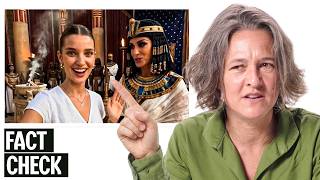
Cleopatra spoke multiple languages, and her outfits in the video are anachronistic, resembling New Kingdom styles from centuries earlier.
The library was in the Royal Quarter on the coast, one of the most important collections of books, but the building shown is not accurate.
The lighthouse was a working lighthouse, crucial for the treacherous Mediterranean coast, and fell due to earthquakes.
Kohl was a powdered carbon or galena pigment used for eye makeup and sun protection. Mirrors were made of bronze or silver, not glass.
Gods traveled in bark shrines carried by priests, often going to visit other gods, similar to the Ark of the Covenant.
Priests wore jackal headdresses during mummification, embodying Anubis. Canopic jars held internal organs, typically four.
Boats used sails mainly when sailing south against the current; when sailing north, the flow helped.
Beekeeping existed as a sweetener source. Childhood as a separate phase is not well-supported; children worked early.
Only elite children learned to read and write, often at the palace. School texts exist with examples of bad handwriting.
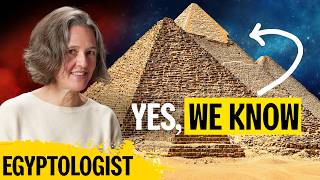
Pyramids were originally bright white, cased in fine limestone, and smooth. The casing was removed in medieval times.
Chariots with two people are accurate, but large armies and triple-decker boats are not. Temple reliefs show chariot warfare.
Temple doorways were narrow, not for crowds; most people were not allowed inside. Pylons had two sides higher than the middle, representing the horizon.
Ancient Egyptian cities were not dense skyscrapers; they were different from modern urban settings.
The public could enter temple courtyards but not the inner rooms. The straight axis mirrored the rising sun.
The video demonstrates that while AI-generated content may capture some accurate elements, it often contains significant historical inaccuracies. Expert fact-checking is essential to separate truth from fiction.
Did ancient Egyptians use money?
No, they used a barter system.
02:13
Who used cosmetics in ancient Egypt?
Everyone, both men and women.
02:55
What were canopic jars used for?
To hold internal organs during mummification.
08:25
What was the primary sweetener in ancient Egypt?
Honey from beekeeping.
09:18
What were pyramids originally cased with?
Fine limestone, giving them a bright white appearance.
11:35
How did ancient Egyptian boats travel south?
They used sails to go against the current.
08:52
No Money in Ancient Egypt
Corrects a common misconception about ancient economies.
02:13Pyramids Were White
Reveals the original appearance of the pyramids, often misrepresented.
11:35Anubis Headdresses
Explains the ritual role of priests in mummification.
07:29Temple Access Restrictions
Highlights the exclusivity of temple spaces in ancient Egypt.
13:56[00:00] The headdresses that these guys are wearing [light thoughtful music] What's wrong, however, is this sort of yellow hat.
[00:15] This has nothing to do with ancient Egypt. Let's fact-check some AI slop. Okay, first video.
[00:30] - No one ever builds statues of me smiling. - I find this line hilarious because, in fact, most statues We as Egyptologists recognize a particular era
[00:46] when statues are frowning, where they weren't smiling, - Well, I lift stones all day
[01:01] - So the whole construct of "What's your job? This is a very modern way of understanding - What's your role in society?
[01:16] But I also run the fish stall on weekdays. and the people who would have served as priests for the gods who are selling fish in the marketplace.
[01:31] - Well, the Nile gave us water, took the house, - And this is, of course, hilarious way of putting it, but the importance of the flood in ancient Egypt was real.
[01:45] and brought not only water to irrigate crops, but also fine silt, which was basically nature's fertilizer in which to plant barley indeed,
[01:59] - Made three sales, got accused of sorcery, and my goat ran off with the change, so could be worse. in ancient Egypt, although they must have existed.
[02:13] that there was change that goats could have run away with, Money had not been invented yet in ancient Egypt. It was a barter system, so people worked out exchanges
[02:26] in a marketplace context. - Chloe, welcome to my home. Cleopatra knows my name. [gasps]
[02:39] because of the stereotypes of women in our [gasps] I can tell this is all gonna be about makeup and clothes. - Okay, I have to ask, what is the actual beauty routine?
[02:55] - Beauty routines in ancient Egypt. that is an exclusively women's world here, Cosmetics in ancient Egypt were actually used by everyone.
[03:10] as heavily jeweled as women were. - These murals depict the great victories of my ancestors. We do have images of warfare
[03:25] and these are not they. This is not what you would expect in a palace. of great victories in a palace.
[03:38] [Cleopatra speaking in foreign language] so I cannot evaluate whether or not that was accurate Greek. and that's actually a point that's important.
[03:50] She spoke multiple languages. from the Greek-speaking world. is shown in a classically pharaonic idiom.
[04:05] and we have outfits that look like New Kingdom outfits. These are from Egypt from many hundreds of years earlier?
[04:19] Probably the latter. Everything the world has ever known - So here we are on the coast of Alexandria.
[04:32] We do know approximately It was in the Royal Quarter, which is on the coast here. It was one of the most important collections of books
[04:46] But the building we actually see in the background here was one of the wonders of the ancient world. It is not shown here as enormous at all.
[04:59] This lighthouse was a working lighthouse. and how visible this was from far away. Alexandria was an incredibly significant trading hub
[05:12] and the coast of the Mediterranean is very treacherous. through underwater excavations in the harbor of Alexandria. It fell down because of earthquakes over the centuries.
[05:25] You want to try it? Oh, my God! Yes! Not all of this is amazing. was used much earlier than this in ancient Egypt as well.
[05:38] This is a powdered carbon-based or galena lead-based pigment as well as sort of sunglass protection properties, - I look incredible.
[05:53] - Okay, let's talk about mirrors in ancient Egypt though. and the mirror is a perfect glass we have in ancient Egypt at all.
[06:07] are of bronze and sometimes silver. So it would've been, in fact, This is something you're relying on your best friend,
[06:19] Next. Here we have the procession of a bark or a boat, that are being carried by priests through a crowd.
[06:34] and we can see a temple here as well. for what an Egyptian procession, When gods traveled on procession,
[06:46] put in a bark shrine on a boat like this, carried by priests through the city. as you can see here, but they're usually going somewhere.
[07:01] They're going to visit another god in a different temple, So while the basic idea of a procession When we actually look at
[07:14] it looks totally like Ark of Covenant stuff. This is a scene of embalming, He's getting the full works here, being turned into a mummy.
[07:29] They've got trays of things like salt, as they're drying it out and wrapping it in linen. is the priest who is standing at the head
[07:44] We can see that he is wearing what looks like a helmet or a headdress that has a long snout and big ears. who takes the form of a jackal.
[07:58] We do know that priests engaged in aspects of mummification did actually wear headdresses like this,
[08:10] they were themselves Anubis. We have in the foreground, we can see these jars These are in order to hold the viscera.
[08:25] Those wet bits, they're your internal organs. and you're gonna want them in the afterlife. There are only four of them in an actual Egyptian burial,
[08:39] Here we have a Nile scene with a temple in the background, The shape of the pylon here And in the foreground, we have boats,
[08:52] and some don't have sails up. and in fact, they used them principally When ancient Egyptian boats sailed south,
[09:04] would have propelled the boats. but the flow of the river is with them. Next video.
[09:18] and you wake up on your mat looking out over the pyramid, They did use beekeeping in ancient Egypt, They didn't have sugar, so it was a major sweetener.
[09:33] not so probable. Again, pyramid in the background, not so likely. of carefree ability to explore and learn on your own
[09:50] The idea that childhood was even a separate a ton of evidence for in ancient Egypt. We have evidence of the domestication of the donkey in Egypt
[10:06] Board games. All of our evidence is that these are actually used by adults, sometimes ritually, sometimes to pass time.
[10:18] and play was not considered important, as far as we know, As soon as they could, they were being engaged in and involved in the productive economic life of a household.
[10:32] - School in ancient Egypt. Only very elite people were expected to learn to read
[10:44] Very elite children would've then gone to the palace. or very favored courtiers as well. by writing down what a teacher is speaking.
[10:56] They're not pre-written on, as you've seen here. We do have school texts, so we have the bad handwriting Okay, next video.
[11:10] Here we are at Giza, that we're finding in a lot of the AI slop. and we have some agricultural land
[11:22] [lively upbeat music] is that they are represented as bright white
[11:35] The bright white is quite accurate. would have been cased in fine limestone and really valued for its whiteness.
[11:48] This glowing whiteness would have been characteristic They would have been quite smooth as well. Pyramids were capped with stones, but from far away,
[12:02] We don't know if they were gilded or another color. Most of these were removed in the medieval period, and were used as building stone for other buildings.
[12:16] and that is on top of Khafre's pyramid. And so today, Khafre's pyramid the once bright white limestone
[12:31] Let's talk about warfare in ancient Egypt. have elements that are accurate. One thing that's jumping out to me as unlikely, however,
[12:45] Really large armies We have here a chariot with two people in it, This is accurate.
[12:58] We have actual chariots preserved They were disassembled, but all the parts are there. that show chariot warfare on the walls of temples.
[13:12] This has no relationship to what we think while going into battle. [bells chiming]
[13:25] We have triple-decker boats, not a thing in ancient Egypt. We have a line of temples on the bank of the Nile. but particularly let's look at this temple.
[13:39] to get to this temple, and they're entering through Steep staircases leading to temple entrances to an ancient Egyptian temple looks like at all.
[13:56] The doorway into an Egyptian temple is quite narrow. not to allow big crowds to walk in. Most people were not allowed to go into the temple at all.
[14:10] not a place where the crowds are gathering in most cases. the facade of this stone gateway, We would expect a pylon in ancient Egypt
[14:25] The two sides are higher than the middle. which represents the horizon [bells chiming]
[14:40] two different places in Egypt, but I'm not entirely sure. We have no depictions of boats that look like this. We have a really good idea
[14:56] because we do have them carved in relief scenes on temples. For instance, we excavated a boat The way background, we have an urban sprawl.
[15:10] these must be skyscrapers. is really this pyramid. It was the second of the very large pyramids at Giza,
[15:24] And by the time the top there were, in fact, all three pyramids at Giza. Here, we have an urban setting.
[15:36] that this is a place where life is taking place. which is not where most cities were. don't look like the urban fabric of ancient Egypt.
[15:49] They're really dense. Here we seem to be in the courtyard of a temple, that is not so off in one of these videos.
[16:02] in a temple courtyard. were allowed to come into the god's precinct, if not actually into the rooms where the god himself lived.
[16:16] and what the crowd itself actually looks like. [bells chiming] and the temple is big stone architecture.
[16:32] We have a lot of sculpture on the sides here, In particular, I would note So we are walking down the middle of the temple
[16:46] which is small. from at least the New Kingdom onwards, and manifest in a statue that is in the back.
[17:01] being able to walk out of his temple The straightness also mirrors the rising [bells chiming]
[17:14] The more I look at this, the more ridiculous this is. They look more like cats. Thanks for watching.
[17:27] [light gentle music]
⚡ Saved you 0h 17m reading this? Transcribe any YouTube video for free — no signup needed.