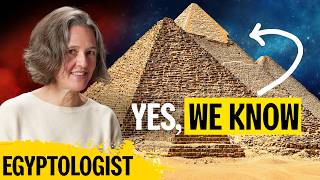

Pyramid Scans Debunked?
45sThe opening directly challenges common sensationalized pyramid news, sparking curiosity.
▶ Play Clip"Delivers on its promise by presenting concrete evidence that demystifies pyramid construction, though it could have been more concise."
This video challenges common misconceptions about the construction of the Great Pyramid of Giza, presenting five key discoveries that reveal the sophisticated engineering and organizational skills of the ancient Egyptians. It emphasizes that the pyramid was not built in isolation but was the result of centuries of trial and error, with evidence from quarries, ramps, workers' villages, and papyri.
Most of the stone for the pyramid was quarried locally at Giza. Workers used a technique of cutting narrow trenches by dropping hard stones, then inserting logs that expand when wet to crack the stone free.
No ramp remains exist at Giza, but the best example of an ancient ramp is at Karnak. It shows a mud brick ramp used during construction, which was later removed. This supports the theory of ramps, likely spiraling up the pyramid.
Blocks were dragged on sledges, likely lubricated by pouring water in front of them. This was backbreaking labor, but effective. Animals were not used for hauling.
The workers' village at Giza, excavated since the 1980s, housed and fed the construction crews. It included bakeries, barracks, and large grain silos, indicating a well-organized workforce.
In 2013, papyri were discovered at Wadi el-Jarf, including the diary of an official named Merer. This is the earliest known inscribed papyrus, documenting the daily activities of transporting limestone from Tura to Giza.
Giza was built at the end of a long process of experimentation. The Step Pyramid at Saqqara and the Bent Pyramid of Sneferu show earlier attempts and failures that led to the perfected techniques used at Giza.
The Great Pyramid of Giza was a monumental achievement, but it was not a miracle. It was the result of generations of trial and error in engineering, organization, and logistics, as revealed by archaeological discoveries.
What technique was used to extract stone blocks from the quarry?
Workers cut narrow trenches by dropping hard stones, then inserted logs that expand when wet to crack the stone.
01:07
What is the best remaining example of an ancient ramp?
The ramp at Karnak, a mud brick ramp used during construction.
02:19
How were blocks likely moved up the ramp?
They were dragged on sledges, lubricated by pouring water in front of them.
04:08
What did the workers' village at Giza include?
Bakeries, barracks, and large grain silos for storing food.
05:39
What is the significance of the Wadi el-Jarf papyri?
They are the earliest known inscribed papyrus, documenting the daily activities of an official named Merer.
07:25
What was the Bent Pyramid and why is it named that?
It was a true pyramid attempt by Sneferu that failed due to structural weaknesses, causing a change in angle.
10:44
Stone extraction technique
Demonstrates a clever use of natural materials (wood expansion) to solve a massive engineering challenge.
01:07Karnak ramp evidence
Provides tangible archaeological evidence for ramp construction, countering the lack of ramps at Giza.
02:19Earliest papyrus diary
Offers a firsthand account of pyramid construction logistics, a rare primary source.
07:25Bent Pyramid failure
Shows that pyramid building involved trial and error, humanizing the ancient engineers.
10:44[00:00] the news story breaks: new satellite imagery, new scans, of the pyramid-but it's usually a big nothing burger.
[00:12] and that understanding comes from multiple discoveries, Discovery number one: the Giza Quarry.
[00:25] and the Giza Plateau. Most of the stone that was used to build We have, in fact, an area that was a quarry,
[00:39] that was used to pull up the blocks out of a quarry like this. but it can actually be done fairly well.
[00:53] a stone like granite or diorite, so, in a line. You're going to do this in a bunch of lines.
[01:07] narrow trenches made by dropping a hard stone And you go down for a couple of meters like this. Now, looking from the side, you have these narrow trenches.
[01:21] You've only defined this on the sides from the top. It's harder to do this because you don't have gravity, but you chip away the sides.
[01:36] And then you put a log in each of these. When you wet the log, the wood is going to expand. And as the wood expands, it cracks right here.
[01:49] that you can pick up and take to your ramp. This is the big question: How on earth did you raise before modern technology?
[02:05] We do not have ramp remains at Giza itself. This is one reason why this is fertile ground for theories But, in fact, we know a great deal about what ramps looked
[02:19] Probably the best remaining example of an actual ramp Karnak is a huge temple. but it does show us a lot
[02:33] And, particularly, it shows us the building of a mud brick One reason the ramp at Karnak is so cool is Very often, we don't have evidence of construction process
[02:50] At Karnak, that wasn't the case. and, as such, they removed the remains of the ramp, as they finished them.
[03:03] would've been straight and gone up the side of the pyramid, that supported it and spiraled up around the pyramid,
[03:16] A straight ramp for a building as large The ramp would've had to be extremely long for dragging the blocks up once you got to the top.
[03:30] and think how much territory That means your starting place for dragging the blocks and it's less likely that there would be nothing left
[03:44] So, both practically and in terms of the evidence a spiraling ramp up the pyramid particularly for the higher levels of the pyramid.
[03:56] It's another thing to get the blocks up the ramp. To get a block of this size up the ramp, They're flat.
[04:08] And you pull the sledge up. It doesn't seem that they're using animals You can ease that process somewhat by lubricating
[04:22] by pouring water in front of the sledge as it's going up. It's backbreaking labor. But ramps didn't build the pyramids alone.
[04:38] of people were needed to haul the stones up those ramp. the work mans' village at Giza, Archeologists since the 1980s have been working
[04:55] the vast monuments that are symbols of kingship, of building the pyramids and, in particular, The site of the workers' village at Giza
[05:10] It is rather closer to the cultivation, While our estimates of the number of people are wildly variable,
[05:24] it is clear that the workers' village could have supported The town that has been uncovered since the 1980s types of evidence.
[05:39] the place where they were baking the bread for the construction crews who are working on the pyramids. as sleeping places, as barracks for seasonal workers.
[05:55] at the pyramid construction site. for the population here lived. of most Egyptians, but the level of animal keeping
[06:12] who were building the pyramids absolutely needed that people here are doing an incredible amount of labor. is we have these enormous silos for storing grain.
[06:27] but another thing you make is beer. and it is even given as part of payment to people. because money hadn't been invented yet.
[06:42] but they're being paid in food, in bread and beer, would have consumed. to be a patron yourself and hire others.
[06:58] We do have questions about the labor status, It's a really normal question to ask. as to whether or not they made the choice
[07:13] There's a lot of room in between. In 2013, archeologists working at the site of Wadi el-Jarf,
[07:25] discovered a cache of papyri The papyri at Wadi el-Jarf included the diary and a day-by-day account of activities directly
[07:40] This is the earliest known inscribed papyrus Papyrus is a material that is made by splitting the stocks The papyri that have been translated
[07:56] about the activities of the official Merer. that was quarrying stone for the outer parts of the pyramid.
[08:08] about the activities of quarrying, and he gives us, particularly, the itineraries So, at the top of every column here,
[08:23] He is recording exactly what's happening on any given date, who are responsible for transporting the blocks. from the site called Tura,
[08:38] to the pyramid site at Giza, on the West Bank. large blocks of stone took two days round trip, to the quarry as soon as they had dropped off the blocks.
[08:54] the name of Khufu is present. It's usually because Merer is referring to places
[09:06] and the places themselves are named So, it's calling Giza "Khufuville," for instance. Discovery five: the early pyramids.
[09:21] that came into being with no precedent, But, in fact, Giza was built at the end, not the beginning,
[09:33] of a process of discovering how to build large buildings. which was built at the site of Saqqara, before Khufu built his pyramid.
[09:45] in a very different way. are smaller than the blocks of the Great Pyramid. It's rectangular.
[09:59] with the layers of diminishing size, because it's stepped. rather than being laid flat, We can see here that they're figuring out
[10:15] in stone in Egypt here. and they changed their minds and their techniques is the reign of King Sneferu, the father of Khufu.
[10:32] The first pyramid was built much like with leaning courses and a stepped structure.
[10:44] to have run into engineering difficulties, probably because of structural weaknesses It's now called the bent pyramid because it's bent.
[10:58] in the bottom half of the pyramid Sneferu, when he builds the bent pyramid, he's going for a true pyramid structure, but it fails.
[11:11] for what the ground can accommodate. which we call the red pyramid, is of a much shallower angle. of messing up with the bent pyramid that a steeper angle
[11:27] By the time Khufu comes to build his pyramid he has all of the lessons that he was able to learn
[11:39] So, if you ask me how the Great Pyramid of Giza after an enormous amount of trial and error. And that trial and error over previous generations was trial
[11:53] It was trial and error figuring out how to recruit development of writing and record keeping, It is the exploitation of sites far afield
[12:10] on a construction and engineering front: and trial and error on keeping and feeding so that they're ready to perform their labor.
[12:25] The Great Pyramid is an awe-inspiring, amazing monument. But, as generations of scholarship have taught us, something that was built by people,
[12:38] how to do the engineering, We continue to learn more through new discoveries of the people who built it.
[12:53] [gentle jingle]
⚡ Saved you 0h 12m reading this? Transcribe any YouTube video for free — no signup needed.