[00:00]
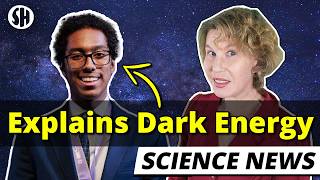
A 14-year-old Canadian just won a prize for a new theory of the universe which might explain dark energy. Well, that is interesting. Let’s see what his idea is and we can learn from this.
[00:13]
His name is Liam Desre and he won 5000 euros for his entry. I’ve had a look at what he submitted, and you know the scary thing is that this would totally check all the boxes for a typical journal submission in the field. Even if you listen to him speak in his video abstract,
[00:29]
he would pass as a researcher in the field. “I derived new solutions to the Friedmann equations and generated over three and a half million data points through Monte Carlo simulations, I then used a Bayesian inference technique to analyze my statistics.
[00:44]
My model shows that this model closely matches the predictions of Lambda CDM.” energy can’t be understood without citing the reviewer.
[00:56]
For starters, I find this remarkable because it used to be the case that you could tell outsiders right away the moment they opened their mouth, they just weren’t speaking in the right community
[01:09]
accent. But in the past years, more and more of the conversation of scientific communities has become publicly available. And then add AI on top of this and it’s become increasingly difficult to tell insiders from outsiders. The boundaries of academia are blurring in front of our eyes.
[01:25]
But back to the 14-year-old and his new theory for the universe. He is looking for a solution to one of the biggest open mysteries in physics, one that we have gotten so used to that nowadays we barely talk about it. Why is the expansion of the universe speeding up
[01:40]
at just that rate? Astrophysicists say that it is speeding up because of dark energy, alright. And there is some discussion about whether dark energy really is constant or not. But the more basic question is, why is it just this amount of dark energy. And I’ve
[01:56]
learned this the hard way through my tax advisor: unexplained amounts are bad. They raise questions. The curious thing is that the amount of dark energy seems to be related to the current size
[02:09]
of the universe, by which I mean the part of the visible universe that we can see. But why is this? Well, so Liam says, maybe it’s thermodynamics. You see, this argument is similar to Hawking’s argument for why black holes emit particles. In
[02:24]
quantum physics, particles can share a link called entanglement. If you have a pair of entangled particles you know something about both of them together, for example that their spin might add up to zero. But you don’t know what the individual spins are. The thing is that this
[02:39]
information in entanglement is only useful if you have both particles. If you have both, you know their spin adds up to zero. If you have only one, you don’t know what its spin is, end of story.
[02:51]
Now imagine you have a sort of boundary and one of the particles in the entangled pair vanishes behind it. Then you lose information, for good. And what happens if you lose information? You create entropy. And this entropy, Stephen Hawking showed, is itself made from particles which cause
[03:09]
gravity. Black holes now create such a boundary, at their horizon. This is why they emit radiation that is now called Hawking radiation. But the entire universe also has a boundary beyond which we can’t see. If you have particles created across that boundary, that creates entropy,
[03:25]
which creates gravity. And that, so the idea that Liam works on has it, is what dark energy is. The neat thing about this idea is that it naturally explains why dark energy is related
[03:37]
to the size of the universe. Because it comes from the boundary! The idea itself is not new and it’s not Liam’s. What he has done is instead to look at a variant of the idea in which the contribution
[03:49]
from thermodynamics grows increasingly important. Then he did some numerical analysis to show that this idea fits the data reasonably well and that it could alleviate the Hubble tension. He is very honest about what this method can and can’t do.
[04:04]
It introduces new parameters that tell you how fast the contribution from the boundary becomes important. That makes it easier to fit the data. If this was a standard research paper, I wouldn’t be talking about it. It’d get a
[04:17]
10 out of 10 on the bullshit meter. This is because all this talk about In the end it’s a model with more free parameters to fit the data and that’s that.
[04:29]
But it’s not a standard research paper and this is why I am telling you about this. I think it’s amazing that young people have an interest in the foundations of physics and that they care enough to learn the basics. I want to see more of it, but with more courage.
[04:45]
Do not repeat the mistakes of the past. The standards in this area of research are currently incredibly low. I count on the next generation to come up with better methods. Then again maybe there won’t be any next generation of physicists because
[04:59]
AI is doing it all. I wish this was a joke, but it no longer is. So you think you're good at maths? So did I but recently I've been trying Matiks which is a mobile
[05:12]
app for quick 1-minute mind sport duels against real people. That's how I found out that I think I haven't used my brain enough and now I have a way to train it while having fun. On Matiks,
[05:24]
you pick a format, get matched with someone at your rating and then it's a race against the clock. There are formats for math, memory, puzzles and classical challenges including Blitz, Mind Snap, Ken Ken and Math Maze. It's fast enough to play in a spare minute but because
[05:41]
it's against a real person, it's got a nice human and competitive angle. Matiks also has streaks, ratings, leagues, daily puzzles, and leaderboards so you can see how you're doing and compare scores
[05:54]
with others. You can also add friends, play together, or compete directly. I honestly enjoy these little games because I feel like I'm doing something good and useful for myself. Next time you catch yourself doom scrolling, give Matiks a go. The thinking sport with quick games for your
[06:11]
memory, math, speed, and focus. Check out the link in my description or the QR code. And if you're in the US, you can get 20% off the annual plan. Thanks for watching. See you tomorrow.