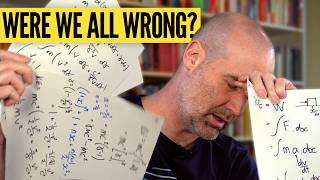

Kinetic Energy is NOT 1/2 mv²?
45sThe clickbait-style opening challenges a fundamental physics formula, immediately grabbing attention and sparking curiosity.
▶ Play Clip"The title promises a surprising twist, and the video delivers a solid physics lesson, though it's padded with jokes and a sponsor-like segment."
This video challenges the common physics formula for kinetic energy, 1/2 mv², by exploring its derivation and limitations under special relativity. The host demonstrates how the classical formula is an approximation that breaks down at speeds approaching the speed of light, introducing the relativistic correction factor gamma and the full equation E = γmc² - mc².
The video opens with a bold claim that kinetic energy does not equal 1/2 mv², setting up a discussion about its derivation and limitations.
The host derives 1/2 mv² from the work-energy theorem, integrating force over distance and using Newton's second law (F=ma) and definitions of acceleration and velocity.
The classical derivation ignores relativity. Momentum is actually p = γmv, and kinetic energy must be derived from the relativistic expression, leading to a more complex formula.
The relativistic correction factor gamma (γ = 1/√(1-v²/c²)) is introduced. The host uses a binomial expansion to approximate the square root, resulting in an infinite series of terms.
The final equation is E = γmc² - mc², which expands to 1/2 mv² + 3/8 mv⁴/c² + ... The classical term is just the first in an infinite series.
The fastest human-made object, the Parker Solar Probe, travels at 690,000 km/h (428,000 mph). Its relativistic kinetic energy correction is only about 0.00153% of the total, less than one part in a million.
A physicist from CERN explains that at the Large Hadron Collider, protons travel at 99.9999991% of the speed of light with gamma ≈ 7250. However, they don't calculate higher-order terms; they use experimental methods instead.
The classical formula 1/2 mv² is an excellent approximation for everyday speeds, but relativity adds tiny corrections that become significant only at extreme velocities. The video humorously concludes that the binomial expansion is a 'terrible approximation' for a square root, yet it reveals the deeper truth about the nature of kinetic energy.
Kinetic energy is not always 1/2 mv²
Challenges a fundamental physics assumption, immediately engaging the viewer.
Relativity changes the derivation
Shows that classical mechanics is an approximation of relativistic physics.
04:08The full equation is an infinite series
Reveals that the classical formula is just the first term in a series, providing a deeper understanding.
09:07Parker Solar Probe example
Provides a concrete, real-world context for when relativistic corrections matter.
11:11CERN uses experimental methods
Highlights the practical limitations of theoretical calculations in high-energy physics.
13:34[00:00] Okay, now, for the record, not clickbait. Kinetic energy does not equal a half mv squared. Sort of, in some situations.
[00:13] Anyway, look, it's been real busy around here in stand-up math world. Oh my goodness, like, we're doing videos of ridiculous scale. We're putting something on the moon for crying out loud. We're renovating the new studio, the newdio,
[00:27] which is what I had to make do here in this temporary studio, pseudo-rio, temporary space. And I came across this fun fact about kinetic energy, and how it's not a half mv squared.
[00:42] I thought, you know what? Quick, easy, fun video where I'll just show you, first of all, why we think it's a half mv squared, and I'll show you why it's not.
[00:57] Before we get into the derivation proper, we have to define some terms. Where is kinetic energy? Well, it's the amount of energy something's got because it's moving. That's why things hurt.
[01:09] It's throwing at you. For example, plasterboard. It's a hilarious joke. But yeah, something's not moving. No kinetic energy. You start it moving. You apply a force. You do some work.
[01:21] It starts moving. And that's, I mean, the technical physics definition is kind of just the total amount of work that's been done to an object. What's work? Perfectly good physics word that physicists have decided actually means if you keep track of the amount of force you're applying to something and the distance it's traveling as you do that.
[01:43] So actually, you know what, let's just start writing some stuff down here. So, the kinetic energy equals the total amount of work. And that equals, if we sum up all of that force over distance,
[01:57] that's going to be an integration of the force we're applying, dx. Now, okay, let me draw a little diagram here. So you've got a surface with some kind of object on it.
[02:10] We're applying our force to it, and it starts at position x. And then, so this is like a one-dimensional direction it can move in. as it goes along to a new location.
[02:22] In fact, dx is like that tiny little change in direction. So kinetic energy is just the integral of the force dot dx. Now, force, we know from Newton, is mass times acceleration.
[02:38] So that equals the integration of, now force becomes mass dot a, n times a, dot dx. Now, I know me putting those dots at the bottom It's going to make some of you mad.
[02:51] I think I'm pretty funny. Now, here's what we're going to do to rearrange this. Acceleration is just the rate of change of velocity. So in fact, that A equals dz dt.
[03:06] So I'm going to substitute dz dt for A, except I'm going to move the dt over to the side. So it equals mass times, instead of acceleration, dv dot,
[03:20] and now I'm going to have the dx over dt. And what is dx dt? Well, it's the rate of change of position. It's velocity. So that dx dt just becomes v.
[03:32] This whole thing equals integrating mass times velocity times dv. And now it's just a standard integration like what you might be having flashbacks to from when you were at school. What can we differentiate to get v?
[03:47] Well, it must have started v squared, since the second one we get v, and that two must have gone somewhere. So it equals a half mv squared. So this is also obvious why is it not the correct answer Well we gonna try try again but we going to do it with more attention to detail So we start basically the same
[04:08] way we were right from the beginning. Now, last time we just replaced F, the force, with mass times acceleration. And actually, F equals dp dt. And p
[04:20] is momentum. I mean, we're already using m for mass. It's not ideal. I get it. that mass under acceleration is just a way of saying it's the rate of change in momentum. Momentum P equals MV. That's momentum. Ah, that is it. It's only momentum at boring
[04:39] normal speeds. You know, anything way below the sphere of light. We've forgotten about relativity. Yes, if you're waiting for the big twist, it's that this is actually a video about relativity. That ridiculous physics theory where how big you are and
[04:56] how much mass you get changes based on how fast you're going. And that's why kinetic energy isn't a half mv squared. You've got to compensate for how fast you're going compared to the speed of light. Now I did a video previously that covered
[05:10] special relativity and I showed how you can work out this compensating factor. It's often called gamma. It's the square root of 1 minus your velocity squared by the that speed of light squared, I'll link to that video below, but now all I have to do is redo the
[05:25] entire working out in far more detail, factoring that in, and look I'll level with you, this is going to take a very long time, so I'm just going to skip through it here, if you do want to watch doing things properly Matt, work it out in excruciating accurate detail, the entire thing
[05:41] will be over on the second channel, so you can pop over there and watch it if you want, I'll link it from the end card at the end of this video. But all you need to know here and now is we put the gamma factor in. We crunched it through for a while. But because it's a square root,
[05:53] we've got to work that out somehow. And I use the binomial expansion, which gives us an infinite series of terms, the more of which you use, the more accurate your square root calculation is. And so I crunch the handle on that, and eventually, out the other side,
[06:07] arrives a proper equation for kinetic energy. Okay, you know what? I'm going to try and just break out a little bit to see what that d gamma mv is going to look like.
[06:19] Now, mass is a constant, so we can put the mass at the front. Okay, that all works. Now, a little bit of a detail in here, because you can see we've got gammas and v's and d gammas and d v's. We kind of want to be able to link all these together and simplify that down a little bit.
[06:33] So we get d gamma equals, so the half is just classic differentiation. So in fact, to simplify that down, it's just d on c squared outside of 1 minus v squared on c squared negative 3 on 2.
[06:49] Great. So it equals gamma cubed v over c squared dv. Okay, so now we have, we've got d gamma, and we've linked that to dv via gamma cubed v on c squared.
[07:06] So let's get page three, start joining this all together. And that's now the gamma. I'm going to multiply that b through, and the b is going to cancel with that one. Boom, out of here.
[07:18] So now it's c squared on gamma squared. Love it. All of that's going in there. It turns out the kinetic energy just equals the integral of mass.
[07:33] That's all cancelled. c squared d gamma. All we gotta do is integrate that. What are we integrating to or from?
[07:46] So, I mean, this is going to be a bit odd, but gamma doesn't start at zero. Gamma is a function of your velocity, and if velocity is zero, gamma is one. So we're integrating
[07:58] from gamma equals one up to some gamma it the total energy of the system Gamma nc squared minus the bit that just the bit you get for free
[08:12] E equals nc squared. It's just the energy of nearly being. That is the kinetic energy. It's got to work it out. Surely that's going to be easy. The problem now is we've got to deal with that gamma.
[08:25] It's getting in the way. And it contains a square root. So we're going to remove it using a fun side binomial fact. Gamma equals, well, we saw it before. It's 1 minus v squared on c squared to the 1 half.
[08:43] So what we're doing now is we're setting our x equals negative v squared on c squared, and our n equals 1 half. Oh, I forgot my negative.
[08:55] That's the negative 1 half up there. because it's gamma's in negative. Whoops, that's on me. So those negatives are going to cancel. Woo! Thought I had negative energy there for a second.
[09:07] Let's check the physics. If we put it in up there, minus 1, you can see the expansion starts with a 1. That's out of here. See, I'm going to multiply all the terms by mc squared.
[09:19] So the first one's a half m. The c squareds cancel out. v squared. We got it. It's exactly the same as before.
[09:33] Oh, it's so much more complicated. But before, we got to that and it stopped. We're like, oh, that's the end. Just a half mv squared, no more to say.
[09:45] Now we know, forget that, you know here, there's more to say. We've got to add on these infinitely many other terms. because now it's also plus 3 eighths V to the 4 on,
[10:04] well, C to the 4, C squared is going to cancel that, C squared plus more. So there it is. Kinetic energy is a half m V squared, same as before, plus plus 3 eighths m V to the 4 C squared
[10:20] plus another one. I'll put it on the screen, plus that, and then plus this one. As many as you want, because we're using the binomial expansion
[10:32] to represent a square root. But if you happen to do it that way, you swap it in to represent a square root, then out drops the classical one at the top.
[10:46] And that makes sense. That's the whole point. I mean, relativity didn't replace classical mechanical physics. We kept that. Special relativity just said, ah, if you're going real fast,
[10:59] there's these extra ones. But at slow speeds, like as we always knew, slow speeds, this works great. Just if you're going very, very fast, you've got to factor it.
[11:11] You're a little bit off at high speeds. Factor the other terms. And they're talking real high speeds. The fastest moving human-made object is the Parker Solar Probe. The spacecraft studying the sun, whipping around that sun.
[11:24] And is it perizillion? I think that's the fastest part of the orbit. Oh, it's trying to not melt. It's going by so fast. That's why they called it Parker. Because it's so quick.
[11:38] And at its absolute max velocity, It is going at 690,000 kilometers per hour. That's like a lot in miles per hour.
[11:52] A lot. I mean, over 428,000 miles per hour. And obviously, it's got a lot of regular kinetic energy, so much kinetic energy. But is that fast enough compared to the speed of light for the second term to kick in We round the numbers and there is a non second term In fact as a percentage of the total kinetic energy
[12:14] your relativistic kinetic energy comes in at around about 0.00153%. That's less than one part in a million.
[12:28] it's about one part and six and a half million but that's that's not zero I mean that's significant for some definition of significant I mean I imagine
[12:40] NASA probably don't have to factor it into their calculations but technically the fastest moving humanoid object has a noticeable noticeable amount of
[12:53] relativistic momentum this will be not enough and we have to actually care about it as it's racing past the sun. Other than that, I think there are some electron calculations
[13:07] where you might have to factor in some of the higher order terms, but that's pretty much it. I mean, maybe the people at CERN, I assume if you're working at CERN, you have to use loads of those higher order factors to get the precision of the relativistic moment.
[13:20] Oh, hang on, that's... Yes, everyone's back. I hear a phone call. Oh! Okay, Clara, hang on. Hey, this is my friend Clara. There you are. Clara works at CERN. Actually, Todd, why don't you introduce yourself to our viewers?
[13:34] Hi, yeah. My name is Clara, and I'm a classical physicist working on the ATLAS experiment here at CERN. The beams that we use at CERN, they are relativistic, highly relativistic. So the Large Hadron Collider, once it gets to top energy, it's traveling at 99.9999991% of the speed of light,
[13:55] which is about five miles an hour slower than beams of light. So the Large Hadron Collider, when it's at its top energy, we're using 6,800 GeV, so an EV is an electron volt,
[14:10] and the mass of the proton is 938 energy. And so when we do the calculation, we get 7,250 for our gamma, which is slightly bigger than one. So how many of the higher order terms do you need to use?
[14:25] So I have to be honest that we don't end up calculating them because there's so many higher order calculations that we'd have to do that to get the precision that we need, it would just take a very long time.
[14:43] So instead, we work out the kinetic energy through experimental methods. also with protons because they are not fundamental particles they have particles inside of them we don't know what the exact collision energy is for protons so we want to know what their energy
[14:59] is but it doesn't matter so much for the large hadron collider if we were colliding electrons and positrons their antimatter counterpart then we want to know this more precisely because then we want to know exactly the energy of the collision so we can work out what happened in the middle
[15:14] Anyway, Clara, always a pleasure to chat. Thank you so much for phoning in with a correction. You can wave goodbye to everyone over there. There you go. Yeah, cheers. So, it's a big lie, everyone. Turns out, I guess the moral of the story there is
[15:26] a binomial expansion is a terrible approximation to a square root. So that's it. That's the most quick, straightforward video. Thanks for watching. I hope I didn't clickbait you into just watching someone do integration.
[15:39] The whole video. You're still watching. And you've never watched one of my videos before. welcome aboard it's more of this if I'm being honest and is this clickbait I don't know momentum is
[15:51] a half mv squared that is still true but sometimes sometimes you need to create mv to the 4 on c squared but not often it turns out and if you do need it
[16:04] if you don't do it that way that's why that's why today we learn nothing bye




⚡ Saved you 0h 16m reading this? Transcribe any YouTube video for free — no signup needed.