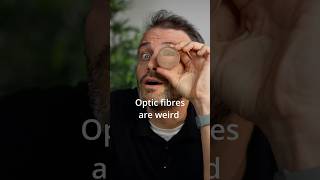

Why Does This Fiber Optic Bundle Do That?
45sThe strange visual effect of images jumping between surfaces sparks curiosity and invites viewers to learn the physics behind it.
▶ Play Clip"A clear, concise explanation that fully delivers on its promise."
This video explains the science behind optical tapers, a bundle of optic fibers that can magnify or shrink images. It draws a parallel to the naturally occurring mineral ulexite, also known as TV stone, to illustrate the principle. The explanation clarifies how the tapering of the fibers focuses light, enabling this fascinating optical effect.
An optical taper is a bundle of optic fibers that has been heated and stretched to create a thinner end, causing images to be magnified or shrunk.
Ulexite, also known as TV stone, is a naturally occurring mineral that forms tiny optical tubes, similar to a bundle of optic fibers.
Each fiber in the bundle acts as a pixel, and when the bundle is tapered, these pixels are compressed into a smaller area, focusing the image onto a smaller or larger surface.
The optical taper is a simple yet powerful tool that demonstrates how light can be manipulated, with applications ranging from natural minerals to advanced technology.
What is an optical taper?
An optical taper is a bundle of optic fibers that has been heated and stretched to be thinner at one end, causing images to be magnified or shrunk depending on orientation.
What is ulexite and why is it called TV stone?
Ulexite, also known as TV stone, is a naturally occurring mineral that forms tiny optical tubes, similar to a bundle of optic fibers.
00:28
How does an optical taper magnify or shrink an image?
Each fiber in the bundle acts as a pixel, and when the bundle is tapered, these pixels are compressed into a smaller area, focusing the image onto a smaller or larger surface.
00:41
Optical taper definition
Provides a clear, concise definition of the video's main subject.
Ulexite as natural example
Connects the technology to a natural phenomenon, making it more relatable.
00:28Mechanism of image transfer
Explains the core principle of how the taper works, which is the key takeaway.
00:41[00:04] называется оптическим конусом. Раньше это была часть более крупного стержня из оптических волокон, а часть более крупного стержня из оптических волокон, а кто-то нагрел его и растянул один конец, чтобы сделать его тоньше. Так почему же происходит такое странное поведение, когда текст
[00:20] такое странное поведение, когда текст и изображения перескакивают с одной поверхности на другую, либо увеличиваясь, либо уменьшаясь в зависимости от того, как вы их расположите ? Мне попался улексит, который является природным аналогом
[00:35] этого вещества. Это минерал, образующий множество крошечных оптических трубок, похожих на пучок оптических волокон. Иногда его называют "телевизионным камнем". То же самое происходит и камнем". То же самое происходит и здесь. Каждый пиксель оптоволокна на
[00:50] здесь. Каждый пиксель оптоволокна на этой поверхности соответствует пикселю на этой поверхности. Однако все они сужены, поэтому изображение фокусируется на smaller area, or vice versa when you flip it around.
⚡ Saved you 0h 01m reading this? Transcribe any YouTube video for free — no signup needed.