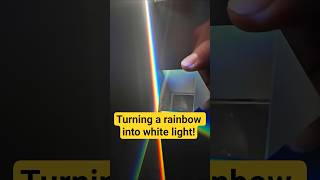

Can a Rainbow Be Turned Back into White Light?
44sThe hook is intriguing and challenges a common misconception, making viewers want to watch the experiment unfold.
▶ Play Clip"The title promises a specific experiment and the video delivers exactly that, with clear explanations and a satisfying result."
This video demonstrates a physics experiment to recombine a rainbow spectrum back into a single beam of white light using a convex lens and a second prism. The creator explains the optical principles behind the process, referencing Newton's work and the concept of wavefronts.
The creator aims to reverse the dispersion of white light into a rainbow, a challenge Newton did not achieve with a simple second prism.
Simply flipping a second prism does not recombine the spectrum; it only makes the rays parallel, resulting in a parallel rainbow beam, not white light.
A ray table is used to visualize the light path and how it changes when interacting with optical elements, helping to understand the refraction process.
Light slows down when entering glass, but the amount of slowing depends on wavelength: blue light (short wavelength) refracts more, red light (long wavelength) refracts less, causing dispersion.
The creator consults Newton's 'Optics' (1704) and finds that a convex lens can focus the parallel rainbow rays back to a single point, where they can be recombined.
A convex lens with a focal length of 75 mm is used, and the distance between the lens and the rainbow is set to 150 mm (twice the focal length) to achieve a focused point.
Placing the second prism at the focal point straightens each wavelength by the same amount as the first prism, causing all colors to overlap and produce white light.
This experiment, known as the 'experimentum crucis', disproved the prevailing belief that white light is pure, proving it is composed of all colors of the rainbow.
The video successfully demonstrates that white light can be recreated from a rainbow by using a convex lens to converge the spectrum and a second prism to align the wavelengths, confirming Newton's theory that white light is a mixture of all colors.
Why does a second prism alone not recombine a rainbow into white light?
It only makes the rays parallel, resulting in a parallel rainbow beam, not white light.
00:13
What is the relationship between wavelength and refraction?
Blue light (short wavelength) refracts more, while red light (long wavelength) refracts less.
00:54
What optical element is used to focus the parallel rainbow rays to a point?
A convex lens.
01:39
What is the focal length of the lens used in the experiment?
75 mm.
01:39
What is the distance between the lens and the rainbow to achieve a focused point?
150 mm (twice the focal length).
01:52
What is the 'experimentum crucis'?
An experiment that disproved the belief that white light is pure, proving it is composed of all colors.
02:20
Wavelength-Dependent Refraction
Explains the core principle behind dispersion, essential for understanding the experiment.
00:54Using a Convex Lens
Shows a practical solution to a classic optical problem, demonstrating problem-solving skills.
01:39Experimentum Crucis
Highlights the historical significance of the experiment in proving the composite nature of white light.
02:20[00:01] это снова объединить в белый свет? Ньютону удавалось создавать радуги с помощью призм, но я хочу посмотреть, смогу ли я сделать наоборот и превратить радугу в луч белого
[00:13] света. Можно подумать, что я мог бы просто взять вторую призму, перевернуть её в другую сторону и поместить перед радугой, и это превратило бы радугу обратно в луч белого света, но это не работает. Вот почему мне нужна
[00:25] таблица лучей. По сути, это вертикальный луч света. Таким образом, вы можете наблюдать за траекторией света и за тем, как она изменяется при взаимодействии с различными оптическими элементами. Вот что на самом деле происходит, когда вы помещаете перевернутую призму сразу
[00:41] после первой призмы. Это не работает. Причина, по которой вам нужна не просто вторая призма, заключается в том, как преломляется свет при переходе из воздуха в стекло. Больше всего мне нравится рассматривать это с точки зрения волновых фронтов. Таким образом, свет
[00:54] это меняет его направление. Но, что крайне важно, величина замедления света зависит от длины волны света. Таким образом, синий свет с короткой длиной волны преломляется сильнее, а красный свет с большей длиной волны — слабее.
[01:10] Таким образом, белый свет рассеивается, образуя спектр. Перевернутая призма будет преломлять все эти различные длины волн света на нужную величину, так что в итоге они окажутся параллельными друг другу, выходя из призмы. Другими словами, в
[01:25] итоге мы получаем параллельный радужный луч вместо луча белого света. Как нам это решить? Думаю, ответ кроется в этой книге, «Оптика Ньютона», кроется в этой книге, «Оптика Ньютона», изданной в 1704 году. Посмотрите, на странице 156,
[01:39] вот она, выпуклая линза. В итоге я выбрал вот этот. Это действительно здорово. выбрал вот этот. Это действительно здорово. Фокусное расстояние составляет 75 мм, но я хочу, чтобы объект и изображение находились на одинаковом расстоянии от объектива, а это значит, что мне
[01:52] нужно удвоить это расстояние, то есть расстояние между объективами должно составлять 150 мм. И вот, смотрите, с другой стороны, радуга теперь снова сфокусирована в одной точке. Именно туда мы снова сфокусирована в одной точке. Именно туда мы помещаем вторую призму, которая распрямляет каждую
[02:07] длину волны света ровно на ту же величину, на которую первая призма изначально распрямила свет . Таким образом, выходя из второй призмы, мы видим все разные цвета, движущиеся в одном направлении и наложенные друг на
[02:20] друга. Вот и всё . Мы снова получили луч белого света . Мы снова получили луч белого света . The experimentum crucis. Объединив весь спектр в белый свет, он опроверг господствующее мнение о том, что
[02:36] белый свет от солнца является чистым. И, конечно же, как мы теперь знаем, white light is made up of all the colors of the rainbow.
⚡ Saved you 0h 02m reading this? Transcribe any YouTube video for free — no signup needed.