
I Lied About Understanding Gyroscopes
45sThe creator admits to faking understanding, creating relatable vulnerability and curiosity about the real explanation.
▶ Play Clip"Title promises a gyroscopic precession explanation and delivers a clear, hands-on demo."
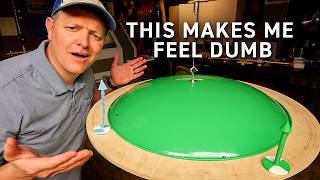
Destin from Smarter Every Day explores gyroscopic precession using a custom-built spinning disc model. He demonstrates that when a force is applied to a spinning object, the resulting motion occurs 90 degrees later in the direction of spin, not at the point of force.
Destin admits he previously pretended to understand gyroscopic precession but now aims to truly understand it with a hands-on experiment.
A disc is suspended by four wires with a bearing, allowing it to spin freely. Cameras capture motion from multiple angles.
Pushing down on a non-spinning disc causes it to tip directly at the point of force, as expected.
A 'spin-o-matic 3000' tool spins the disc to high angular momentum using a silicone paint stirrer.
When the spinning disc is pushed down, the motion occurs 90 degrees later in the direction of spin, illustrating gyroscopic precession.
Gyroscopic precession causes a spinning object to respond to a force 90 degrees later in the direction of spin, a key concept for understanding disc flight.
What happens when you push down on a non-spinning disc suspended by wires?
It tips directly at the point of force.
02:41
What happens when you push down on a spinning disc?
The motion occurs 90 degrees later in the direction of spin.
04:18
What is gyroscopic precession?
The phenomenon where a spinning object responds to a force 90 degrees later in the direction of spin.
04:52
Honest Confession
Destin admits he faked understanding gyroscopic precession, making the quest relatable.
Stressful Decoupling
The tension of decoupling the spin tool adds humor and realness to the experiment.
03:58Precession Revealed
The moment the spinning disc moves 90 degrees away from the force is visually striking and clarifies the concept.
04:18[00:00] It's finally time for the flying saucer video. No, I'm joking. So, welcome to Smarter Every Day. This is a YouTube channel that I, my name is Destin, I make little experiments sometimes to
[00:13] try to understand things. And there's a thing that I want to understand that if I'm honest, I have pretended to understand it in the past, but I don't think I really did. And that thing is gyroscopic procession. Okay. I know how gyroscopic procession works. If you touch a
[00:30] thing on one direction, it happens 90 degrees out of phase if it's spinning. And there's been a lot of explanations on the internet and most of them involve a bicycle wheel. I've got friends that have made videos about this. You can see professors use a bicycle wheel to explain gyroscopic
[00:45] procession. I've even made a video using a bicycle wheel with my friend Carl trying to explain gyroscopic precession. But what I explained is what happens, not why it happens. And I think a
[00:58] lot of videos, mine included, kind of assume a lot of prior knowledge and they jump from like zero to 10. But what I need is a baby step towards understanding about gyroscopic precession. So this video today is for me. I'm trying to understand this and I'm happy that you're here
[01:14] because I have a crazy setup in the garage and I going to show it to you now Okay So first of all This is the garage and I have cameras everywhere Okay I just show you the cameras I got a camera here Is it on Are you on camera Yep that camera on
[01:29] I've got a camera there. I've got a camera there. I've got a camera here. I've got a camera down there on the floor and I've got one way over here, okay? So what you'll notice is I've got an arrow in the floor
[01:42] and that represents the direction that this model of a disc is going to fly. If I were a big person and I could throw a frisbee or a disc like this, this is how the disc would fly.
[01:58] And the reason we're making this video is because I'm doing a series on how disc golf discs fly and I want to understand it. And I came up against this problem where gyroscopic procession is involved, hard to even say, and I realized I didn't understand it. And so I built this model
[02:13] and then I realized this video needs to be its own video because I haven't seen an explanation like this on the internet. Okay. So first of all, let's look at this disc. If I have just a disc suspended from these four wires that you can see, one, two, three, four, I've got a bearing here so
[02:29] things can spin. But what would happen if I just take my finger and I push down on this disc right here. So this camera is 90 degrees here. I'm throwing it that way. What happens if I push
[02:41] down on this Ready One two three Okay It just tips No big deal right No big deal So now let look at gyroscopic precession Let look at what happens when the disc is spinning
[02:53] and I put a force there. Okay. Let's do that. And the way we're going to put the spinitude in this is I have 3D printed that thing and I have the disc, uh, spin-o-matic 3000 here.
[03:07] And what I'm going to do is I'm going to put that little silicone paint stirrer. That's my last of three because I broke the other two. We're going to put that in there and we're going to slowly add spin to this. Another way to say this is we're going to increase angular momentum,
[03:22] but we're not going to use the physics words here. We're just going to spin things. Okay. So spinning this thing up and I've learned that if it's bent like that, then I can go faster once it straightens out. All right. Caught up to me,
[03:38] catching up to, all right, there it goes, all right, all right, one of the hardest parts is to decouple, oh, okay, hold on, okay, we have decoupled, that's very stressful, I've broken
[03:58] two of those so far, okay, so, we now have a spinning disc with a lot of angular momentum, them Okay let do the same thing as before except this time we going to push down with air right here okay So is it going to do the same thing it did last time
[04:18] Let's watch. I've got a 90 degree angle here. Watch what happens. Three, two, one. It does not. It does not do the same thing. If you were watching, I pushed down here with the air and that side over there went down.
[04:37] So 90 degrees after the applied force, it went down.
[04:52] And you'll notice it's doing this wobbling thing now. Okay, so the more experienced of you out there will note that this is actually gyroscopic precession. And yes, you're right. And that's a function of how I have my device set up here.
[05:07] But I think it's neat that we applied a force here and it saw something happen 90%



⚡ Saved you 0h 05m reading this? Transcribe any YouTube video for free — no signup needed.