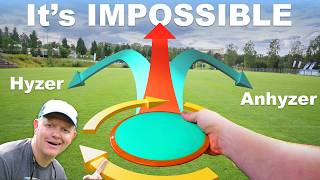

Why Every Disc Golf Throw Curves
45sThe hook immediately addresses a common observation in disc golf, sparking curiosity about the physics behind the curve.
▶ Play Clip"The title promises to explain disc curve physics, and the video delivers with pro insights and expert analysis."
This video explores the physics of disc golf disc flight, particularly why discs curve. Host Destin interviews professional players and a professor to explain the aerodynamics and terminology behind disc movement.
Every disc golf throw curves, even short ones. The video aims to explain why.
The video will explore disc flight through professional players, tech-integrated discs, and a professor's dissertation.
A right-hand backhand throw produces clockwise spin (viewed from above), causing the disc to fade left. Left-hand backhand produces counterclockwise spin and fades right.
Overstable discs fade left (RHBH), stable discs fly straight, understable discs turn right. These terms describe a disc's tendency to turn or fade.
Hyzer is an angle where the disc tilts downward (fades left for RHBH), anhyzer tilts upward (turns right). Flat is neutral.
An overstable disc thrown on an anhyzer can create an S-curve: it turns right initially, then fades left as it slows.
The X-step involves crossing the back foot behind the front to generate power from the ground up, increasing velocity and spin.
Disc flight is governed by spin direction, disc stability (overstable/stable/understable), and release angle (hyzer/anhyzer). Mastering these elements allows players to shape shots creatively.
What is the spin direction for a right-hand backhand throw?
Clockwise when viewed from above.
08:13
Define overstable, stable, and understable for a disc.
Overstable: fades left (RHBH); Stable: flies straight; Understable: turns right (RHBH).
15:34
What is a hyzer angle?
A hyzer is when the disc is tilted downward, causing it to fade left for a RHBH throw.
16:23
What is an anhyzer angle?
An anhyzer is when the disc is tilted upward, causing it to turn right for a RHBH throw.
16:23
How can an S-curve be achieved?
Throw an overstable disc on an anhyzer angle; it turns right initially then fades left as it slows.
17:59
What is the purpose of the X-step?
To generate power from the ground up by crossing the back foot behind the front and planting the front foot.
21:56
Eagle's Perfect Shot
Eagle throws a perfect shot onto the island green, showcasing elite skill.
05:54Simon Played Sparkman Park
Simon reveals he played Destin's home course, creating a fun, relatable moment.
06:36Putter Thrown 450 Feet
Simon throws a putter 450 feet, demonstrating incredible arm speed and control.
10:12[00:00] Hey, it's me, Destin. Welcome back to Smarter Every Day. This is my favorite disc golf course in the entire world, and I have a physics question for you today. Let's go figure it out. Every time you throw a disc golf disc, it curves. Every time. There's a curve. It curves.
[00:19] Do you see that curve? Even a short throw like this. Let's see if I can hit this. Okay, it was subtle, but that disc curved on the way to the basket. Today we're going to understand why.
[00:32] It's a thing I've been wanting to figure out for a long time, but it's very, very complicated. And we're going to explore this three ways. The first thing we're going to do is we're going to go talk to some professionals in Finland. The Disc Golf World Championship happened in Finland for the first time.
[00:46] We're going to go meet these pros and ask them what's going on with this curvy thing, okay? The second thing we're going to do is we're going to meet some tech guys that integrated some technology into a disc. and it helps us understand the vocabulary and the dynamics and kinematics of how the throw happens.
[01:02] And once we understand all that, we're going to go meet the professor. Dr. Johnny Potts did his PhD dissertation on the aerodynamics of disk flight, and he's going to put it all together for us.
[01:15] So if you watch this video, you and I are going to learn together the aerodynamics of a disk in flight and why that curve happens. This is going to be awesome. Let's go get smarter every day.
[01:30] Now, in the last video when we talked about disc golf, we talked to Brad and Chad. These guys own a company called MDP Disc Sports. They manufacture disc golf discs right here in America, which is really fun.
[01:45] So we went and learned how they do this with robotics, and it's an amazing thing. But we also learned about how they care about the geometry and the balance of these discs and all this stuff. It's amazing, right? So, MVP has sponsored this video.
[01:59] I want to be very clear about that. Usually when a company sponsors a video like this, there's a code or a URL or something, go buy this thing. Brad and Chad did not want that for this video. They just want people to love disc golf.
[02:11] And the thought is, because they're nerds, if you nerd out with the physics of throwing a disc, you're going to enjoy disc golf as well, and the whole community is going to rise. And I thought that was really cool. So big thanks to MVP for sponsoring this video.
[02:25] So to start our journey of understanding of disc golf physics, let's go to Finland. Now, when I got off the plane, I was greeted by an old friend, Yussi from Camera Store, who later tagged me up with Yuho from Camera Store.
[02:37] These are buddies of mine from Finland from a previous episode, if you've seen that. The reason we're in Finland is for the first time ever, the Professional Disc Golf Association World Championships is being held outside of the United States.
[02:50] It's being held in Finland. Fins absolutely love disc golf. So the day before competition, I went to the course, and I met up with two of MVP's sponsored athletes. The first is Simon Lazat, an absolute legend in the world of disc golf.
[03:06] And the second one was Eagle McMahon, who has an incredibly strong drive right now. He's on top of his game. These are two guys that were practicing the course the day before, and they let me jump in with them.
[03:18] This is the most tight they've fallen the whole course, actually. Is it really? It's an infamous island roll. Fair four, you gotta lay one up between the stakes and then shoot over across out of bounds to like a little island. But it's pretty small, so if you miss it you have to keep re-throwing and get in at least
[03:33] a great shot by missing. So this first one is all by just putting yourself in position. And try to throw like a big right to left swing to the fairway down there. Sweet. Little too wide.
[03:50] Oh, that's going to be okay. Yeah, right there. Not bad. Okay. You're doing the same eagle? Yeah, I'm going out to the right and just trying to get it just past that gravel path.
[04:03] Got it. That's better. Gotcha.
[04:16] All right, so you set up over here. Exactly. So everything inside these white stakes is considered inbound. And the fairway goes all the way up to here. So if you wanted to, you could lay up another shot to there to make the island shot shorter.
[04:30] And now you're just faced with a decision to make if you want to go for it and try to stick it on that little half-circle island green. Anything outside of the hay or long over the path is out of bounds.
[04:44] So if you go OB then you come back to this spot? Well I get to advance to the OB line and then I have to try again from there until I hit. So yeah this hole obviously is wide open so wind comes into play more than another hole.
[04:56] So this one's all about angle control and distance control. I'm going to throw it pretty high and try to like spike it down into the green so it doesn't skip or anything or roll. It just sticks right there.
[05:09] That's a bit too high, too left. So you made it? No, that's out of bounds by like a foot. Are you serious?
[05:21] Yeah. So, I would basically... I'm going to come watch Eagle.
[05:39] Set. Set. Set. Holy cow, dude. That's perfect. What the heck, man? I put you one in the third game. What the heck, dude?
[05:54] That's an easy birdie right there for him. I get like a double bogey Everyone who plays disc golf loves a specific course Normally their home course So what you about to see is a total freakout moment for me because my favorite course is Sparkman Park in Hartzell Alabama
[06:12] It's great. So just watch this exchange. And if you play disc golf and you have an affection for a certain course, you're going to know what I'm feeling here. Have you ever played disc golf? Have I ever played disc golf?
[06:24] No. Oh, you don't know about Hartzell, Alabama, dude. I don't. Sparkman Park? You've never heard of Sparkman Park in Hartfield, Alabama? No, it's international. No, I can't believe you guys are. I played it. I played a tournament out there. Did you really? Yeah.
[06:36] In Hartfield? Yeah, I won the Monster in 2020. My girlfriend's from Huntsville. She's not a man of debt? No way! Yeah, I've spent plenty of time in Huntsville. Dude. Bronsbury. Bronsbury, Huntsville, and then Hartfield's the...
[06:49] Yeah. Oh, you don't... Oh, yeah. So it's the two put together? Yep. Mm-hmm. That's the Monster. I haven't played like the typical course at Hartle. I've just played the tournament way I've gone there. Gosh, man. So, I mean, I know you're kind of new to disc golf,
[07:03] but you don't know how big of a deal that is. I'm joking, man. I know. No, it's great. If someone played my own course, I get excited. Okay, you're okay. Simon Eagle, I apologize for epic levels of cringe.
[07:15] I apologize to myself because I'm not going to forget that. And also, I do owe you an apology. I took the wrong micro SD cards on this trip. So the audio is pretty rough. I apologize for that in the video. Anyway, sorry for the cringe. Here we go.
[07:34] That's ideal. I'll come back left. Little skip. That's gonna be right about 10 meters. So it went left and right and then left. Yeah, this is a bit under stable.
[07:46] So that's when it has a tendency on the right hand back and throw to turn to the right. but naturally with clockwise spin, everybody just wants to fall left when it slows down. So we're going to assume something called a right-hand backhand throw
[08:00] when we're looking at the physics, okay? This is my right hand. It's the dominant hand I use to throw a disc. So a right-handed backhand throw is like this, okay? And when you do that, if you were to look from the top down of bird's eye views,
[08:13] you would see that the disc is rotating. We're flying that way. The disc is rotating clockwise, okay? If you were to throw it with your left hand backhand, the disc would be rotating counterclockwise when viewed from the top.
[08:25] So everything we're going to do, we're going to assume a right-handed backhand throw, because that allows us to talk about the physics. Everything works for left hand, it's just backwards. Okay, let's go learn.
[08:38] What you just saw Simon do, he threw a backhand shot, which has a clockwise spin, and the disc is going to go out and naturally want to fade to the left. To throw a forehand, you're going to put a counterclockwise spin
[08:52] And it's going to want to fade to the right So the best players in our sport are very proficient in both forehand and backhand Because you're able to shape different shots depending on what the fairway needs
[09:07] Playing into the hillside generally is a little bit better coming in on a forehand angle So that counterclockwise spin is going to help it stick better in the hill Meaning it's going to die when it hits. It's going to die when it hits.
[09:19] Exactly. Perfect shot. Nice.
[09:31] Now I'm going to try throwing a backhand with a putter, which a putter is a slower disc that won't go as far, but it has more drag in the air, so it's going to want to fall quicker and sit softer.
[09:47] I like that.
[10:00] You just shot a putter 459 feet? It helps because you have elevation on your side. He has the top, pretty fastest arms in the world, so... Does he really? I'd say so.
[10:12] You just threw a putter 450 feet? I mean, that's what 18 years of playing gets you. How old are you? You're like 19. I'm 27.
[10:24] That's crazy. Yeah, I started playing when I was 9 years old. So what we're going to do now is we're going to learn the vocabulary that they use. And the interesting thing about these words is they were born out of this utilitarian need to have a word for the thing that happens when you do this with a disc.
[10:39] So what we're going to do is we're going to go talk to them, ask questions, and we're going to learn the vocabulary of professional disc golf players. So what I want to know, Simon, is how you think about the angle that you throw at
[10:51] and the power and the spin and all that. Like right now, if we were going for that cone that's way down there that I can barely even see and you wanted to lay it up right in that, I know that as you throw a disc it goes and at some point it turns and it turns a different way.
[11:06] How does all that work? Alright, so as professionals we try to figure out what is the most repeatable way to get to our target. And there's something that we call a one angle shot.
[11:18] It's where the disc actually only flies on one angle. And the most natural angle for a backhand throw is this right to left kind of diving hyzer, what we call it. Where a disc goes up and then falls down to the left.
[11:31] The most repeatable thing is to throw a hyzer with an overstable disc. disc because the room for error is very big because you can be slightly off angle and miss your shot a bit but the result will be almost the exact same what does overstable mean overstable
[11:48] is the disc's tendency to basically dive to to the ground depending on which way it's spinning so for a backhand throw for right-handed it's spinning clockwise which means it wants to fall
[12:00] left and for forehand it counterclockwise and it wants to fall right so overstable like if i throw it kind of goes it falls towards my belly button Correct Okay yeah and so basically just with
[12:12] reading the wind direction and from experience how your disc flies, you basically visualize a line where you want the disc to go and then you just throw it up on the one angle on the high user
[12:24] and it should just consistently dive to the same slot. Can you show me what that looks like? Yeah, absolutely. Very easy. So, I'm just going to show you three examples. First, I'm going to show you what I would throw in a tournament as my most consistent shot,
[12:38] which is, like I said, a back-end hyzer shot, where I will kind of aim about 30 feet right of the cone, maybe 40 feet, throw the disc about 40 feet high, and have it dive left. What angle are you going to throw the disc at this way?
[12:52] So, you're having to think about this angle, this way, and this angle, right? Yeah, I mean, I've been doing this my entire life. I really don't try to think about it. I kind of just do it. Okay, just do it. Just do it. Watch.
[13:04] I kind of pick a spot in the sky, and then you kind of want to line up your run-up and your body to that spot, and then just match the angle with your hand and arm. So, and so you're going to try to have it die on the line of the cone.
[13:17] Correct. Okay. So, here we go. Very high. Yeah, a bit higher than I wanted, but you can see it's diving right on the cone. Dude, you almost hit the cone, dude.
[13:29] So what I just learned is that if you're trying to get on a line right here, you want to hit over here and have it bounce over. So you're planning all that. Correct. Okay. Yeah, I'm going to show you a different shot now. This is actually a putter, which is as straight as a disc can fly.
[13:45] Just the way the profile works, it doesn't have much tendency to dive in either direction. So this is more like a Frisbee. I'm going to try to throw just right straight at it in a straight line. We call it the easiest try on disc golfing.
[13:57] No, that's just a joke. It's the hardest try on disc golf. Throw it dead straight. Technically, this is just throw it dead straight. You can see very little fade left at the end,
[14:11] but, I mean, compared to the driver, it just basically just wants to go straight and get dived on it. So why did the putter stay so much straighter compared to the driver? That is a great question. You just know it does. That's just what it does.
[14:23] Okay, show me more. Show me more. Okay, and now I'm going to do the exact opposite of what I did. This would be a very technical throw, which this is a very understable putter. The reason I know it's understable is because you can see kind of this nose of the disc is all the way bent down,
[14:38] and the parting line between the two molds, which is the bottom and the top, meets very low on the profile. That makes it understable? This makes this disc really want to go left to right. So understable means it goes behind you.
[14:51] Like if I'm throwing, it doesn't go where my belly button goes, it goes back. That's understable. Understable means the disc has a tendency to turn over, and if it turns too much, it'll actually hit the ground and start rolling. So you're going to throw the same shot, and we're going to watch it fade left.
[15:05] Right, I'm going to aim about 30 feet left of the cone, and the disc will naturally just drift left to right. Okay. Wow. A little short, but Lionel's good.
[15:21] That's a good shot. Okay, so that's understable and overstable. Correct. That's amazing. And the second one we consider stable. Stable means straight. Overstable means right to left. Understable, left to right. So the first throw was overstable.
[15:34] Yes. The second throw was stable. Yes. And the third throw was understable. Correct. Dude, I played disc golf as an amateur for a really, really long time, and I know that was simple for you. That was very good.
[15:47] I'm glad. Okay, now, right hand, back hand, we have overstable, we have stable, and we have understable. Now let's go to the next level deeper with eagle,
[15:59] who's going to teach us a couple of more words. Eagle. So I just learned about understable, stable, and overstable. Okay. I guess I should say it backwards. It's overstable, stable, understable.
[16:11] So what I want to know is how does, so there's two angles that you throw. Like which one is, there's a word for this. What's this and what's this? So this is a hyzer.
[16:23] Okay. That's a hyzer. This is flat. Flat. And this is an anhyzer. Anhyzer. So hyzer is like if I'm throwing it, I want to fall into the ground. Yes, exactly.
[16:35] A good way to picture it is think of a hula hoop around you. If you want to throw a hyzer shot, you're going to tip forward. The front of the hula hoop is going to go down, and the back is going to go up. So hula hoop hyzer.
[16:47] So hula hoop hits the ground on the hyzer. Yes, exactly. So you lean forward, and then on an anhyzer, you're going to be leaning slightly back. So that's how the hula hoop is going to go up, and the back part is going to go down.
[17:02] So I'll use these two stabilizers which are they the same disc? They're virtually the same disc. So you'll be able to see how they function. Okay. So what are you trying to do now?
[17:15] So let's throw a hyzer first. With this disc I'm going to throw it out to the right on a hyzer. And since this is already a fairly overstable disc, it's going to want to fall to the ground and hyzer pretty quickly.
[17:31] Okay. Got it. Okay, and now I'm going to throw the stabilizer on a slight anhyzer,
[17:47] and with this being a slightly more overstable disc, it has, it's going to want to gradually spike back to a hyzer.
[17:59] So we're going to get an S out of this? Potentially. Okay. Potentially. It depends how you want me to throw it. I could throw it a little bit It depends on how much anhyzer I put on the disc Give me an S So you going to use anhyzer and overstability to create an S in the throw
[18:17] Yeah. Okay, yeah, show me that. I'll show you just my ability. So you saw a little bit of that S curve? Yeah, I did. Interesting.
[18:30] It's easier to throw an S curve with a more overstable disc because you're able to what we call force over on the disc. And with an overstable disc, as it gets through its flight,
[18:44] it's going to want to gradually start panning out and then fighting back into a hyzer with the natural stability of the disc. Why would you do that? Like, why would you want to do that? Because it depends where you're at on the course.
[18:57] Think of hundreds of trees in front of you where the fair way, You have to start it out left and bring the shot from left to right and get as close to the basket as you can.
[19:10] There becomes a whole lot of creativity where you see the basket. You're like, okay, how am I going to get there? Am I going to throw a hyzer that's going to gradually flip up with an understable disc and push forward?
[19:24] or am I going to want to take a flex shot where I force an overstable disc on an anhyzer that's going to gradually pan out and fade. And a lot of it depends on the ground.
[19:38] Is it going to skip? Is it on a hill? Is there water in front or behind the basket? So a lot of it comes down to is actual decision-making in the moment where you're at.
[19:51] And we've played practice rounds at these courses. but it's really hard to know exactly where we're going to be until we're in that position and you've got to do it. Yeah. Okay, already, with the tendency of certain discs to be stable or understable,
[20:07] and then combine that with the ability to throw hyzer or anhyzer, you now have the ability to morph how that disc will fly down the fairway. So we're getting a lot of tools in our toolbox
[20:19] that we can use at any point on a disc golf course, right? We're going to talk to Simon and Eagle again, but we're about to meet a new player on MVP's team, Jeremy Killing, known throughout the sport as Big Germ. He's got a really strong forearm, and he's a great communicator about the sport.
[20:34] Show me how a forehand works. All right, well, so everything that I ever did as far as athletically, if I was throwing something, was using this notion. So when I found the sport of disc golf, I didn't know what this was,
[20:47] so I developed my entire game early on around just learning how to do this. You're bringing the disc back, and then you're using your wrist and your elbow coming through your hips to create this little fulcrum,
[21:00] and you're going wham, and you're trying to put basically as much spin as you can. My forehand, my spin rate stays pretty consistent, whether I'm throwing a short shot or a long shot.
[21:13] The thing that really is changing is how much pressure am I putting in with my legs when I'm planting. Really? And how fast my elbow comes through my hips. So you're, yeah, I guess that's right, because all of the force has to come from the ground.
[21:25] It starts from the ground, it goes all the way up from there. Really. So did they teach you the X-step? No, what's an X-step? The X-step is something that we teach people playing disc golf. When you learn the mechanics of the throw itself, you're usually teaching people early on the mechanics just from a standstill.
[21:43] But once they get the basics of the throw down, and you want to teach someone how to throw a little bit farther, you keep in the X steps which is getting your body from this forward position where you can see your target
[21:56] to getting your body into this perpendicular position where this your back foot crosses over your front foot and simultaneously before this foot even lands
[22:08] you're moving this foot forward into a plant position and now your body and your hips are turned to your target so you're able to reach back use your legs to push into the throw, and that's how you get your entire body from your ankles to your
[22:22] knees, your hips, your shoulders, your elbows, everything into the throw, as opposed to just your arm and your upper body throwing the disc. So it's all coming from that back leg. It's all starting from the ground up, but you're getting velocity by doing the exercise.
[22:34] You're getting, yeah, you're not only getting velocity, you're getting speed, but you're also getting this twisting propelling, like almost like you're squeezing, you're twisting this rubber band, and then you let loose, and this rubber band uncoiled, and it creates
[22:47] all this power. Can you show me? Sure. So we have a relatively short soccer field here, so I'll just grab a putter and give you an idea here.
[22:59] We'll try to go somewhere near that cone, and I'll go in slow motion, so that's kind of the idea of the step, is that I want to keep my body in a straight line. If I start going out here and back here, then I'm losing whatever I was trying to get into that throw.
[23:14] Oh, momentum. So you're trying to get linear momentum. We try to go from slow to fast. Okay? Right? So we've got a stable base. I've got the cone lined up. Now, I'm going to move a little bit to the left because if I want to throw to that cone,
[23:28] I'm going to have to aim a little bit right of the cone because the disc is naturally, for a right-hand, back-hand throw, going to fade towards the left because it's overstable. because all discs have a little overstability in them. It's just the amount of the overstability varies from disc to disc, okay?
[23:43] And sometimes if a disc is really understable, and if I do want it to go left, I can make it go left by putting more down angle on it, okay? But for this shot, I want to basically aim towards that right cone that you see in the background,
[23:55] and the disc will just naturally finish to the left, okay? All right, so we'll do our run up here. Wow.
[24:09] Yeah, and so you were far more linear than I do. And I just played...

⚡ Saved you 0h 24m reading this? Transcribe any YouTube video for free — no signup needed.