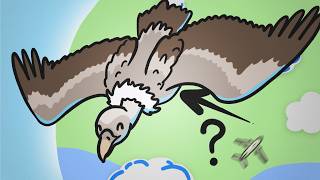

Plane Hits Bird at 11,000m!
45sShocking real-life fact about a bird strike at cruising altitude grabs viewer attention immediately.
▶ Play Clip"The title is accurate and delivers on its promise: the video thoroughly explains the science behind avian flight altitude limits, concluding with the likely highest-flying bird."
This video explores the biological and aerodynamic limits that determine the maximum altitude a bird can achieve. By analyzing oxygen availability, heat retention, and lift generation, the presenter combines theoretical calculations with observed data to estimate the highest-flying bird species.
In 1973, an airliner struck a Ruples Griffin vulture at over 11,000 meters, far above typical bird flight altitudes.
A bird's maximum altitude is constrained by its ability to stay aloft as air pressure decreases and its ability to survive as temperature and oxygen levels drop.
Oxygen efficiency and heat retention are key; larger birds generally have higher 'popsicle points' (hypothermia threshold), with the wandering albatross potentially surviving up to 17,000 meters.
Less dense air at higher altitudes reduces lift; smaller birds tend to have higher lift limits, with the sand martin potentially gliding at nearly 19,000 meters.
Birds must balance survival (popsicle point) and lift (lift limit); geese like the bar-headed goose show high potential, matching observed migrations over 7,000 meters.
The white stork theoretically could fly up to about 10,500 meters based on its popsicle point and lift limit.
The Ruples Griffin vulture, known to exceed 11,000 meters, does so by riding thermals (rising warm air), surpassing its calculated lift limit of ~8,200 meters.
With optimal thermals, the Ruples Griffin might reach its popsicle point of 15,000 meters, making it the bird capable of the highest flight.
While theoretical calculations suggest that birds like the white stork could reach up to 10,500 meters, real-world observations show that the Ruples Griffin vulture, aided by strong thermals, is likely the highest-flying bird, potentially reaching 15,000 meters. Birds don't always fly as high as they physically can, but the combination of biology and aerodynamics explains their altitude limits.
What are the two main factors that limit how high a bird can fly?
1. Its ability to stay aloft as air pressure decreases (lift limit). 2. Its ability to survive as temperature and oxygen levels decrease (popsicle point).
0:52
At what altitude did the airliner strike a Rüppell's Griffon vulture in 1973?
Over 11,000 meters.
Which bird has the highest predicted 'popsicle point' (hypothermia threshold) according to the video?
The wandering albatross, potentially up to 17,000 meters.
2:06
What is the lift limit of the sand martin?
It should be able to glide at nearly 19,000 meters.
3:38
How does the Rüppell's Griffon manage to exceed its calculated lift limit of ~8,200 meters?
It rides thermals (warm columns of rising air) that provide additional lift.
5:22
What is the theoretical maximum altitude for the white stork based on the video's calculations?
About 10,500 meters.
4:50
Which bird was observed migrating over the Himalayas at altitudes over 7,000 meters?
The bar-headed goose.
4:38
Historical Collision at 11,000 m
It sets up the central question and shows real-world evidence of birds flying extremely high.
Wandering Albatross Survival Potential
Demonstrates how large birds can survive at extreme altitudes due to oxygen efficiency and insulation.
2:06Geese as High-Flyers
Confirms theoretical predictions match real observations, especially for the bar-headed goose.
4:21Thermal Riding Enables Higher Flight
Explains how Rüppell's Griffon exceeds theoretical limits, highlighting the role of environment.
5:22Rüppell's Griffon as Likely Highest Flyer
Provides the video's final conclusion backed by both math and real-world data.
5:40[00:00] In 1973, an airliner struck a bird
[00:03] called a Ruples Griffin vulture, which
[00:05] on its own isn't that weird. Planes hit
[00:07] birds pretty regularly during takeoffs
[00:09] and landings. But this collision
[00:11] happened at a cruising height of over
[00:13] 11,000 m. That's way above the height at
[00:16] which most birds fly, which it makes me
[00:19] wonder, what is the highest a bird can
[00:21] actually fly. Hi, I'm Cameron and this
[00:24] is Minute Earth. Birds don't tend to fly
[00:26] higher than they absolutely need to for
[00:28] the same reason you don't sprint when
[00:30] you could walk. It's difficult and
[00:32] tiring. So, we can't necessarily get the
[00:35] answer to this question through
[00:36] observation. I mean, I guess we could
[00:38] drop a bunch of birds out of airplanes
[00:40] and see what happens, but our AdSense
[00:42] revenue definitely isn't going to cover
[00:43] that. Plus, we're not monsters. So,
[00:46] let's use our understanding of
[00:47] aerodynamics, scaling laws, and biology
[00:50] to science our way to an approximate
[00:52] answer. There are two things that limit
[00:54] how high a bird can fly. Its ability to
[00:57] stay aloft as the air pressure
[00:58] decreases. And on a much more basic
[01:01] level, its ability to stay alive as the
[01:03] temperature and amount of oxygen
[01:05] decreases. So, first, let's figure out
[01:07] which bird could survive at the highest
[01:09] altitude. Oxygen supplies birds the
[01:12] energy they need to stay warm, but at
[01:13] higher altitudes, there's less oxygen
[01:15] available and the temperature is much
[01:16] colder. So, a bird's ability to survive
[01:19] high up in the air depends on how
[01:20] efficiently they use oxygen and how well
[01:22] they can retain body heat. This paper
[01:24] measured the oxygen use of a handful of
[01:26] birds and found that very generally
[01:28] their overall oxygen use increases with
[01:30] mass. We can then adjust according to
[01:33] other traits like how much energy their
[01:35] flight muscles require and how much
[01:36] insulation their feathers provide. From
[01:38] all of this, we can calculate the
[01:40] altitude at which each bird should
[01:42] suffer from hypothermia. Let's call this
[01:44] their popsicle point. If we then compile
[01:46] a data set of flying birds and plug
[01:48] their data into these equations, we can
[01:50] see a general pattern emerge. Larger
[01:52] birds can theoretically survive at
[01:54] higher altitudes than smaller birds.
[01:56] There are exceptions, of course. This is
[01:58] biology after all, but our calculations
[02:00] suggest that there are a bunch of birds
[02:02] that could potentially survive above
[02:04] 10,000 m. And the largest bird in our
[02:06] data set, the wandering albatross, might
[02:09] be able to survive as high as 17,000 m.
[02:12] But remember, we also need to figure out
[02:13] if any of these birds could actually
[02:15] stay aloft at such high altitudes.
[02:17] Because the air is less dense the higher
[02:19] you go, less air is available at higher
[02:21] altitudes to push upward against a
[02:23] bird's wings and create that lift. A
[02:25] bird's ability to stay a loft high in
[02:27] the air depends on its weight, size of
[02:28] its wings, and the shape and angle of
[02:30] attack of its wings. That's a factor
[02:32] called the lift coefficient. Combining
[02:34] all of that tells us how much lift a
[02:36] bird's wings should generate in still
[02:38] air at a given altitude. Simple enough
[02:40] at first. Uh, but while weights and
[02:42] wingspans and whatnot are easy enough to
[02:44] measure, the wing shapes and angles
[02:45] aren't because a bird's wing shape
[02:47] changes as it flies. I'll save you the
[02:49] long explanation of my rationale here
[02:51] and just say that this is about where I
[02:53] go out on a bit of a limb. The lift
[02:54] coefficient for the birds in our data
[02:56] set peaks at about 1.5 or so, and that's
[02:58] when they're taking off or about to
[03:00] stall. In other words, when the bird is
[03:02] trying hardest to generate lift. And
[03:05] since staying aloft is likely a struggle
[03:06] at a bird's maximum altitude, this is
[03:08] probably a pretty good estimate of the
[03:10] lift coefficient at this point. From
[03:11] there, we can find the lowest air
[03:13] pressure at which each bird could
[03:14] generate sufficient lift to keep its
[03:16] mass aloft. And then use our friend, the
[03:18] barometric equation to convert those
[03:19] numbers to altitudes to estimate the
[03:21] highest point each bird in our data set
[03:24] should be able to actually maintain
[03:26] flight. Let's call this their lift
[03:27] limit. In general, the smaller birds
[03:30] have the highest lift limits. The
[03:32] hulking mute swan would struggle to
[03:33] generate lift at a mere 3,800 meters,
[03:36] while the puny sand martin should be
[03:38] able to glide at nearly 19,000 m. Of
[03:41] course, air moves and it's not uniformly
[03:43] dense at given altitudes, so there's
[03:45] definitely some wiggle room here, which
[03:47] will be a surprise tool that's going to
[03:49] help us later. But in any case, a bird
[03:51] with a higher lift limit should be able
[03:53] to fly higher than a bird with a lower
[03:55] one. Now, let's combine our lift limit
[03:57] data with our popsicle point data. We
[03:59] can see that lots of birds like the
[04:01] missile thrush can theoretically fly
[04:02] super high but would freeze long before
[04:05] they got there. And then there are a
[04:07] bunch of other birds like the wandering
[04:08] albatross that could likely survive at
[04:11] super high altitudes but wouldn't be
[04:13] able to actually maintain flight up
[04:14] there. That leaves us with a small
[04:16] cluster of birds with relatively high
[04:18] popsicle points and high lift limits.
[04:21] Mathematically, these should be the
[04:22] highest flying birds. And for the most
[04:24] part, they're geese. The grey lag goose,
[04:27] the bean goose, the Canada goose, and
[04:28] the barheaded goose should be able to
[04:30] fly as high as 8,000 meters or so,
[04:32] according to our calculations. And this
[04:34] matches up pretty well with what
[04:36] scientists have actually observed. Like
[04:38] during its migration over the highest
[04:39] mountain range on the planet, the
[04:41] bar-headed goose can reach altitudes of
[04:43] over 7,000 m. And then there's the white
[04:46] str, which based on its popsicle point
[04:48] and lift limit, is our predicted highest
[04:50] flying bird. It could potentially fly up
[04:53] to about 10,500 m. In reality, it
[04:57] doesn't fly anywhere near that high. But
[04:59] remember, birds don't necessarily fly as
[05:01] high as they might be physically capable
[05:03] of. But wait, what about the Ruples
[05:05] Griffin? A bird we know for a fact can
[05:08] fly higher than 11,000 m. Our math
[05:12] suggests that it is lift limited a lot
[05:14] lower than that, about 8,200 m. But this
[05:17] is where theoretical calculations fall
[05:19] short without some additional real world
[05:20] knowledge. See, the Ruples Griffin likes
[05:22] to soar on thermals, warm columns of
[05:25] rising air that can help birds exceed
[05:27] their mathematical lift limit, sometimes
[05:29] even thousands of extra meters up into
[05:31] the air. Other birds are also known to
[05:33] ride thermals, but none of the other
[05:35] high popsicle point birds ride such
[05:37] supercharged thermals. So, the Ruples
[05:39] Griffin is likely the bird capable of
[05:41] the highest flight. With the right
[05:42] thermal, it might even reach its very
[05:45] generous popsicle point of 15,000
[05:47] meters. Turns out that bird might have
[05:49] had a lot of climbing left to do.
[05:55] You might have noticed that this video
[05:57] is chalk full of all sorts of
[05:59] calculations that I basically ripped my
[06:01] hair out trying to make sure I got
[06:02] right. It would have been great if I had
[06:04] a brilliant tutor sitting next to me
[06:06] guiding my learning. Wait, there is a
[06:08] brilliant tutor. If you regularly watch
[06:10] our videos, you're probably aware of the
[06:13] awesome interactive learning platform
[06:14] that is Brilliant. Now, Brilliance
[06:16] lessons are guided by a super
[06:18] intelligent personal tutor for math and
[06:20] coding. You can now learn hard subjects
[06:22] with one-on-one feedback whenever you
[06:25] want to fill the gaps and build your
[06:27] confidence. Click the link below or scan
[06:29] the QR code to get started with
[06:31] Brilliance Tutor for free. You can
[06:32] upgrade to premium to unlock all
[06:34] courses. And Minuteear's viewers can
[06:36] save an additional 20% off an annual
[06:39] subscription at brilliant.org/mminar.
[06:42] Thanks Brilliant.



⚡ Saved you 0h 06m reading this? Transcribe any YouTube video for free — no signup needed.