
Forests are more than trees
45sChallenges common assumption by revealing trees aren't the heaviest part, sparking curiosity.
▶ Play Clip"The title is accurate and intriguing—it delivers exactly what it promises with a surprising, well-supported answer."
The video explores the surprising answer to what the heaviest part of a forest is, revealing that soil outweighs trees by a significant margin. It breaks down the weights of various forest components, from trees and animals to air and water, and highlights the ecological importance of soil.
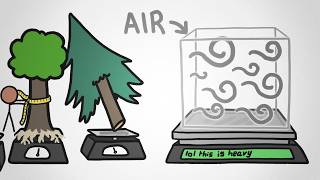
Foresters estimate tree weight by measuring trunk diameter at a standardized height. In a 100x100m temperate forest, trees weigh about 400 tons.
All animals (squirrels, birds, bugs, bunnies) in the forest weigh only about half a ton.
The detritus layer (leaves, poop) is a few centimeters deep and weighs about 20 tons, playing a key role in nutrient cycling.
Air up to the treetops weighs 350 tons, almost as much as the trees themselves.
After a rainstorm, water soaked into the topsoil can weigh up to 3,500 tons.
The top 1 meter of soil weighs about 11,000 tons, making it the heaviest part of the forest—almost 30 times heavier than the trees.
Dr. John Van Stan runs an NSF-funded project to measure how rainwater washes nutrients through trees into soil, collaborating with INCAR, University of Utah, and Utah State.
What is the heaviest part of a temperate forest?
Soil
02:32
How much do the trees in a 100x100 meter temperate forest weigh?
About 400 tons
00:32
How much does the top 1 meter of soil weigh in a 100x100 meter forest patch?
About 11,000 tons
02:32
How much can the water in the topsoil weigh after a rainstorm?
About 3,500 tons
02:04
How much does the air up to the treetops weigh in the same forest patch?
About 350 tons
01:24
Soil outweighs trees by 30x
This is the central surprising fact that reframes how we think about forest mass.
02:32Air is nearly as heavy as trees
Highlights the often-overlooked mass of gases in an ecosystem.
01:24Measuring trees by trunk diameter
Explains a practical method used by foresters to estimate tree weight.
00:32Soil's role in water and nutrient cycling
Connects the weight finding to broader ecological functions.
02:48[00:05] trying to figure out how to weigh a forest, but they weren't particularly because, as it turns [music] out, forests are much more than trees, and trees aren't even the heaviest or even the second heaviest part of a forest.
[00:19] Hi, I'm Cameron, and this is Minute Earth. Of course, the trees are the most visible part of a forest, and foresters have cut down, measured, and weighed pretty good idea of how much a tree weighs just by measuring the diameter of
[00:32] its trunk at a standardized height. And if we did that for all of the trees in, say, a 100 by 100 m section of a typical temperate forest, we'd find that they weigh about 400 tons in total. Then there's the animals, all the squirrels,
[00:45] birds, bugs, and bunnies that live on or even munch on our forest trees. If we collected and weighed them, they would weigh on average only about half a ton. detritus, [music] like leaves and poop that accumulates on the forest floor,
[00:59] and in that temperate forest, this layer is hugely important because of its role in cycling nutrients, [music] but it's only a few centimeters deep on average, and so the litter layer ends up weighing only about 20 tons. So, that's less than
[01:12] the trees, but it's a lot heavier than the animals, which by comparison seem light as air. Wait a minute, air has mass, and it is the source of all of the carbon that ultimately becomes trees, animals, and detritus, so let's weigh it
[01:24] too while we're here. If we count just the air up to the tops of the trees, it the air up to the tops of the trees, it weighs 350 tons, almost as much as the trees themselves. So, never mind nothing about being light as air. If we are
[01:36] animals breathe, we should also count the water they drink, because you can't have a forest without water. Surface water and water being held in the soil ecosystem, cuz without it, they die. Because trees are really good at
[01:50] their stems and trunks into the soil below them, as well as how tree roots create cavities in soil, forest soil is so much better at absorbing water than >> To the point where most of a forest's water is not even in the streams or
[02:04] ponds, but it's in the soil. The water soaked into the topsoil can weigh as much as 3,500 tons after a rainstorm. But even then, water isn't the heaviest part of a forest either. In a temperate forest, the top 1 m of soil is where the
[02:19] most active tree roots are anchored. And it's where the bulk of a forest's decaying material and nutrients are. And it's where all of the fungi hang out help [music] plants access those nutrients. A cubic meter of this soil
[02:32] weighs around 1.1 tons. So, the 10,000 cubic meters in our 100 by 100 m patch weigh right around 11,000 [music] tons, making the soil the heaviest thing in our forest. It's almost 30 times heavier than the trees. And this brings
[02:48] wanted to weigh the forest. They were meteorologists who were interested in they were most interested in the far more fascinating and important, well, to a meteorologist anyway, water absorbing soil right beneath their feet.
[03:08] the National Science Foundation and friend of the channel Dr. John Van Stan, a luxuriously bearded professor in the Department of Biological, Geological, and Environmental Sciences at Cleveland State University. Remember how I said
[03:21] that trees help funnel water into the soil? Well, it also turns out that the of other stuff. And as water flows downward, it carries lots of vital nutrients from the tree canopy into the soil. Professor Van Stan is currently
[03:34] running an NSF-funded Macrosystems project to measure and map all of the specific ways rainwater washes nutrients through trees and into soils in order to better understand all of the ecological roles that this tree tea fills. [music]
[03:48] It's a big job, so he's working in collaboration with INCAR, the University of Utah, and Utah State with field support from Battelle and the National Ecological Observatory Network. Thanks, John, and thanks, NSF.



⚡ Saved you 0h 04m reading this? Transcribe any YouTube video for free — no signup needed.