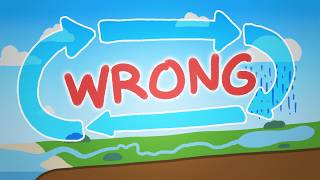

The Water Cycle Diagram Is Wrong
42sChallenges a common school-taught concept, surprising viewers.
▶ Play Clip"Delivers on the promise — clearly explains how the water cycle diagram is misleading and provides valuable insights into groundwater."
The video challenges the accuracy of the typical water cycle diagram, highlighting how it misleadingly emphasizes surface water while downplaying the critical roles of groundwater and ice. It explains that most fresh water is locked in glaciers or stored underground in aquifers, where movement can take millennia. The video also warns of the fragility of groundwater resources due to human extraction.
The standard water cycle diagram overemphasizes surface water (clouds, rivers, lakes) and underrepresents groundwater and ice.
Surface water accounts for only about 2% of Earth's fresh water; 70% is in glaciers and ice caps.
Nearly all fresh water not in ice is underground, stored in aquifers.
Water soaks into the ground and moves slowly through porous rock, taking years to reach the ocean.
Some water seeps into deep rock and may take 10,000 years or more to reach the ocean; some becomes trapped in minerals.
Deep aquifers can be dragged by tectonic plates; water locked in minerals may be released as steam during volcanic eruptions millions of years later.
Humans pump groundwater for use, which is not shown on the diagram. This extraction can drain aquifers that take decades or longer to replenish.
The video promotes the book 'Hydrarology and its Discontents' for a deeper philosophical and scientific look at water management.
The water cycle diagram is a simplification that neglects the vast, slow-moving groundwater system. Understanding groundwater's fragility is crucial because overuse or contamination can have long-lasting effects.
What percentage of Earth's fresh water is found in surface water (lakes, rivers, etc.)?
About 2%.
00:28
Where is the majority (70%) of Earth's fresh water stored?
In glaciers and ice caps.
00:42
How long can a drop of groundwater take to travel through an aquifer to the ocean?
It can take years, thousands of years, or even 10,000 years or more.
01:20
What happens to water that seeps into deep cracks and pores of rocks and becomes trapped?
It can be locked into minerals and later released as steam during volcanic eruptions when the tectonic plate is recycled.
01:46
What is the main human impact on groundwater shown in the video?
Humans pump groundwater for use, which can drain aquifers that take decades or longer to replenish.
02:11
Surface Water is a Tiny Fraction
Reveals that the ocean's water cycle diagram drastically overrepresents surface water.
00:28Groundwater Moves Like a Sponge
Illustrates the slow, sponge-like movement of groundwater through permeable rock.
01:06Water Can Be Locked in Minerals
Explains that water can become chemically bound in rocks and only released by volcanoes.
01:34Groundwater is Fragile
Emphasizes the vulnerability of groundwater to depletion and contamination.
02:24[00:01] million in an effort to bring clean drinking water to millions of people teamwater.org. In school, you probably learned about the water cycle with a diagram that looked a lot like this one. The problem
[00:14] is it's wrong. Or at the very least, it's pretty misleading. Hi, I'm Cameron and this is Minute Earth. So, let's check this diagram out. Look at all the stuff going on up here. Which seems to suggest that most of the fresh water on
[00:28] our planet cycles from clouds and lakes to rivers to ultimately back to the at any given time only accounts for about 2% of Earth's fresh water. Basically a rounding error. The majority of our fresh water, about 70% of it, is
[00:42] locked away in glaciers and ice caps. All that water is represented here by this teeny tiny part of the diagram. But that's not even my bone to pick here. It's down here where according to the picture, not that much is happening. But
[00:54] in reality, the second largest portion of our fresh water, almost all of what isn't locked up in ice is underground. You see, a small amount of surface water escapes the Cloud Lake River loop and makes its way underground. And it soaks
[01:06] kind of like water in a sponge, moving downward until it hits a layer of less permeable rock. And over time, this water flows slowly toward the ocean, like really slowly. It might take a drop of water years to get there. And a
[01:20] layer will take a different path. It can seep into a lower layer deeper and trickle of water that ends up here might filter through the deep cracks and pores of rocks for the next 10,000 years, meandering toward the ocean. And even
[01:34] then, some of that deep water can seep even deeper into the Earth's crust. Some of these bodies of water, called aquafers, are so deep that they can get dragged along with the Earth's tectonic plates or even partially dragged
[01:46] underneath the ocean floor. Or the water in them creeps so slowly through such dense rock that heat and pressure lock it into minerals until the tectonic plate carrying it is recycled through a volcano, which means that the crust rock
[01:58] is melted and the aquifer turns to steam. And wow, this is taking forever to animate. But in real life, this volcano bit happens millions of years in the future. And at least these days, there's also one more way for water to
[02:11] make it out of Earth's aquifers, one that doesn't appear on this diagram at all. Typically, us. We humans have become really good at pumping water out of the ground for our own use. This is why making sure we understand this part
[02:24] of the diagram. You know, what actually happens down here and how long it takes is so important. Because although the underground supply of fresh water is huge, it's also fragile. And once an aquafer is drained, it can take decades
[02:38] or longer to replenish. And once an aquifer is contaminated, it may never be clean again. This video could not have been made without help from our great the department of biological, geological, and environmental sciences
[02:53] at Cleveland State University in Ohio. He's got a book out written with his co-author Jack Simmons called Hydrarology and its discontents. It's part water science, part philosophy, and all nerding out about the paradoxes of
[03:05] dealing with and managing the single most important life-giving resource on our planet. Seriously, if you are looking for a deep and thoughtprovoking dive into our complicated, fraught, and fascinating relationship with water,
[03:17] this book is for you. In fact, we have a discount code just for our audience that through Springer Nature in the next month. As always, thanks, John.



⚡ Saved you 0h 03m reading this? Transcribe any YouTube video for free — no signup needed.