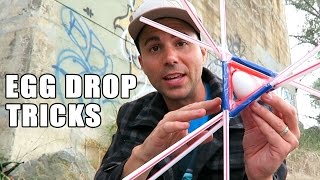

Egg Drop Physics: The Science of Not Cracking
47sThe clear, visual explanation of potential and kinetic energy with the broom analogy makes complex physics accessible and engaging.
▶ Play Clip"Delivers exactly what the title promises—five simple egg drop methods with clear physics explanations. Slight padding in the intro and outro, but overall solid content."
This video revisits the classic high school physics egg drop competition, presenting five simple contraptions that protect an egg from cracking upon impact. The host explains the underlying physics of energy absorption and impact force diffusion, then tests each design to demonstrate their effectiveness.
The host's favorite high school class was physics, which inspired this revisit of the egg drop competition. The goal is to find simple ways to protect an egg from cracking when dropped.
Different competitions have different rules—some ban materials like popcorn or shoes, others reward the smallest or lightest contraption. This video offers five options to cover various scenarios.
The first method involves placing the egg in a ball of cushioning material (e.g., popcorn, bubble wrap). It's simple and effective, similar to how shipping companies pack fragile items.
The egg starts with potential energy (height) which converts to kinetic energy (speed) as it falls. Upon impact, this energy must be dissipated to avoid breaking the egg.
Reduce the energy spike by slowing descent (e.g., parachute) or spread the impact force over time (e.g., cushioning). Both keep the energy below the egg's binding energy threshold.
A simple parachute made from a trash bag, string, and tape significantly reduces impact speed, making it a highly effective addition to any contraption.
Longer impact duration spreads the force, preventing spikes that exceed the egg's strength. Examples include car airbags, long jump sand pits, and parkour rolls.
A triangular pyramid of straws directs impact forces away from the egg. The straws break to absorb energy, protecting the egg. This design survived about 20 drops before breaking.
Inspired by NASA's Mars rovers, this uses inflated balloons around the egg to extend impact time and increase cross-sectional area, acting as its own parachute.
A creative method using a toy drone to gently lower the egg, bypassing impact entirely. It's allowed in most competitions since you don't touch the egg after release.
Using helium balloons to achieve near-neutral buoyancy, the egg floats down slowly. This is lightweight (a few ounces) and ideal for competitions favoring light contraptions.
The best method depends on competition rules: airbags for small size, helium for light weight, and any method for durability. The key is to have fun and learn.
The video emphasizes that understanding the physics of energy and impact force is key to designing effective egg drop contraptions. With five tested methods, viewers can choose based on their competition's specific constraints, but the ultimate goal is to learn and enjoy the process.
Energy Conversion
Explains the core physics concept of potential to kinetic energy conversion, foundational for understanding the egg drop.
01:39Two Protection Strategies
Provides a clear framework for designing any impact protection: reduce speed or spread force.
02:36Impact Force Diffusion
Connects the egg drop to real-world examples like airbags and parkour, making the physics intuitive.
03:16Mars Rover Inspiration
Shows how NASA's engineering solutions can be adapted for a simple classroom project.
06:05Choosing the Best Method
Emphasizes that the optimal solution depends on competition constraints, teaching adaptability.
08:59[00:00] So my favorite class in high school was physics. It opened my eyes to the fact that we can understand and predict so much of the everyday world around us using math and equations.
[00:13] So today I want to revisit the classic high school physics egg drop competition, where you have to throw some sort of contraption around an egg to make sure it doesn't crack when it hits the ground. Originally I wanted to do a bunch of research and testing to find the single best way to win the competition every time.
[00:27] But what I found out was that each competition sort of has different rules. In some, you're not allowed to use popcorn or pair of shoes, and in others, you win if your contraption is the smallest or the lightest, or both. So I'm going to show you five super easy options, and then we'll talk about why each one works.
[00:41] Go crack some eggs.
[00:54] Okay, so let's start with the popcorn ball. The basic principle is that you put your egg in the middle of a box that contains some kind of cushioning material, such as bubble wrap, or packing peanuts, or popcorn. Personally, I think this one is the most boring, but it worked, and that's why every shipping company ever ships this way.
[01:13] I'm using a ball here because it's more weight efficient than a box, where you have unnecessary cushioning in the corners, plus the stretchiness of the ball will help absorb some of the energy.
[01:26] The moment of truth. And we have an intact egg. And before I say the other four ideas, let's talk about the science behind landing with an uncracked egg.
[01:39] So at the start of your drop, your egg is up high, and it's stationary, so it has potential energy, which is the energy associated with height. So these red blocks represent the potential energy. And the higher I go, the more blocks of energy I start.
[01:53] And then as the egg falls, that potential energy is converted to kinetic energy, which is the energy of speed. So you start up high, and every single block is over here as potential energy. But as you start to fall and fall faster and faster, every single block comes over here as kinetic energy, or speed.
[02:10] And now your egg is about to impact the ground and has all this energy in the form of speed that's got to go somewhere. Now this broom represents the standing energy that holds an egg cell together and makes it hard. So the way to think about this is when your egg hits the ground if you introduce more energy than the binding energy of the molecule pulling the hard egg cells together at any point you going to break at that point So the question then becomes what do we need to keep our blocks below the broom
[02:36] Because simply put, below the broom, your egg is safe. Anything above the broom and your egg is busted. Well there's two things we can do. The first is that we can make this pile of green blocks not as tall. This is why no matter what your contraption is to protect the egg, if your rules allow it,
[02:50] you should make a parachute. The bigger the better. This does not have to be fancy, this is like old school army guy style. Cut up a trash bag, a little bit of string, a little bit of tape. Just looking at this you can see the difference the parachute can make.
[03:03] The second thing you can do is not to remove any green blocks by reducing your speed, but to spread them out. So if we say left to right is our time axis, the more we can stretch out this impact event, the more we can lower that high energy spike.
[03:16] And this is a cool way to think about any two objects impacted. The longer the duration of the impact, the more you can spread out that force so success doesn't break. So for example, this is the point of car airbags.
[03:28] Instead of your hand hitting the steering wheel and stopping near instantaneously, it stretches out the impact force over time so you don't get a quick spike that exceeds the broom line four years of school. This is exactly why long jumpers prefer to land in sand and not on asphalt, and why parkour
[03:42] runners will always roll after a big jump. It's all about diffusing the force over a longer period of time. So what does that mean for our egg contraptions? It's really just something to keep in mind because it can make it more intuitive, for example, to see why putting your egg in the middle of a jar of peanut butter,
[03:56] which is a popular and not a very good idea, isn't as good as putting your egg in the middle of a popcorn ball. Okay, back to the bridge.
[04:12] A lot of people like to build contraptions out of straws, and in some competitions that's all you have to work with. How you configure your straws depends a little bit on how thick they are. The good folks at Wendy's have fairly thick straws, which means I didn't have to use quite as many.
[04:25] So my idea was to take six, like, three inch long straws and build a regular triangular pyramid, and then put the egg in the middle. And then I took two of the wendy's straws and joined them together to sort of make a mega straw.
[04:38] And I used this white tape to help prevent it from buckling. And then I made six of those mega straws pointing directly at the egg When it impacts the ground the force goes up the stiffest path through the straw
[05:05] I saw a ton of examples online where the straw was actually pointed at the egg, which would create a puncture load. In our case, we have this pyramid, so all the loads pass next to the egg, and you don't get that primary impact. 3, 2, 1
[05:26] So your motive, you've got a couple of broken pieces, but that's okay because it took energy to make those breaks. And that serves to protect the shell of the egg when you're eating that energy. So, success!
[05:38] Okay, so our egg finally broke, but it took about 20 tries, and you can see there's a
[05:51] lot of busted straws here. All in all, it was pretty resilient. Yeah!
[06:05] So this one is a throwback to my Napa roof. In 2004, the M.E.R. rovers landed on Mars using giant airbags. And even though Mars has one third the gravity of Earth, I figured it would still work.
[06:17] I started by cushioning the egg in four little balloons that I barely filled up. And then I blew up bigger balloons, and then just tied it all together with some string and tape. And then if there's any gaps in coverage, you can just tape a balloon directly to the string you just tied around.
[06:37] In addition to the balloons extending the impact time, this design benefits from a large cross-sectional area relative to its weight. So in a sense, it becomes its own parachute. Of course, if you were able to allow it, you could still throw an additional parachute on it anyway.
[06:53] That's shocking for us. Appreciate it.
[07:07] In 2012 we landed another rover on Mars called Curiosity, but this one was too big to use airbags so we had to have a power consent pretty much like a jetpack So I wanted to pay tribute to Curiosity since I got to work on it for 7 years and at first I was thinking like model rockets But without gyroscopes and control algorithms things could get pretty unsafe pretty quickly
[07:27] So I thought of this idea where I use balloons that could deflate and then they would provide upward thrust like before landing, but... No
[07:46] And as ridiculous as this might seem, it's actually not a violation for most rules because you're not touching it once you've released it. The fact is, most competitions are using rules that were written before you could go on Amazon
[07:59] and buy a toy drone for less than $50. Is that good?
[08:16] I'd save this one for last since I've never seen anyone do it and it's probably my favorite in terms of its simplicity. So you want to buy a few more balloons than you need and then just pop them until you get to the point where you're just under neutrally blinded.
[08:35] You can see at the bottom I've just got this little protector of the egg. You don't have to get fancy but I use those little animal balloons and it makes them look pretty good. This one weighs in at a couple ounces, so it is a strong option if your competition favors lighter contraptions.
[08:59] So which one is the best? Again, it sort of depends on the rules of your competition. In some cases, being small is to see the most slings. So I'm thinking an air wolf all the way. If being light weighs the most important, then go with the helium uphouse method.
[09:12] And if your hub just doesn't survive, then you can pick any one of these. But the most important part is to have fun and experiment and learn something, and then to dominate yourself into it. Yeah, you guys are great.
[09:24] No, that's alright, that's alright. And now you're on YouTube! Thanks for watching. If you learned something, or if you didn't learn something, or if you're a mammal, then you can subscribe.
[09:39] Is your blood warm? You got a horse in your heart? Welcome aboard.


⚡ Saved you 0h 09m reading this? Transcribe any YouTube video for free — no signup needed.