AI Summary
This video explains how submarines navigate underwater without GPS, using a combination of inertial navigation systems and sonar. It details the principles behind fiber optic gyroscopes and accelerometers, which work together to track a submarine's position.
Chapters
GPS relies on radio waves that are easily absorbed by seawater, so an antenna must be above the surface to work. Even a few centimeters below the surface, GPS fails.
Submarines can use sonar to map the seafloor and compare it to historical maps for navigation, but this is noisy and compromises stealth.
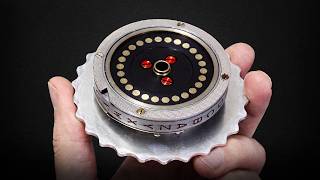
This device sends two beams of light in opposite directions. When the submarine rotates, the distance each beam travels changes, causing a phase mismatch that indicates rotation.
A common accelerometer design uses a tiny weight attached to a thin beam of crystalline quartz. The weight's inertia under acceleration changes the beam's tension, altering its vibration frequency.
The computer calculates acceleration from the frequency changes and integrates it to determine velocity and position, tracking how far the submarine has moved.
Submarines navigate by combining inertial sensors—gyroscopes for orientation and accelerometers for movement—to maintain accurate positioning without external signals, preserving stealth.
Study Flashcards (4)
Why does GPS not work underwater?
easy
Click to reveal answer
Why does GPS not work underwater?
GPS uses radio waves that are easily absorbed by seawater, so an antenna must be above the surface to work.
00:02
What is the main drawback of using sonar for navigation?
medium
Click to reveal answer
What is the main drawback of using sonar for navigation?
Sonar is loud and compromises stealth, which is undesirable for a submarine trying to stay hidden.
00:28
How does a fiber optic gyroscope detect rotation?
medium
Click to reveal answer
How does a fiber optic gyroscope detect rotation?
It sends two beams of light in opposite directions; rotation changes the distance each beam travels, causing a phase mismatch that indicates rotation.
00:28
What is the role of the accelerometer in submarine navigation?
hard
Click to reveal answer
What is the role of the accelerometer in submarine navigation?
It measures acceleration by detecting changes in vibration frequency of a quartz beam, allowing the computer to calculate position and distance moved.
00:54
💡 Key Takeaways
GPS fails underwater
Explains a fundamental limitation of GPS that is often overlooked, setting the stage for alternative navigation methods.
00:02Fiber optic gyroscope principle
Demonstrates a clever use of light interference to measure rotation, a key technique in inertial navigation.
00:28Accelerometer using quartz vibration
Shows how a simple physical principle (guitar string analogy) is applied to measure acceleration precisely.
00:54Full Transcript
[00:02] surface they can just stick out an antenna above the water to use GPS, but if the antenna is even a couple of centimeters below the surface, the GPS will stop working because it uses radio waves that are easily absorbed by
[00:16] seawater. So, as an alternative, a submarine can actually use its sonar to map out the seafloor and then it can compare those maps to maps that were [music] made in the past. But, if you're trying to stay hidden in your submarine,
[00:28] blasting loud sonar waves probably isn't a good idea. So, most submarines rely on something quieter. To work out which way the sub is pointing, they use something called a fiber optic gyroscope. What it does is it sends two beams of light
[00:41] directions. [music] And then when the submarine turns, the rotation is going to change the distance each beam has to travel, meaning they're going to return slightly out of phase. And that tiny [music] mismatch can be used to work out
[00:54] how much the submarine is rotating. And to work out how far a submarine has moved, [music] they use an acceler- -ometer. So, a common design uses a tiny weight that is attached to this thin beam of crystalline quartz, which is
[01:06] [music] frequency. It's kind of like a guitar string. Then, when the submarine accelerates, the weight's inertia pulls or pushes on the beam, which puts it under tension or compression. And just like tightening a guitar string raises
[01:19] its [music] pitch, that changes the frequency at which the quartz vibrates. >> the computer can work out the acceleration and from that the position acceleration and from that the position and how far the submarine has moved.