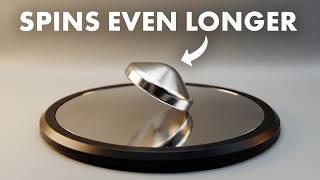

The Anti-TikTok Challenge: Watch This Spin
44sThe creator directly challenges viewers' attention spans and criticizes TikTok-style editing, sparking debate and engagement.
▶ Play Clip"Title is intriguing but the video delivers a thorough exploration of the physics, not just a clickbait claim."
The video explores the physics behind spinning discs, specifically why some spin longer than others. The creator collaborates with Metmo to develop a compact disc that matches the spin time of larger discs, discovering that conventional assumptions about shape and material are often wrong.
The video begins with a demonstration of spinning discs of different sizes, noting that larger discs spin longer than coins. The creator sets up an experiment to test a mystery disc of intermediate size.
The big disc spins for 1 minute 39 seconds, the small disc for 39 seconds, and the mystery disc for 2 minutes 12 seconds, surprising the creator.
The mystery disc is called the Singularity Disc, developed over a year with Metmo. The creator initially thought they knew what made discs spin long but discovered something unexpected.
The creator hypothesized that a ring shape would spin longer than a disc of the same mass because mass concentrated at the edge increases kinetic energy. However, testing showed the ring spins for less time.
Air resistance is not the main culprit; contour friction (deformation of the disc and surface) is the primary energy loss mechanism, especially at low speeds.
Changing mass distribution to a ring did not improve spin time as expected. The creator tried a cone shape with mass near the center, which performed better.
Tungsten discs spin longer on average than stainless steel, and edge roundness matters: an optimum roundness of about 1 mm radius exists, with sharp edges performing poorly due to deformation.
Glass outperforms steel as a base material because it returns more energy to the disc after deformation. A shallow curvature is best, and three adjustable feet prevent wobble.
When scaled up, the cone and disc perform similarly, possibly due to trade-offs between kinetic energy and dissipation.
The Singularity Disc is available for pre-order in tungsten or stainless steel cone versions, with the base sold separately. The name comes from the finite-time singularity phenomenon in the sound it makes.
The video reveals that intuitive assumptions about spinning discs are often wrong, and optimizing spin time requires careful consideration of material, shape, and base design. The result is a compact disc that matches or exceeds the performance of larger devices.
What is the main mechanism that causes a spinning disc to lose energy?
Contour friction, which is deformation of the disc and surface, not air resistance.
04:29
Why does a ring shape spin for less time than a disc of the same mass?
The ring has less mass if material is removed, or if radius is increased, contact point speed stays the same, but empirically it performs worse.
07:03
What is the optimum edge roundness for a spinning disc?
About 1 mm radius.
09:42
Why does glass outperform steel as a base material?
Glass is more elastic and returns more energy to the disc after deformation.
10:37
What is the name of the disc developed in the video?
The Singularity Disc.
02:29
Contour friction is the main energy loss
Challenges common assumption that air resistance dominates.
04:29Ring shape fails expectations
Demonstrates that intuitive physics can be wrong.
07:03Optimum edge roundness exists
Shows that maximum roundness is not always best.
09:42Glass base outperforms steel
Highlights importance of elasticity in material choice.
10:37Finite time singularity
Connects the disc's sound to a mathematical concept.
16:17[00:02] maybe you've spun one of these big chunky discs as well. They're famous for spinning for a really long time, much longer than a coin, for example. But what about this middle mystery disc? It's halfway between the two in size.
[00:17] spin for longer than the coin, but not for as long as the largest disc. But given that I'm subtly framing your expectations, we should probably wait and see. So, that's exactly what we're going to do. We're going to watch this
[00:31] going to do. We're going to watch this to the end. No cuts, no edits. And people will tell you that that's a bad idea for a YouTube video to open with several minutes of unedited footage. It's bad for attention, they'll say. But
[00:45] we're going to do it anyway. You and I, we're going to take a stand against the ticktoification of online video. We're going to test our ability to concentrate, to focus, our attention span, if you like. Listen, Paul, I'm
[01:02] talking to you. Don't put it on two times speed. Don't put it on one and a half times speed. Maybe put it on 0.5 times speed. Really give yourself a test. You're probably thinking, "Look, Michael Stevens can do it. It's not a
[01:16] lens and not say anything for several minutes." Well, I'm not Michael Stevens and I don't have that Janice Qua that he has. So, I'm going to keep talking because actually, you know what? I do worry
[01:31] actually, you know what? I do worry about retention. Of course, I do. I put my heart into a video, my soul. So, I want it to do well. So, yeah, maybe I want it to do well. So, yeah, maybe I feed the algorithm a little bit. Maybe I
[01:45] tweak the thumbnail sometimes. Yeah, maybe I put too many cuts at the beginning to keep you watching, but we're not doing that today. We're just going to watch and listen together. And you know what? Maybe the time for
[02:01] talking is over. As we reach the final few seconds, we're going to lean in. No speaking anymore. Just silence. No words, no voices,
[02:15] just the sound. of the disc. How cool was that, though? So, the big discs span for 1 minute and 39 seconds and the small discs span for 39 seconds and the small discs span for 2 minutes 12 seconds. So, what's going
[02:29] on? Well, the difference is that me and the guys at Memo have spent a year perfecting this one. We're calling it the Singularity Disc for reasons that I'll explain later, but it's interesting. Going into it, we thought
[02:43] interesting. Going into it, we thought we knew what it was that made these big discs spin for so long. But in the end, we discovered something completely unexpected. You might know Memo from the Metmo Cube. They got in touch after I
[02:57] made that video, and they asked if I wanted to collaborate on anything. And what we ended up with is a pocket-size disc that spins for just as long as the even trying to make a smaller version. See, I was convinced that changing the
[03:13] shape of the disc in one specific way would increase the spin time. We only scaled it down so that we could iterate quickly through a whole bunch of designs. The idea being that once we had exactly the right design, we'd scale it
[03:28] back up again. Because of course, the absolute size of the disc isn't going to have any effect on the physics. So my idea was this. It shouldn't be a disc, it should be a ring. Cuz hear me out, right? A ring should be harder to stop
[03:42] in general than a disc with the same mass. Like these two things have the same mass, but the ring has all its mass concentrated near the edge, which means that if I roll them at the same speed, well, the ring will have more kinetic
[03:58] energy. That extra kinetic energy needs dissipating, and so it should take longer to come to a stop. It's reasonable to assume then that if you take the mass of this disc and arrange it as a ring, well, you should be able
[04:12] to spin it for longer. So, I had one made and it doesn't. In fact, the ring spins for less time than the disc. So, we decided to go back to basics and just like as a first step, try and figure out what is the main mechanism that causes a
[04:29] spinning disc to lose energy. You might assume that air resistance is the main culprit. I know I did. But a surprising amount of research has gone into spinning discs. And it seems like air resistance only really matters in the
[04:43] last couple of seconds. And the main culprit is something called contour friction. So we decided to iterate three different things to try and reduce contour friction. And pretty much every single one went against our
[04:57] expectations. But first, what is this contour friction thing that robs the disc of most of its energy? Well, it's a bit like rolling friction, but actually misnomer. Like when you think about friction, you think about things rubbing
[05:11] together. But with rolling friction, it's about deformation mostly. So like if your bike tire is a little bit flat, then it's deforming a lot as you roll it
[05:24] forwards. And so it takes more energy to ride your bike. I'm oversimplifying there, but that's the basic idea. And surprisingly, even though you can't see the deformation in a disc like this with the naked eye, it is still deforming, as
[05:38] is the surface that it's rolling on, to the point where that is the main thing that robs the disc of its energy. So, why not just call it rolling friction? Well, rolling friction gets worse the faster a wheel is rotating. But look
[05:54] towards the end of a spin with one of these discs actually it's hardly rotating at all and it's the speed of the contact point that matters here. So researchers call it contour friction to distinguish it from rolling friction.
[06:08] was changing the mass distribution. Remember I thought it should be a ring instead of a disc. But why would that reduce contour friction? Well for the same amount of kinetic energy the ring should spin more slowly. That's because
[06:23] should spin more slowly. That's because all its mass is concentrated out where the shape is moving the fastest. And that means the contact point will be moving more slowly. And because contour friction increases with contact point
[06:35] speed, that should reduce contour friction. But actually, we also expect the ring to have more kinetic energy at the beginning of the spin, which means it should last even longer. The reason the ring would have more kinetic energy
[06:49] at the beginning is because for small masses like these, the speed of your muscles is maxed out. So even though in principle the disc is easier to spin, you can't actually spin it any faster. And for the same spin speed, the ring
[07:03] has more kinetic energy than the disc. So why is it that when I actually tested it, that was wrong? Well, one way to turn a disc into a ring is to remove material from the middle, but then you're also reducing the mass. And for
[07:17] the same initial spin speed, less mass means less kinetic energy. The other option is to keep the mass the same and increase the radius of the object. And the same spin speed, you're then getting more kinetic energy. And if you do the
[07:32] maths, you find out that the contact point speed stays the same. So really, this should be better. And I don't know why it isn't. I guess it's an open why it isn't. I guess it's an open question in the spinning disc community.
[07:44] Actually, I do have a theory for why it might be worse. We haven't yet talked about dissipation of energy through the wobble of the base. If you think about the ability of a small disc to wobble the base, well, it's pushing side to
[07:58] side like this, but quite close to the middle. He doesn't have as much mechanical advantage as the larger disc which is pushing side to side out here. It's got more mechanical advantage. It can wobble the base more. Anyway, if a
[08:14] ring is empirically worse, we thought maybe the opposite of a ring would be better. In other words, let's put additional mass close to the center. And what we found was this cone profile seems to be the best. We also played
[08:27] around with density. So this disc, the one you saw at the beginning, is made of tungsten. And on average, it spins for longer than the cone. It's probably because the extra kinetic energy you can give this one at the beginning is more
[08:42] important than the mass distribution change. Why not make a cone-shaped one out of tungsten, you might ask? Well, tungsten is much more expensive as a raw material than stainless steel. And to make a cone-shaped one, you have to
[08:57] start with a disc that is as tall as the tallest part and then cut away everything that isn't a cone. And actually, the cutting away process is more expensive, too, because the physical properties of tungsten make it
[09:11] that. Perhaps even more important than the mass distribution, surprisingly, is the roundness of this edge here. And that's the second thing we iterated on. the larger disc that you can buy because one edge is rounder than the other. And
[09:28] when you spin it, it's 50/50 which edge it lands on. The rounder edge seems to consistently perform better. When we tested a bunch of edge roundnesses, I tested a bunch of edge roundnesses, I assumed that maximum roundness would be
[09:42] the best option, but I was wrong about that as well. There seems to be an that as well. There seems to be an optimum roundness about 1 mm radius. I honestly have no idea why, but I can tell you why a sharp edge is bad. It's
[09:56] all to do with pressure. See how a sharp contact point can more easily deform the base because all the mass is focused onto a smaller area and a sharp edge onto a smaller area and a sharp edge itself is weaker and so will also deform
[10:09] more easily. So, a rounded edge reduces deformation and therefore reduces contour friction. The third thing we played with was the composition of the base. Our assumption was that a sturdier base is always going to perform better.
[10:23] But it's more complicated than that. Like what does sturdy mean? Sturdy, tough, strong, hard, they all have different meanings in engineering and they're all important in different ways. In the end, we just tested a bunch of
[10:37] different materials and glass came out on top. Although steel is tougher than glass, it will deform somewhat under a focused load. And crucially, it's not as good at springing back. In other words, it's more likely to deform plastically
[10:53] it's more likely to deform plastically than glass is. Glass is going to give more of its energy back to the disc following the deformation. We also following the deformation. We also tested different curvatures of the base.
[11:05] And interestingly, the more curved it is, well, the worse it performs. So, we went for a very shallow curve here. The trade-off is that the disc is more likely to work its way off the base if it isn't level. So, we added these three
[11:21] adjustable feet so you can get the level just right. We originally had the three feet embedded in the metal housing. This is a 3D printed prototype. The problem is if the disc wandered past this line,
[11:34] it could cause the base to tilt up like that. You might think, well, just add more feet. The problem is with four or more feet, you can end up with that situation you sometimes get at restaurants where there's a bit of a
[11:47] wobble. You could always correct that wobble with a little bit of adjustment, wobble with a little bit of adjustment, but it would be a pain. And actually, it seems like bass wobble is a really important contributor to contour
[12:00] friction. Honestly, I'm not sure if bass wobble fits under the umbrella of contour friction, but anyway, a three-legged table can never wobble. So, we stuck with three. And to fix the problem of base tilt, we added these
[12:13] outriggers for the feet. A nice side effect of that is that the adjustment knobs are now super accessible. So, while the thing spinning, if you notice that it's not in the middle, you can make adjustments so the run will be more
[12:27] centered the next time. There's a few other ways that we reduce wobble. Like the glass is really thick, so it's got lots of inertia. The housing is metal, so that's really rigid and it adds to the inertia. And these outriggers are
[12:41] made of a kind of engineering nylon. It's called PA12. It's super rigid and if it does undergo any deformation, it'll be elastic deformation. So, in
[12:54] principle, it could give that energy back to the plate and back to the disc. Though given what I learned in that bouncy balls video, who knows where that energy would go. But empirically at least, the bass performs really well.
[13:08] least, the bass performs really well. So, we had everything how we wanted it. Then we scaled it back up to this size. And strangely, at this size, the cone And strangely, at this size, the cone and the disc perform about the same.
[13:23] What? To be clear, they both spin significantly longer on this base than on this one. This one, I think, is a bathroom mirror in a injection molded plastic base. I'm not exactly sure why the cone shape stops making a difference
[13:38] the cone shape stops making a difference at the larger scale, but maybe the extra mass of the cone starts to be detrimental instead of beneficial. Like it should be beneficial because you can give it more kinetic energy at the
[13:52] beginning because it has more mass, but it also increases dissipation of energy through deformation and base wobble. And maybe those things scale differently to the benefit of having extra kinetic energy. And maybe we're near a tipping
[14:07] point here. This project was only ever partly about satisfying my curiosity. We always had a mind to maybe we could sell this thing and I think we've got something really nice here. So, if you agree and you'd
[14:24] like to own one, well, the good news is you can. To start with, we'll be selling two options. Either the tungsten or the stainless steel cone. Like, in terms of average spin times, the tungsten is a bit better than the stainless steel
[14:40] cone. But from my experience, if you're interested in, you know, like what's your personal best or whatever, the tungsten seems to have much better extreme outliers. So, my best on this is 3 minutes 28. My best on this is 2
[14:56] minutes 34, but on average, this is like a bit better than this. I mean, the tungsten is more expensive, you know, because it's tungsten. You can also buy the bass on its own if you want to just try and improve the spin times of discs
[15:09] you already own. But here's the main pitch, if I may. What you have here is a pitch, if I may. What you have here is a much more compact thing. It'll go on your desk, on your mantle piece, and you get the same, if not better, spin times
[15:22] than this beast of a device. We could also sell the large cone disc if people are interested, but you know, because we're not getting vastly better times than the discs you can already buy. We're not doing that unless you express
[15:36] an interest on the website. And maybe we'll figure out a price for a tungsten cone if you're interested. We can put up spin times as well cuz I'm going to get one made just for my own curiosity. Again, you can let us know on the
[15:49] website. I'll be honest, it's not cheap. Like you might see the price and think, you know, I can get this on Amazon for $45. And that's true, but just the raw $45. And that's true, but just the raw materials alone for this are $80. It's a
[16:02] precision engineered thing, small batch, and hopefully we'll break even. Oh, I singularity disc. It's because of that sound that it makes at the end. It's a bit like the sound that colliding black holes make
[16:17] or the sound that a ball bearing bouncing on a metal surface makes when it comes to a stop. They're all examples of what's called a finite time singularity. Like if you throw together a simple model for how
[16:33] fast the disc processes or the frequency of bounces of the ball, you find that it of bounces of the ball, you find that it reaches infinity at some finite time in the future. In reality, it never reaches infinity of course because some other
[16:48] process takes over like the viscosity of the thin film of air under the disc or Vanderval's forces or something like that. But it's fun to think that there's a mathematical singularity hiding in the
[17:02] geometry of this little toy. Go to metmmo.co.uk/s singularity to place your pre-order. Now, the pre-order is very transparent. We're doing it in batches of 300. So,
[17:15] the first 300 there'll be a delivery date and once there's been 300 pre-orders, the next 300 will have a new delivery date and then the next 300 a new delivery date and so on. So you'll always know how long the wait time is.
[17:28] The link is also in the description. So check out the Metmo Steve Mold check out the Metmo Steve Mold Singularity Disc today.




⚡ Saved you 0h 20m reading this? Transcribe any YouTube video for free — no signup needed.