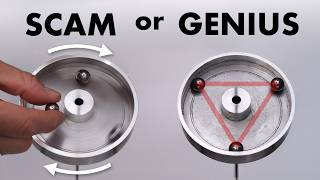

Steel balls that balance themselves?
45sVisual demonstration of a counterintuitive physics phenomenon grabs viewer attention.
▶ Play Clip"Thorough physics explanation that answers the question with clear demonstrations, though sponsor segment adds fluff."
This video explores the physics behind tire balancing beads, which are claimed to balance car tires by simply adding glass beads inside the tire. Through a spinning cup demonstration, the host shows that at low speeds beads worsen imbalance, but at high speeds they self-organize to balance the cup. The explanation involves center of mass rotation, resonance, and supercritical self-centering, concluding that beads can work if the car reaches freeway speeds regularly.
Dropping steel balls into a wobbling cup causes it to balance itself, contrary to intuition.
People claim glass beads can balance car tires without mechanic counterweights; host initially assumed snake oil.
Unbalanced tires cause vehicle shaking; mechanics use precise counterweights to fix.
At low speed, beads rush to heavy side worsening wobble; at high speed, beads balance perfectly.
With fixed and free ball bearings, free bearing oscillates and settles opposite the fixed one, balancing the cup.
At high speed, cup spins around its center of mass due to flexible axle, allowing beads to find correct positions.
At low speed, resonance causes flailing; above resonance, cup enters supercritical self-centering mode.
In rotating reference frame, beads experience centrifugal force and roll to the opposite side of the fixed mass.
Wheel hop resonance occurs at 10-15 rps (~50 mph), where unbalanced tires shake most. Beads need supercritical speed to self-center.
Once beads are set at high speed, they stay in place even when slowing down, reducing wobble at lower speeds.
Tire balancing beads can work if the car reaches supercritical speed (above ~50 mph) to allow self-centering, but they may not be useful for drivers who rarely drive at freeway speeds.
What is the typical speed range for wheel hop resonance in cars?
10 to 15 rotations per second, which is about 80 km/h or 50 mph.
09:10
At low speeds, do tire balancing beads improve or worsen imbalance?
They worsen imbalance by rushing to the heavy side.
01:25
What is the name of the mode where a spinning body rotates around its center of mass above resonance?
Supercritical self-centering.
08:02
Why do beads move to the correct position at high speeds?
Centrifugal force pushes beads outward on a sloped wall, causing them to roll to the side opposite the fixed mass, balancing the system.
05:41
After beads are set at high speed, do they stay in place when slowing down?
Yes, they stay in place until gravity overcomes the centrifugal effect at very low speeds.
10:19
Self-organizing system
Demonstrates counterintuitive physics where adding disorder (beads) creates order (balance).
00:01Resonance transition
Explains why beads work only above a critical speed, linking to wheel hop resonance in cars.
04:43Centrifugal force explanation
Uses rotating reference frame to intuitively explain bead movement, a key physics principle.
05:41Practical speed condition
Provides concrete number (50 mph) for when beads become effective, making science actionable.
09:10[00:01] wobbling until I do something really counterintuitive. When I drop a few steel balls in there, suddenly it balances itself. But, that's weird, self-organizing into the exact right
[00:13] anything? People claim that you can balance car tires in the same way. Like, instead of paying a mechanic to place counterweights to fix the problem, just chuck some glass beads in there. And, honestly, when I heard about tire
[00:27] balancing beads, because so many of you emailed me about them, I just assumed they were snake oil. But, then my friend Hugh Hunt sent me a video of this contraption that he built. And, now I'm thinking maybe there's something in it.
[00:41] Tires can shake your entire vehicle if they're unbalanced. It's like installing a rumble pack for your car. So, typically, a mechanic would precisely place counterweights to fix it. But, what if we could skip all of
[00:55] that and just throw glass beads at the problem? Well, here's why I thought, just intuitively, that tire balancing beads couldn't possibly work. See, if I stick a mass to the side of this cup and spin it, look, the cup just flies around
[01:09] like crazy. The flexible axle allows the heavy side to fling outwards, which seems quite intuitive to me, and it models the way that an unbalanced tire shakes your car. Some people think that this wild motion is the thing that moves
[01:25] the tire balancing beads into the right position to balance the tires. That means that if I was to pour some beads in here, it should balance this little cup of mine. But, look, the beads rush to the heavy side of the cup, which just
[01:39] makes the problem worse. And, honestly, that's what I imagined would happen, which is why I assumed that tire balancing beads were a scam. But, here's the weird thing. If I spin the cup faster, suddenly the movement changes.
[01:53] Instead of flailing around, it smooths out. It's still unbalanced. You can see that wobble in slow motion, but it's much tidier. And now when I add the beads, look, it balances perfectly. So, what changed? To figure out what's going
[02:07] much as possible. We'll start with a perfectly balanced metal cup. And then look, I'm going to add a ball bearing in there, and that's fixed in place. So, I know that when I add a second ball bearing, it's going to balance the cup
[02:21] if that second ball bearing moves to the exact opposite side of the cup from this exact opposite side of the cup from this fixed ball bearing.
[02:34] bearing moves to that sweet spot. Though, interestingly, it seems to oscillate back and forth around the sweet spot and eventually settle down there, which makes sense because it has some additional momentum that keeps it
[02:47] oscillate. But, that's cool though, I didn't predict that at all. What if I added two ball bearings? Wouldn't that be too much? equilateral triangle, which is just
[03:00] again. It's cool, isn't it? It's maybe not a perfect equilateral triangle. That might be because the cup itself isn't perfectly balanced, and we're not taking into account the mass of the Blu Tack, and maybe friction is stopping them from
[03:14] they're just oscillating around their final perfect spots like we saw with the single free ball bearing. What about three additional beads? So, that's four in total, including that fixed one. So, these beads somehow magically find the
[03:30] right configuration to cancel the wobble, but only at high speeds, which is weird. How do we explain this? I understand why it goes like that at low speeds, but why does it go like that at high speeds? And why do the balls
[03:45] move into just the right position to balance the whole thing? Okay. So, I think I know what's going on with the high-speed spinning motion. When a body spins freely like this, it spins around its center of mass. Now,
[03:59] technically this cup doesn't have complete freedom of movement because it's attached to this axle, but this axle is just incredibly flexible, or at least it gives almost no resistance to motion in the horizontal plane. So,
[04:14] although the axle is driving the rotation of the cup, the cup isn't rotating around the axle because the axle is free to move horizontally, and that allows the cup to act like a freely spinning body to spin around its center
[04:30] of mass. So, both types of motion now make sense to me, the low-speed flailing mode and the high-speed vibrating mode. So, why does it switch from one to the other? Because we need to know that
[04:43] before we can decide whether tire balancing beads are a scam or not. But first, can we figure out why the beads move into just the right spot to balance the cup when the cup is spinning fast enough for it to be spinning around its
[04:58] about it like this. You start with the cup perfectly balanced, then add two masses exactly opposite each other, so everything's still balanced, but then shift one of the masses around a little bit. So, now that's moved the center of
[05:13] mass of the whole thing downwards a little bit to here. Now, let's fix this little bit to here. Now, let's fix this mass in place, so it can't move, and set the whole thing spinning. And as we know, it's going to spin around that new
[05:26] center of mass. Now, it's much easier to analyze this if we imagine that we're of those sticky wall rides at the flung outwards. You feel like you're being pushed against that back wall.
[05:41] This is, of course, centrifugal force, which is a fictitious force, but because we're in a rotating reference frame, that's actually the correct force to use. So, imagine you're the ball, you're being flung outwards from the center of
[05:54] rotation. So, this wall feels like the floor, but the floor isn't flat, look, it's sloped. That means that you're going to roll. And of course, you're rolling towards that sweet spot opposite the fixed mass. And as you roll towards
[06:08] that perfect position, you're shifting the center of mass back towards the axle. When you finally get there and everything is perfectly balanced, that centrifugal force will be perpendicular to the wall {slash} floor, and so you
[06:24] stop rolling. You can make a similar analysis for two additional ball bearings, at which point I'm basically happy to accept that it works for n ball bearings. In case you're unhappy about the use of centrifugal force, by the
[06:37] way, I'll just leave a link to the relevant XKCD comic in the description and will say no more about it. So, that's why the steel balls move to just the right place to balance the spinning cup. But to figure out whether balancing
[06:50] beads can do the same thing for your car tires, we need to work out at what speed does the car transition from flailing mode to vibrating mode? And I think I've resonance. You see how this thing naturally swings back and forth at a
[07:06] certain frequency. Well, if you drive it at that frequency, resonance. And if you want, you can drive it in a circle instead of side to side, and it's still resonance. In this resonance mode, the inertia of that mass
[07:22] at the top and the springiness of the axle are perfectly in balance, but if you try to move it any faster, the springiness of the axle just isn't
[07:34] big enough to overcome the inertia of that mass, and so it just waggles there instead. What does that look like when you try to spin it above its natural resonating frequency instead of waggling it? Well, remember a spinning body wants
[07:48] to spin around its center of mass. So, if you wanted to get it spinning around some other point, you would need to overcome its inertia. And at high speeds, the springiness of the axle isn't strong enough to overcome that
[08:02] inertia. So, the center of mass stays where it is, and the axle moves around it. And you can actually see the axle moving around look underneath the cup. And when you get up to this speed, it's called super critical self-centring. So,
[08:16] how do we know what mode a car wheel is in? Well, I'll get to that in a moment, but first just a couple of things that I've realized are related to all of this. Like this milk frother, for example. Sometimes it's annoying and it
[08:28] does this, which I now realize is that resonance thing. But interestingly, if I push it into the center like that, it then stays there, which I think is a power thing. Like I can get this set up
[08:44] to do the resonance thing as well. And you would think that if I increase the power, it would speed up and eventually switch to the super critical self-centring mode. But because it's on such an exaggerated orbit, the motor
[08:56] isn't powerful enough to speed it up. But if I force it to be straight, I'm lowering the moment of inertia of this mass, and the motor is suddenly able to increase the speed past super critical, and so it stays there. But anyway, in
[09:10] cars, this type of resonance is called wheel hop resonance. And it typically happens around 10 to 15 rotations per second, which works out to about 80 km/h or 50 mph, which by the way is the speed at which you feel the effect of
[09:26] unbalanced tires most strongly, which makes sense because well, that's the when the amplitude goes up. But you need to get past that speed for the balancing
[09:38] beads to move into the right position to balance your tires. And that fits with the advice given by the manufacturer of these things. They tell you that you should get up to freeway speed, or as we say in the UK, motorway speed, before
[09:51] the beads will move into the right positions. But here's the thing, when you're at super critical self-balancing speed, the amplitude has gone way down. It's gone from this to this. And in fact, drivers with unbalanced tires
[10:04] almost completely when you get to freeway speeds. So, if the beads only work when you get to freeway speeds, but the problem has mostly fixed itself at freeway speeds, what's the point of balancing beads? Well, the point is,
[10:19] once the beads are in place, they stay there even when you slow down again, even down to wheel hop resonance speeds. You'll still have a smooth ride because your wheels are perfectly balanced by the beads being in the right place. It's
[10:33] only when you slow down so much that gravity is able to move those beads out goes away. And so, if you want your tires to be balanced once again, you tires to be balanced once again, you once again have to touch freeway speeds,
[10:48] and then your wheels are balanced. So, balancing beads can work, but only if your tires spin fast enough to reach the super critical self-balancing regime is rarely the case for me, but I don't know, maybe you do a lot of motorway
[11:02] driving. Some people swear by What do you think? Have you tried tire balancing beads before? Does your experience fit with my analysis? I say my analysis, really these results come from Cambridge Professor of Engineering
[11:16] Hugh Hunt, the same person who lent me this device. So, thanks, Hugh. And a big YouTube channel for letting me use this amazing footage from inside a car tire. You should definitely check out the full video. I'll link to it in the end card.
[11:30] My last video was about this intriguing device, but before I made the video, I got a chance to demo the device at the Cheltenham Science Festival. I don't do as many live events as I used to because YouTube takes up so much of my time, but
[11:42] I make sure to never miss the Cheltenham Science Festival. The issue is I really needed to be editing this video while I was away, but my editing PC is at home. So, it's difficult. And actually, I've only recently found a viable solution to
[11:57] this problem that's working really well for me. So, I'm very happy to have them as a sponsor. I'm talking about AnyDesk. AnyDesk is remote desktop software, and like of course, I've tried remote desktop software before, but it's never
[12:10] been viable for video editing or really anything where you need a decent frame rate, low lag, that kind of thing. AnyDesk is free, by the way. I'll get to how they make money in a second, but first, the reason AnyDesk is better than
[12:25] other solutions that I've tried in the past is because of compression. The challenge you've got to get all this visual information across the internet in a timely manner. The solution to that is compression. You compress the data
[12:37] one end and decompress it at the other end. So, the sales pitch is simple, really. AnyDesk has great compression algorithms. It's lossy compression anything. And it's end-to-end encrypted, and it works between all the major
[12:52] mobile and desktop operating systems. So, you could, in principle, connect to So, you could, in principle, connect to a Mac from an Android device. I mean, completely free for personal use forever, but they hope that you'll love
[13:06] it so much that you'll persuade your boss to purchase it for the business. You know, I usually say try it for free, but in this case, I mean, just use it for free. It's free. So, if you need remote software, give AnyDesk a try. And
[13:19] if you use my special URL, they'll know that I sent you. anydesk.com/stevemold. The link is also in the description, so check out AnyDesk today. I hope you forget to hit subscribe, and the algorithm thinks you'll enjoy this video
[13:34] algorithm thinks you'll enjoy this video next.



⚡ Saved you 0h 13m reading this? Transcribe any YouTube video for free — no signup needed.