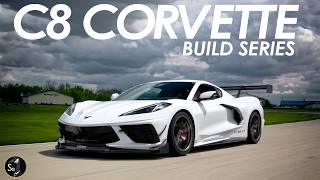

C8 Corvette: Affordable Supercar!
50sReveals the surprising affordability of a C8 Corvette, sparking interest and debate among car enthusiasts.
▶ Play Clip"The title is accurate; the video genuinely shows a C8 build, but the 'Not So Easy' twist reflects the lap time plateau despite upgrades."
This episode of the C8 build series focuses on upgrading a C8 Corvette Stingray with advanced suspension and aerodynamics to approach Z06/Z07 performance at a lower cost. The team installs MCS single-adjustable dampers and a Varys Ventus 3 aero package, then tests the car at the track to evaluate lap time improvements and driving dynamics.
The series aims to show how to upgrade an affordable C8 Stingray (Z51, 1LT) to near Z06/Z07 performance for much less money.
Episode 1 included Swift springs, Apex wheels with RE71 RS tires, Varys stage 1 aero, and reliability mods like grill guards and an additional oil cooler.
This episode upgrades suspension (MCS single-adjustable dampers) and aerodynamics (Varys Ventus 3 big wing package).
Stock car with track alignment, brake fluid/pads, and Patenza race tires ran a 132.3 lap time. With Swift springs, Varys aero, and RE71 RS tires, it improved to 129.6.
Eric explains their use of CFD for aero development, with validation showing CFD underestimated downforce by 1.9% and drag by 1.7%.
Ventus 1 (dive planes, diffuser, underbody strakes), Ventus 2 (bigger wing), Ventus 3 (V1X swan neck big wing, front splitter). The Ventus 3 generates 90-115% more downforce than Z06 Z07, but 32-37% more drag.
Rear wing generates about 500 lb at 120 mph. Total additional downforce at 120 mph ranges from 380 lb to 750 lb depending on setup.
Despite more mechanical grip and corner speed, the car ran the same lap time (129.6) as the previous setup due to increased drag on straights. Conditions were hotter (mid-80s vs 55°F).
The car is faster in corners, can brake later, and feels more stable and approachable. However, it loses 2-3 mph on straights due to drag. The suspension and aero make the car easier to drive fast for non-professionals.
The car carried more corner speed but lost time on straights. The wing's drag offset the corner gains. The setup improves drivability and approachability, but lap time didn't improve due to conditions and drag.
The upgraded C8 Corvette offers significantly better handling and driver confidence, but the added aerodynamic drag prevented a lap time improvement on this particular day. Future episodes may address power upgrades to complement the chassis improvements.
What was the baseline lap time of the stock C8 Stingray with track alignment and race tires?
132.3
03:59
What lap time did the car achieve with Swift springs, Varys aero, and RE71 RS tires?
129.6
04:38
How much more downforce does the Varys Ventus 3 package generate compared to a Z06 Z07?
90 to 115% more total downforce.
10:19
What is the drag penalty of the Varys Ventus 3 package compared to Z06 Z07?
32 to 37% more drag.
10:27
How much downforce does the rear wing generate at 120 mph?
About 500 lb.
10:09
What method does Varys Engineering primarily use for aerodynamic development?
Computational Fluid Dynamics (CFD).
06:36
How accurate was Varys' CFD compared to wind tunnel testing?
CFD underestimated downforce by 1.9% and drag by 1.7%.
07:35
What was the temperature difference between the previous test day and the current test day?
Previous test was 55°F, current test was mid-80s (about 30°F warmer).
18:10
Why did the car not improve its lap time despite more corner speed?
Increased aerodynamic drag caused slower straight-line speeds, offsetting corner gains.
14:04
What is the adjustment range of the V1X rear wing?
0 to 14 degrees.
09:38
Massive Downforce Increase
Quantifies the aero upgrade's performance relative to a factory Z06 Z07, showing 90-115% more downforce.
10:19Corner Speed vs. Straight-Line Drag Trade-off
Illustrates the fundamental compromise in aero upgrades: more grip but slower straights.
14:04Approachability for Non-Professional Drivers
Highlights that the upgrades make the car easier to drive fast, not just faster for pros.
16:00CFD Accuracy Validation
Demonstrates that CFD can be highly accurate (within 2%) for aero development, challenging the need for expensive wind tunnels.
07:35[00:09] Welcome to episode two of our C8 build
[00:12] series. Behind me we have a C8
[00:13] generation Stingray with a Z-51 package
[00:16] is a 1LT car. And the point of this
[00:18] video series is to show you what you can
[00:20] do with now a increasingly affordable
[00:22] mid-enine V8 sports car. We bought this
[00:24] thing a year ago. Let me be clear. When
[00:26] C8 Performance bought this thing a year
[00:28] ago, the car was under $60,000. The
[00:30] upcoming LS6 or new engine, the 6.7
[00:34] liter, these things will continue to
[00:36] increase in affordability. I imagine
[00:38] prices of these cars will be in the low
[00:39] 50s, potentially high 40s the near
[00:41] distant future. So, we want to do in
[00:43] this series is to show you what you can
[00:44] do with this car and see if we can get
[00:46] to that Z06, Z07, GT3 level of
[00:50] performance for a hell of a lot less
[00:51] money. So, what have we done already?
[00:52] Well, in the first episode, we did a
[00:55] spring package from Swift Springs. We
[00:58] did the Apex wheels with RE71 RS tires
[01:01] with 305 rear, 265 fronts. We did some
[01:04] arrow work from Varys, their lower stage
[01:06] arrow package, which adds a little bit
[01:07] of downforce. And of course, we did some
[01:09] reliability modifications like grill
[01:11] guards. And more importantly, we did the
[01:13] V9 cooler or basically the additional o
[01:16] oil cooler that C8 Performance is
[01:18] building using existing parts that are
[01:20] in Middle East spec or warm client spec
[01:23] C8 which dramatically drops oil
[01:25] temperatures. For this episode, we're
[01:27] going to go the suspension and
[01:29] aerodynamics route with big wings and
[01:32] more impressive, more expensive
[01:33] suspension. The last thing to talk about
[01:35] is brakes, which we're running the
[01:37] two-piece rotors from Essex AP and a
[01:40] Froto pad and of course a spindler lines
[01:42] and the hightemp brake fluid. But
[01:44] really, the real problem with this video
[01:46] so far is there's not enough Corvettes.
[01:49] When Jack told me we were doing at least
[01:51] 30 more Corvette videos this year, I
[01:53] knew I had gone too far. I'd been
[01:55] working on trying to digitally clone him
[01:57] for years. With my Falcon PC, I can now
[02:00] render him locally and for maximum
[02:02] profits. But the side effect was I could
[02:05] no longer control his code. It turned
[02:07] into a virus titled ABM or aggressive
[02:11] businessman. His connections at Bowling
[02:14] Green are fully integrated. And I
[02:16] believe he has replicated himself
[02:17] physically and is now capable of driving
[02:20] multiple Corvettes at once. I never have
[02:22] time to drive my Corvette.
[02:27] for this video. He demanded we get
[02:29] sponsored by Wolfbox so he could have a
[02:31] powerful handheld duster capable of
[02:34] cleaning his circuit boards. He likes
[02:36] cold swapping batteries with military
[02:38] precision. His favorite is playing with
[02:40] different tips, which means optimal air
[02:43] control, including three different motor
[02:45] speeds. One of his clones said it needed
[02:47] to generate wind forces of over 200 mph
[02:51] to blow the water out of the toilet. He
[02:53] said with that power he could easily
[02:55] remove bionetic skin off the piano black
[02:58] in vehicles. Bottom line is the Wolfbox
[03:01] Megaplow 200 air duster is a product
[03:04] powerful enough for cyborgs and usable
[03:07] enough for normal people who need to
[03:09] clean keyboards, coolers, and other
[03:11] finicky items in a touch-free manner. If
[03:14] you want to get blown away, Wolfbox is
[03:16] offering discounts on Prime Day.
[03:21] Oh, to my brand new car.
[03:36] Now that you know a little too much
[03:38] about me, let's talk about Corvettes
[03:41] once again. What have we done already?
[03:43] Well, our wheelman, Brick Casey Jr., a
[03:46] IMSA driver who was a TCR champion and a
[03:48] better driver than you and I will ever
[03:49] be set a lap time in this car when it
[03:52] was stock. A 1LT or base model Z-51
[03:55] Corvette. It ran a 132.3
[03:59] with patenza race tires, the track
[04:01] alignment, some brake fluid, and brake
[04:03] pads. A very, very quick lap time. And
[04:05] that Patenza race is stickier than the
[04:07] Pilot 4S. I view that as sort of a what
[04:10] you would do with a stock car if you
[04:11] went to a track day often lap time.
[04:13] Very, very quick. Then we went to C8
[04:15] Performance or Limit Plus1W and we added
[04:18] the Swift springs on the stock damper.
[04:20] We continued to run the track alignment.
[04:22] We added some Varys Arrow. Of course, we
[04:24] did our brake changes and we did the
[04:26] Apex wheel setup with RE71 RS tires, the
[04:30] outgoing track tire with 305 rears, 265
[04:33] fronts. With that homologation of parts,
[04:35] he ran a 129.6.
[04:38] A very, very quick lap time again for
[04:40] the price of the car that it is. So,
[04:42] what did we do now? Well, we went back
[04:44] to see Performance and we wanted to
[04:45] touch just two parts or two systems of
[04:47] the car. The aerodynamics and of course
[04:50] the suspension. While the spring package
[04:53] is on the affordable side, it is not a
[04:55] perfect solution to this car. Obviously,
[04:56] lowering springs have their pros and
[04:58] their cons. So, we went with MCS, their
[05:00] single adjustables again to try to keep
[05:02] this car, I hate to use the word
[05:03] affordable, but more on the affordable
[05:05] side. And of course, we went to Varys
[05:07] for their very not subtle and aggressive
[05:10] aero package. So that let's go talk to
[05:12] Eric from Varys Engineering.
[05:14] I'm here with Eric, the founder of Varys
[05:16] Engineering, an aerodynamics company you
[05:18] may be familiar with at this point. But
[05:20] before I butcher his introduction any
[05:21] further, please introduce yourself, sir.
[05:24] >> Eric Hazen. Um, starting way back in
[05:27] high school, I started as an automotive
[05:28] technician. I then went to uh mechanical
[05:31] engineering and I did went through that
[05:33] in university. I was an Indie car safety
[05:36] mechanic or technician and then that
[05:38] graduated into CNR racing where I
[05:41] designed and developed uh cooling system
[05:42] packages for NASCAR, Indie Car, trophy
[05:45] truck and various other racing series.
[05:47] That fast forward into um this side
[05:50] project which was vary engineering and
[05:53] that became a full-time job um and has
[05:55] been my life for the past 10 years.
[05:57] >> Needless to say, at this point you know
[05:59] what you're talking about and you've
[06:00] been doing this for a very very long
[06:01] time. This stuff works. How do you
[06:04] actually validate it though? So when we
[06:05] talk to a lot of aerodynamics engineers,
[06:08] some of the various brands we work with,
[06:09] they all tell me the same thing. The
[06:11] reason it works is because we have a
[06:12] wind tunnel. We have a lot of money
[06:14] behind us. As successful as you guys
[06:16] are, you're not an OEM. You don't have a
[06:18] billion dollar budget to work on a car.
[06:19] So how are you doing the testing to make
[06:21] sure that the parts you're developing
[06:23] for these cars actually work? Because
[06:24] for a long time, the Fast and Furious
[06:27] days, a lot of aerodynamics was
[06:29] vibes-based. It looked cool, but it
[06:30] didn't actually do anything. often made
[06:32] the car worse. So, how do you know this
[06:35] works?
[06:36] >> So, since day one, we've been using CFD,
[06:38] which is computational fluid dynamics.
[06:40] Think of that as we build a virtual wind
[06:43] tunnel. It's got a huge box. You shove a
[06:45] car in it, which we have in CAD, and
[06:47] then we run air flow over it. Um, it is
[06:51] a fluid dynamics calculationbased. We're
[06:53] able to put component forces into there,
[06:56] and we're able to test a bunch of
[06:57] different situations. We then test the
[07:00] stock car. We throw our parts on it,
[07:02] ensure that the balance is what good and
[07:04] make sure that the components are
[07:05] actually doing what they're
[07:07] >> supposed to be doing
[07:07] >> supposed to be doing.
[07:09] >> So yeah,
[07:10] >> the traditional thought process and this
[07:11] is in a in a past life. I worked in a
[07:13] fluids lab and I've spent a lot of time
[07:14] with aerodynamics engineers of the
[07:16] various brands. They will tell me the
[07:18] same thing. CFD is not a onetoone
[07:20] recreation of how the car actually will
[07:23] behave in the real world. Say I know
[07:24] wind tunnel isn't perfect either, but
[07:26] you have done wind tunnel testing. How
[07:28] much of a margin of error is there?
[07:30] >> So, we have done one ton total testing.
[07:32] We have done comparisons. Um, compared
[07:35] to CFD actually underestimated our
[07:38] downforce by like 1.9% and drag by 1.7%.
[07:42] It was very minimal. Um, so we were
[07:44] actually really happy with that.
[07:45] >> Effectively, in the real world, it's not
[07:46] a margin of error at that point.
[07:48] >> So, the car though already is a vehicle
[07:51] that generates some level of downforce.
[07:53] It's a no lift at least car in the case
[07:55] of a standard Stingray.
[07:56] >> Yep. Where are you developing downforce
[07:59] and more importantly drag? Because as
[08:01] you traditionally
[08:03] generate more downforce, the car while
[08:05] it has more mechanical grip, it does
[08:07] slow down in the straits. It creates all
[08:09] sorts of drag. What have you done? And
[08:11] can you walk me through your various
[08:12] packages because we've already done a
[08:13] stage one and now we're in sort of your
[08:15] big wing, no longer subtle phase.
[08:17] >> Correct.
[08:17] >> So, can you walk me through the the the
[08:20] changes you've made and how they work?
[08:21] >> Yep. So, we we do packages. Um, we call
[08:24] it um, Ventus one, which is like, uh,
[08:26] Latin for air flow. Um,
[08:28] >> very clever.
[08:29] >> Uh, dive planes, diffuser, and some
[08:32] underbody strakes. Um, that adds like a
[08:35] marginal bump in downforce, not too much
[08:37] drag. It's a nice starter package.
[08:40] >> Then we get into the Ventus 2, Ventus 3
[08:42] packages, which we add a big bigger
[08:44] wing. And then the Ventus 3, which is
[08:45] what you have, which is the V1X swan
[08:48] neck.
[08:48] >> Big wing.
[08:49] >> Big wing. And then uh we have a front
[08:51] splitter. um those those two add um a
[08:54] decent amount of downforce and a decent
[08:56] amount of drag as well.
[08:57] >> So, can you walk me through the
[08:58] adjustability? So, as you're going to
[09:00] hear later when we show the driving
[09:02] section of this car, one of the benefits
[09:04] of having an adjustable rear wing is you
[09:06] can add and remove essentially
[09:07] mechanical grip off the rear of the car.
[09:09] How much are you able to pull out or in?
[09:12] >> It's quite a bit. Um so, you guys have
[09:15] our Ventus 3 package, which is our
[09:17] standard front splitter. We now have a a
[09:19] higher downforce front splitter that is
[09:22] um not currently released.
[09:23] >> Yes.
[09:24] >> Slightly bigger. Has some diffuser
[09:25] tunnels. Um it actually produces about
[09:27] like 33% more front downforce than the
[09:30] standard.
[09:30] >> Um the V1X rear wing, which is on your
[09:33] car, which is perfect for upgrading
[09:35] later on down the road, has a large
[09:38] range of adjustment, 0 to 14 degrees. Um
[09:41] we took out a ton of rear wing today.
[09:44] Um, and we do that so that people of
[09:47] different varying skill levels are able
[09:49] to drive the car confidently and and
[09:51] safely.
[09:51] >> Walk me through exactly how much arrow
[09:53] aero downforce we're actually making in
[09:55] the rear to begin with. So, so
[09:57] abstractly before we start pulling
[09:58] things out at let's say 120 130 mph, how
[10:01] much downforce are you making over a
[10:03] stock Z-51 car?
[10:05] >> In just the rear or the whole car?
[10:06] >> Just in the rear?
[10:07] >> Just the rear probably. The rear wing
[10:09] probably generates about 500 lb at 120
[10:11] >> versus like a Z06, Z07. And I know we
[10:13] were talking about that number as well.
[10:14] What are you generating versus that car?
[10:16] >> So, compared to a Z06 Z07 package, we're
[10:19] generating 90 to 115% more downforce.
[10:23] >> Total downforce.
[10:24] >> Total downforce. And but we are also
[10:27] increasing 32 to 37% more drag.
[10:29] >> But it's a really good um trade-off.
[10:32] >> So, you're you're gaining a lot more
[10:33] speed in the corners and potentially
[10:35] losing some speed on the straights. But
[10:36] that's how a lot of this stuff works. I
[10:38] think your ability to gain speed though
[10:40] might be dependent on the track you're
[10:42] on. Is that a fair statement?
[10:43] >> That's 100% fair.
[10:44] >> So,
[10:45] >> something else that something else that
[10:47] like we've noticed as well, and I I
[10:49] believe even Britain mentioned it, the
[10:51] the car feels substantially more stable,
[10:54] which does allow people that aren't able
[10:56] to drive at the limit
[10:57] >> repeatedly, someone that's a
[10:59] professional driver, um, a lot easier.
[11:01] >> Having mechanical grip is never a bad
[11:03] thing,
[11:03] >> right? According to our analysis, it's
[11:05] about it goes from about total 380 lb
[11:08] additional at 120 to 750 additional
[11:11] pounds.
[11:12] >> Ah,
[11:12] >> yeah.
[11:12] >> So, we pulled about 400 lb out of the
[11:14] car.
[11:14] >> Yes.
[11:15] >> Oh, that's why it drives differently.
[11:17] >> Yep.
[11:18] >> So, look, we're going to work with you
[11:19] more in the future. Obviously, we do a
[11:21] lot of these build series at this point.
[11:22] Is there anything else you want to talk
[11:23] about?
[11:24] >> No.
[11:37] See that? That's all arrow.
[11:40] That's big grip.
[11:56] >> Oh, this car's got a phenomenal amount
[11:57] of lateral grip. I know. It's That's why
[12:00] I'm like, "How is it going slower?"
[12:02] >> It's got to be the straights.
[12:04] >> The drag. Yeah, it feels really good.
[12:09] Watch how fast I can take this. Fourth
[12:12] gear, third gear. Just off the brake.
[12:14] It's going full power.
[12:17] >> All right, Brett. We have literally
[12:19] chased a lap time the entire day, like 3
[12:22] or 4 hours. It is much, much hotter out
[12:26] than when we were here last. much
[12:28] hotter, like 10° warmer, and it's very
[12:31] humid. So, this is not a fast track. And
[12:33] after this entire day, we basically ran
[12:36] the same lap time we did when this car
[12:38] was on the lower arrow package from
[12:40] Varys, the Swift spring, and the same
[12:44] size, but older design RE71 RS versus
[12:49] these RZ's. So, not a great result, but
[12:51] I can, let's call it, blame the weather
[12:54] conditions. I also want to walk through
[12:55] some factors. So, dynamically, the very
[12:57] first thing I'm going to notice is there
[12:59] is a lot more mechanical grip than there
[13:01] used to be. How does it feel in the
[13:03] corners though?
[13:04] >> Yeah, I would say it can do it feels the
[13:07] same amount of effort, but it's just
[13:10] doing it better cuz it just has so much
[13:12] more grip.
[13:13] >> It's hard to talk with so much more
[13:15] grip.
[13:15] >> So, when we're going through this
[13:16] corner, what can you do now? What versus
[13:18] what you could do before?
[13:19] >> Slow, deliberate input with a really
[13:22] early confident throttle input. And it's
[13:26] probably 5 miles an hour faster through
[13:28] the middle. And um ride quality over the
[13:31] bumps still really good and progressive.
[13:35] Whereas before it was like on and off
[13:38] the bump stop. Very nervous feeling.
[13:41] >> Very. And in the left to right
[13:42] transitions especially now with a better
[13:44] race shock,
[13:45] >> some more air,
[13:47] >> some more air on them tires. The amount
[13:49] of speed you can carry into going into
[13:52] patience I know
[13:53] >> is uh alarming.
[13:55] >> Yeah, it it feels really good.
[13:57] >> This car needs new seats.
[13:59] >> Yes.
[14:00] >> Um so to to answer everybody's question,
[14:04] this is faster in every corner. It can
[14:05] break later. The place it is slower. One
[14:08] of the reasons it's not helping its lap
[14:09] time is the straightaways. It feels like
[14:12] because this does make a lot of
[14:14] downforce. You have a giant parachute
[14:16] behind you. It's probably I haven't
[14:18] looked at the data at least a couple
[14:20] miles an hour slower in all the
[14:21] straights which you know not that the C8
[14:24] isn't a big powerful car but compared to
[14:26] like the ZR1 or Z06 it doesn't feel
[14:30] feels more like a momentum car which is
[14:32] funny to bring up. Um yeah it's a good
[14:34] point. I mean I didn't think about it
[14:35] that way but I would agree because it's
[14:37] not it's not difficult to drive fast. I
[14:40] mean, it is to drive it fast. 10 out of
[14:42] 10. But when you're doing it like this,
[14:44] it does feel like it is a momentum car
[14:46] just because it responds to entry speed
[14:48] really well. And I think that's where
[14:50] most of the speed is with the new setup
[14:51] on this. Well, it's a really new car at
[14:53] this point.
[14:54] >> I have nothing to hold on to at all.
[14:55] >> Yeah. Sorry.
[14:56] >> No, it's fine.
[14:57] >> I'm driving like nine out of 10 right
[15:00] now. But
[15:01] >> it's a good car.
[15:02] >> You know, I I feel that from the
[15:04] passenger. I feel like Mark, dude,
[15:06] overweight Asian ragd doll in
[15:08] your passenger seat. Just
[15:10] >> just don't throw up on me.
[15:12] >> Um,
[15:13] the balance of the car. So, in the past,
[15:16] you we couldn't adjust anything. One of
[15:18] the things that we were doing throughout
[15:19] the day is, you know, when we first set
[15:22] up this car, we set the dampers in
[15:24] neutral front and rear. And then, for
[15:26] whatever reason, we decided more
[15:28] downforce in the back was a good thing.
[15:30] We basically backed that off the entire
[15:32] day to get this car to feel a little
[15:33] less
[15:35] >> pushy to more to over steer, which is
[15:37] now something you could do. I think
[15:40] >> me versus you, you're a better driver
[15:42] than I am, the the benefit of this car
[15:44] prior versus the the the old spring
[15:48] setup is while that old car was very
[15:50] very quick, I mean, the fact that it ran
[15:51] the same lap time for a hell of a lot
[15:53] less money. Problem with that car is you
[15:54] have to be a ULE driver to get that lap
[15:57] time out of it. the joy of the
[15:59] suspension and the arrow of this is
[16:00] something you you value and again to
[16:02] your point we talk off camera there's a
[16:04] lot of money uh is that it makes the car
[16:07] more approachable. So again it's about
[16:09] value set. I will say as we do another
[16:13] one of these episodes in the future I do
[16:15] want to touch power. I have noticed this
[16:17] is a hot as hell day and with our oil
[16:19] cooler where we've never gotten it past
[16:20] 225 oil temp. Yeah.
[16:22] >> Which is again a testament to the uh the
[16:26] optional oil cooler we threw on this.
[16:28] How are the brakes holding up? That's
[16:29] something I haven't asked.
[16:30] >> Really good. I mean, we saw we saw brake
[16:32] dust collecting on the wheels pretty
[16:34] aggressively, but in terms of pedal
[16:36] travel, it's been really similar the
[16:38] whole day. It hasn't really faded. I've
[16:40] noticed no pedal fade at all. I mean,
[16:43] the brakes bite really well and then uh
[16:46] like so total Yeah. So, total breaking
[16:48] force. Imagine being on the radio like
[16:49] trying to tell the team something right
[16:51] now. There's just a lot going on. Um so,
[16:54] but the the suspension's good, the
[16:57] brakes are good, and I think the arrow
[16:59] helps them also like it and we have
[17:01] these weird issues with the Corvettes,
[17:03] right, with the brake field.
[17:04] >> Yeah. I will say it was a theory
[17:07] committed today on on how the brake
[17:09] pedal would feel with all this added
[17:10] grip with the aerodynamic changes and
[17:14] it's better in terms of brake feel. I
[17:16] can confidently say that. And you can
[17:17] come off the pedal obviously with a lot
[17:19] more speed because you got all this air
[17:21] on the car. So, it's a pretty slick
[17:24] machine. Yeah, it's it's got a little
[17:25] bit of a parachute behind it and I think
[17:27] it it's not a onetrick pony anymore. You
[17:29] can tune the wings and and the
[17:31] suspension to do it live on a big
[17:33] highspeed track too. It should be a lot
[17:35] less sketchy. Autobon is not a
[17:36] high-speed track despite
[17:39] >> whatever is happening to my body right
[17:40] now as the passenger seat in this car,
[17:42] dude. All right.
[17:43] >> Need more lateral support in the seat
[17:45] now. That's the next upgrade.
[17:47] >> Um have like something to hold on to as
[17:50] a passenger. All right. So, with that,
[17:52] uh let's head into the well, let's head
[17:54] into the final box there. Goodbye.
[18:02] We're back at CA Performance and we have
[18:04] a lot of things to discuss. Let's talk
[18:06] about testing conditions as this video
[18:07] is going to be data driven. Naturally,
[18:10] when we last drove this car on the,
[18:12] let's call it the springs and the low
[18:13] arrow and on the RS tire, it was 55° out
[18:17] and Brit ran a very, very fast lap time,
[18:20] a 1296, similar lap time to a stock
[18:23] 992.1 911 turbo. And I've sent that lap
[18:28] to a variety of human beings and they
[18:30] will all tell you the same thing. God
[18:31] came down and made Brit drive very
[18:33] quickly because that was the miracle lap
[18:35] between the tires and the springs. He
[18:37] shaved off over two seconds versus the
[18:39] car stock on a 200 treadware. Less
[18:42] sticky but still sticky tire. All right.
[18:45] When we ran this car at this point
[18:47] yesterday, whenever you're watching that
[18:49] video yesterday means something
[18:50] different to you. It was in the mid 80s.
[18:52] So it was a much much warmer day out.
[18:55] The track has much different conditions.
[18:57] It's different time of year. It's less
[18:58] rubbered in. A variety of factors have
[19:01] made it a hard thing to do apples versus
[19:03] apples as a comparison. It's different.
[19:05] The truth is though, he ran slower. He
[19:07] is 210 of a second slower than he did in
[19:09] the past. Now, let me qualify that and
[19:11] potentially make some race car driver
[19:13] excuses. Let's talk about the subjective
[19:15] part, the vibesbased part of this. The
[19:17] car does drive better than it used to.
[19:21] At least from Brit's commentary to mine.
[19:23] Brit is a much much faster driver than I
[19:25] am. I fit your track day bro criteria
[19:28] and I am going to be faster in this car
[19:30] than it used to be. I like a loose car,
[19:32] but it did seem to tighten this thing
[19:33] down. It's better in transitions. And if
[19:35] you're going to drive this on the
[19:36] street, again, I know this car looks
[19:38] very extra at this point. The MCS's,
[19:40] this kit that CA Performance is selling,
[19:43] rides well and goes a long way making
[19:45] this car more approachable. The arrow,
[19:47] the wheels and tires, the suspension
[19:49] seem to fix some of the brake vagueness
[19:51] that exists in this vehicle. Either it's
[19:53] due to the weight transition in the car.
[19:55] It just doesn't seem to get into ice
[19:56] mode as often. It doesn't seem to freak
[19:57] out the ABS as much as it used to. Car
[20:00] feels good to drive. Now, when it comes
[20:03] to actual lap time, how do I quantify
[20:06] all this? Well, I ran the data. I looked
[20:08] at the car in the springs. I looked at
[20:10] the car stock. And I looked at the car
[20:12] where it is now based upon at least what
[20:14] how I am reading the data. how I've
[20:16] talked to other people, including Eric
[20:18] from Varys. Car seems to be carrying
[20:20] more speed than it used to into corners.
[20:22] Makes sense. More mechanical grip,
[20:23] stickier tire, yada yada yada. Better
[20:25] suspension. Where seems to be losing
[20:27] time is in the straights. Even with us
[20:29] basically flattening out the wing,
[20:32] putting it in almost a stall state. Yes,
[20:33] it's making downforce, but less
[20:34] downforce than in the maximum attack.
[20:37] doesn't seem to be going any faster than
[20:38] the car used to be going in the straight
[20:40] as a stock vehicle despite having a much
[20:44] higher exit speed than the car used to
[20:46] have as a stock vehicle. Which means
[20:47] just the wing is generating more more
[20:49] drag than it used to, which goes back to
[20:51] a point we've made in other videos. Cars
[20:53] are a system. You touch one thing, it
[20:55] affects something else. And that's
[20:56] what's happening in this car's case. I
[20:58] adjusted suspension throughout the day
[21:00] and adjusted arrow throughout the day
[21:01] and tire pressures. First time Brit had
[21:03] driven this car in these conditions on
[21:05] this setup. So maybe in the future we'll
[21:07] go faster. Who knows? So with that,
[21:09] thanks for watching. Hope to see you
[21:10] again soon.
⚡ Saved you 0h 21m reading this? Transcribe any YouTube video for free — no signup needed.