
Why Are We Here? The Ultimate Question
45sThe philosophical opening hooks viewers with existential curiosity, perfect for sparking engagement.
▶ Play Clip"Title promises a deep dive into oddness and the universe, and delivers with math, history, and pop culture—mostly legit."
This video explores the hidden mathematical patterns in the universe, from the odd number rule in falling objects to the surprising geometry of Colorado's borders. It connects Galileo's insights about gravity's constant acceleration to the language of mathematics, and ends by debunking the 'no rule against dogs playing basketball' myth from Air Bud.
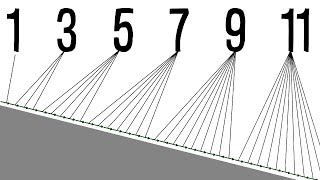
Under gravity, an object falling from rest travels distances in successive equal time intervals that follow the odd numbers: 1, 3, 5, 7, etc. This pattern reveals constant acceleration.
Galileo wrote that the universe is written in the language of mathematics, with characters like triangles and circles, and without it we wander in a dark labyrinth.
Galileo recognized that the odd number pattern spells 'I am speeding up at a constant rate.' This shifted focus from why gravity exists to what it does.
Distance traveled equals the area under the velocity-time graph. For constant acceleration, this area can be computed by summing rectangles, leading to the odd number pattern.
Colorado was intended as a geospherical rectangle but has 697 sides due to surveying errors. The US Supreme Court in 1925 ruled the surveyed borders as official.
The Washington Interscholastic Activities Association rules required players to be regular members of the school. Air Bud the dog did not qualify under any definition, despite no explicit rule against dogs.
The universe communicates through mathematical patterns, like the odd number rule in falling objects, revealing constant acceleration. Even seemingly simple questions, like whether a dog can play basketball, have hidden complexities when examined closely.
What pattern do distances traveled by a falling object follow in successive equal time intervals?
The odd numbers: 1, 3, 5, 7, etc.
02:30
Who wrote that the universe is written in the language of mathematics?
Galileo Galilei.
03:30
What does the odd number pattern in falling objects mathematically indicate?
That the object is speeding up at a constant rate (constant acceleration).
04:57
How is an even number mathematically expressed?
2n, where n is a whole number.
06:17
How is an odd number mathematically expressed?
2n + 1, where n is a whole number.
07:47
What does the area under a velocity-time graph represent?
The distance traveled.
08:42
How many sides does the state of Colorado actually have?
697 sides.
19:37
What did the US Supreme Court rule in 1925 regarding Colorado's borders?
That the borders as surveyed were the correct ones, not the originally intended geospherical rectangle.
20:24
According to the Washington Interscholastic Activities Association rules, could Air Bud the dog legally play basketball?
No, because the rules required players to be regular members of the school, which Air Bud did not qualify under.
20:52
Galileo's Grand Book Quote
A beautiful and profound quote about the universe being written in mathematics, encapsulating the video's theme.
03:30Colorado's 697 Sides
A surprising fact that a seemingly rectangular state actually has nearly 700 sides due to surveying errors.
17:51Air Bud Rule Debunked
The revelation that there actually were rules preventing a dog from playing basketball, despite the famous line 'Ain't no rule.'
20:52[00:13] Why are any of us here? What's the purpose? What does it all mean? Well, sometimes if we listen closely enough when we ask why, we can hear an answer. when we ask why, we can hear an answer. And it's another question. Why?
[00:27] And it's another question. Why? Why? What? Our journey begins here. can't play. He's right. Ain't no rule said the dog
[00:40] can't play basketball. Is that true? Is there really no rule against a dog playing middle school basketball? Vsauce Magic Eightball. Is there really no rule against a dog playing
[00:53] basketball? The answer is yes. The answer is yes. Or is it? We have begun. The actor who played Airbud, Buddy the Dog, passed away in 1998 at the age of
[01:11] Dog, passed away in 1998 at the age of nine. Now, take a look at this. On June 28th, 1914, France Ferdinand, the heir to the throne
[01:28] of Austria, Hungary, and his wife Sophie were assassinated in Saro while riding were assassinated in Saro while riding in a car. The car's license plate was a I I18. They were killed by Gavillo Princip, who
[01:44] said during his trial that he wanted the unification of all Yugoslavs free from Austria. The event sparked a series of escalations in Europe, the July crisis, which ultimately caused World War I. A war that ended on
[02:00] World War I. A war that ended on Armistice Day, November 11th, 1918. Armistice Day, November 11th, 1918. Pretty odd, huh? A spooky coincidence, if you will. But look, odd things happen all the time. Oddness is all around us,
[02:18] all the time. Oddness is all around us, especially in the form of odd numbers. The grip they have on our reality is revealed when we release our grip.
[02:30] Notice anything strange? Under the influence of gravity, things move in an odd way. If something starts moving because of gravity, after say 1 second, it will have traveled some distance. Now, interestingly, during the next
[02:46] second, the distance it will travel will be three times as far as it moved during the first second. During the third second, it will travel five times as second, it will travel five times as far, then 7 times, then 9 times, 11, 13,
[03:01] 15. Now, we used seconds, but it doesn't matter what time interval you use, you matter what time interval you use, you will always find this pattern. The odd number rule hiding right there within the very phenomenon that keeps us on
[03:15] the very phenomenon that keeps us on Earth are the odd numbers. More like God numbers, right? Is the odd number rule the face of the universe looking back at us? Well, here is something that Galileo wrote.
[03:30] Philosophy is written in this grand book. I mean the universe which stands continuously open to our gaze but it cannot be understood unless one first learns to comprehend the language in which it is written. It is written in
[03:45] the language of mathematics and its characters are triangles, circles and other geometric figures without which it is humanly impossible to understand a is humanly impossible to understand a single word of it. Without these, one is
[04:00] single word of it. Without these, one is wandering about in a dark labyrinth. Before this pattern in the grand book of the universe was read and appreciated, people wondered why things fell. Uh maybe stuff just eh has a desire to be
[04:16] in its own proper place, right? Rocks with the earth, fire with the air. That makes sense, right? It was fun to imagine causes and write our own stories. But underneath our desire for explanations, a story was already being
[04:31] told. One that is written in the language of mathematics, measure, and relation. Now, many of these stories are being told all around us all the time, one on top of each other. But if we can look past those disturbances, each
[04:45] look past those disturbances, each isolated event is narrating a quiet, simple story, not of why the universe is, but of what the universe is. Galileo
[04:57] recognized what this pattern spelled mathematically. It spells, "Hello, I am speeding up at a constant rate." And that was huge. All this time, for
[05:09] millennia, we had been wondering about the causes of gravity, its cosmic purpose, why it existed. But now, here was someone saying, "Yeah, yeah, yeah, cool. But like, what does it do?" It makes things fall. Great. Well, what
[05:25] does that mean? What does it mean to fall? Fall how? Now, the human mind alone couldn't answer that. But the universe was telling us. We just had to universe was telling us. We just had to speak its language and read it. This is
[05:39] I am gaining velocity at a constant rate spelled with odd numbers. How? Well, what's an odd number? The concept of oddness comes from the observation that
[05:52] sometimes when you have a bunch of things, everything you have can be things, everything you have can be paired up. But sometimes that can't happen. Now when it's possible when you can pair everything up
[06:05] that you have it is said that the number of things you have is even. If you can't do that then the number of things you have is odd. Now what this means is that
[06:17] the number of objects in an even group is equal to 2* n where n is just the number of whole pairs that you have. So n is any whole
[06:29] number. N could be for example 50 giving us the even number of 100 which is also us the even number of 100 which is also the number of legs centipedes have or is it centa 100 peed feet having 100 legs is
[06:46] right there in the name but it's only approximate. Centipedes have been approximate. Centipedes have been observed to have anywhere from 30 to 345 legs. Now 100 falls pretty nicely in that range,
[07:00] that range, but every pair of legs on a centipede is attached to a body segment. Which means that in order to have 100 legs, a centipede would need to have 50 body segments. But not a single species of
[07:15] centipede has an even number of body segments. 50 segments is nowhere to be genomes. So while centipedes on average have a number of legs quite close to 100, they never naturally have exactly 100. Point
[07:34] never naturally have exactly 100. Point is 2 n is the mathematical way to spell is 2 n is the mathematical way to spell even. If I add just one more thing, the amount I have is no longer even. It's odd. If I add yet another thing, I've
[07:47] added another pair. N has gone up by one and the number is even again. This means and the number is even again. This means that an even number plus just one more will always be odd. Now that we know how to mathematically spell odd and even, we
[08:01] can move on to moving. If you and me hugged, well, that would be wonderful. We would both get so much out of it. But if during the hug, you
[08:13] suddenly ran away from me while yelling, "I'm leaving you at a velocity of 2 meters per second. Well, I would be devastated, but I would know that deep down you still cared for me because you told me
[08:27] your velocity. And if I know your velocity, I can know just how far away you are from me at all times. All I have to do is take your velocity and multiply it by the number of seconds that have elapsed since you left. Now, take a look
[08:42] at what a graph of your velocity would look like. Here we have velocity in meters away from me per second and we have time in seconds since the hug ended. Now if your velocity is 2 meters/ second and that persists then here's a
[08:58] graph of your velocity. But look at this after a number of seconds have elapsed like after 1 second the distance you are away is just the rate times the time elapsed. 2 * 1. Well, that also happens to be the area of the rectangle bounded
[09:13] by a line coming up from the time, your velocity graph, and our axes. Well, that's pretty convenient. After 2 seconds, you are 2 * 2, 4 m away from me, which is also the area of this shape we've created. After 3 seconds, you are
[09:29] we've created. After 3 seconds, you are 3 * 2 1 2 3 4 5 6 m away. It's always the area. Well, that's pretty convenient. But let's change up the convenient. But let's change up the story. What if we hugged and it was
[09:41] great? I mean just almost not even a hug like something new was being invented here. But then during that you suddenly leave. You run away from me and while you run you yell I am leaving you at an
[09:56] you yell I am leaving you at an everchanging velocity. lot less helpful. Now let's say that this changing velocity you have that I don't know happens to be an acceleration of 2 m/s per second. What does that
[10:13] mean? Well, that means that your velocity is getting bigger by 2 m/s for every second that you run. It would look like this on a graph. You begin hugging me with no velocity and then 1 second later your velocity is 2 m/s larger. So
[10:28] two larger than zero is two. That's your velocity after 1 second. After two seconds, your velocity is two larger still. So four and then six, your velocity graph would look something like this.
[10:42] But now here's a question. If you're moving like this, is the distance you are away from me at any given time still just the area of the shape bounded? It's
[10:54] harder to see that because you don't maintain any single velocity for any changing. So, we don't have nice rectangles. But we can see that it is true by putting ourselves in my shoes, abandoned, alone. I don't even know your
[11:10] motion. I don't even know how you're accelerating. It's very scary. But I can decide to take matters into my own hands and measure your velocity as often as I like. Let's say that I measure it just
[11:24] once. Um, I measure it after, let's say, 2 seconds. All right. Wonderful. Now the question I want to answer is how far away you are after 3 seconds. All right.
[11:36] So I have this measurement. I know that you were traveling at 4 m/s. you were traveling at 4 m/s. Well, I mean look, if you're going 4 m/ Well, I mean look, if you're going 4 m/ second for 1 second, then that's a
[11:50] rectangle like this and it's got an area of four. Um, but you're not 4 m away, are you? You're a lot further than that because you weren't traveling 4 m/s for this entire second. You were at all times actually traveling a bit faster
[12:05] and I'm totally forgetting all the distance you covered before my measurement, which is not zero. Uh, okay. So, clearly I need to measure your that I measure your velocity twice
[12:18] during the 3 seconds I'm curious about. Let's say I measure it after 1 second Let's say I measure it after 1 second and then after 2 seconds. Well, now I can imagine rectangles here. This one is 2x 1, so it has an area of 2. This one
[12:32] 2x 1, so it has an area of 2. This one is 4x 1, so it has an area of 4. 2+ 4 is 6, but you're a lot more than 6 m away as well because you weren't traveling 2 speeding up, covering more and more
[12:46] distance you covered over here. Basically, this method will always leave me short. But the more frequently I check your velocity, the better things check your velocity, the better things get. Take a look at this. Oh yeah. Oh
[13:01] wow. As you can see, the more frequently I check your velocity, the closer my calculation gets to being based off of what you really did, your actual motion. But also, the more frequently I check your velocity, the closer the combined
[13:17] area of all of my rectangles gets to simply being equal to the actual area bounded by your velocity curve. Which means that the area under your velocity curve, even when your curve is like this, is still totally the distance you
[13:31] are away from me. Now, let's take this knowledge and apply it to the odd number rule. Before some pretty good guesses. Uh, for example, if the reason things fall is
[13:45] that they have within them a desire to be in their own proper place. Uh, in this example, the table, well, then maybe the closer this object gets to the there and the faster it goes. In which case, its velocity would change over
[14:01] time, like this, getting steeper and steeper and steeper. But Galileo didn't think that. He believed that when objects fell, their velocities increased at a constant rate. So graphed like this, their velocity would just follow a
[14:15] straight line. Let's draw a straight line. Beautiful. Now let's divide this graph up into strips of equal time. Perfect. All right. Now, as we know, the Perfect. All right. Now, as we know, the areas of the shapes we have bounded here
[14:30] are the distances traveled during their respective time intervals. So, what's the area of our first shape here, a little triangle? Well, we don't know what it is. We don't have any um actual uh markings here on our axes, but that's
[14:45] fine. It doesn't really matter. We'll just call this one. So, in the first, second, or the first time interval, our object traveled a distance of one unit of space. Perfect. Now, how far did our object travel during the second time
[15:01] interval? Well, that distance will be equal to that area. Well, what is this area? Well, one thing we can do to make this easier is to divide the shape like this. Now, we have two shapes, a triangle and a rectangle. This triangle
[15:16] has the exact same area as our initial triangle. That's because they are congruent triangles. They both have the same base length. And because this velocity line has a constant slope, it rises the same amount per time elapsed
[15:32] all the time. So their heights are the same and they're both right triangles. Their areas are the same. So the area of this space is the area of that triangle plus the area of this rectangle. What is the area of
[15:47] this rectangle? Well, one thing we can do is divide the the rectangle in half with a diagonal like this. And look what we've created. This triangle has the exact same area as our initial triangle. It has the same height. It has the same
[16:02] base. They're both right angles. And look, the same goes for this one. It's a right triangle. Its base is the same as this base. Its height is the same as this one's height. Gosh, this is just the area of the initial triangle, but
[16:15] twice. So, we have two of them. And we have two of them one time. Okay, perfect. Now, let's move on to finding the area of that shape. Once again, I
[16:27] can divide this shape like that. And now I have a triangle which as we know has the same area as our initial triangle right here.
[16:39] So we have that area one. And then we also have look at that two rectangles which as we know we can divide in half like this giving us now four triangles equal in area to the initial one. So what we've
[16:54] done is we've taken the initial area and we have doubled it uh well once and then twice so two times. Now as we continue doing this we find that we're always adding one more of our original areas and then we're always doubling that
[17:09] original area one more time. Here we've doubled it 1 2 three times. Doubled three times. Well look at this pattern right here. We can think of one as being right here. We can think of one as being equal to 2 * 0 + 1 can't we? Well, these
[17:23] numbers are whole numbers and they're just going up by 1. 0 1 2 3. This is all just going up by 1. 0 1 2 3. This is all of the general form 2 n + 1. That is how you mathematically spell odd. So, the odd number rule is not some kind of
[17:38] magical coincidence. It's just what happens when an object's velocity happens when an object's velocity increases at a constant rate. The answer was right there in front of us all along, written in the mathematical
[17:51] language of the universe. The universe also contains Colorado, one The universe also contains Colorado, one of its best rectangles. of its best rectangles. Or is it? Let's find out after a quick
[18:06] Or is it? Let's find out after a quick word from our sponsor, us. Hi, I'm Michael Stevens. Are you a person? Well, then get out of here. Go poop or something. I only want to talk to your brain.
[18:21] Okay, so brains, here's my message to you. Treat yourself. Touch more than just my voice. Become a supporter of the Vsauce Curiosity Box, the subscription
[18:33] for thinkers. It comes to your door every 3 months full of stuff that we have made and things that we love. I'm talking books, shirts, viral physics toys, puzzles, projects, you name it. Its mission is to be good for brains.
[18:47] So, we give a portion of all proceeds from it directly to Alzheimer's research. And it makes our new Inquisitive Fellowship possible, a program that literally just gives money and equipment and assistance to
[19:00] educational YouTubers so they can worry less about monetization and the algorithm and more about just making the kind of content they want to make. and that this world needs. This year's inaugural fellows are fantastic. 12tone,
[19:15] Jordan, Herod, Up and Adam, and Jabril. You should definitely subscribe to them. Continue feeding yourself, right? Join the Curiosity Box today.
[19:37] rectangle, a shape with four sides that all meet at the same angle. But Colorado all meet at the same angle. But Colorado doesn't have four sides. It has 697, making it not a rectangle, but instead a hexainia kakai heptagon. And this was
[19:54] all by mistake. The United States Congress initially defined Colorado as a geosperical rectangle. the space bounded by two lines of latitude and two lines of longitude. In the 19th century, surveyors set out to demarcate its shape
[20:09] to actually mark it on the ground. And they did a phenomenal job with the tools that they had. But mistakes were made. Some were large enough that you can spot them on many common maps of the state. In 1925, the US Supreme Court ruled that
[20:24] the borders as surveyed were the correct ones and would legally stand as the official recognized edges of the state, not the originally intended theoretically pure geospherical
[20:37] rectangle. Thus ending the shaping of Colorado that began with lines drawn by Colorado that began with lines drawn by the compromise of 1850. the compromise of 1850. 1850.
[20:52] We have arrived. Article 18, section 5, paragraph zero of the Washington Interscolastic Activities Association, 1996 to97 Constitution. The set of rules Airbud would have been subject to at the time and place of the
[21:06] movie states that in order to participate in an intercolastic athletic activity like basketball, a student must be a quote regular member of the school defined as someone enrolled half-time or more. The section does refer to
[21:23] more. The section does refer to RCW28A2250, one of these was considered in the case of Airbud. Had they been, it would have been discovered quite quickly that Airbud the dog qualified under
[21:37] absolutely none of them. There is no rule that specifically states a dog cannot play basketball, but there are and were rules that said that this dog
[21:50] Airbud should not have been allowed to play basketball. play basketball. And as always, thanks for watching. And as always, thanks for watching. [Music]


⚡ Saved you 0h 22m reading this? Transcribe any YouTube video for free — no signup needed.