
The Secret Sum Formula Revealed!
45sStarts with a teaser about a secret sum formula, creating curiosity and hooking viewers immediately.
▶ Play Clip"Title lists cubes up to 26, but video covers general formulas; still delivers on the promise of visual proofs."
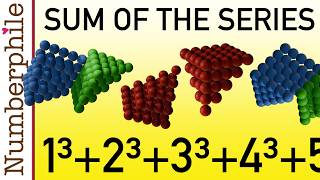
This video explores three classic finite sums: the sum of integers, squares, and cubes. It presents visual proofs for the formulas, showing how geometric arrangements reveal the underlying patterns.
The video covers three finite sums: sum of integers (1+2+...+n), sum of squares (1^2+2^2+...+n^2), and sum of cubes (1^3+2^3+...+n^3).
The sum of integers from 1 to n is n(n+1)/2, known as triangle numbers.
The sum of squares is n(n+1)(2n+1)/6.
The sum of cubes equals (n(n+1)/2)^2, the square of the sum of integers.
Two copies of a triangle of dots form a rectangle of size n by n+1, giving half the product.
Six copies of a stack of squares fit together to form a cuboid with dimensions n, n+1, and 2n+1, yielding the formula.
A square arrangement of cubes, when twisted, forms a larger square whose side is the sum of integers, showing the sum of cubes equals that sum squared.
Higher powers (4th, 5th, etc.) have more complex formulas, but patterns exist between even and odd powers.
The three sums are elegantly connected: the sum of cubes is the square of the sum of integers. Visual proofs provide intuition for these algebraic formulas.
What is the formula for the sum of the first n integers?
n(n+1)/2
01:00
What is the formula for the sum of the first n squares?
n(n+1)(2n+1)/6
01:41
What is the formula for the sum of the first n cubes?
(n(n+1)/2)^2
02:24
How many copies of the stack of squares are used in the visual proof for the sum of squares?
Six copies
06:23
What shape is formed by two copies of the triangle of dots in the sum of integers proof?
A rectangle
03:29
What is the relationship between the sum of cubes and the sum of integers?
The sum of cubes equals the square of the sum of integers.
11:41
Visual proof for triangle numbers
Shows how two triangles form a rectangle, making the formula intuitive.
02:52Six copies for sum of squares
Demonstrates a clever geometric arrangement that yields the cubic formula.
04:23Sum of cubes equals square of sum
Reveals a beautiful algebraic coincidence through a twisting visual proof.
08:32Patterns in higher powers
Suggests deeper structure between even and odd power sums.
12:20[00:02] mathematically defined as a sum of a sequence and there are lots of important sequence. And actually there are three results the end of school still doing maths, they will learn three sums of important
[00:19] anyone who's doing maths at school. They are the sum of the integers, the sum of the natural numbers. Just as a heads up, I'm not going to infinity. Don't start talking about -1/12. These are actually finite sums.
[00:31] So the sum of the integers 1 + 2 + 3 + 4 + 5 up to n. And then like by extension squared + 3 squared + 4 squared all the way up to n squared and the sum of the deals in school. I'm going to write down some of the results. I'm going to leave
[00:46] one as a secret. And I want to tell you the story of all three of them and how you can see the results even if the formulas look like really arcane. Is >> First one up, I'm going to use some notation. This is a Greek letter sigma
[01:00] S. Get used to it. I'm going to use R, which is like a dummy variable and R runs from 1 to n. So this is a mathematically terse description of add up the numbers R as they go from 1 to n. That's what that symbol means. And I
[01:14] hope many numberphile viewers will know the result here. It's a half times n times n + 1. This turns up all over the place. It's actually the formula for the problem about if there are 10 people in a room and they all shake hands, how
[01:26] out that's a triangle number and the formula comes very like this. It's like n n - 1 instead of n n + 1. Thing is this is a famous formula algebra. Maybe a lot of you could do that. Next
[01:41] time R squared. So this is the sum of one, I mean when I first saw this one I was like, really? Why does it have to be was like, really? Why does it have to be this? It's a sixth n n + 1 2n + 1. That
[01:56] particularly when this one gets familiar, this one doesn't feel so >> So, if I do 1 squared plus 2 squared plus 3 squared all the way up to say 20, >> 20 is in there, and that will give me the the result.
[02:09] it'll always give you a whole number, which is a relief. Otherwise, like, how but the sick thing there is like, there's a fraction, but we're going to I'm going to prove it works, hopefully. The last one, sigma r cubed this time.
[02:24] This is the the third in the sort of triumvirate. >> Okay. >> Some people will know it already, but three of these stories together. Let's start with the triangle numbers, the sum
[02:37] numbers up to n. Uh so, this is 1 + 2 + 3 + 4 + dot dot dot up to n minus one plus n. You get to n in the end. And we can do this algebraically. There's all sorts of nice stories.
[02:52] adding up the numbers from 1 to 100. I'm not going to tell the story again. You draw a picture. And the pictures look very simple. Here is one blob. Here is two blobs. And here is three blobs. Can
[03:05] the triangle numbers? I'm sure you can. That's a slightly patronizing question. It turns out if you draw a triangles of shapes of blobs, you get these triangle numbers. And you can see that's why 1 + 2 + 3 + 4 gives you a triangle.
[03:17] Crucially, this does not help me see that formula until I draw another copy. this one. This is the sum of the first four integers. So, it'll be like up to If I draw another copy and fill them in this time,
[03:29] it's upside down, but it's the same triangle. Agreed? way I've drawn them, always fit together like this, I will always make a which has got, in this case, four along here,
[03:42] and one more than four here, and it's two copies of it. 5, but I better halve it to get just the and if I generalize it, this could be n, this could be n plus one, and it'll be a
[03:56] half of n times n plus one. And that is that formula. And just in case you weren't sure that this generalizes, here is the seventh triangle number. Uh and I can crank this up, right? Once you
[04:09] GeoGebra is it lets you generalize without redrawing the thing. And I can and it always makes that rectangle, which is one longer that way than it is and halve it because I've got two copies. This method of making more than
[04:23] one copy of a thing in order to then like halve it to cuz we've doubled it in technique. We're going to use that again for the next one. the sum of the squares. This formula is really much less intuitive to me, and
[04:36] it, and I'm not going to do it, but if you notice that this one ends up being a there, so it's got an n squared in it. It may be it's not a surprise that this one has to be a cubic. And you can use that information to algebraically come
[04:50] that. I want to show you a better way of adding the squares together. Here is a stack of some squares. Takes a little bit of getting used to. In fact, there bottom. Um
[05:02] apparently. Uh There's a square with one and a square And if I do a square of three on the bottom of that, you can see I'm stacking squares up. So, the number of balls in this diagram is is kind of
[05:15] >> So, at the moment I can see that there's a nine on the >> Yeah, there's a nine plus a four plus a one, so we're at 14. The thing is, once generalize it. So, here's a stack of squares. Um actually, if this is looking
[05:27] familiar, go and have a fun time with Matt's cannonball video from a few years what numbers do this and are square shape. That's not many are in there. And the reason I'm showing you diagram is that
[05:43] I can make copies of this diagram, and let's do that. Let me I'm going to bit better. But here's a stack of four squares and I'm going to put two more versions on the screen.
[05:55] Red and blue, they are the same copy. Do you just So I've I've made three times the original thing, but they fit together really nicely. Now, it's not as nice as I'd like. If it had made a nice cuboid, I could get the
[06:09] balls in it in this case by just multiplying the dimensions. But I've got isn't it? >> It is. It's offset by one row, in fact. Which means if I get another copy of these three and put them on top, I think
[06:23] that. There they are. to see now. Let me just separate them so you can see them. so we can uh get a hang of it. These are six copies
[06:35] the ones on top. But if I put them all together, >> Perfect. >> In fact, I can tell you the dimensions and remember my original one if I just
[06:48] the squares from four up to the to one or one [clears throat] up to four. So, this side's got four, but then on this side it's four plus one. It's always plus one because it's the tip of the of the red tetrahedron going on
[07:00] here. And then the other dimension, which is the height of the thing, is actually two copies. So, four plus another four plus one cuz it's the tip of that green one that went in there. So, the dimensions of this cuboid are n,
[07:13] [clears throat] there are six copies.
[07:25] copies. That is the formula for the sum of the squares. And although it's once you've got it, you can prove it by induction. All sorts of ways to do it. I really like the visual proof of seeing the six copies and seeing how they fit
[07:37] together. Now, while this might be not a formal mathematical proof, it really deals with your intuition. And I'm a much happier person about this formula those bits are coming from. >> Why does that not count as a proof? That
[07:50] looks like a proof to me. >> Yeah, and I mean I'm all all for like diagram does everything for me, but maybe that's only a proof that it works But the the fact that I've done it in GeoGebra means I can generalize it as
[08:04] There's five, uh there's six. Yeah, I'm beginning to see the generalization, but it is technically only one specific example. And maybe that's why a proof needs to cover in general and show why not just works for that one.
[08:19] always. We've got to be a bit careful, but actually this diagram gives me a way could prove by another way. So the diagram has a lot of value whether Let's do part three. Part three I deliberately suppressed cuz
[08:32] let me start by going straight in with cubes together now. I mean I can I can draw it first. Let's let's do some some blocks, right? There's there's one cube and then two cubes
[08:45] >> [snorts] >> that and then I could draw the three something. I've got to add all those together and drawing them like that stacking them together in a way that makes me
[08:57] see an answer. But drawing them in a different way gives me a really nice visual thing. Okay, so on screen is, believe it or a tiny bit of thought. So first of all I can change the number of cubes in here.
[09:10] They don't look like cubes, so bear with me here, Brady, but that square down I hope you agree it's just one square. The next pile is two squares of two. squared and it's then multiplied by two again. So I think that the number of
[09:26] squares in that pile is two cubed. And similarly, three squares of three is three cubed. Four squares of size four is four squared times four and five squared times five. The number of squares in this figure is
[09:39] look like a super intuitive thing, but I'm going to do something which the Okay, I get it. >> So, you're saying >> So, you're saying um one five cubed is
[09:52] >> Exactly that, yeah. The number of squares in there. It's It's just like what Why are you bothering to draw that diagram? Well, squares for a moment, but it's still the same area. I just made it go red. And
[10:05] I'm going to draw a line. In fact, I'm just going to draw this line. And it actually it's a 45° line that's going straight through the middle of the first straight through the middle of the first square at 45°. So, it's slightly un
[10:17] non-intuitive where it cuts the other piles, but actually it's cutting them in important. And I'm going to go into three dimensions now, slightly you really should do this with a piece of paper, but then you
[10:31] whatever I just done does generalize. Let's leave it at five for example. I'm going to twist. And actually, if you imagine the pin in the middle of each imagine the pin in the middle of each sort of pile, you'll see how they twist.
[10:48] That is a square. And this always works. I can generalize cubed plus two cubed three cubed, four cubed, five cubed. It always works. I can always twist it back.
[11:03] area here, because it's a square and the side of the square is 1 + 2 + 3 + 4 + 5 + 6. The side of the square is the sum of the integers. And you remember remember from a few minutes ago that we have a formula for
[11:16] can now write down the formula for the sum of the cubes. integers. >> Because the sum of the integers runs along the bottom and square. >> The first pile was width one, the second
[11:28] and five, and six. So, this total length is the sum of the integers, and then the can write down the formula. Let's write it down. >> It must be the same as this one squared.
[11:41] Which would make it square the half, a quarter, n squared, n plus one squared. And that is the result. But actually written on its own, it's forgivable that you don't notice it's the same as that one squared. And I really think this is
[11:54] got three classic series, one of which is nice, triangle numbers famous, one of see it, and one of which is just the same one again squared. And if you'd integers squared is the sum of the cubes,
[12:08] mixed up in your head because all everything's involved. You've got the power one, you square that to get the cubes of the beautiful algebraic coincidence, and
[12:20] means that I really like these three results as a little sort of trio of >> Presumably, the sums of the powers of four and powers of five and all that sort of other trends start to show up? >> Yeah, the It It turns out that the even
[12:36] to the odd powers, and you can kind of see that happening with the one and the But I'll leave that as an exercise. It gets messy, and if you want to do these algebraically, which is presumably how they were originally done, you do
[12:48] through. There are some really nice methods, too. Classically in school, you that's a method which needs you to know the answer before you prove it. And did they come up with the original answer? And almost certainly they did it
[13:04] algebraically by other methods. They're all out there. But maybe they stumble across across a nice diagram like this which gives them the intuition, which and then you can prove it formally if you care about that sort of thing. Check
[13:16] out the links below for more videos with Ben Sparks. Plus, find out more about what he's up to, chances to hear him speak, training, [music] and maybe pre-order or order his new book. Check that out. As I said, links
[13:31] book. Check that out. As I said, links down below in all the usual places.
⚡ Saved you 0h 13m reading this? Transcribe any YouTube video for free — no signup needed.