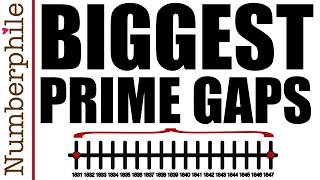

The Infinite Prime Mystery
45sEngaging intro to primes and the concept of infinite gaps sparks curiosity.
▶ Play Clip"The title promises a deep dive into prime gaps, and the video delivers solid mathematical content, though it could be more concise."
This video explores the fascinating world of prime numbers, focusing on the gaps between consecutive primes. The host and guest discuss the concept of prime gaps, construct guaranteed runs of composite numbers using factorials, and delve into the challenge of finding the smallest such runs.
Primes are fundamental building blocks of numbers, divisible only by 1 and themselves. All other numbers are built by multiplying primes together.
There are infinitely many primes, a fact that can be proven. The video references previous discussions on prime gaps and twin primes.
Using factorials, one can construct a guaranteed list of consecutive composite numbers. For example, (n+1)! + 2 through (n+1)! + (n+1) are all composite.
While the factorial method guarantees a run of composites, it does not necessarily produce the smallest such run. Finding the lowest example is a more difficult problem.
By adjusting the starting point, a run of 9 consecutive non-primes is found starting at 114. Similarly, a run of 11 consecutive non-primes also starts at 114.
The longest run of non-primes under 100 is seven, starting at 90.
To find a prime of a certain size, one can test consecutive numbers. This method is believed to be efficient, but theoretical understanding of prime gaps is limited.
The video demonstrates a method to construct arbitrarily long runs of composite numbers using factorials, but highlights that finding the smallest such runs remains an open and challenging problem in number theory.
Constructing Composite Runs
Provides a clear, constructive method to generate arbitrarily long runs of composite numbers.
06:00Lowest Run Challenge
Highlights the difference between existence and optimization in mathematics.
07:30Longest Run Under 100
Gives a concrete example of prime gaps in a small range.
09:14[00:00] You heard about prime numbers, Brady? I am familiar with the concept. What do you know about primes? That they are like the fundamental building blocks of numbers and you can't divide them by anything but one and themselves
[00:13] and all other numbers that aren't prime numbers are built by multiplying prime numbers together. He knows his stuff, doesn't he? I'm very glad, I'm proud of you Brady, and I would expect nothing less. They feel like really fertile ground when you're just chatting about the way the universe is in numbers.
[00:28] You know how many primes there are, I think you do. There are an infinite number of primes. Yeah, and we can prove that as another, I'm sure this has been done many times on Numberphile. There's a lot to chat about prime gaps, the gaps between primes. We've talked about twin primes before.
[00:40] We've talked about whether we know whether they're infinite or major in primes. We don't know yet. But I want to ask an opposite, almost an opposite question about primes, which feels like it's low-hanging fruit. Instead of getting the gap small between primes, like twin primes,
[00:52] how big a gap between primes could you find? What's the biggest gap between two primes? Do you have any thoughts? My guess is that the biggest gap between two prime numbers continues to grow the further
[01:09] down the number line you go. So you can say it's unbounded? Well it can't be infinite because there are infinite number of primes. And infinity is a strange answer to any question if you want it to be a number, let's say infinity is not a number, but you could say the gap could be any size you like and that would
[01:22] be kind of an equivalent thing. Yeah. That's my sense. My sense is that, yeah, it will just keep getting bigger and bigger and bigger and there's The Harron conjecture, the gaps in theme primes could be of any size. Or should we find a counter example? That one's hard to do because you pick a size and
[01:39] you can't find it and you look hard enough or we could prove it and that would set it to rest. What's nice in maths is that there's different types of proofs. There are constructive proofs and there are non-constructive proofs. So I could come up with an argument that confirms your statement but I can't. If you then pick a gap of size 23, we couldn't find it without
[01:57] looking, like hunting through it. Or we could actually construct a gap of size 23. In fact, I wish I picked a smaller number now. Do you want to pick a smallish number and let's see if we can find a gap between primes of that size. 10. Now you've
[02:12] picked an even number, that's interesting. It depends how we count the gap and maybe for clarity let's count the non primes between them. So a gap of 1 would mean that you found a twin prime. Well that is a gap of 2 isn't it?
[02:26] No, it's two away that you count two, but the number of composites between is one. Either way I think we just have to be clear otherwise we going to cause confusion So I going to for the sake of picking one I going to pick the number of composites I going to call them non because that feels more descriptive Twin primes have one composite number between them
[02:44] Could we find a gap of 10? Well the interesting thing is you know that all primes of E2 are odd. Yeah. So I think there's going to be an odd number of composites between them. Yeah, so we always have to choose an odd number using your definition.
[02:56] And also let's not get picky. Let's say if we found a gap of 15, that's a gap of at least 10. So if we kind of get 15, we're kind of done with the 10. Let's pick 9. I'm going to give you 9 consecutive non-trials, at least.
[03:10] OK. I'm going to start by doing 9 plus 1, which is 10. I'm going to do factorial, and I'm going to start with this number then. So that's 9 plus 1, 10 factorial. Yeah. 3, 6, 2, 8, 8, 0.
[03:25] I'm going to add 2. And what I hope you notice, and everybody else notices, is that both of these are even, so these are not trials. But there's a reason I've added two which I'll come back to in a moment.
[03:37] That's not fine. And neither is this. And neither is this. And this needs to get fast forwarded.
[03:49] I appreciate that these are difficult to confirm at the moment, unless you're doing better calculations in your head than I am. There are even ones I'm pretty confident about. Yeah, I agree, but don't give me any prizes for picking them. 1, 2, 3, 4, 5, 6, 7, 8.
[04:02] this is the last one I'm going to claim for certain is not prime. What I'm saying is that if all of these are not prime then we're done and somehow I had some method of coming up with some numbers so that if you gave me a longer number and we had more time to kill I could write down a list of any
[04:17] list of composites that you want to before we come up to how I've done it should we check? Oh I think I've judged you. I said look what did we say? 3628802 not prime and just in case you
[04:30] you are convinced by me rewriting not prime, the factor decomposition of that number is there. So that's a guaranteed list of nine consecutive non-primes and by this demonstration what I'm doing is claiming that any number you give me I can give you a list of n consecutive non-primes.
[04:50] By doing that that factorial? Well do you remember what I did? You added one for the number and then factorial and then you added two. The reason I want to show you this is that once I show you why this works, I think it's really satisfying that you can build whatever list you like of n consecutive non-primes.
[05:08] Let go general Instead of giving me 9 let say you gave me n and I built the number n plus 1 factorial So if it was 3 or a billion you do that Yeah First of all I going to ask you some quick pedagogical questions
[05:23] I know you love them, Brady. n plus 1 factorial has like 1 times 2 times 3 times all the way up to n times n plus 1. So I'm going to claim it's obvious that that number has lots of factors.
[05:36] Yeah. These are factorials. Literally in the name, right? In particular, it's got a factor of 2. obviously. So if I add 2 to it, well first of all let's go back, if I add 1 to it, all bets are off here.
[05:48] I don't know if n factorial, any factorial, plus 1 is actually divisible by anything. It might be pi. But if I add 2 to it, I know it's got a factor of 2, because both bits have got a factor of 2.
[06:00] It's stayed even. What if I add 3 to it? I mean this number has a factor of 3 because there's a 3 in there. Yeah. And this number? Okay. Is 3. Okay. Has a factor of 3. So it's remained invisible by 3. So this, these two numbers, that one has
[06:14] definitely got a factor of 2, it probably has other factors, this one has a factor of 3, and in fact if we carry on that one will have a factor of 4 because the original one had a 4 in there and that's got 4 in it. All the way down to n plus 1 factorial plus n plus 1, that will also have a
[06:28] factor of n plus 1 because in the n plus 1 factorial all the way up here it has a factor of n plus 1. what I've constructed is a list of numbers which all have factors which are not themselves, so they're all definitely composite.
[06:40] And this is it, it's so much about how big a gap in the times you can get, any size you like, and it's not just a question of me proving it, I can actually name it. If you want the run of 13 composite numbers, the reason you start with 13 plus 1 factorial is that you can't add that plus 1
[06:57] and expect that to be definitely composite. So 13 factorial plus one, I don't know, might be prime. Okay so 13 factorial plus two is definitely not prime. So what I'll do is I'll go one more,
[07:11] so the compensator that I'm losing my first one, so that's where that's why we've got the plus two, the compensator that I'm losing the plus one, and then I can get the run of nine that I guarantee will be composite. So here's my question, how do I find the lowest example of that run?
[07:30] Because you've blown pretty big with some of these numbers. Absolutely, and as anyone who's played the factorials knows, they get big real quick. And it's categorically not necessarily the lowest example, in fact, I'm going to say, which he certainly has never
[07:45] had. That's not it, that's certainly not the lowest run of the run. Well let's have a look some of the lowest ones and actually finding the lowest one is a much more difficult problem And I not gonna claim to solve that quickly But you can construct a run of composites of any size you like and it not a question of like I know they out there somewhere
[07:59] There is an example and you can build it, but the lowest one, well that's not the question. Have a look. Here's a list of guaranteed non-primes and, you know, the big numbers we came up with and I set the slider to 9 because we're looking for 9. Now here, the same slider says
[08:12] the list 9 numbers, this time they're starting at 1, they're not all not prime. What I can do is change where we start on this list and have a look through to see if we can find a list of nine that are all not prime. Let's just have a look through it. It will tell me if it finds one. So I can change the
[08:26] starting point. You see starting at two, well some of them are prime. And I need to go quite quickly. I'm not expecting to find this early, but if I go high enough, if it finds a... oh, do you see the yellow flash? Yeah! I'm going to go back. It found a list, several lists, starting at 114, there are nine consecutive non-primes. And this is why you were
[08:45] right to be suspicious about the size of the numbers I constructed. My list is guaranteed but it's definitely not going to be the lowest one. We could look for a longer list, so if I change my end to a list of 11 consecutive non-primes, you can see a
[08:57] guaranteed list over here. The same list starting at 114 has 11 consecutive non-primes. There's a famous run of quite a few of them starting at 90. So 90 is not prime and there's a run of, let's have a look, seven of them. Under 100, a run of seven non-primes.
[09:14] it's the longest non-prime run under 100. So using this method n plus one factorial plus two all the way up to n plus one factorial plus n plus one, I guarantee you that is a list of n numbers that are not prime.
[09:29] Okay, if I have a prime number of about a million digits, how big can the gaps between prime numbers be? For example, if you're trying to find a prime number, let's say I challenge you to find a prime number that's the size about a million.
[09:44] One way you might try and go about it is take a million, try and test if it's prime. If it's not prime, and a million is not prime, test a million and one, test a million and two, test a million and three, until you find a prime number. And this is actually, we believe,
[10:00] a pretty good way of finding prime numbers, that it's completely deterministic, you can do it quite quickly on the computer, maybe takes you a while to try and find after the millions, but a computer do this very quickly. However, mathematically our theoretical
[10:14] understanding of this is pretty poor at the moment and it could be the case that you have to go on ages and ages before you find a prime number if there were these really large gaps between prime numbers. So you want to make sure that
[10:26] random dart you threw at the number line didn't happen to land in the middle of an awesome prime gap. Exactly.


⚡ Saved you 0h 10m reading this? Transcribe any YouTube video for free — no signup needed.