
What is an Emirp? (Prime backwards)
44sClear and fun explanation of a quirky prime type that primes curiosity.
▶ Play Clip"Title is the number itself, no clickbait, but video includes banter and sponsor which slightly dilutes the density."
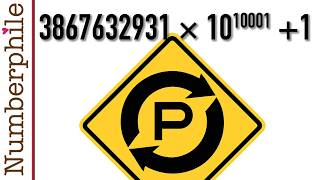
A new record-breaking emirp (reversible prime) has been discovered: 3867632931 × 10^10001 + 1. Numberphile's Matt and Steve discuss the discovery, how it was found by an enthusiast using PrimeGrid, and the open question of whether emirps are infinite.
An emirp is a prime number that is also prime when its digits are reversed. Example: 1021 is prime, and 1201 is also prime.
The new emirp has 10,011 digits, beating the previous record of 10,007 digits.
The prime is expressed as 3867632931 × 10^10001 + 1, which is a 1 followed by 10,001 zeros, with 3867632931 prepended and a 1 appended. The reverse is 1 followed by zeros and then 1392367683.
Stefan, an enthusiast, discovered the prime using PrimeGrid and custom C code. He combined PrimeGrid's algorithms with his own sieve to search for emirps.
Matt compares primes to an orchard: different trees (types of primes) have fruit at varying heights. This emirp was medium-low hanging fruit, attainable by an enthusiast.
Whether there are infinitely many emirps is an open problem. This could be the last emirp ever discovered.
The discovery highlights how amateur mathematicians can contribute to number theory using distributed computing and customized algorithms. The existence of infinitely many emirps remains an open question.
What is an emirp?
A prime number that is also prime when its digits are reversed.
00:46
How many digits does the new record-breaking emirp have?
10,011 digits.
02:10
What is the expression for the new emirp?
3867632931 × 10^10001 + 1
03:19
Who discovered the new emirp?
An enthusiast named Stefan using PrimeGrid and custom code.
05:23
What programming language did Stefan use for his custom sieve?
C code.
06:03
What is the reverse of the prefix 3867632931?
1392367683
04:38
Is the infinitude of emirps a solved problem?
No, it is an open problem; we do not know if there are infinitely many emirps.
09:49
Definition of Emirp
Clearly defines the key concept of the video.
00:46New Record Length
Quantifies the achievement with a specific digit count.
02:10Structure of the Prime
Shows how the prime is constructed, making it easy to remember.
03:19Discovery by Enthusiast
Demonstrates that amateurs can contribute to mathematics using distributed computing.
05:23Open Problem on Emirps
Highlights the ongoing mystery and potential for future discovery.
09:49[00:04] That's it. That's where the world's largest reversible prime was found in there. Today, ready? Breaking math news. New prime. It's not often we get a new prime. Well, a new prime. It's a
[00:19] record-breaking length of prime, but only of a certain type of prime. And only of a certain type of prime. And it's the same type of prime as 1,21. That is a prime number. We call it a prime. But more than that, this is a
[00:33] prime. But more than that, this is a special type of prime. This is an M Herp prime. And do you want to have a guess what an EMURP or MER prime is? >> Look, it says on the box, doesn't it? >> It really does.
[00:46] >> It's a prime backwards. There you are. Very, very funny mathematicians. Well done. Haha. It's a prime, which is a prime in both directions. So the number prime in both directions. So the number 1 0 2 1 is also prime. So because the
[01:02] digits forward and the digits backwards are prime, it's an emote prime for prime >> That's nice. >> Also works for 1,193. ready. Now you can see there's already going to be some constraints on what
[01:17] going to be some constraints on what makes an EMP because it's got to be odd beginning and end. Can't be five beginning and end. So you you're going beginning and end. So you you're going to rule out a lot like being prime is
[01:29] >> Two. >> What about two? >> Yeah. >> Two is the special prime. >> That's the same forward and backwards. >> Mhm.
[01:42] >> All one digit primes primes. Anything palendroic 101 palendroic prime. I I think to be emurp you really it has to be not a palendrome but stays prime both ways. I feel like
[01:56] that's I think palendromes are their own special thing. So I would say two is a special. So anyway to complete that 3 911 is also prime. So you can check >> Nice. >> Um and a record-breaking
[02:10] emote prime was discovered. It has 10,01 digits, beating the previous record of 10,07 >> Okay. >> It's not a lot. And would you believe I
[02:26] >> It's not a lot. And would you believe I have already memorized all 10,1 digits? >> You [laughter] would believe that. And you believe it for a very good reason that it's very easy to memorize. It's So, originally I
[02:39] was like, "Oh my goodness." uh massive record-breaking emote prime and when I got the news so the person Stefan who found it emailed me to say found a new prime and I'm like I love the fact I am the lightning rod for people to email
[02:52] when they discover new primes and I happen to be in a van with alien of number file fame we both got very excited we're like how long would it take to say it could you then reverse you saying it to still say a prime
[03:06] you saying it to still say a prime number yes and then we realized saying it would be super boring. So, without dragging it out any longer, let's have a >> It is >> Hey, what are you looking at? You said
[03:19] you'd memorized it. >> Let me rephrase that. Uh, I could >> let me show you the I'll show you the number and you get the idea. It is 3 number and you get the idea. It is 3 bill867,632,931*
[03:40] [laughter] What you have here is 10 to the power of What you have here is 10 to the power of 10,0001 means a one followed by 10,01 zeros and then you multiply this on the front. So what that ends up looking like
[03:56] front. So what that ends up looking like is 3 8 6 7 6 3 2 93 1. Then you start 00 0 dot dot dot dot dot zero's for day 0 0. But then the plus one comes in
[04:09] 0. But then the plus one comes in clutch. Boom. So that actual stretch in clutch. Boom. So that actual stretch in the middle there that is going to be uh 10,000 zeros. That's the easiest bit to remember. So,
[04:22] if you lock in these digits on the top and then say zero 10,000 times and then say one, you're done. The question now is, well, hang on. It's got to be a reversible prime. So, you just flip the whole thing around. Now, you can write
[04:38] it out the fancy way. So, the fancy way is 10. So, now the 10,10, so that's going to give us 1 followed by 10,10 zeros. So that's 10,011 digits
[04:51] including that lead one which is the record-breaking length. But then on the end you add the reverse of this. So then you add on 1 3 9 2 oops 3 6 7 6 8 3 and
[05:07] that gives you your number. So, so just to you know for complete that's now a one followed by a 0 0 0 dot dot dot dot dot 0 0 1 3 9 2 3 6 7 6 8 3 and done.
[05:23] >> Yeah. >> Who uh how was this done? Who like was with a computer. >> It's done with a computer. So we have talked about this many years ago on number file um prime grid cuz not many
[05:37] people do prime grid. I mean I do as I speak. There is a computer in my office that I built solely to run prime grid and I used to have a server called Calculus Prime which is very sadly was decommissioned when I moved office. It
[05:49] was getting very old and adding a trivial amount of compute power these days. And someone called Stefan got involved in Prime Grid. Got very excited Realized that maybe they could break the record for emers. So they wrote their
[06:03] record for emers. So they wrote their own prime civ. So, it's a way of like you use numbers that aren't primes to kind of build up where all the primes previous primes get removed. You civ them out. They wrote their own terrible
[06:16] prime civ their words, not mine, in CC code. And then they also used some of the offthe-shelf prime algorithms on Prime Grid. So, if you go on Prime Grid, there's a page which is basically excellent prime algorithms and
[06:31] they picked two of those and used them as well. And then they just started doing it. So you search for different combinations of these and then different lengths of zeros and then just chuck a one on the other end. And if you find
[06:44] one that works this way around, you whoop and you check it the other way around. And these are nice compact ways to to phrase them. You set that code actually don't know how long Stefan was waiting. And it spits out one of these
[06:58] and you email it to me. That [clears throat] seems to be the entire journey. I thought about emailing Matt right at the beginning. I was like, "Yeah, okay. I will I will do it someday." Right. F first person I I told
[07:10] someday." Right. F first person I I told was my girlfriend. She was like, "Cool." she into this stuff? >> She she's not into this stuff. She She thinks it's it's pretty cool that I found something, but um she really can't
[07:25] found something, but um she really can't um yeah see the the nerdy value of of these kind of numbers. >> Was this lowhanging fruit? primes, you said >> Yes. Yes. You
[07:39] you can think of numbers and primes as like an orchard and not all trees are equal and like the just the generic prime tree. That's amazing. And everyone >> That's the magic far away >> magic far away tree. Um but everyone's
[07:55] a little bit of fruit right at the top. But then [laughter] above the threshold. Correct. Correct. regard. But then there are other trees with less appealing fruit that may be
[08:08] lower down. And what you're going to do is trade off the appealingness of the fruit with the distance from the ground. And I wouldn't say this was lowhanging And I wouldn't say this was lowhanging fruit. I'd say medium medium low, but
[08:21] very cool type of number. I mean, we're making a video about it. People are don't make a video. But this I was like, that's cool. People wouldn't know about that. and it was within reach of Stefan just being an enthusiast putting some
[08:34] code together and being able to to find one. And what I really like about it was an enthusiast who decided to give it a go. It was a combination of self-written code or be in C which is far more efficient than Python not to
[08:50] throw shade on Python um and the shoulders of giants. So taking the giants can reach further up the tree. And so by taking the uh algorithms prime grid and applying them with their own civ, Stephan was able to do this.
[09:06] And that collaboration of prime grid which is just like a huge collaborative amount of human intellect gone into it and a little lone warrior getting the >> You really ran with that fruit analogy. >> Thank you. I didn't realize I didn't
[09:20] realize how much how much juice was available in that analogy. available in that analogy. >> Show me the computer that did it. under the >> Yeah, it's it's the mini computer with
[09:33] like uh eight cores. >> That's it. That's where the world's largest reversible prime was found in there. or e-urpers? >> I don't know. Um, I just stick with the
[09:49] wording reversible. >> Are there an infinite number of emers according to Wikipedia? Open problem. We don't know. This could be the final e-urper. Imagine. Wouldn't that be special? Now,
[10:03] that would be top of the tree. We don't know how big the tree is in this case. This could be the last run. Isn't that incredible? So, yeah. Uh, open problem. You could try and find a bigger one or I don't know if there's a way. There might
[10:17] be some kind of statistical argument about what percentage of primes, but if done the proof by now. There might be. I don't know how hard that would be to be honest. Again, a lot of lowhanging proofs like that are done. And the fact
[10:30] that Wikipedia says no one's managed to prove one way or the other yet probably means it's a slightly difficult proof to be able to do. So, there you are. That's be able to do. So, there you are. That's possibly the final emote.
[10:43] I reckon there's another one. Nah, I think that's it. Here on number five, we show you a lot of freakish cool things in mathematics like biggest prime in mathematics like biggest prime numbers. But to make these discoveries,
[10:55] you need the foundations. You need to understand how mathematics works, how to code, all that kind of stuff. And for me, you know, it's been a long time since I learned that back at high school. And if you want to get those
[11:08] skills or you want to get them back, a really good place to go is today's episode sponsor, Brilliant. [music] Brilliant is jam-packed with courses that are highly interactive, engaging,
[11:21] and frankly just good fun. You'll get smarter with a smile on your face. But the thing I find exciting is that for some people, the skills and
[11:33] knowledge they're taking on could lead to new career paths, new opportunities. It could be the start of something really big. To learn for free on Brilliant for a full 30 days, go to brilliant.org/numberfile
[11:46] or scan that QR code there on screen or description. Brilliant's also giving our viewers 20% off an annual premium subscription which will give you unlimited daily access to everything on
[12:00] their site and apply new I guess and [music] uh yeah with with the with these kind of prime numbers there is no software to see for them so um I try with my limited
[12:15] programming skills as as Matt um says all the time it's like terrible Python code In my case, it's terrible CC
⚡ Saved you 0h 12m reading this? Transcribe any YouTube video for free — no signup needed.