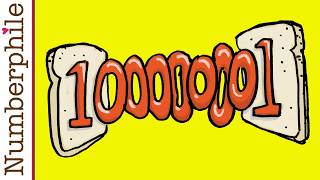

100M+1 is divisible by 17? Mind-blowing!
43sThe unexpected simplicity of a huge number's divisibility sparks curiosity and shares widely.
▶ Play Clip"Delivers the promised fact and expands into an open math problem — excellent content density."
A Reddit post about 100000001 being divisible by 17 leads to an exploration of 'zero sandwich' numbers (10^n + 1). The video reveals surprising patterns, such as every second zero sandwich being divisible by 11, and ultimately uncovers an unsolved problem in mathematics: whether any zero sandwich beyond 101 is prime.
A Reddit post claims that 100000001 (100 million and one) is divisible by 17, which is confirmed by calculation.
100000001 / 17 = 5,882,353. The result is demonstrated.
Numbers like 101, 1001, 10001 are called 'zero sandwiches' – a 1, some zeros, and a 1. 101 is prime.
1001 is divisible by 7 × 11 × 13.
Any three-digit number typed twice (e.g., 417417) is divisible by 13 and 77 because it's 1001 times the number.
Every second zero sandwich (even number of zeros) is divisible by 11.
The zero sandwich with seven zeros is divisible by 17 again (17 × 5,882,353).
For any integer x and odd y, x^y + 1 is divisible by x + 1.
Zero sandwiches can only be prime if the number of zeros is one less than a power of two (i.e., n is a power of two in 10^n + 1).
No prime zero sandwich beyond 101 has been found; it is an unsolved problem in mathematics.
A simple divisibility observation leads to deep number theory and an open problem about prime zero sandwiches, demonstrating how small curiosities can uncover unsolved mysteries.
What is 100000001 divided by 17?
5,882,353
00:45
What is a 'zero sandwich' number?
A number of the form 10^n + 1 (e.g., 101, 1001).
02:28
Is 101 a prime number?
Yes.
02:28
What are the prime factors of 1001?
7, 11, and 13.
02:56
Why does typing any three-digit number twice make it divisible by 13 and 77?
Because it multiplies the number by 1001, which has factors 7, 11, and 13, and 7×11=77.
03:08
Which zero sandwiches are always divisible by 11?
Those with an even number of zeros.
06:11
What is the condition for a zero sandwich to have a known factor from the x^y+1 rule?
If the exponent n has an odd factor, then 10^n+1 is divisible by 10^k+1 where k is that odd factor's cofactor.
13:34
What type of zero sandwiches are candidates for being prime?
Those where the number of zeros is one less than a power of two (i.e., n is a power of two).
17:25
Is it known whether any zero sandwich beyond 101 is prime?
No, it remains an open problem in mathematics.
18:33
Up to how many zeros have been checked for prime zero sandwiches?
Up to about 1,048,575 zeros (2^20 - 1) as of the website's last update.
19:05
Divisibility by 17
The initial claim that 100000001 divides by 17 is verified with exact calculation.
00:45Zero Sandwich Definition
Introduces the concept of zero sandwich numbers that form the basis of the exploration.
02:28Pattern with 11
Spots a clear pattern: every second zero sandwich is divisible by 11.
06:11Odd Exponent Divisibility Rule
A key algebraic fact that explains why many zero sandwiches have known factors.
13:34Only Power-of-Two Candidates
Narrows down the search for prime zero sandwiches to a very sparse set.
17:25Unsolved Problem
Reveals that the existence of another prime zero sandwich is an open question.
18:33[00:02] This video old school number file a video about one zero zero zero zero seven zeros one 100 million and one I came across this on a Reddit post on the math subreddit here it is someone asked and
[00:17] I'm going to read this as written what's the most mind-breaking thing you've encountered in math they started the conversation by saying oh what about like calculus and complex numbers and other people down here are like talking
[00:29] uh you know advanced bits of mathematics and then one person just jumped in with that the number 100 million and1 is divisible by 17 and then they dipped. [laughter] That's I just love like that feels so comically underpowered for
[00:45] everything else that's going on in that conversation. Uh but they're right. They're right. Let's just do do the math. One, two, three. Divide that by 17 math. One, two, three. Divide that by 17 equals 5,82,353.
[01:04] >> I don't know. I I That's what I was wondering. I was like, "Huh? Well, what you What are you What would you expect from a number like this?"
[01:16] I like it. It's cute. It's a cute number. And 17 is also rather an I'm not >> It's a quirky prime 17. away. >> Blown away. Yeah. Yeah. No valid point.
[01:30] So I was like, okay. I mean, a lot of numbers divisible by 17. I mean, 117th of numbers. But I was like, you know what? This I couldn't find a name for this type of number. A bunch of zeros with a one on each end. There's no
[01:43] >> I mean, it's a palendrome. >> It is a It's a palendrome. Correct. But it's like a one like a zero sandwich. It's a very sparse binary number just then I was like, "Okay, well, what was I expecting? What are the other numbers
[01:58] like this do?" >> The the other one sandwiches >> Yeah. >> Because I do like zero sandwich, but >> Yeah, exactly. It's not It's not quite right. And a rep unit is where it's all
[02:13] ones. >> It's like the fewest number of ones and the rest are zeros. I think we can call it a zero sandwich because do you reckon >> Yes. Yes. One looks like bread. >> One and a one zeros. Zero sandwich. So
[02:28] >> One and a one zeros. Zero sandwich. So the null sandwich 11 is prime. I was to write prime next time." The the first non-trivial zero sandwich 101 is prime. So I was like, "Ah, interesting. Interesting." That may maybe the reason
[02:43] this could be amazing is because you expect it to be prime, but it's not. It's got 17. No one saw that coming. Um, and then then it starts to break down a and then then it starts to break down a little. So 1,01 is not prime. It's
[02:56] little. So 1,01 is not prime. It's divisible by 7 * 11 times 13. There's it prime factors, which are kind of fun. They're all fun. They're they're they're mediumsiz primes, I guess, in that situation. Do you want a side math
[03:08] situation. Do you want a side math trick? Always. students. This is the staple of kind of calculator tricks you can do. So you ask would you like, Brady? Any three-digit number.
[03:22] >> 417. So you get people to type any number they want into a calculator. And then you say, "Oh, just type it again." So uh 417. So now you got 417 417. And you're like, "I don't know. You could have
[03:34] picked any number. I couldn't control that, but I predict that's divisible by 13." I was like, "What?" And you divide it by 13 and it is. And you're like, "Ah, whatever's left is divisible by 77." And you're like, "No way. Divide
[03:49] that by 77." And it is. In fact, you got your original number back. It's because any three-digit number, if you type it in twice, is that three-digit number multiplied by 101? And so, it's a hidden multiplied by
[04:03] saying, "Oh, you could have picked any number." Yeah. But then you by saying, "Type it in twice." You're saying, "Pultiply by 10001." And then you're but it's divisible by the factors of 101." And of course it is because that's
[04:17] >> And there's your 77, your 13. >> Yeah. So I And you can clump them together however you want. I like I like 13 and 77, but you could have done 11 and then seven if you want to string it out. And this trick would work for any
[04:29] of these, any any zero sandwich. You could say, "Give me could say, "Give me any eightdigit number. Type it in twice. You're like, "Would you believe it's divisible by 17?" They're like, "What?"
[04:45] multiplied it by 10 million or one. >> And it would also be divisible by Yeah. Yeah. [laughter] All the prime factors of that, although that's prime. factors of that, although that's prime. It's just those two. [music]
[04:59] not? What am I expecting here?" So, I wrote some code to just go through them >> Go through all the sandwiches. >> Yeah. and pull out the prime factors. So, let's put a couple more in here. How would we do sandwich notation? Like how
[05:13] it a bit more understandable. >> I would put like maybe the um the zero the like a rectangle or a square and then put the number of zeros in there. inside it.
[05:28] >> Would that work? Like so. So, let's say the next one is one zero one, but work? >> I like it. Yeah. >> that's even better. >> Okay, we'll do that. Okay, so 10,01
[05:42] >> Three zeros >> is 73 >> is 73 * 137. And the next one up, four zeros * 137. And the next one up, four zeros is 11. Oh, 11's back. Time
[05:57] 091. That's prime. Okay. Okay. You know what? Uh, I'm seeing 11 has appeared twice. That's interesting. And 11 is one of these numbers. Let's see if anything else drops out that we um we think is an
[06:11] interesting pattern. I'm still trying to find something mind mindbreaking about prime at some point. >> It feels like it, doesn't it? >> Where's it going to be? >> Next one. Get ready for this. Now, this
[06:24] is where I thought this is getting interesting. 101 times 9 01. I was like, "Okay, there's like I'm starting my my math pattern senses are >> This is interesting." And this is similar. And we've now had our first two
[06:41] >> Yeah. Yeah. >> Interesting. The the fact that these later sandwiches are multiples of smaller sandwiches. Curious. So, what >> This is your code. >> This is my Well, this is this is the
[06:55] ran it. Oh, this is the number of seconds it took to do each number been running for because it got this far and just wouldn't go any further. So, I swapped to a better prime factor um library and then ran it for longer. And
[07:10] >> It's still running now. >> It's still trying to do 94. So, these numbers, we could rewrite them as 10 to the power of n + one.
[07:22] >> And that would be a zero sandwich with n minus one zeros in the middle. And so the side over here so I can keep track of what what size I'm up to. >> So your side numbers here are actually >> one bigger than the sandwich number. And
[07:37] that's just because I was just printing the value of n I was ticking up through. And at the moment we're doing n= 94 >> 93 in the zero. case. >> This is pretty big. Pretty big. So here
[07:50] you can see five zeros. We just did. That's 101 times this. Then you get That's worthy of putting on the sheet. Let's have a closer look at what's going on there. So, the six zeros, we're back to 11 again, and it's times 9 090
[08:08] 91. I'm like, oh, that's that's definitely something happening here. And every second one has an 11 now. So, there's our first fun pattern that I spotted. And if you look at the the cheat notes
[08:22] over here, every second one has 11. 11 11 11 11 11 11 11 11 11 11 11 11 11 11 11 11 11 11 11 11 11 11 11. So obviously every second one is a multiple of 11. now. >> Okay, but Oh, but the next one down.
[08:35] Let's You know what? Let's just do the next two just so we have them. Seven and next two just so we have them. Seven and eight zeros. And seven is going to be 17 eight zeros. And seven is going to be 17 by 5 8 2 3 5 3. We've hit this again.
[08:49] And I've switched to just doing lists of primes. I'm not going to write multiple primes. I'm not going to write multiple each time. That's 7 11 13 19 5 2 579.
[09:01] each time. That's 7 11 13 19 5 2 579. We have our pattern of every second one is multiple of 11. But before we had this fun number that was 9091 9091
[09:13] and we haven't got it here unless it's unless it's hidden in here. Hang on. Let's if we multiply some of these together. Let's times it by 19. and see together. Let's times it by 19. and see what we get. Oh, that's it. That's
[09:26] what's going on there. Very interesting numbers. Oh, also if you multiply these together, you get 1,0001. Again, if you multiply these together, that was our crazy 9999 01. So, interesting things happening.
[09:42] There are some patterns in the factors. There are some kind of recursive thing going on where we're seeing them reappear as we go down. So these are two different avenues we could explore to see if it's mindbreaking. We could
[09:56] either try and work out why every second one's 11 and then maybe how many 17s we're going to get or we could try and work out why we're seeing the previous leftover sandwiches, if you will. >> Let's do the first one first.
[10:10] >> What's with the 11s here? >> The 11s. Ter, let's get some new paper cuz this is going to be a little sketchy. [music]
[10:22] I've got this uh paper weight we can use to hold that down. Oh, what's that? >> Oh, just something I had lying around. >> What language is that? There you are. Isn't that great? I mean, who would leave translations of their
[10:35] who would leave translations of their books just sitting around? [music] Okay, here we go. Here we go. Let's pull apart uh the 6 sandwich. So that's 10
[10:48] apart uh the 6 sandwich. So that's 10 million. 1 2 3 4 5 6 and one. That's >> Now, we already know that's a multiple of 11, but let's say we didn't. We're This is basically a bunch of 11s
[11:02] start by just taking one of them off. So we're going to subtract 11 from the we're going to subtract 11 from the whole thing. So 11 is 10 and a unit, right? So we're subtracting a unit and then we got to subtract the 10. So this
[11:15] is basically remove that it's 10 million - 10 and 10 million - 10 is 9,999,90.
[11:30] because 99 is a multiple of 11. Then 99 of 11. So because we got a we can look at as a bunch of 99s and each 99 is 9 * 11. So you could think, oh, I just divide through by 11. So that 99 just
[11:46] divide through by 11. So that 99 just becomes nine. That 99 becomes nine and becomes nine. That 99 becomes nine and that 99 becomes nine and the zero on the end. Oh, but we did subtract one lot of 11. So actually this
[11:58] is why this original number that whole thing there is a multiple of 9 09091 99. So that basically multiplying by 11 turns this into all nines. and then
[12:14] turns this into all nines. and then adding the extra 1* 11 puts the unit on the end and the 10ens rolls all the way up turning them all into zeros and puts a one on the lead. So that's why if you start with 90909 and then a one on the
[12:27] start with 90909 and then a one on the end multiply by 11 you get a sandwich number as a result. We've kind of looked at it the other way around, but I'm like, "Oh, okay. That kind of I understand now why every second one is a
[12:40] multiple of 11 because each time you increase it by an extra 09, that's ends up being two more zeros in your sandwich. >> So, as long as that as long as the number of zeros is even
[12:55] >> Okay. >> And that and that's enough to give you a zero sandwich. So we'll never get a prime with an even number of zeros. >> Correct. We've now managed to remove every second one all the way down apart
[13:08] from the null sandwich which is is that technically is zero even? Let's not open that now. Um they're prime and then after this we've removed every second one all the way down. So now we're like okay if there's going to be another
[13:21] prime it's got to have an odd number of zeros in the middle. But let's have a look now at the fact that we see them appearing again as we go down. Although there wasn't one in here, which is interesting. Let's draw that. And we're
[13:34] going to use, and you're going to have to trust me on on a weird math fact. If you've got some whole number x and you raise it to the power of some whole number y, and you add one, that is always divisible by x + one. If if if
[13:52] and only if best type of if y is odd. There's my fact fun fact. Now actually let me just triple check I got that run the right way. Yes. Correct. Great. And the reason that's useful for us is we were the
[14:06] other way of writing sandwich numbers is it's 10 to the^ of some n [snorts] it's 10 to the^ of some n [snorts] uh plus one. And so this is a very in this form and you're like this is telling us something about when
[14:21] something to the power of something plus one is not prime because it's always divisible by this plus one. So we're like okay that's interesting but the constraint is y has to be odd. So what does that mean for our n? Well,
[14:34] sometimes n is going to equal well, it's going to equal some other number times an odd number. So that that k could be anything number. So that that k could be anything and y is odd. And in those cases, 10 the
[14:49] and y is odd. And in those cases, 10 the n we can now say is 10 the k * y + 1. Tidy that up a little bit. I mean that's 10 to whatever k is to the power of y +
[15:01] one. So we've put it back into this form where now x is 10 the k. where now x is 10 the k. This will always be divisible by our x This will always be divisible by our x is 10 the k + 1. Now to recap in normal
[15:17] is 10 the k + 1. Now to recap in normal language if your sandwich number is of the form 10 to the power of some number that's a multiple of an odd number and then plus one because that's our sandwich. that's always divisible by
[15:31] 10 to the power of whatever you're multiplying your odd number by plus one which is another sandwich number. So any sandwich number where the n is a multiple of an odd number is always divisible by another sandwich number
[15:45] obviously. >> So we now know a sandwich number will >> So we now know a sandwich number will never be prime if that n has any odd factors at all. And that's why we keep seeing other sandwich numbers either
[16:01] clear because they happen to be prime. So 11s and 101s we always see the other as their prime factors. So if you look down my list here if you pick an earlier one like up here we've got like uh where's there's a look at look at this
[16:16] one. All these numbers here but that 52 579 kind of sticks out. So down here those factors have appeared again because that sandwich number appears as a factor in this sandwich number because that power is a multiple of a odd number
[16:30] that's a multiple of three. And so every single one of these if there's any odd factors over here will have other sandwich numbers hidden in the factors. >> Somewhere. And the only ones we see explicitly are 11 and 101 cuz they're
[16:43] pieces. >> Yeah. ingredients. Yeah. >> Um like we saw before. So now we have to say well hang on which sandwich numbers are going to have a value of n that
[16:56] doesn't have any odd numbers in powers of two because the only way you can of two because the only way you can avoid odd numbers is to only use two and that's it. Otherwise there's a odd in there somewhere. So if you would look
[17:11] going to have a hidden sandwich number in their factors is going to be early on. It's going to be eight. And that's why, oh, this is mindbreaking. That's why there were no sandwich numbers in the very first one we looked at because
[17:25] and that's a power of two. So, there were no no sub sandwiches. And then down here, 16. There's no sub sandwiches hidden in that one there. That's all hidden in that one there. That's all that's all legit. And then 32. And then,
[17:38] there. They're the interesting ones, but they're not primes, though. So, these are the only candidate primes. But all the ones I got down to 64 and it had look at the look at the size of these. Look at that prime factor. That's nuts.
[17:52] Look at the size of it. So there is still the possibility of finding a prime >> Yeah. >> But the but the number of zeros is going haven't found one yet. >> The number of zeros will be one less
[18:08] >> One less than a power >> because this is this the 10 to the thing includes the one on the end >> of course. So it would be a mercen >> A merren number >> not necessarily a mer prime just a
[18:21] mercen number is adequate. So we just need to check the sandwiches with a mer number of zeros and they're the only possible candidates for being prime and possible candidates for being prime and I got down to two to the uh six and then
[18:33] my code hasn't I haven't got to 128. >> But has anyone else looked? It turns out >> But has anyone else looked? It turns out yes and we haven't found any >> It's open. >> It's an open question in mathematics. We
[18:49] do not know if there are prime sandwiches but we've not managed to >> other than >> other than other than the Yeah, we get these and then we don't know. >> There you go. Open question. So that's
[19:05] searched up to? >> Great question, Brady. Would you believe someone was keeping track of it on a website that went offline at the end of 2014? I used the Wayback Machine. Let me show
[19:20] you. So, you know what? I actually haven't checked who our buddy Wilfred Caller is, but they were maintaining this um on the University of Hamburg's website up until late 2014. I hope they're okay if we will check. and they
[19:36] they this was the progress. >> So their notation f of 4 means that's >> So their notation f of 4 means that's the sandwich number where n is 2 ^ 4 and they they've generalized this. They weren't looking at sandwich numbers.
[19:49] They're just looking at ones where the base is 10. So this notation means 10 to base is 10. So this notation means 10 to the power of 2 ^ 4 + 1. And they're the prime factors. And we got as far in my code. This is that number I showed you a
[20:03] code. This is that number I showed you a moment ago. That's as far as I got. And then they've done the sandwich number with 127 zeros, the sandwich number with with 127 zeros, the sandwich number with 255 zeros, and then all the way down
[20:17] to Oh, by the way, they switched to this notation where P16 just means a prime with 16 digits. So I um I I I then I found that prime to >> 116 or 16? >> Sorry, 116 prime here. that's got 116
[20:33] [clears throat] bothered typing out all 116 digits. I mean, I went >> Maybe it means composite. >> Maybe it's composite. And then I was like, maybe yeah, maybe this means there's a composite number with 473
[20:46] digits that I haven't fully checked that we go all the way down to uh two to the^ like coming up for a million zeros. That
[20:59] coming up for a million zeros. That would be a sandwich with 1,48,575 zeros. That's a big sandwich. So, we now know just above a million zero sandwich,
[21:12] not prime. But, as far as I can tell, no one's checked the next one up. from a number I saw on Reddit and we ended up with a um unsolved problem in mathematics. Maybe you could solve it. >> Well, me or that person?
[21:27] >> Just a camera. It's great hearing from people who are experts at math, but do first step to really upping your mathematical game could be these amazing courses on Brilliant. Learn by interacting, [music] by actually solving
[21:42] problems. Build a deeper understanding of all aspects of mathematics and do it in an environment personalized to your interests, your journey, the places you interests, your journey, the places you want to take it. Anyone for calculus?
[21:56] I'm always so impressed by the design of Brilliant. You can tell it's been made their stuff. Brilliant believes something I've always agreed with. Everyone is a math person. It's the way we learn about it that can make it feel
[22:09] we learn about it that can make it feel tricky. To learn for free on Brilliant, go to brilliant.org/numberfile or scan that QR code on screen or click the link in the video description. Brilliant also gives our viewers 20% off
[22:22] an annual premium subscription, which gives you unlimited access to gives you unlimited access to everything.
[22:37] forget? >> I want to win my own prize. >> Any >> oat milk applied by eye? Do you ever >> oat milk applied by eye? Do you ever like drizzle like a bit honey or No. No.
⚡ Saved you 0h 22m reading this? Transcribe any YouTube video for free — no signup needed.