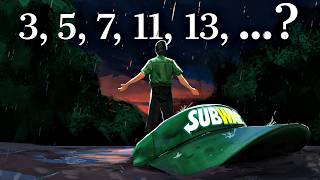

The Unknown Mathematician Who Shocked the World
45sThe story of an unknown Subway employee submitting a proof to a top math journal creates an irresistible underdog narrative.
▶ Play Clip"The title accurately reflects the video's deep dive into the twin prime problem and its history."
The video explores the history and mathematics behind the twin prime conjecture, which posits that there are infinitely many pairs of primes separated by two. It covers key attempts to prove the conjecture, from Viggo Brun's sieve to Yitang Zhang's breakthrough showing a bounded gap of 70 million, and James Maynard's subsequent improvements. The narrative highlights the interplay between heuristic reasoning, rigorous proof, and the role of unknown mathematicians.
In 2013, the Annals of Mathematics received a proof from an unknown mathematician, Yitang Zhang, claiming a breakthrough on the twin prime conjecture.
Twin primes are pairs of primes separated by one number (e.g., 11 and 13). The conjecture states there are infinitely many such pairs.
In 1923, Hardy and Littlewood estimated the density of twin primes using the prime number theorem, predicting the count grows like N/(log N)^2.
Brun adapted the sieve of Eratosthenes to twin primes, but error terms grew too fast. He proved there are infinitely many pairs with at most nine prime factors.
In 1973, Chen Jingrun proved there are infinitely many primes p such that p+2 has at most two prime factors, the closest approach to the conjecture.
Goldston, Pintz, and Yildirim developed a method using a stencil to find primes within bounded gaps, but their weighted average could not exceed one due to the level of distribution limit.
Zhang focused on step sizes with only small prime factors, reorganizing error terms to cancel out, pushing past the half barrier by 1/584.
Zhang proved a bounded gap of 70 million, showing infinitely many prime pairs within that distance.
Terence Tao's Polymath project reduced the gap to 4,680. James Maynard independently developed a method that lowered it to 600 and later to 246.
The unconditional record is 246. Assuming the Elliott-Halberstam conjecture, the gap can be reduced to 12 or even 6.
The twin prime conjecture remains unsolved, but progress has been made through sieves, the GPY method, and Zhang's breakthrough. The current unconditional bound is 246, and further improvements may require new ideas.
What is the twin prime conjecture?
There are infinitely many pairs of primes that differ by 2.
01:06
What is the average gap between primes near N?
Approximately the natural logarithm of N.
01:41
What did Viggo Brun prove about twin primes?
There are infinitely many pairs of numbers two apart where each number has at most nine prime factors.
16:31
What is Chen's theorem?
There are infinitely many primes p such that p+2 has at most two prime factors.
16:56
What is the level of distribution (theta) in the context of primes?
It indicates how large step sizes can be while still reliably counting primes in arithmetic progressions.
28:50
What was the key insight in Yitang Zhang's proof?
He focused on step sizes with only small prime factors and reorganized error terms to cancel out, pushing past the half barrier.
30:41
What bounded gap did Zhang prove?
70 million.
32:16
What is the current unconditional record for the bounded gap between primes?
246.
36:45
What is the Elliott-Halberstam conjecture?
It assumes primes are spread evenly across arithmetic progressions, allowing a level of distribution as large as 1.
37:56
What gap can be achieved assuming the Elliott-Halberstam conjecture?
12, or 6 with a stronger version.
38:09
Zhang's Email
A pivotal moment where an unknown mathematician submitted a proof that would change the field.
Hardy-Littlewood Heuristic
Shows how probabilistic reasoning can guide number theory, despite not providing a proof.
03:13Chen's Theorem
The closest unconditional result to the twin prime conjecture for decades.
16:52Zhang's Backyard Insight
A dramatic example of a breakthrough occurring away from the desk, challenging groupthink.
30:41One Half Was a Mirage
Maynard's method showed that the previous barrier was not fundamental, changing the approach to the problem.
35:16[00:00] - [Derek] On the morning
[00:02] the journal Annals of Mathematics
[00:06] It claimed to contain a 50
[00:09] of the oldest unsolved
[00:12] A problem that great
[00:15] called unattackable.
[00:18] But this proof didn't come
[00:21] it came from an unknown.
[00:23] (bright music)
[00:25] Someone who had once spent years working
[00:27] at a subway restaurant.
[00:29] - So, they're like, okay,
[00:30] surely this isn't gonna
[00:32] You know, we'll send it to a referee.
[00:34] - [Derek] They expected to
[00:37] but they didn't.
[00:39] So, they went through it again,
[00:40] closely studying the fragile parts
[00:42] where a proof like this
[00:45] but still nothing.
[00:47] Soon they realized they were
[00:50] - Oh, damn, he did it.
[00:52] - So, how did he do It?
[00:54] What did the experts miss
[00:57] he was working on?
[00:58] He was working on a new way
[00:59] to attack one of the
[01:02] in number theory,
[01:03] the twin prime conjecture.
[01:06] The twin primes
[01:07] are prime numbers separated
[01:10] like 11 and 13 or 17 and 19.
[01:13] As you go up, the number
[01:16] and twin primes become rarer still.
[01:18] But the twin prime conjecture claims
[01:20] that there are infinitely many
[01:25] But is it true?
[01:26] Well, one way to approach this problem
[01:28] is to look at the gaps
[01:31] as you go up the number line.
[01:33] (bright music)
[01:34] Now, at first they seem chaotic,
[01:36] but if you average them
[01:41] The average gap between
[01:43] as the natural logarithm of the number N.
[01:47] So, for example, the average gap
[01:49] between primes around
[01:53] The average gap between
[01:57] Logarithms grow very slowly,
[01:59] but they do keep growing forever.
[02:01] So, as N approaches infinity,
[02:03] the average gap between
[02:07] which is not particularly encouraging
[02:09] if you expect to always
[02:12] that are just two apart.
[02:15] But if you start checking large numbers,
[02:17] then after a million you
[02:20] 1,000,037 and 1,000,039.
[02:24] Past a billion, there's
[02:28] In fact, we have found a
[02:31] as 2,996,863,034,895
[02:38] times two to the power of 1,290,000
[02:42] plus or minus one.
[02:44] That is a pair of numbers
[02:51] If you wanted to print those
[02:54] you would need around
[02:59] All of this is to say that
[03:02] we've kept finding twin primes.
[03:04] But of course, that is not how you solve
[03:06] the twin prime conjecture,
[03:07] because you cannot physically check
[03:09] all the numbers out to infinity.
[03:11] So, we need another way.
[03:13] And around 100 years ago,
[03:15] it felt like mathematicians
[03:17] with a more sophisticated method.
[03:20] In 1923, English mathematicians,
[03:22] Hardy and Littlewood figured
[03:25] how many twin primes there should be.
[03:27] To do it, they started with one
[03:29] of number theory, the
[03:32] which tells you that the odds
[03:33] of a large number near N being prime
[03:35] are roughly one over the
[03:39] So, let's do a quick example
[03:43] Say you wanna find the
[03:47] Well, you just plug that in
[03:49] and find that it has about
[03:51] chance of being prime.
[03:53] Of course, you could use the same trick
[03:54] to find the odds that 137,039 is prime,
[03:58] which is also around 8.5%.
[04:02] So, what are the odds that
[04:05] Well, you just multiply
[04:07] that gives you around a 0.7% chance.
[04:10] Now we are simplifying a little here
[04:12] because we're assuming that
[04:15] which they're not.
[04:16] But putting that to one side,
[04:18] the odds of both a large number N
[04:20] and N plus two being prime,
[04:22] is one over ln(n) times
[04:26] for large N the plus two is insignificant.
[04:29] So, we get the odds of any pair of numbers
[04:32] of size N being a twin prime
[04:34] are roughly one over ln(n) squared.
[04:38] But of course, the
[04:40] is that the odds of a pair
[04:43] as you go to larger numbers.
[04:44] So, to count all twin primes up to N,
[04:47] we add up the odds at
[04:49] In other words, we
[04:52] from the first prime
[04:55] Now Hardy and Littlewood
[04:58] to account for the fact that primes
[04:59] aren't really independent.
[05:01] But all that added is just
[05:04] So, the final expression looks like this.
[05:07] (bright music)
[05:08] Now let's plot how many twin primes,
[05:10] this predicts up to 1 trillion.
[05:12] We see that it keeps growing
[05:13] and if we fill in the actual count,
[05:16] you'll notice that it is extremely close
[05:20] to the point where by 1 trillion,
[05:21] our estimate is only off by 0.001%.
[05:26] (bright music)
[05:29] - The only issue though, is
[05:33] or what mathematicians call a heuristic.
[05:36] It can tell you roughly how
[05:39] but it can't guarantee that they never stop.
[05:42] As Terry Tao puts it, for all we know,
[05:45] there could be this fast conspiracy
[05:47] that every time a number
[05:50] it has some secret agreement
[05:52] with its neighbor N plus two saying
[05:54] you're not allowed to be prime anymore.
[05:57] So, what we need is a rigorous
[06:02] but finding such a proof
[06:03] it turns out, is extremely difficult.
[06:07] One of the first mathematicians
[06:08] to really try was a 29-year-old
[06:12] (bright music)
[06:14] Brun was working during the early years
[06:16] of the first World War,
[06:17] and with travel disrupted
[06:19] and Europe's mathematical
[06:22] much of his work happened in
[06:27] His goal was simple to try
[06:30] or count of twin primes always increases.
[06:33] And to do this, he took a 2000
[06:37] and tried to adapt it for twin primes.
[06:39] Now the normal version
[06:41] the sieve of Eratosthenes, and
[06:46] (bright music)
[06:47] Say we want to find the primes up to 100.
[06:50] First we remove one
[06:53] Then we circle the first
[06:55] and we remove all of its multiples.
[06:58] We do the same for three.
[06:59] Circle it and remove its multiples,
[07:02] (bright music)
[07:03] and then repeat that for five and seven.
[07:06] And with these four very quick operations,
[07:09] every single number that's
[07:12] is a prime number.
[07:15] Now we stop the sieve at seven,
[07:17] and we could keep going sieve by 11 or 30,
[07:21] but it turns out that we don't have to.
[07:23] So, why is that?
[07:25] Well, the next prime is 11.
[07:27] So, let's check the numbers below 100
[07:29] that are divisible by 11.
[07:31] 22 is two times 11,
[07:33] but since it's divisible by
[07:36] We also have 33, but that
[07:39] And a similar logic holds for 55 and 77.
[07:43] But what about 11 times 11?
[07:46] Well notice that is 121,
[07:51] So, every multiple of 11 below 100
[07:54] was already caught by a smaller prime.
[07:57] So, sieving by 11 would
[08:00] - So, Eratosthenes,
[08:02] has this idea that you
[08:05] the primes that are at most square root,
[08:06] the size of the number.
[08:08] - But there's also a second
[08:11] Take the number line
[08:13] and let each prime send out a
[08:16] to the size of that number.
[08:18] So, the wave from two lands
[08:21] and the wave from three
[08:24] (bright music)
[08:26] Now, notice that wherever a wave lands,
[08:29] that number has to be composite.
[08:32] But the numbers that escape
[08:34] well those have to be prime.
[08:37] And so you end up with this
[08:41] of the sieve.
[08:42] (bright music)
[08:43] And both of these methods
[08:46] to identify the primes.
[08:49] - But Brun didn't care about
[08:52] he just needed to know how many were left.
[08:55] And to do this, he counted all the numbers
[08:58] that were crossed out and then subtracted
[09:00] this from the total,
[09:01] since whatever is not
[09:05] So, let's use this to find the
[09:09] We can keep a running count.
[09:10] So, we'll start with 100.
[09:12] We're gonna throw out
[09:14] Well, that's 50 numbers left, okay?
[09:16] Then we're gonna throw
[09:18] Well, how many multiples of three
[09:19] are there less than 100.
[09:20] 100 divided by three
[09:22] It's like 33 and a third, but
[09:26] So, okay, forget that
[09:28] We do the same for the
[09:30] but now the count has gone negative.
[09:33] Well, it turns out that some
[09:36] like six for example, it's
[09:39] So, we crossed it out once when
[09:42] and again when we removed
[09:44] So, we have to add it back once.
[09:46] The same thing happens
[09:48] which is two times five,
[09:50] 14 which is two times seven,
[09:51] 15, which is three times five and so on.
[09:54] So, we add these overlaps back
[09:56] and now the count rises to 28,
[09:59] but it's still not quite right.
[10:01] - Now we've triple added
[10:04] of two times three times five,
[10:06] so that we need to subtract one more time.
[10:08] - The same thing happens for 42,
[10:10] which is two times three times seven,
[10:12] and 70, which is two
[10:15] There's a fourth triple two,
[10:17] which is 105, but that's
[10:21] So, it contributes nothing here.
[10:23] But we'll write it in to
[10:26] After the triples, we
[10:29] two times three times five
[10:32] That's also bigger than 100,
[10:34] so it contributes zero as well.
[10:36] And finally, we add back the
[10:40] and subtract one because it
[10:43] So, the count lands at 25 primes.
[10:47] This process of alternating
[10:48] between subtracting and
[10:51] is called inclusion exclusion.
[10:53] And it makes it super easy to find out
[10:54] how many primes there are
[10:58] Now this equation still looks
[11:01] but actually we can
[11:05] Now notice that every prime factor
[11:07] we added just adds an
[11:10] We've got the two that goes over here,
[11:13] the three goes over here,
[11:16] and seven goes over here.
[11:18] And if we were trying to find
[11:21] and we wanted to add 11 as a prime factor,
[11:23] it would just add one additional
[11:27] Now in general,
[11:28] if we keep the sieve
[11:31] which is less than the square root of N,
[11:33] then the count becomes approximately this.
[11:38] - But this is still just
[11:40] What Brun really wanted was
[11:43] And so this is the part
[11:47] to find a case where both
[11:51] For example, when you're sieving by five,
[11:53] you remove the numbers where
[11:56] just as before.
[11:58] But in addition, you need
[12:00] where N plus two is divisible by five.
[12:03] So, you also remove 23, 28, 33 and so on
[12:07] because in those cases, N plus
[12:13] So, this means that while
[12:16] a prime P removes about
[12:19] the twin prime sieve removes two.
[12:22] And this changes the count to this,
[12:25] where the numerator for
[12:28] ends up getting a two.
[12:31] Now, if we plot the count of
[12:34] we see that it grows roughly like N
[12:36] over the natural logarithm of N squared,
[12:39] just as for our heuristic.
[12:41] And so it seems like Brun did it,
[12:43] but unfortunately that is not the case.
[12:47] - We said that 100 divided
[12:51] but forget about that little error,
[12:52] those little errors,
[12:54] it's very difficult to
[12:56] 'cause there are so many
[12:58] Each one of them is at most
[13:00] - Take the traditional
[13:03] when we're sieving with just one prime,
[13:05] we just have an over two.
[13:07] So, one rounding error,
[13:09] with two primes, two and three,
[13:10] there are three separate rounding errors,
[13:13] but with three primes,
[13:15] there are already seven
[13:18] each for one term in
[13:22] And so you might start to
[13:25] One prime gives two to the
[13:28] two gives two to the
[13:31] and three primes gives two
[13:33] to the power three minus one terms.
[13:35] In general, if you sieve by K primes,
[13:38] you get roughly two to the
[13:42] but we can drop the one
[13:43] because it doesn't really
[13:47] So, that means that if you're
[13:49] the error grows roughly
[13:53] But if you're saving for twin
[13:56] And now the error grows roughly
[13:59] And so this causes a lot of
[14:03] (bright music)
[14:06] And then here for the twin
[14:11] The main term grows a bit more slowly,
[14:15] but the error term grows much faster.
[14:18] So, it still starts off slow.
[14:21] And so you can quickly see
[14:22] that once these error
[14:25] you get into trouble.
[14:26] So, the issue he was facing
[14:28] and the main term, you know,
[14:30] it grew in the way he wanted to,
[14:32] but then it just got overtaken
[14:34] and dominated by those error terms.
[14:35] - Exactly.
[14:36] And that's all of analysis,
[14:37] in general analytic number
[14:40] is the fight between the main term
[14:41] that you think is the truth,
[14:44] and getting the error
[14:47] - So, for twin primes,
[14:49] the main term grows roughly like this,
[14:51] something like N over the
[14:55] But that's not the true count,
[14:56] because to get the true count,
[14:57] we must add and subtract the error terms,
[15:00] which gives us this upper and lower bound.
[15:03] And now you can see the problem.
[15:05] Because the true count can
[15:08] and as you can see, a big
[15:11] So, to prove the
[15:14] is we must show that this lower bound
[15:16] is always positive and growing.
[15:19] But that is where we run into a problem
[15:21] with the sieve we've been using.
[15:23] Because the more primes we sieve by,
[15:25] the more those error
[15:29] and we just can show this.
[15:30] - And so what Brun eventually realized
[15:33] is that if you weaken the sieve,
[15:35] if you don't sieve all the
[15:37] but to up to something less than that,
[15:40] and you are very careful about
[15:44] you can actually take
[15:46] - So, run a sieve by fewer factors,
[15:48] only up to N to the power one over 10.
[15:52] And as a result,
[15:53] he gained enough control
[15:56] But this chooses a trade off.
[15:58] Say you wanted to find
[16:00] up to 10 billion,
[16:02] then using the square root method,
[16:03] you would need to sieve up to
[16:06] which is 100,000.
[16:08] But that gives you a lot of error terms.
[16:12] But with Brun's method,
[16:13] you would only need to
[16:16] to the power one over
[16:20] But there's a catch.
[16:21] Because Brun, didn't
[16:24] there were some survivors
[16:26] but numbers with many prime factors,
[16:29] in Brun's case up to nine.
[16:31] So, what he actually ended up proving
[16:34] is that there are infinitely many pairs
[16:36] of numbers two apart,
[16:37] where each number has at
[16:42] - Brun's techniques were improved
[16:45] and we went from nine prime
[16:49] to three prime factors.
[16:50] Until in 1973,
[16:52] a Chinese mathematician
[16:56] and proved that there are
[16:58] where P plus two has at
[17:02] - This is as close as you could get
[17:05] to proving the twin prime conjecture
[17:07] without actually getting there.
[17:09] We're stuck like we're
[17:12] and no further.
[17:14] - Right.
[17:14] So, that's one approximation,
[17:17] one mechanism for
[17:19] There's another.
[17:20] So, the other mechanism
[17:24] between two consecutive primes?
[17:25] So, instead of saying they differ by two
[17:27] and one of them's prime
[17:30] we're gonna try to get,
[17:32] of prime factors that it has.
[17:33] Instead we're gonna say
[17:36] but let's reduce the
[17:39] - Now remember, on average
[17:42] about the natural logarithm of N apart.
[17:45] And so the question became,
[17:48] that primes come closer
[17:52] For decades, mathematicians
[17:55] at this problem.
[17:56] By 1988, the gap had
[17:58] to roughly a quarter of the average gap.
[18:01] This means that say the average gap is 100
[18:03] at some enormous scale,
[18:05] then primes must sometimes come
[18:07] within about 25 of each other.
[18:10] But then in 2005, Goldston,
[18:14] proved a result that shocked
[18:17] - And they announced the
[18:20] 0% bounded gaps of 0% of the average.
[18:24] - Wait, what?
[18:26] - They proved that you
[18:27] as small as you want.
[18:29] This means the gap could
[18:33] or even 1000000th of the average gap.
[18:35] It could be as arbitrarily
[18:38] and infinitely often
[18:42] - When I was young, we didn't
[18:44] less than say one 10th log X
[18:46] or infinitely many primes pairs
[18:50] and Goldston and Yildirim,
[18:50] came up with a method to attack that.
[18:54] - But the method also came
[18:57] an absolute bounded
[19:01] (bright music)
[19:02] - And so that was like a big thing.
[19:04] - What was the big desire to go from 0%
[19:07] or arbitrarily small to
[19:11] - Well, because we think that the bound
[19:13] between two consecutive primes
[19:15] and right now we're showing
[19:18] - If they could get to bounded gaps,
[19:21] then they had another method
[19:25] The only problem
[19:26] was that it seemed like
[19:30] And so in 2005,
[19:32] the American Institute of
[19:35] gathering all the world's
[19:39] GPY, Andrew Granville,
[19:43] all gathered for a week in California
[19:46] with one explicit goal,
[19:48] to prove a bounded gap between primes.
[19:51] - I was a young graduate student,
[19:53] I was very lucky to get
[19:56] You're surrounded by
[19:58] on this subject.
[19:59] We spent an entire week.
[20:01] And the upshot of this week
[20:02] was basically that it's impossible.
[20:04] And Soundararajan shows
[20:07] to do this thing.
[20:08] And so as far as I was
[20:11] you know, this wasn't
[20:13] I'd have to do something else
[20:14] and I went off and and did other things.
[20:16] But there was one person
[20:19] Yitang Zhang.
[20:20] (bright music)
[20:22] - Zhang grew up in China,
[20:24] and around the age of 30 moved to the U.S.
[20:27] to get his PhD in mathematics,
[20:29] but he never got any
[20:31] and so struggled to find a job.
[20:36] He ended up living in his car for time
[20:38] and ultimately working
[20:41] including at Subway,
[20:44] and sorted receipts.
[20:47] Yet, while doing all of
[20:50] he would drive down to the local library
[20:52] to read books and
[20:56] (bright music)
[20:57] Then in 1999, he got a lucky break.
[21:01] One of his friends helped
[21:04] at the University of New Hampshire.
[21:06] So, now he could spend all his time doing
[21:09] what he loved most, math.
[21:12] Zhang said that when he was a kid,
[21:14] he "Imagined there would be a day
[21:15] that I would solve a major math problem."
[21:19] And by 2010, he had identified
[21:21] his major problem to focus on,
[21:24] bounded gaps between primes.
[21:27] But to understand what he was working on,
[21:29] we need to understand what
[21:35] See, they wanted to find two
[21:38] And to do this, they
[21:41] with some holes in it.
[21:43] So, let's do the same,
[21:44] and for the sake of this example,
[21:47] let's say the stencil
[21:49] and holes at spot zero, two and six.
[21:53] Next we place the stencil
[21:56] say starting at 12.
[21:59] And we ask a simple question,
[22:03] In this case, we see 12, 14, and 18,
[22:06] none of which are prime.
[22:07] So, we write down zero.
[22:09] Next we shift the stencil
[22:13] 13, 15, and 19, two of which are prime.
[22:17] So, we write down two.
[22:18] And then we keep doing this.
[22:20] If you slide it a bit further,
[22:21] we catch two primes again, 23 and 29.
[22:25] Now, if you keep moving the
[22:29] and it keeps catching two primes,
[22:31] then you have proven
[22:33] that infinitely often
[22:36] within a bounded gap.
[22:37] Six in this case, since that's
[22:42] But there are two problems
[22:45] The first is that we don't know exactly
[22:47] where all the primes are.
[22:49] And the second is that of
[22:52] a stencil down the number line forever
[22:54] because well, it's infinitely long.
[22:57] Fortunately, there is an easy way
[22:59] to get around that first problem.
[23:01] See, while we don't know exactly
[23:04] we do know how they behave on average.
[23:07] For example, say we take some
[23:10] from some very large number X to two X,
[23:14] then we can't predict
[23:16] in this stretch will be prime.
[23:18] But what we can do is put this
[23:21] and estimate how many
[23:25] (bright music)
[23:27] And GPY realized they
[23:30] for their stencil method
[23:32] to build an averaging machine of sorts.
[23:35] All you do is you set
[23:37] input your range, and out comes
[23:40] it caught per position.
[23:42] So, let's do a quick
[23:46] to see how this helps.
[23:48] Let's use the same stencil from before
[23:50] and use the range 20 to 40.
[23:52] Now, in reality, you would
[23:55] but for simplicity, let's stick to this.
[23:58] To find the average, you
[24:01] at the start of your range,
[24:02] and you'll look at which numbers you see,
[24:04] 20, 22 and 26.
[24:06] None of which are prime
[24:08] and so the total prime count is zero.
[24:10] Then we shift the stencil over one spot
[24:12] and see 21, 23 and 27.
[24:15] One of which is prime, so we
[24:19] Now let's keep shifting the stencil
[24:21] and keep adding all the primes we see.
[24:24] No primes, so add zero,
[24:26] two primes, add two, and so on.
[24:29] (stencil shuffling)
[24:31] Now, if you keep shifting the stencil
[24:33] all the way until the end,
[24:35] you find a total of 14 primes
[24:40] (bright music)
[24:42] And so the average is 14 over 21,
[24:45] or about 0.67 primes per location.
[24:51] Now in this case where we
[24:55] we could see that the stencil
[24:58] with two primes in them.
[25:00] But the averaging machine
[25:03] All that spits out is an average,
[25:05] and that average alone
[25:07] can't guarantee that it
[25:10] because you could just
[25:12] all of these 14 primes over
[25:17] And the same would be true
[25:21] or even one.
[25:23] I know it's unlikely,
[25:24] but it could be that every
[25:28] to bring the average to one.
[25:31] But what if the average
[25:34] What if we found 22 primes in total?
[25:37] Well, even if every position
[25:41] you would still have one prime left over
[25:43] and that needs to go in one
[25:47] So, in other words, if
[25:50] then that guarantees
[25:51] that at least one position
[25:55] And so that's the game.
[25:56] Get the average number
[25:59] but that still leaves one question.
[26:02] Even if you could do that, then
[26:06] that you keep getting bounded gaps
[26:08] all the way up to infinity?
[26:10] Well, remember you just proved
[26:15] so there's nothing stopping
[26:18] with two X, and that two X with four X,
[26:21] and then you could replace
[26:23] and the four X with eight X, and so,
[26:27] on all the way up to infinity.
[26:29] So, if you can prove that the average gap
[26:31] is above one for any large number X,
[26:35] then with this clever setup,
[26:36] it immediately extends all
[26:40] and you would've proven your bounded gap.
[26:43] (bright music)
[26:45] - Unfortunately, running the machine
[26:47] with just the current inputs,
[26:48] the stencil visits many positions
[26:50] where it catches zero primes,
[26:52] this drags the average down
[26:53] and means it will never get above one.
[26:56] So, GPY made one final
[26:59] They realize that some starting positions
[27:01] are more likely to catch
[27:04] For example, if the stencil
[27:07] it will always give zero
[27:11] So, those positions
[27:12] should not be weighted
[27:15] Similarly, if you can divide
[27:17] in the stencil by three, five, seven,
[27:19] or other small prime factors,
[27:21] it's also more unlikely you
[27:24] So, they should also be weighted less.
[27:27] Now, GPY did a few simple checks
[27:30] to assign it a weight,
[27:33] it is that this position contains primes.
[27:36] This turned their averaging machine
[27:38] into a weighted averaging machine.
[27:40] And as a result, that
[27:43] With their updated machine
[27:45] they proved that if you
[27:48] then in the range X to two X,
[27:50] you could get the weighted
[27:54] but not above one.
[27:56] They were close, but they ran into a wall.
[27:59] A wall that came from their weights,
[28:02] because to figure out how to
[28:04] they needed to know how
[28:07] in something known as an
[28:09] These are basically just series of numbers
[28:12] where they're all the
[28:15] So 3 7 11 15
[28:17] that's an arithmetic progression
[28:21] Now, GPY needed to know
[28:24] over many such arithmetic progressions
[28:26] with all kinds of different step sizes.
[28:29] Fortunately, they knew
[28:32] they could use to do exactly this.
[28:34] - It's the substitute for the
[28:37] and it turns out that that's
[28:40] in a lot of these arithmetic applications.
[28:42] - But that theorem
[28:45] It only works for step sizes
[28:48] or X to the one half.
[28:50] The technical term for this one half
[28:52] is the level of distribution or theta.
[28:55] It tells you how large the step sizes
[28:57] can be while still getting
[29:00] in those progressions.
[29:02] And mathematicians believed
[29:03] that the theorem worked
[29:06] but this was never proven,
[29:08] and that is where the trouble lies.
[29:11] When GPY ran their
[29:14] they found the maximum
[29:17] was two times theta.
[29:19] In other words, they
[29:22] but they could never actually cross it.
[29:25] - They showed in their method
[29:26] that if you could get beyond a half,
[29:28] you could do 0.5000001.
[29:31] Then instead of just getting
[29:34] they can get bounded gaps.
[29:36] The primes would be some
[29:38] - That's what the 2005
[29:41] They kept trying to push
[29:45] but they ended up concluding
[29:49] From 2010 on, Zhang spent
[29:52] at it as well, internalizing
[29:56] working day and night just to
[30:00] (bright music)
[30:02] But by the summer of 2012,
[30:04] Zhang was exhausted, and
[30:08] Hoping to clear his head, he
[30:12] where one evening while they were waiting
[30:14] to leave for concert,
[30:15] Zhang stepped outside
[30:19] looking out for the deer that
[30:23] but no deer came.
[30:26] So, he was just walking and thinking
[30:28] when all of a sudden
[30:33] He hadn't brought any notes or paper,
[30:35] but Zhang believed his idea would work.
[30:38] (bright music)
[30:41] - You see, GPY had to count primes
[30:42] in many different arithmetic progressions
[30:44] with all sorts of step sizes.
[30:46] But Zhang focused on a
[30:49] one's built only from small prime factors,
[30:52] and he realized he could
[30:55] into a form where most
[30:58] This allowed him to push
[31:00] by a tiny fraction, just one over 584.
[31:06] Zhang spent the next year
[31:09] and then on the 17th of April, 2013,
[31:11] he sent off that curious email
[31:16] - Now, the Annals gets a proof
[31:17] of the Riemann Hypothesis every other day,
[31:20] so they're like, okay, surely
[31:23] but whatever.
[31:23] You know, we'll send it to a referee.
[31:25] And they're like, well,
[31:28] let's spend a few hours this afternoon.
[31:30] We'll find a mistake.
[31:31] We'll tell the annals, you
[31:33] Here's where the the gap is.
[31:35] And they start reading it,
[31:37] and then they flip back,
[31:39] So, they can just flip through
[31:41] this will work, but wait a second,
[31:42] you're gonna get stuck here.
[31:43] And they flip five pages
[31:46] that's interesting.
[31:46] That's how you're gonna handle that.
[31:48] Okay, but then you're gonna have another,
[31:50] it's like trying to lay down a carpet
[31:53] in a room.
[31:54] You're like, okay, I know that corner,
[31:56] that corner's gonna screw you up
[31:57] even if you managed to
[31:59] And then he goes over there,
[32:01] It fits in that corner.
[32:02] Wait a second.
[32:03] And then they flip, you
[32:05] and by the end of the week,
[32:06] they've reconstructed the
[32:10] - Wow.
[32:11] (bright music)
[32:12] - Zhang's stencil had 3.5 million slots,
[32:16] spread across a span of 70 million.
[32:18] And by proving two of those
[32:22] he proved a bounded gap of 70 million.
[32:26] When the news broke,
[32:27] mathematicians were in disbelief.
[32:29] - It was basically an
[32:31] I actually thought
[32:32] when I started reading
[32:33] and started realizing
[32:36] I thought it was probably
[32:37] I knew under a pseudonym,
[32:39] trying to avoid being
[32:41] If they were wrong.
[32:42] - Of course it wasn't, Zhang was real.
[32:45] And just over a year later
[32:46] he was awarded the MacArthur Genius Grant.
[32:49] (bright music)
[32:51] - To me, this is a
[32:54] of mathematics in particular.
[32:56] I think it's one of the very few fields
[32:58] where we have a truly honest approach
[33:02] to success and what counts as success.
[33:05] He sent in an argument,
[33:08] They looked at it.
[33:09] They didn't think that
[33:10] They sat there, they gave him the time
[33:14] that the argument was due,
[33:15] and he was immediately made a
[33:17] To me, it shows that
[33:19] We're doing the right thing.
[33:21] I think the cover of
[33:24] or whatever in 2013 is
[33:27] and how he got this bounded gap
[33:28] between primes toiling
[33:31] And maybe it's because he was in isolation
[33:33] that he didn't have the group
[33:35] To know that this was not,
[33:37] we were all told it's
[33:39] - After realizing a bounded gap
[33:44] people reworked Zhang's
[33:47] Terence Tao spearheaded an
[33:50] and they sharpened the method.
[33:52] So, every month, week or day,
[33:54] that upper bound kept coming down.
[33:56] One of the attendees described
[33:59] at the time, as I remember,
[34:02] everyone was refreshing
[34:04] who had the world record now,
[34:06] and ultimately they got the number
[34:08] all the way down to 4,680.
[34:12] - Meanwhile, there's a young
[34:16] who just got his PhD at
[34:19] and other one of these analytic
[34:22] And he's working with Andrew
[34:26] And he has a completely orthogonal
[34:31] that he'd been making
[34:32] some very incremental
[34:34] - When Maynard started, his
[34:38] "I hope you won't work on
[34:41] because I'm really pretty
[34:45] But Maynard ignored the warning,
[34:47] and came up with a different
[34:51] and within just a few
[34:55] Further bring down the gap to 600.
[34:58] But his method also proved something else.
[35:01] - He can get three primes
[35:03] The bound has to change
[35:05] you wanna put in that window,
[35:06] and that his number is better.
[35:08] And the method has nothing to
[35:11] - Wait, what?
[35:13] - One half was a pure mirage.
[35:16] It was a red herring.
[35:18] - That is crazy.
[35:19] One half was not a
[35:22] See where GPY average was
[35:26] Maynard's average grew
[35:29] times the natural logarithm of K,
[35:31] where K is the number
[35:34] So, all Maynard needed was
[35:39] - You need any number greater than zero.
[35:41] When you go up to one half
[35:43] you'll get better numerics.
[35:45] But the bounded gaps you
[35:47] you know, 0.01, not 0.50101.
[35:50] Now, curiously, Terry Tao independently
[35:54] has the same approach.
[35:56] He tells Ben Green about it,
[35:57] Ben Green is meeting
[36:00] and says, "Hey, Terry's got this new idea
[36:03] that he thinks is gonna get even farther."
[36:05] And Granville, says, wait a second.
[36:06] My postdoc, Maynard, is
[36:09] We gotta get these two guys
[36:11] Terry's a Fields medalist,
[36:13] he's like a super
[36:16] whereas James is this,
[36:21] and Terry says, you take
[36:23] You know, you this,
[36:24] it's your idea, you go with it.
[36:26] - By early 2014, Maynard joined forces
[36:29] with Tao's Polymath group.
[36:31] - It was clear that somehow 600
[36:34] and the same methods would
[36:37] but there were extra ideas
[36:40] to squeeze everything out.
[36:42] And so the current world record
[36:43] is that there's infinitely
[36:45] that differ by no more than 246.
[36:49] (bright music)
[36:49] - And that for now is where it stops.
[36:52] In 2022, James Maynard was
[36:56] Mathematics, highest honor
[37:00] - Yeah, I think that's the basic outline
[37:03] is the kind of two
[37:06] to twin primes Chen's direction,
[37:08] Brun, Chen, whatever,
[37:12] and this story that the
[37:15] so he didn't know it was impossible.
[37:16] - It reminded me of the four minute mile
[37:17] where everyone thought it was impossible.
[37:19] No one did it.
[37:21] - And then for the first time ever,
[37:22] Roger Bannister broke it in 1954,
[37:25] and after knowing it was possible,
[37:27] just 46 days later,
[37:29] another runner called John
[37:32] And by the end of 1956,
[37:37] all from knowing that it was possible.
[37:41] So, what about pushing
[37:44] Is that possible?
[37:46] Well, mathematicians have found ways
[37:48] to bring it down even more,
[37:50] but all of these results are conditional.
[37:52] For example, there is the
[37:56] which assumes primes
[37:57] are spread evenly across
[38:00] or that the level of distribution
[38:02] can be taken as large as one.
[38:04] And in 2013, Maynard
[38:08] this conjecture is true,
[38:09] then the gap plummets to just 12.
[38:12] A year later,
[38:12] the Polymath Group
[38:15] an even stronger version
[38:17] the gap drops all the way down to six.
[38:21] But without assuming
[38:27] Let me ask you, do you
[38:30] the twin Prime conjecture?
[38:31] - I am totally convinced that
[38:36] the twin prime conjecture.
[38:37] Often when I'm asked about some
[38:40] like Twin Primes or Riemann
[38:45] one way of kind of avoiding the question
[38:48] is that if you imagine you
[38:52] you'd expect to be sort of
[38:57] through when the
[38:59] So, an actual guess, if you
[39:02] is to guess that a problem will be open
[39:05] for as long as it has been open for already.
[39:07] But obviously this doesn't
[39:09] 'cause we don't know whether it's-
[39:11] - Right.
[39:12] (all laughing)
[39:13] - 125 years old or whether
[39:16] So, I think it's a fools game to guess,
[39:18] but it clearly needs a really big idea,
[39:21] but maybe it only needs one big idea.
[39:24] - Although maybe, just maybe,
[39:27] not knowing this with
[39:30] Because if we knew for sure
[39:34] then we would've likely missed out
[39:36] on most of these inventions
[39:37] and new methods over the past century.
[39:40] So, sometimes it pays
[39:46] - You know, before I started this channel,
[39:48] I was a teacher at a tutoring company,
[39:50] and honestly, it was the best job
[39:52] I'd had up until that point.
[39:54] I could be the person who gave my students
[39:56] that one big idea that
[40:00] You know, the fastest
[40:02] is to have someone next to you
[40:06] Unfortunately, many
[40:08] to that kind of support.
[40:10] That is, until now, our
[40:13] has just launched Koji,
[40:15] which is a revolutionary personal tutor
[40:17] that makes one-on-one learning
[40:20] Koji can see what you do
[40:22] and answer any questions.
[40:24] He can even draw onscreen to
[40:27] just like a person sitting next to you.
[40:29] He asks guiding questions,
[40:30] walks you through problems step by step,
[40:32] and adapts to where
[40:35] You get a world class
[40:38] Koji can help you work through
[40:40] from grade five through
[40:43] Each course is designed by
[40:46] Harvard, Stanford, and Caltech.
[40:48] It's a great way to get seriously
[40:51] think hard and have fun,
[40:53] especially for students on
[40:56] or get ahead for next year.
[40:57] So, click the link below to get started
[40:59] with Brilliant's tutor for free,
[41:01] and you can also upgrade to Premium
[41:03] to get full tutor support.
[41:05] Right now, Brilliant is
[41:07] a special 20% off an annual
[41:11] Just go to brilliant.org/veritasium.
[41:14] You can scan this QR code
[41:15] or click the link in the description.
[41:18] So, I wanna thank Brilliant
[41:20] and I wanna thank you for watching.



⚡ Saved you 0h 41m reading this? Transcribe any YouTube video for free — no signup needed.