
The Power Tower Meme That Breaks Math
45sThe surprising reveal that a power tower equals its own square root is a perfect 'wait, what?' moment that hooks viewers instantly.
▶ Play Clip"Delivers exactly what the title promises: a fun mathematical exploration with new examples, though the 'no catch' is quickly undermined by the 'tiny catch' of the blocker digit."
In this Numberphile video, Matt Parker explores a mathematical meme involving power towers and square roots, where stacking the digits of a number as exponents and taking the square root returns the original number. He explains the mechanics behind the trick, including the role of the digit 1 as a 'blocker,' and then demonstrates his own computer search for new examples, including numbers with zeros as even more powerful blockers.
The video starts with the meme: 2 to the 6 to the 2 to the 1 to the 4 to the 4, square root, equals 262144. The digits of the result are the same as the digits in the power tower.
The digit 1 acts as a 'blocker' because 1 to the power of anything is 1, neutralizing all digits above it. This simplifies the tower to 2 to the 6 squared, which is 2 to the 36, and the square root gives 2 to the 18, which is 262144.
Matt explains how to find new examples: you need a number n that equals a base b to a power k. The digits of n must start with the base, followed by a block of digits that form a multiple of k (to allow for the root), then a blocker (1 or 0), and then any free-ride digits.
Matt wrote code to search for new examples, checking over 300 billion combinations of bases and powers. The search involved raising bases to various powers and checking if the result's leading digits matched the base, then verifying the blocker and tower structure.
Matt presents a new example: 3162278 to the power of 6 to the power of 7966335 to the power of 0 to the power of 8952, square root, equals 316227952. The zero acts as a blocker, and it can absorb any number of digits to its left and right.
Matt shows a simpler example: 2 to the 56th, 7th root, equals 256. This works because 56 is 7 times 8, so the 7th root effectively divides the exponent by 7, leaving 2 to the 8.
Matt presents a more complex example using a plus sign: 247 to the 4 plus 8 to the 2 to the 9763 to the 0 to the 8, square root, equals 2474829763080... The plus sign allows for a different structure, and the zero still acts as a blocker.
Matt shows an example with a massive number: 2673 to the 495682 to the 48420 to the 0 to the 4 to the 8, 11th root, equals 267349048... This number has 154,428 digits, and the implied root sign would be about a mile long if written out.
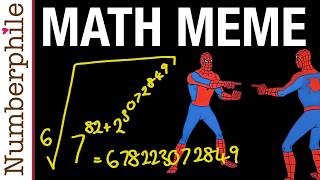
Matt's favorite new example is: 7 to the 82 plus 2 to the 3 to the 0 to the 7 to the 2 to the 8 to the 4 to the 9, 6th root, equals 678223072849. It uses a plus sign, a zero, and a tower of single digits.
The video demonstrates that the original meme is just one example of a broader class of numbers that can be constructed using power towers and roots, with the digit 1 or 0 acting as a powerful 'blocker' that simplifies the calculation. Matt's computational search found many new examples, some with enormous numbers, and he shares his favorite candidate as the 'best he can do.'
The Blocker Concept
Explains the core mechanism that makes the meme work, which is essential for understanding all subsequent examples.
00:43Computational Search Scale
Demonstrates the scale of the search (300 billion combinations) and the practical approach to finding new examples.
04:20Zero as a Super Blocker
Reveals that zero is even more powerful than one, as it can absorb digits on both sides, making it a key tool for constructing new examples.
05:48Mile-Long Root Sign
A striking visualization of the scale of the numbers involved, making the abstract concept tangible.
13:15[00:00] Okay, what's this? 2 to the power of 6 to the power of 2 to the power of 1 to the power of 4 to the power of 4. Square root the whole thing equals 2, 6, 2, 1, 4, 4.
[00:16] Same number. Yep. If you stack the digits of this number into a power tower and take it square root, you get back your original number. That's the video. Ta-da!
[00:30] Is there a catch to that? No catch. Literally no catch. Okay. Tiny, tiny, tiny catch. Minus. I don't even know why we're talking about it.
[00:43] There's a one here. So when you calculate down, you work out four to the power of four, and then you've got one to the power of that. And guess what one to the power of anything is, Brady? One.
[00:55] One. One. So this one, this one, it's basically holding back everything else like I got I gotcha so this one just neutralizes like everything above it it's like no it doesn't doesn't doesn't matter then you've got two to the one
[01:09] that's just two so what you've actually got here is the square root of two six squared 36 equal well square root you just half that because that's to the power of a half
[01:23] equals 2 to the 18, which equals 262144. Do you want to know how I found this number? Yes, on the internet. One day I came across like a math meme page,
[01:37] and I thought I'd check it out. They were all pretty underwhelming. Maybe the funny Spider-Man one about the square root of g equaling pi, but I was underwhelmed by almost all of them, and then this was just in the mix. I was like, what? And so I pulled it out, and I checked it, and it worked.
[01:51] I was like, oh, the one's doing a lot of whatever the opposite of heavy lifting is. And I get it. It's just kind of fun that 2D18 is this. I was like, actually, you know what? Let's just have a think about how, I don't know where this came from.
[02:05] I cannot, if any internet archaeologist can tell me where this came from, I'd love to know. I couldn't find it. But I was like, well, how did this person find it and could I find some of my own? and so I realized pretty quickly what you're doing here is you need some number.
[02:21] This is going to be our number n. So you need some number n equals, well it's going to have to equal like some here, this step here, that is some base b to some power k. So it's going to have to equal
[02:39] some base to some power k. Oh and the b for base is, everything is in base 10, but the base is just whatever the bottom of that exponent is. When you expand the digits out, obviously you start with the lead digit as the base,
[02:53] or the lead sum digits of the base, let's say. Then you stack the rest on top, but whenever you hit a 1, the rest doesn't matter. So when you write the digits of this out, it's going to have to start with the base,
[03:06] so whatever the digits in the base have to come first. Then the following block of digits have to be whatever digits you need. in this case the next block of digits so actually the 6
[03:18] well just the 6 and the 2 really form 36 which is a multiple of k and we don't mind it being a multiple because the root means we can divide it by something and so these need to be whatever the digits are
[03:31] and here there's an implied 2 obviously but that some root n so this has to be the digits of whatever that tower value is times some n that we can cancel out so that's a multiple three times and you do a cube root. I'm assuming that's the rule.
[03:47] I'm just trying to do this as general as possible. Over here you've got to have whatever's running interference So some kind of blocker which in our case is the one is like stopping everything after it and then everything else is the free ride So here it doesn matter what these digits are because they after the blocker The one is the blocker
[04:07] it stopped everything else after it. So that's what we're looking for. So I looked for them. I wrote some terrible piping codes, ran it on my computer across all the cores for a very long time,
[04:20] checked just a huge space of B's and K's and they're pretty quick to churn through because you take every range of Bs, you take your Ks, and I was just gradually increasing both,
[04:32] so I went up and up and up. I ended up checking over 300 billion combinations of B and K. At some point, I just turned the computer off and that's what we stopped. And between them, each one,
[04:44] the first thing you're doing, you raise it to a whole bunch of different powers and for each power you're just checking it doesn't start with the original base and then you keep those. Then you go through and check for your blockers and see if you can do the tower afterwards. So that's the search method.
[04:57] Now you want to see one? New paper. Okay, are you ready? 316-2278.
[05:10] So 3,160,578. To the power of 6. The power of 7,966,335. You're thinking, that's pretty ridiculous.
[05:22] Like, this is going to be outrageous. to the power of 0 to the power of 8952 square root equals those exact digits
[05:35] 316227952 I'm now open for comments and questions. Well, I can see who's running interference. The 0.
[05:48] Turns out the reason I was vague before I'm just like a blocker running interference is because 1's obviously work great, 0's even better. So 0 here, well, I was going to say 0 is running interference,
[06:01] but that's not exactly what's happening, is it? Because 0, all of this to the power of 0 is 1. So in fact, everything back to that 7. So all of this, that 0, all the way back to that 7 is all the blocker.
[06:15] So I don't know. Now, running interference, that's an American football term, isn't it? It is. So I don't know what you'd call the person in charge of running interference. There's probably a name for that. We'll put it on screen if there is. That's the zero. The zero can recruit as many digits to the left as it needs.
[06:30] And what we're actually doing is just using up all these digits. This is almost a free ride as well. We're just using these up until we get to the business digits, which in this case is just the six. The six is the only power that's doing anything
[06:45] because the six is the power of one. So that's it. And so zero is just eating all of these. These are all the free ride on the end. All this is, is that this to the power of square root of this cubed equals itself.
[07:01] How do you feel? Is that better or worse than the original? Worse? Oh. Because the zero is so incongruous. Like the zero doesn't belong there. It doesn't belong there. It's a perfectly good digit.
[07:13] It's stood out a little bit too much. It's overpowered. What's in superhero films? The power scaling issues, right? Zero is closely overpowered because everything to the right of it is free ride
[07:25] and as much as you want to the left, it's free ride. So zero is just like, they're all with me, they're all coming with me. And it can expand as far as little in both directions as you want. 2 to the 56th square root,
[07:42] 256. Oh, sorry, I meant 7th root. So the fact this is resting on is that 2 to the power
[07:57] of 8 equals 256 right So I would have picked this up on my search because the base 2 the answer begins with 2 And then you like well we got 8 here but we got 56 over here But 56 is 7 times 8 So if we put a 7th root here that means effectively that means
[08:15] to the power of 1 7th. So this all becomes, if you want to simplify that, this thing here, we can break that out. That is 2 to the 56th. Instead of doing a 7th root, that's to the
[08:28] power of a seventh. And that means you divide 56 by 7 and that gives you your 2 to the 8. 256. I'm okay with that. You're okay with that? Pretty good, but the fact you had to write down a number 7.
[08:40] Ah. Is that making you sad now? Yeah, it loses its meanness. Alright, here's another one. Alright, new paper time.
[08:53] Okay, Brady, for you, I'm going to fix your concern and break something else. 247 to the power of 4 plus 8 to the power of 2 to the power of
[09:07] 9763 to the power of 0. There's our 0 to the power of 8. And then you know what? A bunch of other digits. Let's not get too distracted. Square root equals
[09:21] 2, 4, 7, 4, 8, 2, 9, 7, 6, 3, there's our 0, 8, 0 and a bunch more digits. There you go. And, as you may have noticed, there's a cheeky extra Q out here.
[09:36] That's because... Screw it. There. There. Fixed it. We're using the square root. And there are more numbers here. Oh, yeah, yeah. Now, if you really want to dig into it, this number has 82 digits.
[09:51] So, it's way, way that way, but everything after the interference doesn't matter. Like, this could be literally whatever digits you want, so it doesn't matter what these
[10:04] are, because whatever they are, we can just copy them in there. So, I just stopped bothering writing the digits down, because the moment you get your zero or your one, you don't have to care what's afterwards, because you can pad it out here
[10:16] with whatever you fancy. And we've got this plus. Yeah, I was hoping you wouldn't notice that. Well, I also know this is zero. Yeah. So what I'm doing here is collapsing that down. So this is 2 to the 1.
[10:28] So that's 8 squared is 64. That's 68. We've got the 2 at the front. Half of 68 is 34. And 247 to the 34 is this. I'm more comfortable with the plus than I am with the plus.
[10:43] Wow, really? I'm more upset by the zero. I'm upset at it in a way where I respect a really good, successful weed. I'm like, that's a little annoying, but I'm amazed at your success.
[10:58] Against all odds. I like it as a loophole. I think that, well done, you've found a way to break the system and to succeed where you shouldn't. I don't know, I love that.
[11:10] And the fact that it means you can just have arbitrary digits for the rest of it, I find very, very neat. But the effectiveness of the zero is what makes finding one without a zero all the more special. Ah, yeah, you really like the non-zero ones, you're right.
[11:24] But what about, what about 2673 to the power of 495682? That's a big number. To the power of 48420, then we get our extra zero.
[11:40] We could have done the first one. I just thought I'd have that number out of smidgen. then to the four, eight, and then a bunch of stuff, right? That, take a root, which in this case happens to be the 11th root, but I'm not gonna use that.
[11:52] That now equals all of this. That equals two, six, seven, three, four, nine, zero, four eight blah blah blah blah blah That zero either one of these zeros or both together you could have a two zero that kind of fun right That is simplifying down
[12:10] this is actually 2, 6, 7, 3, you divide this by 11, that's to the power of 4, 5, 0, 6, 2. That's a massive number.
[12:23] And this is that massive number. And this continues on. That's 154,428 digits.
[12:37] Isn't that nuts? Look at the size of that. That's a crazy big number. If you were to write the whole... In theory, you have to write them out twice because it equals it and they're all about...
[12:49] That might be... Is that the record for the biggest root sign ever used? I didn't bother writing it all out. let me dot dot dot the root sign biggest implied root sign ever used in mathematics
[13:02] because it goes that way like if I'm doing wait if I'm doing let's say a centimetre per digit maybe a little under that so every 100 digits
[13:15] would be a metre that's one and a half kilometres that is basically just shy of a mile so that root sign there has to be a mile long Yep, that's a mile.
[13:28] We've done a mile of pi. Now we've done a mile of root sign implied, if we round with it. So that's because of the zero. I never computed the whole thing.
[13:41] I would only compute the lead bit and then check if the base matched the beginning. And I'd always check with or without the root. And then I didn't bother with the rest.
[13:53] I've never actually computed the rest of this number, but I know the meme works, right? Because of the zero. Power to zero. Alright, to recap. Here's the original one we're competing with.
[14:05] 2 to the 6 to the 2 to the 1 to the 4 to the 4. Square root. Equal 2, 6, 2, 1, 4, 4.
[14:18] It's nice. Everyone agrees. All single digits. All single digits. Implied 2 that we're not using. Here's my favorite candidate. Are you ready? 7 to the 82 plus 2 to the 3 to the 0
[14:37] to the 7 to the 2 to the 8 to the 4 to the 9. 6th root equals
[14:50] 678223072849 I give to you the best I can do.
[15:05] We're using the root because up here I hate to label the point phantom 2 that is no SIPC on this side using a root. Got the plus in there.
[15:18] Using a zero. And this is like a tower that goes all the way up. Single, single, single, single, single, single. Same deal. Single, single, single, single, single. All the way up. All the way there. All the way there. What more do you want?
[15:31] Vote now. There's no vote. Brady's the adjudicator. Numberphile patrons can check out where the conversation went next and a few outtakes from filming.
[15:43] And if you want more Matt Parker in your life, and let's face it, who wouldn't, check out some links below for more videos, books, live shows, maths toys, all that good stuff. Matt, like I know we joke around, right?
[15:55] You're a funny guy and you're a comedy guy, aren't I? And we've had a good laugh today. I feel like there's a big butt coming up here. Butt. Butt.
⚡ Saved you 0h 16m reading this? Transcribe any YouTube video for free — no signup needed.