
Mom's Palindrome Puzzle
45sThe personal and relatable story of a mom texting about a palindrome age hooks viewers with curiosity and family dynamics.
▶ Play Clip"The title 'Palindrome Ages' perfectly matches the content—the video delivers exactly what it promises: a mathematical deep dive into reversible ages."
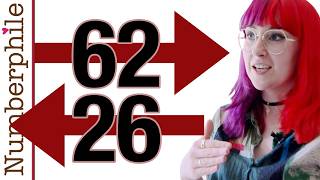
In this Numberphile video, a mathematician recounts a puzzle from his mother: their ages (62 and 26) form a reversible pair. He breaks down the math behind palindrome ages, showing that the age gap must be a multiple of 9 and that such reversible ages occur every 11 years. The video offers a clear, accessible explanation of a fun numerical curiosity.
The speaker's mother texted him 'Happy palindrome year' after noticing their ages (62 and 26) are reversible. This sparked a mathematical investigation.
The mother asked: Why did this happen? Will it happen again? Does it happen to everyone? The speaker set out to answer these on a train with just a notebook.
The speaker and his mother have a constant age difference of 36 years (the mother's age when she had him). This gap is key to finding reversible pairs.
For a two-digit number N = 10A + B and its reverse 10B + A, the difference is 9(A - B). This is always a multiple of 9.
For reversible ages to occur, the age gap must be a multiple of 9. The speaker's gap of 36 works (36 = 9 × 4). Not all parent-child pairs share this property.
With a gap of 36, the digit difference A - B must equal 4. For the speaker and mother, A=6, B=2 gives 6-2=4.
Adding 11 to both digits yields the next pair: 73/37, then 84/48, 95/59. So reversible ages occur every 11 years once both ages are two-digit numbers.
Going backwards, the pair 51/15 also works. Including 40/4 is debatable but fits the digit difference of 4. The speaker allows it.
If two people have an age gap that is a multiple of 9, they will have reversible ages every 11 years. The video teases further exploration in other number bases.
The video elegantly demonstrates that palindrome ages occur when the age gap is a multiple of 9, and then repeat every 11 years. It turns a personal anecdote into a fun, accessible math lesson that anyone can explore with their own family.
What is the age gap between the speaker and his mother?
36 years.
02:15
What must the age gap be a multiple of for reversible ages to occur?
A multiple of 9.
04:44
How often do reversible ages occur if the age gap is a multiple of 9?
Every 11 years.
07:13
What is the formula for the difference between a two-digit number and its reverse?
9(A - B), where A and B are the digits.
04:17
For the speaker and his mother, what is the difference between the digits of their ages?
4 (since 6 - 2 = 4).
05:40
List all reversible age pairs for the speaker and his mother (including past and future).
40/4, 51/15, 62/26, 73/37, 84/48, 95/59.
06:48
Does every mother-child pair have reversible ages at some point?
No, only if their age gap is a multiple of 9.
05:09
Real-world palindrome ages
Provides a concrete, relatable example of a mathematical pattern (62 and 26).
00:41Difference always multiple of 9
Core mathematical principle that explains the condition for reversible ages.
04:17Not universal for all parent-child pairs
Clarifies a common misconception; only works for age gaps divisible by 9.
05:09Reversible ages every 11 years
Predictable frequency makes the phenomenon easy to anticipate.
07:13General conjecture for any age gap multiple of 9
Extends the finding beyond the specific example to a general rule.
08:04[00:00] Uh, I want to tell you a puzzle that my
[00:02] mom showed me and some really nice maths
[00:04] behind it. If that's all right.
[00:05] >> Your mom, is she a mathematician?
[00:06] >> No. No, she's not, but she loves
[00:08] puzzles. Um, and she really in
[00:10] particular loves throwing complicated
[00:13] puzzles at me and seeing how I react to
[00:15] them. Um, so story starts. I'm on a
[00:17] train and I get a text from my mother uh
[00:20] saying, "Happy palendrome year."
[00:25] Wasn't anything particularly palendroic
[00:27] about the date itself. I think it was
[00:29] like 2023 or something. Um the day there
[00:32] was nothing reversible going on there.
[00:34] So text my mother, what are you on
[00:37] about? And after a bit of back and
[00:38] forth, I realized that both of us had
[00:39] just had birthdays quite recently. Um
[00:41] and she was 62 and I had just turned 26.
[00:46] And this is the bit where I apologize
[00:48] for telling people my mom's age, but
[00:49] she'd noticed that our ages made this
[00:51] reversible pair. She had a few questions
[00:54] that she wanted me to answer as the the
[00:56] family mathematician. Um, namely, why
[01:00] has this happened? Uh, is it going to
[01:02] happen again? And is there something
[01:03] special about me and mom or does this
[01:05] happen to everyone? Pretty normal
[01:07] questions that you'd have, I guess,
[01:09] about about this. So, I was stuck on a
[01:11] train with nothing but a notebook. Um, I
[01:13] could have Googled it, but that's
[01:15] boring. So, I decided to take up the
[01:18] challenge and and see what was going on
[01:20] here.
[01:22] Key thing to note about this is we have
[01:24] two ages and mom is older than me. I
[01:27] think that's pretty well established. I
[01:29] can say that we're definitely going to
[01:30] have one number bigger than the other.
[01:32] Otherwise, we would both be, you know,
[01:33] the same age, 11, and that solves my
[01:36] problem. Because it's our ages, there's
[01:38] a fixed distance between the two
[01:40] numbers, right? Realistically, me and
[01:41] mom, we're very fortunate that outside
[01:43] of I think one or two weeks, we are
[01:46] exactly the same age apart throughout
[01:48] the year. So, this works for most of the
[01:50] year round, which is nice. that's going
[01:52] to is that an assumption we're going to
[01:53] work with that that your kind of your
[01:54] birthdays are on the same day sort of
[01:56] thing
[01:56] >> basically. Yeah. I think we could do it
[01:58] where you know half the year we're one
[01:59] age gap apart and half the year we're
[02:01] the other but this is a nicer story and
[02:03] makes the maths easier. So assume two
[02:06] people who have fixed ages and say their
[02:08] birthday is the same. So for me and mom
[02:11] uh the difference between our ages is 36
[02:15] which I I worked out by hand and then
[02:17] realized that's the age mom was when she
[02:18] had me and I could have just asked. So
[02:21] in particular, I'm looking for when do
[02:23] twodigit numbers, we're going to assume
[02:25] we throw out the hundreds and anything
[02:26] bigger than that. When do two-digit
[02:28] numbers with a difference of 36 have
[02:31] this reversible um property,
[02:33] >> this palendrome, this 62 26?
[02:35] >> We could start doing it by writing out.
[02:37] So we're looking for digits 62 and 26.
[02:40] And I could say that six is going to be
[02:41] a and two is going to be b um and say
[02:44] that we're looking for numbers a ba. But
[02:47] as a mathematician, if I write a b next
[02:49] to each other, I think I'm going to be
[02:51] multiplying them. So, we need to be a
[02:53] bit more formal in in how we write out
[02:54] the numbers. So, 62
[02:58] is the same as if I was going to expand
[03:00] this out. 6 * 10
[03:04] + 2, right? Pretty confident with my
[03:06] maths there, Brady.
[03:07] >> Looks good.
[03:08] >> Thank you. Um, and then similarly, 26, I
[03:11] could do the same thing and I would get
[03:12] 2 * 10 + 6. Yes. So doing this
[03:16] generally, we're looking for a number n
[03:19] which I can write as uh a * 10 + b. And
[03:26] then I'm looking for the reverse of that
[03:28] number,
[03:30] which is b * 10 + a. So we've swapped
[03:36] the digits around and then I'm calling
[03:38] them n and reverse of n. I don't know if
[03:40] that's a well established mathematical
[03:41] function, but it's the one I'm going to
[03:42] use. And then in particular what I'm
[03:44] looking for is when is the difference
[03:45] between these two numbers or what values
[03:47] of a and b work for the difference of
[03:50] 36. So if I do that computation so the
[03:54] difference between these two numbers if
[03:56] I subtract them and because I'm saying
[03:58] this one is a so a is bigger than b I
[04:01] can do it this way around b * 10 + a. If
[04:04] I expand this out and solve it we get 10
[04:06] a minus a. So I get 9 a and then I get b
[04:10] minus 10 b. So minus 9 b or 9 a minus b
[04:16] to write it nicely. So what this means
[04:18] is I haven't even got to the the 36 the
[04:21] age gap yet. But for a number a
[04:23] two-digit number in base 10 and it's
[04:25] reverse the difference between those two
[04:28] numbers will always be a multiple of
[04:29] nine which is quite cool I think at the
[04:32] very least. And and what this tells me
[04:33] is that any two people if their age gap
[04:37] is a multiple of nine, they will have
[04:39] some reversible ages.
[04:42] >> 36.
[04:44] >> Yeah. Or it could be um 18 or I'm trying
[04:48] to remember my nine times tables here.
[04:49] 27, 36, 45. I'm going to stop there
[04:53] before I get it wrong. But for me in
[04:55] particular, me and mom, it was 36. I
[04:57] hope you don't mind. I did check your
[04:58] age. we do not have this property
[05:00] because I thought that would have been
[05:01] really fun but uh unfortunately we don't
[05:04] have a multiple of nine difference
[05:05] between us so we probably won't share uh
[05:08] reversible ages.
[05:09] >> When you first told me the problem I was
[05:11] thinking I wonder if this is true for
[05:12] all mothers and their children at some
[05:14] point in their life. But but no
[05:16] >> nope no only if uh your age gap with a
[05:19] person is a multiple of nine. Uh and in
[05:22] particular in my case
[05:24] this is equal to 36. So the difference
[05:28] between these two numbers is the other
[05:29] factor of 36 in this case. So for me and
[05:33] mum, we're looking for when does the
[05:35] difference in the digits of our age
[05:38] equal four, right? When this is equal to
[05:42] 36. It's 9 * 4. So we're looking for
[05:45] values of a and b that have a difference
[05:47] of four, which we can check here. 6 and
[05:50] two does in fact have a difference of
[05:52] four, which is quite nice. Am I allowed
[05:54] to get a new bit of paper? Yes, you are.
[06:06] >> So, how often does it happen? Um, or in
[06:08] particular, when is it going to happen
[06:09] again? So, we've answered the why and
[06:11] we've answered the who. But next is the
[06:13] when. Again, we're looking for numbers n
[06:15] with digits AB and
[06:18] reversible numbers n or the reverse of
[06:21] that number. And we know that 62 and 26
[06:23] work because those were our ages. We
[06:27] proof by lived experience, I guess. But
[06:29] we're looking for particular the
[06:30] difference between the digits being
[06:31] fixed, right? It has to be equal to
[06:33] four. So whatever we do to one digit, we
[06:36] just do to the other. That's quite nice.
[06:38] Um so if I plug in, say I add one to
[06:41] each of these digits and I get 73, that
[06:44] would make my age 37 just by flipping
[06:47] them. And we can check that the
[06:49] difference between these two numbers is
[06:51] in fact 36. And you can do that maths
[06:54] yourself. The exercise to the viewer.
[06:57] Um,
[06:57] >> you added 11 to both of them.
[06:59] >> I did.
[07:00] >> Yeah.
[07:01] >> So it's plus 11. So I can do it again.
[07:04] Um, and I'd get 84 and 48 and 95 and 59.
[07:10] Yeah.
[07:11] >> So it happens every 11 years
[07:13] >> once you reach double digits because
[07:15] when you were born obviously and when
[07:17] you were
[07:18] >> when you were 11.
[07:20] >> Yeah. Hang on. So when does it kick in?
[07:22] >> So we can go backwards to check. So if
[07:24] we go from 62 and we take one off each
[07:26] side. Uh I got to really This was a fun
[07:28] bit of the conversation with mom was
[07:30] being like well actually mother we've
[07:32] already had a palendrome year. You
[07:33] you've missed one out. Um because when
[07:36] she was 51 I was 15. And this is the bit
[07:39] where people might have opinions. I
[07:41] would say because we're talking about
[07:43] twodigit numbers.
[07:45] I would allow 40 and four. But I
[07:49] appreciate people are going to have
[07:51] opinions about that. But I think it's
[07:52] really nice if we include this one
[07:54] because four is precisely the difference
[07:56] between the digits that work in this
[07:59] case of me and mom.
[08:00] >> Okay.
[08:00] >> So these are all of our possible
[08:02] palendrome years that could happen. And
[08:04] as you say, it's every 11 years. So uh
[08:07] this was the closest they think I'm a
[08:08] applied mathematician so I don't do
[08:10] theorem proof style maths and this was
[08:13] my closest conjecture of if two people
[08:17] have an age gap that's a multiple of
[08:19] nine then they will have reversible ages
[08:23] every 11 years.
[08:25] >> Right. Yeah.
[08:29] >> Yeah. Check out the links below to a
[08:32] video on number file 2 where cat
[08:34] continues this conversation and cracks
[08:37] out the code and looks at other bases.
[08:39] >> This is where the powers of coding come
[08:40] in. Um, so that's exactly what I did.
[08:43] Would you like to see the results?
[08:45] >> Also down below you can find links to
[08:46] cat and her work and find out other
[08:48] stuff she's up to.
[08:53] >> Find out what the representation of that
[08:55] number is in our given number base. find
[08:59] its reverse and then see if the
[09:01] difference between those two numbers is
[09:02] 36 base 10. Okay.
⚡ Saved you 0h 09m reading this? Transcribe any YouTube video for free — no signup needed.