
The Holy Monster: 46 Holes!
45sIntroduces a bizarre, record-breaking shape with a catchy name that sparks curiosity.
▶ Play Clip"The title '291 Holes' is accurate and delivers on its promise, though the video could have been more concise."
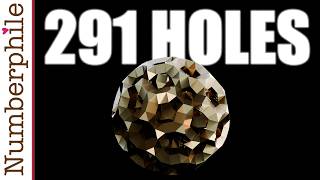
This video from Numberphile explores the quest to find the Stewart toroid with the highest genus, or the most holes. It revisits previous records, including Bonnie Stewart's 'Holy Monster' with 46 holes and Robert Webb's compound with 87, before revealing a new record of 291 holes achieved by an enthusiast named Squilliams.
The video revisits the search for the Stewart toroid with the most holes, building on Bonnie Stewart's work in 'Adventures Among the Toroids'.
Bonnie Stewart's 'Holy Monster' had 46 holes (genus 46) and was the best known at the time.
Robert Webb, creator of the software Stella, discovered a new polyhedron and had the idea to place Stewart's Holy Monster inside it, creating a compound with genus 87.
The record has since been broken, with toroids now reaching genus 291, a significant increase from 87.
The inside of the new record-holder is a complex, baroque-shaped polyhedron riddled with holes, but it is not quasi-convex on its own.
By placing the internal polyhedron inside Robert Webb's original polyhedron, the entire compound becomes quasi-convex, resulting in 291 holes.
The new record was achieved by someone known as 'Squilliams' on an enthusiast board, and the video credits this 'possible genius'.
The video highlights the ongoing mathematical exploration of toroids, with the genus record now at 291, thanks to the collaborative efforts of the mathematical community.
What is the genus of Bonnie Stewart's 'Holy Monster'?
46
00:17
Who created the software Stella?
Robert Webb
00:32
What is the current record for the highest genus of a Stewart toroid?
291
01:12
Why is the internal polyhedron of the genus 291 toroid not eligible on its own?
It is not quasi-convex.
01:57
Who achieved the new record of genus 291?
Squilliams
02:13
Record Jump to 291
This is a significant leap from the previous record of 87, showing rapid progress in the field.
01:12Quasi-Convexity Requirement
Explains a key criterion for Stewart toroids, which is essential for understanding the construction.
01:57Community Contribution
Highlights the collaborative nature of mathematical discovery, with an enthusiast making the breakthrough.
02:13[00:03] Monsters. About a year ago, we released a video looking for the Stewart Toroid of the highest genus, technically. Uh, what that really means is a shape like this with the most possible number of holes. Watch the video for the original
[00:17] definition. It all comes out of the work of Bonnie Stewart in this amazing book called Adventures Among the Toroids. And this shape here, which he called the Holy Monster, was the best that he could do. This had 46 holes or genus 46. But
[00:32] there was some movement, which we discussed last time. So, Robert Webb, who created this wonderful software called Stella, which we're enjoying using for looking at these things, also discovered this polyhedron here.
[00:46] And then he had the brilliant idea of putting Stewart's original Holy Monster inside it and joining the two together. And when he did that, we got this shape
[00:58] here. So, this has genus 87. And that's where we left it last time. But since then, there have been some developments and the record has actually gone zooming and the record has actually gone zooming up. We now have some toroids which have
[01:12] genus 291. So, it's a huge increase. This is one of them and you can see that the outside of the shape is Robert Webb's original toroid. All these mauve faces here are his original ones. But what's inside now
[01:28] is something a lot more complicated than Stewart's Holy Monster. So, if we take those outside shapes away, you can see what's inside this this extremely baroque-looking object. Don't ask me too many questions about exactly what's
[01:43] going on in this this shape here, this inside shape. But you can see that it's absolutely riddled with holes. On its own, this internal polyhedron would not meet the criteria. This wouldn't be eligible because it's not quasi-convex.
[01:57] Um, if you remind yourself what that means from the previous video, but you can make the whole thing quasi-convex by shoving it inside Rob's original polyhedron. And when you do that, you get um this compound object with uh 291
[02:13] holes, which is the record as we have it so far. >> Someone who goes by the name of Squilliams. Uh that's all I'm able to tell you. I think this is a chat going on on a an enthusiast board for uh
[02:28] >> Squilliams. >> Good job, Squilliams. Possible genius, which is technical way of saying with the most possible holes. Uh and this is the the one he came up with. It's got genus 46,
[02:43] uh and he called this the holy monster, holy with an e. It's got 934 faces. >> There were some mistakes in it. to be some mistakes, so it's not terribly worried about
⚡ Saved you 0h 02m reading this? Transcribe any YouTube video for free — no signup needed.