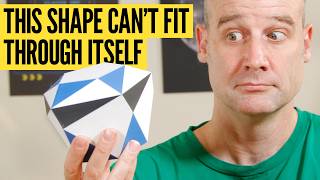

New shape that cannot pass through itself!
45sThe counterintuitive discovery of a shape that cannot pass through itself is surprising and sparks curiosity.
▶ Play Clip"The title accurately reflects the video's content about a new shape that cannot pass through itself, though the focus is more on the search for proof than the final discovery."
This video explains the concept of 'Nopert'—a shape that cannot pass through itself—contrasting it with 'Rupert' shapes, which can. The presenter discusses recent discoveries by Tom 7 and other mathematicians, highlighting the search for a provably Nopert convex polyhedron.
New shape discovered that cannot pass through itself, known as a Noperthedron.
The presenter's preferred Nopert is a pentagon-based polyhedron with 20 vertices and 27 faces, discovered by Tom 7.
A shape is Rupert if one projection fits entirely inside another projection of the same shape, using a cube as an example.
From 'amazing that shapes can fit through themselves' to 'surprising that some cannot'—a Nopert is a convex polyhedron that is not Rupert.
Tom 7 developed a numerical solver to find Noperts, leading to candidate Nopert 214 with 20 vertices and 27 faces.
The Platonic solids all have the Rupert property, but some Archimedean and Catalan solids remain unknown.
A conjecture claimed every convex solid has the Rupert property; Tom 7's work challenges this.
Tom 7's solver found Rupert solutions for known shapes in milliseconds but could not find any for some shapes after trillions of attempts.
By pairing a solver with a random polyhedron generator, Tom 7 discovered many candidate Noperts, with number 214 being the smallest.
Tom 7 investigated prisms (manhole covers to churros) and anti-churros, finding continuous solution trends but no Nopert gaps.
Even-‘n’ churros show multiple solution spikes, while odd ‘n’ have a classic handover, indicating complex orientation effects.
Anti-churros (triangular side faces) show even more complex solution patterns, suggesting much remains unknown.
While no provably Nopert convex polyhedron has been officially confirmed yet, Tom 7’s work and the independent discovery of a Noperthedron by other mathematicians suggest such shapes exist. The video encourages viewers to watch Tom 7’s full video for deeper understanding.
What is the Rupert property?
A shape has the Rupert property if there are two projections of the convex polyhedron such that one fits entirely inside the other.
3'04
What is a Nopert?
A convex polyhedron that is not Rupert—i.e., it cannot pass through itself.
4'20
How many vertices does the candidate Nopert 214 have?
20 vertices and 27 faces.
8'37
How many Platonic solids are known to be Rupert?
All five Platonic solids have the Rupert property.
5'55
What is a 'churro' shape in the context of the search for Noperts?
A prism with a regular n-gon base extruded a lot, so that it can be stuck through its own side.
9'30
How many different topologically distinct projections does a snub-cube have?
Approximately 32 (or 36 according to another part of the video).
17'24
What is the 'manhole cover' arrangement of a prism?
A very shallow extrusion of an n-gon that can fall through itself (like a manhole cover falling through its hole).
9'30
What did Tom 7 use to search for Noperts?
A numerical solver paired with a random polyhedron generator to evolve candidate Noperts.
7'25
What was the key difference between Tom 7's approach and the other mathematicians' approach?
Tom 7 tried to prove a known shape (snub‑cube) is Nopert; the other mathematicians designed a custom shape that made the proof easier.
20'09
How did Tom 7 reduce the continuous search space to something manageable?
By dividing the 7D hypercube into sub‑volumes and showing that entire chunks contain no solution.
19'04
What is an anti-churro?
A prism‑like shape where the side faces are triangles instead of rectangles.
12'43
Why does the 'drain‑hole cover' solution work for thin prisms?
Because the thin extrusion can pass through its own projection in a similar way to a manhole cover falling through its hole.
11'00
Cube fits through itself
Demonstrates the counter‑intuitive Rupert property using a physical 3D‑printed cube.
1:25First provably Nopert convex polyhedron
Historical shift in mathematics from 'all shapes are Rupert' to 'some are Nopert'.
4:20Numerical solver efficiently finds Rupert solutions
Highlights the power of computational search to explore millions of orientations.
7:25Prism/churro analysis shows continuous solutions
Reveals that even simple families of shapes have rich solution structures.
9:137D hypercube breakdown for proof
Clever mathematical reduction of continuous search space into discrete chunks.
19:04[00:00] Breaking Mass News. Some of you will have seen the headline, new shape found that cannot pass through itself. And I know some of you have seen it because you've all emailed me. I mean, what a year to have declared
[00:12] the year of breaking mass news when this no-pethedron was discovered. Everyone started emailing me. Two people walked up to me in real life to tell me about it. One of them had printed out the paper to show me,
[00:25] so thank you everyone for alerting me to the breaking mass news. But I got some terrible news. This, this is not my no-pet. This is my no-pethedron.
[00:50] I say my no-pet, not as in I discovered it. Tom seven discovered this. My no-pet just as in, this is the one I vote to be no-pet. I believe in this no-pet. Look at that, it's got a pentagon top and bottom.
[01:02] I think I think it's really neat. Check it out, I added the colors myself just to make the faces more obvious. 20 vertices, 27 faces. This shape cannot go through itself, probably.
[01:16] To expand on the word, probably. And cannot go through itself. We need to go back to the cube, which I also 3D printed. Has like the greatest misuse of 3D print time ever.
[01:32] But you know, sometimes you just need a really precise cube. First up, we're going to talk about what it means to be a no-pet. Indeed, we're going to recap what it means to be ru-pet. And some of you already know this.
[01:45] I wrote about this in a book back in 2014. The, I do mean ru-pet has been around for a while. And the question was, a print's ru-pet centuries ago, wondered, could you fit a cube through itself?
[01:59] And so here, I've also 3D printed another copy of the cube, slightly more complicated this one. And it's exactly the same size. So if I line them up, look at that boom, exactly the same in every dimension. These are identical cubes. Other than this one has a removable piece.
[02:13] Because we can fit this cube through a cube exactly the same size if I remove that section. There, there's a cube-shaped hole. And so, while it seems counterintuitive, it is possible to fit a shape through itself,
[02:28] or at least, that used to be counterintuitive. Turns out there's loads of room to fit a cube through a cube. So if I very carefully align this so you can look straight down, they're like the diagonal axis there,
[02:40] you're looking at the projection of a cube that is a hexagon. That's kind of fun. And it turns out that hexagon is bigger than that square. In fact, you can fit a square 3.5% bigger by length
[02:52] through that hexagon. If you went off axis slightly, there's actually another projection that's ever so slightly bigger. And you can fit a cube that's 6% bigger by length through a smaller cube.
[03:04] So the root property is just are there two projections of a polyhedron, convex, such that one of them can fit entirely inside the other one. And turns out, yeah, something's not a sphere.
[03:17] If you move it around as projection changes, some of the projections are big, some are small, turned out small things can often fit inside big things. So, I mean, for the longest time, I was like, oh, would you believe a cube fits for a cube?
[03:29] And after a while, everyone's like, oh yeah, actually, it's quite obvious that a cube fits for a cube. A couple of years ago, 2021, I think I did a video about this where for Halloween, I put a pumpkin through a pumpkin. So I bought them two most identical pumpkins I could find
[03:43] in the shops, and then I cut a hole through one pumpkin that would fit the other pumpkin. So pumpkins are ruptured, although not convex. Anyway, the point is, the story went from being always at an amazing, that you can fit a cube through itself,
[03:56] that stunning, and eventually kind of became, oh, turns out, it's quite easy to fit shapes for themselves. And now, it's gone full cycle. And everyone's like, oh my goodness, can you believe, there are shapes that don't fit through themselves.
[04:10] So that's the world we live in now. I mean, a decade after I wrote things to make and doing the fourth dimension, the fact is inverted. So after centuries of showing that shapes are ruptured, it was only this year that humans managed to prove
[04:24] that there is a convex polyhedron that is not ruptured or no-putt. And I actually saw this one coming because I was in New York to do an evening
[04:36] of an accessory detail last July. And I caught up with Tom Seven, and he'd already sent me the paper he was working on. And we talked about how he was trying to research, shapes that were no-putt, and he found this one at that point.
[04:50] And he was working on a way to prove that definitely. Now, I'm not gonna lie, this video, you only need to watch this. You can go and watch Tom Seven's excellent video. So this one is no-putt number 214,
[05:04] or potential no-putt number 214. The only issue is it's an hour and 18 minutes long. And I love, I love Tom's videos. They're incredible. You should go watch that video,
[05:16] but I know a lot of you aren't gonna watch that video. And so I thought, I would make a Rupert video, because my video is just gonna go through Tom Seven's video. So I'll recap some of it,
[05:28] and then you should really go watch the rest. But to explain the no-putt journey, Tom Seven first got a bit distracted when he saw an interesting sentence on Wikipedia. I was reading about the Dodecahedron,
[05:41] which is my favorite platonic solid, maybe even my favorite solid. And the Wikipedia page, at least at the time, contained a puzzle. On the platonic solid page,
[05:54] Tom had come across a statement that all five platonic solids have the Rupert property. And on the page for Archimedean solids, which arguably contains the platonic solids, it has the mysterious puzzling sentence that at least 10 of the Archimedean solids
[06:08] have the Rupert property, why some? It's got Tom wondering, are there shapes that don't have the Rupert property? And I found a claim, a conjecture,
[06:20] that every convex solid has the Rupert property, which is, would be amazing. We can do this for 11 of the 13 platonic Archimedean solids.
[06:33] But there's like two that we somehow didn't check. It is weird that we have shapes of unknown rupertness that are Archimedean solids, or Catalan solids, like after platonic solids with their regular faces
[06:47] and vertices, Archimedean solids, they're up there as well. They've got identical vertices, and every face is a regular polygon, but you can mix and match the polygons,
[07:00] and you've got the Catalan solids, the jewels to the Archimedean solids, they all have identical faces. These are blockbuster shapes. And yet there are three Archimedean solids
[07:12] and two Catalan solids for which we just don't know. And that seems strange. So Tom Seven put together a numerical solver to take a polyhedron and work out a Rupert solution for it.
[07:25] And for all the solutions that we already have, he found them in milliseconds, just was churning them out. And the ones that we couldn't find, he couldn't find, with billions of attempts.
[07:38] Trillions of attempts, which means either the solutions are really obscure or just there aren't any. Sometimes this happens there's a phase change between
[07:51] like two classes of problem. And so mathematically you know this, it's not enough to have that empirical evidence and say, well, they can't be solved, but it is suggestive. And it kind of taught you because you got to know.
[08:05] So, yes, that was part of the suspicion, is that it's very easy to solve them. This is a shape that came out of Tom Seven's code because once he had a solver,
[08:17] he could then pair that up with a generator that's producing random polyhedra and then see if he could produce or evolve a nopet. And he found loads of candidate nopets via this method.
[08:32] The best of which is candidate number 214. The 214th nopet, it's the best in that it's only got 20 vertices and 27 faces. And that's the fewest of all candidate nopets out there.
[08:47] And I like it because it's got this cool kind of pentagonal rotational symmetry. I think it's a really cool shape. And Tom Seven tried literally trillions of different possible alignments of this shape with itself
[08:59] and none of them went through. His solver could not find a solution to this. And the solver is very good. Now that doesn't prove that this is nopet but it makes it exceedingly likely that it is.
[09:12] But a mass, we want a proof. One avenue Tom Seven explored to find a provably nopet polyhedron was to look at the family of prisms
[09:24] which go from manhole cover to tross. This really simple case. So take it and gone and extrude it. And if you extrude it a very shallow amount
[09:36] then you get a manhole cover as I call it. And we know that manhole covers that aren't round can fall through themselves. It's just proof by idiom. And then if you extrude it a lot then you get a churro
[09:49] as I call it which is a long one and you could stick that through its own side. And possibly there's a simple point at which they don't have solutions. And if that's the case then this could be a really good route to proving the existence
[10:03] of simple nopets that no one ever thought to check. Here are Tom Seven solutions for the five churro and on the horizontal axis we have how long the churro is and each of these lines is an integer.
[10:16] So this is a length of one or a d of one where d is the length of the sides of in this case. The pentagon as you can see is the length goes up to two to three to four. What you have here is the quality of the solutions.
[10:29] So sometimes the numerical solver is finding a very high quality solution. That means that the residue what's left after the shape's gone through itself has reasonably for some definition of thick connectors.
[10:41] Down here they're not as good but still connected. And because it's a numerical solution sometimes it finds one of these. Sometimes it finds one of these depends how it randomly orientates the two shapes. And occasionally they're a little bit better or worse. Overall you can see two very clear trends.
[10:54] It often finds the drain hole cover solution here particularly when the churro is very thin, the drain cover arrangement. And sometimes still finds solutions like that. I wouldn't it's much much longer
[11:06] but once it does get long it's way more likely to come in through the side. You can see here these are the churro solutions and they take over in Tom VII's theory was maybe there's a gap in between but no they cross here. And in this case exactly on, well pretty much on one
[11:21] and there's a seamless hand over. So there's always a solution. And you may have noticed this extra spike here that's a different class of solution that I don't think has been investigated yet. So if you wanna go down another math soul
[11:33] you can start to look at this and we can look at the other churros. If we go up one to a six churro ah look at this we got all these extra spikes we still got the drain hole cover solution here. We still got the churro solution there
[11:45] but now we got I mean in this case three new bonus ones. And that's way more pronounced on an even end churro. So when we got to seven this is much closer to the five. There's still a spike there but now not as clear
[11:57] and we got the classic hand over. Well look there are some little subs spikes down here. And we went back to five. You can see there down there as well. Isn't that interesting? But all the even ones have a whole bunch of spikes. So eight, oh it's always half as many.
[12:10] So eight has these four extra spikes here. The nine looks like the classic odd case and then 10 five spikes appearing here. So I'm imagining these are when you've got
[12:23] the drain hole solution. These are some orientation effects that we're seeing but again I'm purely speculating look what's going on down here. And as we go up to more and more complicated churros
[12:35] approximating a cylinder you can see these patterns continue but start to get you know, wow so messy. As well as prison churros Tom Seven also looked at anti churros. These are like a prison but instead of rectangles on the side
[12:49] you use triangles and check out the five anti churro look at all of this. There's so many more complex solutions happening down there. Is this still the drain cover solution?
[13:01] I mean we don't know what's going on here. There's still you know, things crossing it about one in this case. The even ones now look at it. Now the fact that this is so covered
[13:13] means because it's numerical we're not getting exact coverage. I would say in theory this should be block covered which means there's a continuous series of solutions for any given D up to some threshold
[13:25] which is the top of this. And just the number of numerical solutions at Tom Seven RAM means that we've got this kind of spotty coverage but it should be a lot more thorough but you can see there's another one here. We get these extra spikes appearing there and look at these seven eight nine.
[13:37] Ooh there's a lot we don't know about how you intersect anti churros. So if you want to look into this go for it but the point is for all our original churros there's always something going on.
[13:49] There's no point where it's going to hit zero. So while there's other interesting stuff going on we're going to need a different method to try and find a nopet. So when do I have this? Yeah fine.
[14:01] Excellent. I meant the desk because this video is brought to you by Bamboo Lab. The 3D printer we used to print all these fantastic objects to explain the nopet property.
[14:15] Yes I use my Bamboo Lab X1C printer which is so quick and easy to use to print the cube you saw before. Of course the Rupertable Cube with a middle bit comes out
[14:29] and because I can take multiple filament colors at once I could print the nopet with different colors for each of the faces. And if you're looking for inspiration about what to print
[14:42] you can head over to make a world. Look at all these fantastic models and of course Tom Seven has put up a full set of PAC models. You can open them up in Bamboo Studio.
[14:54] Oh look at this. There are Platonic and Archimedean and Catalan solids and you can print them all out. I mean what home is complete without a full set of these wonderful shapes.
[15:08] Fun fact as well as these I did try to print out the Churro example with a very long pentagonal prism and I added in these support structures because I knew the walls would be so thin
[15:20] but I totally printed it too small and so there's little tiny gaps there but you can you kind of get the idea like that will line up there and slide through. And I had a lot of fun in Bamboo Studio arranging
[15:34] the negative one of these to get the correct hole and add that in and it was a fun learning experience. Not quite good enough to be in the main part of the video though. So do check out Bamboo Lab printers.
[15:46] Hang on I'm gonna balance these at a really annoying regular mat. They are a trouble free 3D printing experience and if I can use it to print this stuff you can too, click in the description.
[15:59] Okay back to what happened here. Oh my goodness there's a fragile back to the video. Given there are so many ways to arrange a shape in 3D space I mean uncountably infinitely many ways.
[16:12] How can we search them all? How would we prove that something is no-put? Well if you look at all the orientations of a shape or we really care about the 2D projection
[16:24] and the convex hull like the collection of points and edges that are around the outside and as I move this around if I was to move it like a very very small amount the same edges from your point of view
[16:37] would always be on the outside and if I do a big enough movement one of the edges might pop behind and so you can no longer see it. And so you could classify every possible projection
[16:49] by unique sets of which vertices are on the convex hull in a specific order. I was trying to visualize what is the solution space like here and so what that, what the snub cube,
[17:03] the textured snub cube that's in the thumbnail of the video. What that is is I take all of the different ways of looking at the snub cube and a different way is basically like what is the shape of its shadow topologically?
[17:16] So which points from the snub cube are on the shadow and in what order? Look at that convex hull. And there's, oh I forgot the number 32 or so different ways of looking at the snub cube that are fundamentally different.
[17:28] Any colored in a snub cube to show that there are 36 different colors on this snub cube and each one if you're looking straight at it towards the very center of the snub cube that's the particular collection of vertices
[17:42] that are on the outside of its 2D projection. And I just think it's an amazing visualization and that's a way to kind of tame and contain the collections of possible projections.
[17:54] So what do we do with these 36 different classifications of types of arrangements for projections of the snub cube with Tom Seven realized if you've got your kind of target outer snub cube
[18:07] and then you've got the moving hopefully inner snub cube you've now got 36 squared pairings. So that's 1296 ways you can arrange the pair of them together
[18:22] and then within that, I mean you can fix one and the other one relative you've still got all its orientations and you can translate it. So actually there's still seven different variables
[18:34] within each of those 1296 combinations and you've got to check all of them even though they're continuous. If you've got seven different continuous variables
[18:46] and you want to search that entire space you can think of it as a 7D cube. I mean thinking about it that way is not helpful but if you want to divide it up it is kind of helpful. What Tom Seven did was realize if he could take
[19:01] different chunks of 7D volume and within them cover the entirety of the 7D cube he can show that the entire search space does not contain a solution and each of those individual chunks
[19:14] he just had to be able to show instead of doing individual points within them that the entire sub volume wasn't possible. It was a very clever way to go about it and if you want to explain much better than I just did
[19:27] check out Tom Seven's video linked below. The main thing to realize is that the extreme values of the output which is what we're trying to compute will happen at extreme values of the inputs but not necessarily in the same order.
[19:39] If I have the interval two to three and I multiply it by an interval that's just negative one then I get negative three to negative two so they get swapped around. So I basically compute all the endpoints and do a min and a max over those. Spoiler for Tom Seven's video, he was beaten.
[19:53] When I spoke to Tom in New York he was still working on it, wasn't aware that anyone else was doing it. Him and his buddies were crunching away to get the whole proof together and then I got Anima from him in September this year
[20:06] saying someone else had found a no-pet and they were doing exactly the same style of proof by pairing up the different possible orientations and going through it all. However, whereas Tom Seven was trying to prove
[20:21] that a snub cube and already existing famous shape was no-pet, these are the mathematicians. This is perfectly valid, came up with their own custom shape that made the proof easier to show that it was no-pet.
[20:36] And that's the no-pet hedron that you saw reported in the media and if you read any of the articles, this is the ones I saw, they didn't go into a lot of depth. Now you can look up their paper on the archive
[20:49] if you wanna go through an excruciating detail what they did but because their technique was so close to what Tom Seven was doing, if you watch Tom Seven's video, it's the best explanation I've seen
[21:01] for how you could go about proving something like this. Oh, and the reason that their no-pet hedron was better was they got the space down to a 5D hypercube and they tackled the issue of the diagonal
[21:14] where you have very similar orientations so the shapes coming at each other almost exactly match. And that's just very hard to deal with. Thanks for watching my video, that does just go through Tom Seven's video.
[21:27] So I guess in the analogy, this is my video here and it's gone through Tom Seven's video but now we've got what's called the residue, the bit that wasn't part of the hole.
[21:39] These are all the bits and Tom Seven's video that I didn't talk about. There's some really good stuff in there. I'm gonna link to it, I know it's long, you should watch it and enjoy it. Like a lot of mass videos on YouTube. I mean, do the nature of mass
[21:51] can be a bit lacking in personality? Let's say Tom Seven's videos have the opposite problem. If you wanna watch a different one, I mean, his video about harder drives,
[22:04] that makes the most sense in terms of audience over that we keep watching this one. But I like his ridiculous chess algorithm video is the one that got me into his channel in the first place so I highly recommend that one.
[22:17] I'll link it below and please, if someone could prove that this is definitely notepad, I really want, for me, I mean, I know I said this is my notepad. I really want this to be the smallest,
[22:31] provably notepad, compact polyhedron. So if we could prove that, that would be incredible. I will link to everything I've mentioned in this video below, please do check it out
[22:43] and go watch Tom Seven's videos. Thanks for watching my summary of one of his. Let's just a little bit rough on that one, I just need to look at that.
[23:00] Ooh. Slides right through. Ooh. Let me do this. Ooh. I need to do this.

⚡ Saved you 0h 23m reading this? Transcribe any YouTube video for free — no signup needed.