
The Shape That Moves Without Stretching
45sThe intriguing concept of a shape that moves without stretching instantly grabs attention and challenges intuition.
▶ Play Clip"Delivers exactly what the title promises — a clear, focused explanation of Jessen's Octahedron and infinitesimal flexibility."
The video explores Jessen's Octahedron, a geometric structure that exhibits infinitesimal flexibility—meaning it can move slightly without any of its bars stretching. The creator explains the concept using simple analogies and demonstrates the structure's unique properties, concluding with the Bellows Conjecture, which states that a flexible polyhedron's volume remains constant.
Infinitesimal flexibility means a structure can move a tiny bit without any bars lengthening. The creator demonstrates this with a simple rod and joint example.
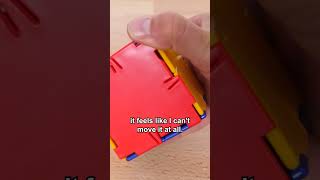
Jessen's Octahedron achieves infinitesimal flexibility without coplanar vertices, which is unusual. The creator shows how squeezing it releases air, proving it's not a true flexible polyhedron.
Robert Connolly discovered the first true flexible polyhedron in 1977. He proved that its volume doesn't change as it flexes, known as the Bellows Conjecture.
What is infinitesimal flexibility?
A structure that can move a tiny bit without any of its bars lengthening.
What makes Jessen's Octahedron special?
It has no coplanar vertices, yet it is infinitesimally flexible.
01:04
Who discovered the first true flexible polyhedron?
Robert Connolly discovered the first true flexible polyhedron in 1977.
01:21
What does the Bellows Conjecture state?
The volume of a flexible polyhedron doesn't change as it flexes.
01:34
Infinitesimal flexibility defined
Provides a clear, intuitive definition of a complex geometric concept.
Jessen's Octahedron's unique property
Highlights a rare geometric structure that achieves infinitesimal flexibility without coplanar vertices.
01:04Bellows Conjecture proof
Explains a significant mathematical proof with practical implications.
01:21[00:02] октаэдр Йессена, обладающий бесконечно малой гибкостью. Что это значит? Если представить себе была абсолютно неподвижной, то никакого движения бы не было вообще. Но в реальной жизни эти перекладины немного растягиваются, а это значит, что я могу подтянуть
[00:15] этот шарнир. А если бы я построил график зависимости удлинения этого стержня от вертикального движения шарнира, он выглядел бы вот так. Вы не сможете сдвинуть сустав, не растянув штангу. А что насчет такой конструкции? Кривая
[00:28] выравнивается по мере приближения к нулевому движению. Таким образом, на самом начальном этапе можно перемещать это соединение, не удлиняя при этом саму штангу. Но затем, как придется удлинить. Подобная конструкция обладает предельной гибкостью, но
[00:42] поскольку она существует в реальном мире, я могу её изгибать. И кажется, что для этого не требуется никаких усилий, пока предмет не пройдёт определённое расстояние. В то время как с её сдвинуть. Создать бесконечно гибкий шарнир очень просто. Вы просто
[00:57] соединитель посередине. Аналогично, в бесконечно гибким, если одна из его вершин лежит в одной плоскости. В то время как многогранник Йессена способен достичь бесконечно малой гибкости, не
[01:11] прибегая к использованию копланарных вершин. Когда я сжимаю его, я чувствую, как выходит воздух. И, что невероятно, это фактически доказывает, что многогранник Йессена не является истинным гибким многогранником. Роберт Коннелли открыл первый настоящий гибкий
[01:24] многогранник в 1977 году. Это вот этот монстр с 18 гранями. Коннелли доказал, что объем гибкого многогранника не изменяется при его изгибе. Это называется гипотезой о мехах, потому что многогранник
[01:39] bellows conjecture because a polyhedron cannot be used as bellows.



⚡ Saved you 0h 01m reading this? Transcribe any YouTube video for free — no signup needed.