
Can You Beat MIT Mathematicians?
40sChallenges viewers to outsmart MIT, tapping into competitive and intellectual curiosity.
▶ Play Clip"The title promises breaking math news and delivers exactly that—a genuine record-breaking discovery with a full backstory."
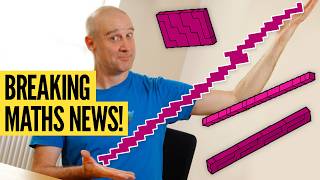
This video announces a major breakthrough in recreational mathematics: a net of just 106 squares that folds into three different cuboids, shattering the previous record of 532. The discovery was made by a community of math enthusiasts, not AI, and the video explains the backstory, the key insights, and the collaborative effort behind it.
A conjecture about a 46-square net was disproven by viewers, leading to a new discovery.
The previous smallest net for three cuboids had an area of 532 squares.
A new net of area 106 was found, much smaller than the previous record.
Michael, a viewer, had the key insight that 1x1xn shapes were more likely to fold into multiple cuboids.
40 distinct nets of area 106 were found, and area 46 was proven impossible.
The nets were classified into stacked nets and simple phase nets, which helped in the search.
The paper's author list includes both professional mathematicians and hobbyists who contributed.
What is the area of the newly discovered net that folds into three different cuboids?
106 squares
06:10
What was the area of the previous record-holding net for three cuboids?
532 squares
05:14
How many distinct nets of area 106 were found that fold into three different cuboids?
40 distinct nets
15:20
What shape did Michael realize was likely to fold into multiple cuboids?
1x1xn
15:32
What are the two types of nets identified in the paper?
Stacked nets and simple phase nets
19:03
How many stacked nets and simple phase nets were found?
15 stacked nets and 25 simple phase nets
19:17
What area was proven impossible for a net folding into three cuboids?
46 squares
14:52
What tool was used to understand the space of possible combinations of layers?
A matrix that tracks which layers can be placed above or below each other
20:11
New record: 106-square net
This is the core discovery, a significant improvement over the previous 532-square record.
06:10Michael's 1x1xn insight
This key observation reduced the search space and made the discovery possible.
15:32Stacked and simple phase nets
Classifying nets into these two types was crucial for the search strategy.
19:03Collaborative discovery
The author list includes both professionals and hobbyists, showing the power of open collaboration.
21:39Area 46 proven impossible
This negative result helped narrow the search and set a new lower bound.
14:52[00:00] They say here, we conjecture that there exists an orthogonal polygon of 46 unit squares that admits to fold these three boxes. So, there's not.
[00:12] People who watch my videos are able to disprove this conjecture as false, and discover a whole new net that even the best mathematicians at MIT couldn't find.
[00:26] Ah, it's so ridiculous. Welcome to this year's best breaking math news.
[00:38] This video is sponsored by Jane Street's 2027 paid internships. Applications open now. Way back at the end of the year of our Lord 2022, the smallest known net that could fold into three different cuboids had an area of 532.
[00:55] But people who watch these videos found a net with an area of 106 that's so much smaller. It's ridiculous. And I will explain the backstory.
[01:09] If you haven't seen the previous video, don't panic. Why this is amazing. What we're going to do next. But I need to say, not AI. Found completely by humans. and I just want to put a little historical marker down
[01:23] right now in the middle of 2026 that in two months we've gone from me making a video saying this is incredible a large language model found some maths
[01:35] to me having to say oh my goodness we found some maths that wasn't done by a large language model so life moves fast what we're talking about here
[01:47] oh and hello new people Thanks for sticking with me. A net that folds into multiple different boxes. This is the animated gif that started this whole thing. I always thought if you unfolded a box, a cuboid, into a net,
[02:01] you fold the net back up, you get the same box back. No, you get the same net that folds into multiple cuboids. And the smallest such one has an area of 22 squares and folds into these two boxes. But that's not the only one.
[02:13] Turns out there are 2,263 of these 22 area nets that have that property. And so I thought just to mix it up, because this is the second video now, and apparently
[02:25] a series, is I've got the website here that has all 2,000 of them all. All laid out in HTML. All 2,263 of these nets. So I figure I'll pick one at random, and I'll build two copies, and we'll fold them into
[02:40] two different boxes. go with this one, that one, let's do it. Oh that's a fun one, so the rule with these is that you don't have
[02:52] to cut any of the edges that line up in the net but the corners aren't fixed so this next row is going to have, and I'll do these in stripes, it's going to have one there but those corners aren't fused but that's that's all going to work out so
[03:06] here we go. If you have to make both of them at the same time if I build them one on top of the off. Genius or foolish? Let's find out.
[03:21] Maybe this way is easier. There we are, upside down. Two identical nets. Now I'm just going to work out how to fold two copies of the same net into two different cuboids.
[03:33] AKA, community bits. If I just start curling this up, it should just become a shape, right? No, what if that was there? Oh hang on, no. Yes, ah right, that can go there.
[03:50] I'm not undoing and redoing anything, I'm just joining edges together as if I was taping, but I learnt last time, that takes forever, as if I was taping a net together. One by one by five, and that goes there. No, no.
[04:06] hang on that would fit through 1x2x3. These both have an area of 22 and they can unfold into the same net and they can do that 2263 different ways. If you
[04:23] think about it, I mean now I've joined it up you can't tell the difference between the original hinge joins and the new ones I just made but where I want to undo this. I have so many choices about exactly which ones I
[04:36] undo until it's plainer, until it's flat on the ground. That's the combinatorics that gets you. When you start undoing cuboids into their nets, you just have so many choices
[04:48] which makes searching for these solutions both on one hand very difficult, but on the flip side it means there can be a lot of them. There's over 2,000 of these. So the obvious next question is if you can find a net that holds
[05:01] into two different cuboids, is there a net that folds into three different cuboids? And for a very long time, ever since 2015, it was known that that was
[05:14] possible, but the smallest net ever found had an area of 532 squares. And last time I got three copies and I put them together.
[05:31] You know what? I don't know if the people who wrote the paper would have ever bothered actually making these so I very easily could be the first human who ever folded the same net into three distinct shapes only with orthogonal folds I mean because either someone else might have done it the authors working on the paper
[05:54] or someone who read it since then, but that was a lot of facts. But now we have a brand new discovery of a much smaller net that does the job. So forget these, honestly, things that fold into two different cuboids, we can fold into
[06:10] three different cuboids and of course we have to do it with an actual piece of paper so here it comes so here we have our newly discovered net and while 106
[06:23] squares is very small compared to the previous record holder it is given we've printed these at a reasonable size it is still a very big piece of paper but
[06:37] don't worry I'm you know it's nothing but not dedicated to physically cutting these things out. As dedicated as I am to ridiculous sight gags. And I have three
[06:50] identical copies, we brought the other two in off-camera and you can see they're all exactly the same. We're just filming in different colors so you can kind of tell them apart and what I'm going to do is fold each one of these up differently
[07:03] to end up with three distinct cuboids. Actually I'll put two of them down there. We'll do the green one first and as is tradition I'm just gonna tape it
[07:15] together. It's not perfect, FYI, just in case you were fooled by my incredible assembly but there it is there first three cuboid oh no this one has a real
[07:36] one by two by n vibe to it okay I think that's the end so if I stick the end I can turn around and go back the other way and while I'm doing it it's a good time to thank the sponsor of this video James Street so they're a quantitative
[07:51] trading firm and applications for their internships next year, 2027, their applications are now open. There aren't many prerequisites as well. J Street Internships are just looking for people who are intellectually curious and
[08:04] enjoy collaborative problem solving. Oh, and at the moment, we've been extra focused on cutting-edge machine learning applications. The applicants can be anywhere in the world. Last year, we had interns from over 117 different schools across 32 countries, and we're looking
[08:20] similar numbers this year going between the Hong Kong, New York, London and now Singapore offices. Oh yes and during your internship you will be able to meaningfully contribute to projects as well as learning from their highly
[08:37] enthusiastic passionate staff that come from a very wide range of academic and industrial backgrounds. And finally you don't need any specific finance background most people at Jenny Street thought exactly the way you were, they were just a
[08:51] curious individual who got hooked on one of the topics available at the internships be it quantitative trading, machine learning, software engineering, research, strategy, product, institutional sales, trading and more. You name it they
[09:03] cover it. I mean as long as what your name pertains to quantitative trading. So thank you so much to Jenny Street for sponsoring this as well as so many of my other videos. If the internship sounds like something you would like to do or you know someone for
[09:16] whom it might be appropriate, please do send them the link that's in the description or scan the QR code that's on the screen right now. Thank you Jane Street. Now I better get back to paying attention to this ridiculous cuboid.
[09:34] Took a little more tape on the outflow than I appreciate, but haha, second cuboid. So now we've got that one and that one. One more to go. Just by sheer luck of the
[09:48] draw, technically I've left the easy one to last for some definition of ease. Okay, there it is. Alright, I'll let's say not my best taping work, but I am
[10:08] disproportionately proud of that because even though it looks a little bit janky that was a tough fold and tight that might be the most complex one I've done on the channel but there you are that is 26 squares this way by one by one for total
[10:23] surface area of 106 back here this one was 17 up and down by two by one for total surface area of 106 and then this one here 8 by 5 by 1 for total surface
[10:37] area, you can work this out yourself, of 106. There you are, three different cuboids all folded from exactly the same net. The shape that mathematicians
[10:50] couldn't find, the best they could do is 532, but you, now I mean literally you, people who watch these videos found this one, and as to how that happened, well,
[11:04] Funny story. This is the 2013 paper that started our adventure. Common developments, which just means like nets that are the same, of three incongruent, so three different orthogonal boxes, which I'll occasionally call cuboids in orthogonal,
[11:21] which just means right angles, well behaved, all that. I'm going to highlight Raihu, one of the authors, we're going to meet them a couple times. Everyone here is based at the Japan Event Institute of Science and Technology Down here in is That the one that I cut out and made last time Area 532 This was the initial announcement of that net
[11:42] the world record for a long time afterwards. And they raised the two questions that over a decade later we solved. Finding much smaller polygons would be future work. They were correct. And in particular, is there a common development of area 46? That can fold into three boxes,
[11:57] may happen to give the sizes there. I saw the highlight down here, these are a lot of the characters you'll see repeating. As well as the Japan Advanced Institute of Science and Technology, you've got the domains going on in here. In fact we'll see Eric Domain a bunch, they're all at MIT.
[12:11] That's the other major institution that's been heavily involved in this work. Oh and here you go, this paper, there's Ruhai kicking around. You've also got the domains, very excited about that. and here's a deep stand-up math cut. This is Zach. Zach is at MIT and they designed the paper
[12:28] clip monstrosity that Adam Savage and I struggled to build. The next major milestone was 2022 when I released a video on the subject. Now a stand-up math video coming out is always a major
[12:41] historical event but on this occasion it's because I also reached out to a bunch of nerds. Shout out out to Landon, Benjamin and Stu who all got heavily involved, but I just basically emailed all the viewers who previously had dramatically improved some code I'd written.
[12:58] It's true. A viewer says one of you, I'm holding you all collectively responsible, took some terrible Python code of mine and made it over 4 million percent better.
[13:11] used to say, it achieves the same thing, but faster. Yeah, jerks, a lot of you. No, I'm kidding. I love my viewers who get unduly involved. And so thanks to these three who really picked up the idea and ran with it.
[13:26] We didn't find anything before my video came out. Afterwards, Michael got involved. They actually put a comment on my Patreon page saying that they had some ideas. I put them in touch with the others. They all started working on it in earnest.
[13:39] and then, 2023, Michael did it. Michael just found a 106 area net, and they let me know by just emailing me a photo of it. So this just appeared in my inbox, a brand new bit of mathematics.
[13:53] No one to no one, except for the small squad of nerds who watch my videos, and me. I, of course, reached out to the folks at MIT, and in 2024, MIT got involved, and huge thanks to Alice, Jenny, and Eric who all got involved
[14:07] to help to organize the process. It contributed new ideas. Jenny particularly worked with Michael to tease out some extra aspects of the mathematics involved. And we also got Ruhaj. It's the whole, it's the dream team, the super group of mathematicians. Because everyone had their
[14:23] actual, you know, real research to be doing and day jobs, in the case of Michael, it took a while to work through all the mathematics. By 2025, we had the paper being written up, pretty much finished and then we'd look for a place to get it published, conferences to go to
[14:38] and that's why in 2026 we are finally announcing this breakthrough discovery and by now you're probably thinking, hang on a second, how did we even find it? Now it wasn't just having more compute time and it wasn't just making the code
[14:52] more efficient, although both those things did happen, in fact those combined is we're able to disprove 46, so we now know there are no solutions within area 46 who are moving the lower bound up.
[15:05] But on top of that, Michael had an extra insight into types of nets that are more likely to have this property. So we haven't done an exhaustive search at 106 or below that,
[15:20] but we have found 40 distinct nets all with an area of 106 that fall into three different cuboids. And what Michael realized is that a lot of the solutions
[15:32] are probably going to have a 1 by 1 by n, and 1 by 1 by n's have certain properties. In our final paper, oh and check out, I mean there's a mass of edges, if I've ever seen
[15:49] them assemble, and polyomino nets is just saying squares joined together on edges, no funny business. So you can see Michael's breakthrough down here, in the official diagram announcing this and you can see the different folding lines, the same net you do subtly different folds
[16:04] for three different cuboids, here they are all overlaid. If you think about the folding that gives you the 1 by 1 by 26, you can see here there's always batches of four squares, four squares, four squares,
[16:16] for every single horizontal row, and this diagram has exactly four squares in a row, and that's because each of these rolls up to form a little band, and there's you know 26 of these which forms
[16:29] the long tube, and then you've got one each end for the caps. It's a very neat insight, and we can show you how we built on this with a slightly less complicated but equivalent type of net.
[16:41] Okay, so I'm just going to kind of hold this one together. This is a 1 by 3 by 5, there's its net, and if I unfold that, it also becomes a 1 by 1 by n, and as I roll it up, you know, wait a minute, as I'm rolling this, these are all four, these are all like bands of four,
[16:57] and that kind of makes sense because each one rolls all the way around the one by one by end. So each one just becomes another band this way and you go all the way along and then you get the end cap. And actually if you unfold the net, that's kind of obvious. We've got a colored in one.
[17:13] This was Michael big insight is you end up with basically stacked rows of four which I fold them all out here to the single one at the top and then we color them four four four four four all the way down
[17:26] and then when you roll that up into your one by one by N, all of these form colored stripes. They go all the way around. But then, if we do it the other way around, and this will take me a second
[17:38] to fold it up in the other orientation. I'll make these files available, by the way. it's kind of fun, like it's not obvious where all the folds go. As you may remember
[17:51] when I was doing the much more complicated 22 one earlier.
[18:08] Okay so I haven't taped it together, but you can see those stripes now go the other way around on the 1 by 3 by 5. So they've kind of, each one combines and goes
[18:22] around it that way there. So the fact that we could reduce the search space from just any old combinations of squares stuck together to ones with these stripes that go in different directions meant that it was searchable
[18:35] and it meant that we were able to find this one. And with one extra insight and and a matrix, we could find multitudes of these. Over here in the same paper you can see where Michael gave the exact same example to show
[18:50] how the stripes when you got your one by one then line up into a different one, but that's not the only direction we took it. These nets were excluding the caps on either end, every single row has four squares that
[19:03] forms a complete band all the way around the cuboid, called stacked nets. And we found a whole bunch of these, specifically as well as the canonical first one that was found, it turns out there were 15 of them. We found 15 common stacked nets.
[19:17] Now a while ago I promised 40, so you're thinking we're only on the 25th. Well it turns out stacked nets aren't the only option. Down here we have, check this out right, so we still have the end caps, one of each, every
[19:29] single row still has four squares, but now they're not contiguous. So it can go down and come back up again. So there's still four squares here that will form a band, but it's not like before where
[19:43] they already start joined together. So it's a more complicated way of doing it. These are called simple phase nets, and these provided the other 25. And once you take out the ones that are equivalent, because they're like, you know, symmetric,
[19:56] they match up, that's the 25 units were found for a total of 40. Now there's loads more in this paper, but I do want to highlight this matrix. may be one of my favorite things that came out of it. So if we go back to that simple phase one here,
[20:11] you can see actually there are seven different possible options for each of the layers right. So you've got seven different arrangements of the four squares in a way such they can all join together to form a complete you know one piece net, and depending on what one you've got above
[20:28] there are a number of different ones in different positions that you can put underneath. And so this matrix is keeping track for any one of those seven states above which ones can possibly go underneath it and you've got that little 16 out the front there
[20:43] that's because the caps each have four options each for where they can go. So you can understand the space of all possible combinations of these seven different layers in the simple phase net using this matrix. I don't get like lost in the
[20:56] weeds here but of course you got a matrix you're gonna have an eigenvalue and the eigenvalue gives us a sense of how fast the number of possible solutions grows as you have more layers.
[21:10] Just one more really nice bit of mathematics that came out in the process of putting together this... I mean, I'm very proud of it, phenomenal, and despite my trivial contribution, Michael should be very proud of this. What a paper.
[21:22] There is loads more lovely mathematics in the paper, so of course I will link to it in the description below. just below the link to the Jenny Street Internships to check those out. But what I love the most about the paper is if you look at the author list, everyone's here. The researchers from
[21:39] Japan, the researchers from MIT, the people who bully me by writing more efficient code and putting it in my YouTube comments. Michael with his big insight that he just put as a comment on Patreon. We've got Producer Nicole and we've got me. I'm now a co-author on a
[21:56] paper with Eric Domain and it's thanks to the phenomenal community of people. You're great humans, you watch my videos and you get involved. Speaking of getting involved, we still have some open questions here don't we? So we now know
[22:10] that a hundred and six is possible for three different cuboids. We know forty six is impossible. There's a bunch of numbers between those two values. Probably like 59 of them, I'm not going to fence both that life, but I am going to
[22:25] challenge you, everyone watching this video, can we find a smaller one than 106? It probably exists. Can we move the lower bound up some more? Almost certainly. So please do get involved and I mean the big question is
[22:41] is there a net that folds into four different tuboids? I mean almost certainly yes. What size? We have no idea. When are we going to find it? Well if we
[22:55] extrapolate from one data point another four years. So everyone, get onto it, and I'll see you in 2030.

⚡ Saved you 0h 23m reading this? Transcribe any YouTube video for free — no signup needed.