
The Impossible Knot Challenge
45sThis segment hooks viewers with a visually intriguing puzzle and a counterintuitive mathematical concept, sparking curiosity and debate.
▶ Play Clip"The title promises a puzzle-solving journey, and the transcript delivers exactly that—a clear, concise demonstration of solving a unique knot puzzle."
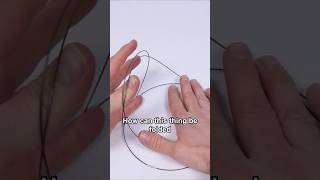
The video presents a unique puzzle that is actually a mathematical knot. The creator explains the definition of a mathematical knot and a fundamental theorem, then demonstrates the solving technique by aligning small triangles.
The puzzle is introduced as a strange object that can be folded back into a circle, setting up the challenge.
A mathematical knot is defined as a loop of string that cannot be untangled, providing the theoretical foundation.
The theorem states that any knot can be arranged into a loop, which is the key principle for solving the puzzle.
The solution involves aligning two small triangles and squeezing them together, demonstrating the practical application.
What is a mathematical knot?
A mathematical knot is a loop of string that cannot be untangled.
00:13
What is the fundamental theorem about knots mentioned?
No matter how complex a knot is, it can always be arranged into a loop.
00:28
What is the key step to solving the puzzle?
Align two small triangles and squeeze them together.
00:56
Introduction to the Puzzle
Sets up the challenge and introduces the concept of a mathematical knot.
00:01Definition of a Mathematical Knot
Provides a clear definition that frames the puzzle's context.
00:13Fundamental Knot Theorem
States a key principle that guides the solving approach.
00:28Solving Technique
Reveals the practical steps to solve the puzzle, demonstrating the application of the theorem.
00:56[00:01] а затем положить её обратно, была изобретена в 80-х годах, и она не похожа ни на одну эту штуку можно сложить обратно в круг? Итак, это пример узла
[00:13] в математическом смысле. Чтобы создать математический узел, достаточно просто вместе. Математический узел — это петля из нити, которую невозможно распутать. о узлах, которая гласит: « Неважно, насколько сложен ваш узел, его
[00:28] всегда можно сплести в петлю». Иными словами, математически доказано, что это можно представить в таком виде. Наша задача — кстати, не очень устойчивы. Они упругие. Когда я говорю, что определенная
[00:43] конфигурация узлов стабильна, я имею в виду, что она была бы стабильна даже при отсутствии первоначальному узлу-головоломке. В чём секрет, чтобы запихнуть это обратно в сумку? Ну, я заметил, что этот узел завязывается вот так: его нужно сжать, и он как бы
[00:56] словами, мне нужно выровнять эти два маленьких треугольника и сжать их вместе. В узле-головоломке нет маленьких треугольников. Там изображены большие треугольники. Но смотрите, если я согну его, чтобы получились маленькие треугольники, а затем сдвину эти
[01:09] triangles and then push those little triangles together, that solves




⚡ Saved you 0h 01m reading this? Transcribe any YouTube video for free — no signup needed.