
Two Math Mindsets: Bob vs Alice
45sRelatable contrast between calculation-heavy and conceptual problem-solving styles hooks viewers who identify with either approach.
▶ Play Clip"The title promises a tale of two problem solvers and delivers exactly that, with a clear contrast and a satisfying mathematical conclusion."
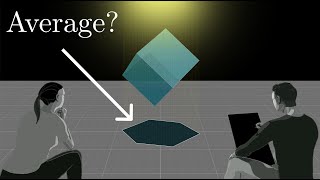
This video explores two distinct problem-solving styles through the lens of a classic geometry puzzle: finding the average area of a cube's shadow. It contrasts the approaches of two hypothetical students, Bob, who favors detailed calculations, and Alice, who prefers high-level generalizations, to reveal deeper insights about mathematical thinking and problem-solving strategies.
The video presents a puzzle about the average area of a cube's shadow, framing it as a study of two different problem-solving styles.
Bob is a student who loves diving into calculations and getting a concrete view of the situation. He prefers detailed, step-by-step computations.
Alice prefers a high-level overview and understanding the general shape of the problem before digging into specifics. She seeks broad generalizations and elegant computations.
The problem is to find the average area of a cube's shadow, considering the cube's size and orientation. The light source is assumed to be directly above and infinitely far away, simplifying to a flat projection.
When the cube is oriented with faces parallel to the ground, the shadow is a square with area s². When the long diagonal is parallel to the light, the shadow area is √3.
The concept of averaging over all possible orientations is defined experimentally: randomly toss the cube, record the shadow area, and take the mean as the number of tosses approaches infinity.
The space of all orientations is described as SO3, typically defined by 3x3 matrices. The question of what distribution to use is deferred until later.
A good first step is to simplify the problem: consider a single face of the cube and a single orientation, ignoring the averaging over all orientations.
Bob derives a formula for the shadow area of a face: area = s² * |cos(θ)|, where θ is the angle between the face's normal vector and the vertical. He uses geometry to find this.
Alice views the transformation as a composition of linear transformations (rotation and projection), leading to the concept of the determinant as a scaling factor for area.
Alice notes that the proportionality constant between the original shape and its shadow does not depend on the shape itself, only on the rotation applied.
Alice uses linearity to factor out the area of the original shape from the average, showing that the average shadow area is proportional to the area of the face, with a constant that is the same for all shapes.
Alice investigates how the cube's shadow area relates to the sum of its face shadow areas, leading to the insight that the cube's shadow is double-covered by the face shadows.
For a convex solid, the shadow area is exactly half the sum of the areas of all face shadows, because each ray of light passes through the solid at exactly two points.
A set is convex if the line connecting any two points inside it is entirely contained within the set. This property is crucial for the double coverage argument.
The video introduces notation for shadow areas and shows how to express the average cube shadow area as a sum over faces and orientations.
Alice rearranges the double sum to average over faces first, showing that the average cube shadow area is half the sum of the average face shadow areas.
The average cube shadow area is proportional to the cube's surface area, with a universal constant that applies to all convex solids.
Bob computes the average shadow area for a square face by integrating over all possible orientations, using a uniform distribution on the sphere of normal vectors.
Bob sets up an integral to average |cos(θ)| over the sphere, using the area of a latitude band to determine the probability of a given θ.
Bob finds that the average shadow area for a square is exactly half its area, giving the mystery constant as 1/2.
Alice uses the sphere as a known case: its shadow is always a circle with area πr², and its surface area is 4πr², so the constant is 1/4. This applies to all convex solids, including the cube.
The result that average shadow area is 1/4 of surface area holds for any convex solid, not just cubes, as shown by approximating a sphere with polyhedra.
The video emphasizes that both styles are valuable. Bob's calculations build intuition, while Alice's generalizations provide elegant solutions and broader insights.
The problem was proved by Cauchy in 1832, and his handwritten notes show an integral similar to Bob's, indicating that a blend of both styles is often necessary for discovery.
Alice's approach suggests a way to quantify convexity: for a solid, compute 4 times the average shadow area divided by surface area; a value of 1 indicates convexity, less than 1 indicates non-convexity.
The video ends by posing a question about the definition of 'average' over orientations, referencing a Numberphile video for further exploration.
The video concludes that both problem-solving styles—calculation and generalization—are essential, and that the average shadow area of any convex solid is exactly one-fourth of its surface area, a result that elegantly generalizes beyond the cube.
What is the average area of a cube's shadow, given a flat projection?
One-fourth of the cube's surface area, which is 1.5 s² for a cube of side length s.
31:29
What is the formula for the shadow area of a single face tilted at an angle θ from the vertical?
Area = s² * |cos(θ)|.
08:31
What is the key insight about the shadow of a convex solid?
The shadow area is exactly half the sum of the areas of all face shadows, due to double coverage.
14:35
What is the universal proportionality constant between average shadow area and surface area for any convex solid?
1/4.
31:29
How is a uniform distribution on the sphere defined?
The probability of landing in any patch is proportional to the patch's area divided by the total surface area of the sphere.
23:05
What is the average shadow area for a square face?
Half the area of the square.
29:33
What is the definition of a convex set?
A set where the line connecting any two points inside it is entirely contained within the set.
15:57
Who proved the general result about average shadow area?
Cauchy in 1832.
36:07
How can you quantify convexity using the average shadow area?
Compute 4 times the average shadow area divided by surface area; a value of 1 indicates convexity, less than 1 indicates non-convexity.
38:13
Double Coverage Insight
This is a key geometric insight that simplifies the problem by relating the cube's shadow to its faces.
14:35Bob's Constant
The result that the average shadow of a square is half its area is a clean, surprising fact.
29:33Universal Constant
The generalization that all convex solids have average shadow area equal to 1/4 of surface area is powerful and elegant.
31:29Cauchy's Historical Proof
Connecting the problem to its historical roots shows that a blend of both problem-solving styles is often necessary for discovery.
36:21Quantifying Convexity
This offers a novel way to measure convexity, demonstrating the practical value of generalization.
38:13[00:00] really nice puzzle involving the shadow of a cube. not exactly the puzzle per se, it's about two distinct problem-solving styles that are reflected in two different ways that we can tackle this problem.
[00:15] In fact, let's anthropomorphize those two different styles by imagining two students, So Bob will be the kind of student who really loves calculation. As soon as there's a moment when he can dig into the details and get a very concrete
[00:30] view of the concrete situation in front of him, that's where he's the most pleased. not because she doesn't know how to do them or doesn't want to per se,
[00:42] but she prefers to get a nice high-level general overview of the kind of problem she's dealing with, the general shape that it has before she digs into the She's most pleased if she understands not just the specific question sitting
[00:55] in front of her, but also the broadest possible way that you could generalize it, and especially if the more general view can lend itself to more swift and elegant computations, once she does actually sit down to carry them out.
[01:13] with is to find the average area for the shadow of a cube. there are a few things that influence the area of its shadow.
[01:25] One obvious one would be the size of the cube, smaller cube, smaller shadow. those orientations correspond to different particular shadows with different areas. over all possible orientations for a particular size of the cube.
[01:44] The astute among you might point out that it also matters a lot where the light source is. then the shadow ends up larger. this can distort the shadow and give it a very different shape.
[01:59] Accounting for that light position stands to be highly interesting in its own right, let's do the easiest thing we can and say that the light is directly above the cube and
[02:11] really far away, effectively infinitely far, so that all we're considering is a flat projection, in the sense that if you look at any coordinates, x, y, z, in space, So, just to get our bearings, the easiest situation to think about would
[02:25] be if the cube is straight up, with two of its faces parallel to the ground. In that case, this flat projection shadow is simply a square, and if we say the side lengths of the cube are s, then the area of that shadow is s².
[02:38] like the one down here, I'll be assuming that the relevant cube has a side length of 1. about is if the long diagonal is parallel to the direction of the light.
[02:53] and if you use some of the methods that we will develop in a few minutes, you can compute that the area of that shadow is exactly the square root of 3 times But of course, more often, the actual shadow will
[03:09] It's some harder to think about shape, based on some harder to think about orientation for this cube. Earlier, I casually threw out this phrase of averaging over all possible orientations,
[03:21] but you could rightly ask, what exactly is that supposed to mean? at least in the sense of what experiment would you do to verify it.
[03:33] freezing it at some arbitrary point, recording the area of the shadow from that position, If you do this many many times, over and over, you can take the mean of your sample.
[03:49] should be whatever that experimental mean approaches as you do more and more tosses, approaching infinitely many. Even still, the sticklers among you could complain that doesn't really answer
[04:04] the question, because it leaves open the issue of how we're defining a random toss. would be to first describe the space of all possible orientations, They call it SO3, typically defined in terms of a certain family of 3x3 matrices.
[04:23] distribution are we putting to this entire space? that we can answer a question involving an average.
[04:35] to hold off on that question until the end of the video. experimental idea of just repeating a bunch of random tosses without really defining
[04:47] Once we see Alice and Bob's solutions, it's actually very interesting to ask how exactly each one of them defined this distribution along their way. And remember, this is not meant to be a lesson about cube shadows per se,
[05:01] different mindsets that we might bring to the puzzle. And as with any lesson on problem solving, the goal here is not to get to the answer as quickly as we can, but hopefully for you to feel like you found the answer yourself.
[05:16] give yourself the freedom to pause and try to think it through. As a first step, and this is really independent of any particular problem solving style,
[05:29] just any time you find a hard question, a good thing that you can do is ask, what's the simplest possible, non-trivial variant of the problem that you can try to forget about averaging over all the orientations.
[05:44] And let's even forget about all the different faces of the cube, Just for one particular face, and one particular orientation, Once more, if you want to get your bearings with some special cases,
[06:00] in which case the area of the shadow is the same as the area of the face. then its shadow will be a straight line, and it has an area of zero.
[06:14] And the way he might think about it is to consider And what seems relevant is the angle that that normal vector makes with the vertical,
[06:26] with the direction where the light is coming from, which we might call theta. we know that when theta is equal to zero, the area of that shadow is square has side lengths s.
[06:42] And if theta is equal to 90 degrees, then the area of that shadow is zero. so anyone comfortable with their trig functions could probably But Bob is more detail-oriented than that.
[06:57] rather than just making a guess based on the endpoints. If we consider the plane that passes through the vertical as well as our normal vector,
[07:09] and then we consider all the different slices of our shape that are in that plane, or parallel to that plane, then we can focus our attention on a If we just look at one of those slices, who has a normal vector,
[07:22] an angle theta away from the vertical, its shadow might look something like this. And if we draw a vertical line up to the left here, we have ourselves a right triangle. where we follow around what that angle theta implies about the rest of the diagram.
[07:38] And this means the lower right angle in this triangle is precisely theta. So, when we want to understand the size of this shadow in comparison to the original size of the piece, we can think about the cosine of that angle,
[07:51] It's literally the ratio between the size of the shadow and the size of the slice. down in this direction is exactly cosine of theta.
[08:05] all the slices in that direction get scaled by the same factor. there is no stretching or squishing, because the face is not at all tilted in
[08:17] So overall, the two-dimensional shadow of our two-dimensional face should also be scaled down by this factor of a cosine of theta. given the case where the angle is 0° and the case where it's 90°,
[08:31] And actually, as stated so far, this is not quite correct. In the case where theta is bigger than 90°, the
[08:43] But of course, we don't want to consider the shadow to have negative area, So there's two different ways you could solve this. that has a positive z component.
[08:58] Or, more simply, we could say, just take the absolute value of that cosine, and that gives us a valid formula. So Bob's happy because he has a precise formula describing the area of the shadow.
[09:11] She says, okay, we've got some shape, and then we apply a rotation and then we apply a flat projection that shoves that back into two-dimensional space.
[09:25] And what stands out to her is that both of these are linear transformations. and that the overall transformation would look like the product of those two matrices.
[09:37] is that if you take some shape and you consider its area, then you apply some linear transformation, then the area of that output looks like some More specifically, we have a name for that constant.
[09:52] It's called the determinant of the transformation. we could give a much more intuitive description and say, the output will also uniformly get stretched in some direction.
[10:07] So the area of each of them should scale in proportion to each other. but it's not really her style to do that, at least not to do so immediately. Instead, the thing that she writes down is how this proportionality constant
[10:22] between our original shape and its shadow does not depend on the original shape. or anything else, and the size of it doesn't really matter. The only thing affecting that proportionality constant is what transformation
[10:36] some factor that depends on the rotation being applied to the shape. we know what that factor looks like.
[10:48] the angle between the normal vector and the vertical. yeah, I can think about that eventually when I want to. though she holds out some hope that any specific formula about a
[11:03] specific orientation might get washed away in that average. Of course the area of the shadow is proportional to the area of the original shape.
[11:15] They should both scale like two-dimensional things. dealing with the harder case that has a closer light source. For example, if I rotate this cat so that its tail ends up quite close to the light
[11:32] source, then if I stretch the original shape uniformly in the x-direction, say by a factor of 1.5, it might have a very disproportionate effect on the ultimate shadow because the tail gets very disproportionately blown up as it gets really close
[11:45] Again, Alice is keeping an eye out for what properties of the problem are Does the fact that we're thinking about a square face and not some other shape matter?
[11:57] Does the fact that the transformation is linear matter? Yes, absolutely. about the average shadow for any shape like this.
[12:12] Say we have some sequence of rotations that we apply to our square face. Then the area of the shadow in each one of those cases And that factor depends on the rotation.
[12:28] rotations we're looking at right now, the way it looks is to add up all of those shadow areas and then divide by the total number that we have. Now, because of the linearity, this area of the original square
[12:42] can cleanly factor out of all of that, and it ends up on the left. it's just an empirical mean of a sample of rotations. approaches as the size of our sample approaches infinity.
[12:57] sample sit cleanly away from the area itself. It might be a royal pain to compute, we're not sure about that yet,
[13:09] and the shape of the particular 2D thing that we're looking at. And her hope is that that universality somehow lends
[13:21] itself to a more elegant way to deduce what it must be. and in a few minutes I'll show you how he does it. because this is where things start to really get fun.
[13:40] before diving into the details, she's curious now about how the area of the shadow of the cube relates to the area of its individual faces. Now if we can say something about the average area of a particular face,
[13:55] does that tell us anything about the average area of the cube as a whole? definitely less than the sum of the areas across all the faces, because there's a meaningful amount of overlap between those shadows.
[14:09] because if we focus our attention just on two particular faces, But in other orientations they do have some overlap,
[14:21] and the specific shape and area of that overlap seems a little bit tricky to think about, much less how on Earth we would average that across all of the different orientations. and this is the first one of them.
[14:35] She says, actually, if we think about the whole cube, not just a pair of faces, we can conclude that the area of the shadow for a given orientation is exactly one half the sum of the areas of all of the faces.
[14:49] light and half of them are not, but here's the way that she justifies it. She says for a particular ray of light that would go from the sky and eventually hit a point in the shadow, that ray passes through the cube at exactly two points.
[15:05] So every point in that shadow corresponds to exactly two faces above it. happened to go through the edge of one of the squares.
[15:19] But those account for zero area inside the shadow, so we're safe to ignore them if the thing we're trying to do is compute the area.
[15:31] which is important for understanding how the problem might generalize, Convexity is one of those properties where a lot of us have an intuitive sense for
[15:44] what it should mean, you know, it's shapes that just bulge out, they never dent inward. formalizing it that's helpful for actual proofs. They say that a set is convex if the line that connects any two
[15:57] points inside that set is entirely contained within the set itself. So, a square is convex because no matter where you put two points inside that square, the line connecting them is entirely contained inside the square.
[16:10] I can easily find two different points so that the line connecting them has to None of the letters in the word convex are themselves convex.
[16:22] You can find two points so that the line connecting them has to pass outside of the set. It's a really clever way to formalize this idea of a shape that only bulges out. Because anytime that it dents inward, you can find these counterexample lines.
[16:36] Or, our cube, because it's convex, between the first point of entry and the last point of exit, it has to stay entirely inside the cube by definition of convexity. But if we were dealing with some other non-convex shape, like a donut,
[16:49] then exits again, so you wouldn't have a clean two-to-one cover from the shadows. The shadows of all of its different parts, if you were to cover this in a bunch of faces,
[17:01] So, that's the first key insight, the face shadows double cover the cube shadow. so let's start things off by abbreviating our notation a little to
[17:13] Instead of writing the area of the shadow of the cube, And similarly, instead of the area of the shadow of a particular face, I'm just going to write s of f, where that subscript j indicates which face I'm
[17:27] But of course, we should really be talking about the So I might write this as s of some rotation applied to the cube, and likewise on the right, it's the area of the shadow of that same rotation applied to
[17:41] With the more compact notation at hand, let's think about the average of this shadow area across many different rotations, some sample of r1, r2, r3, and so on.
[17:54] of those shadow areas and then dividing them by n. And in principle, if we were to look at this for larger and larger samples, let n approach infinity, that would give us the average area of the shadow of the cube.
[18:08] but it's beneficial to write it out so that we can understand why it is that expressing the shadow area for a particular rotation of the cube as a sum across all of its faces, or one half times that sum at least, why is that beneficial?
[18:23] Well, let's just write it out, where for each one of these rotations of the cube, rotation applied across all of the faces. And when it's written as a grid like this, we can get to Alice's second insight,
[18:38] going row by row to instead going column by column. For example, if we focused our attention just on the first column, what it's telling us is to add up the area of the shadow of the first face across many
[18:53] So if we were to take that sum and divide it by the size of our sample, that gives us an empirical average for the area of the shadow of this face. So if we take larger and larger samples, letting that size go to infinity,
[19:07] this will approach the average shadow area for a square. Likewise, the second column can be thought of as telling us the average area for the second face of the cube, which should of course be the same number.
[19:20] us the average area for a particular face. So that gives us a very different way of thinking about our whole expression. Instead of saying add up the areas of the cubes at all the different orientations,
[19:32] faces and divide the total by one half. and the term on the right is thinking about adding up columns first.
[19:44] the same as the sum of the average of the face shadows. but I can tell you that there is actually a little bit more
[19:56] than meets the eye to the step that we just took, but we'll get to that later. And remember, we know that the average area for a particular face looks like some universal proportionality constant times the area of that face.
[20:08] we could think of this as equaling some constant times the surface area of the cube. The average area for the shadow of this cube is But at the same time, you might complain, well Alice is just
[20:25] matters if we don't know what that proportionality constant is. Like, of course the average shadow area should be proportional to the surface area.
[20:37] They're both two-dimensional quantities, so they should scale in lockstep with each other. After all, for a closer light source, it simply wouldn't be true. versus row by row is a little more nuanced than it might look at first.
[20:55] which carries a special significance when we choose to revisit the question of what probability distribution is being taken across the space of all orientations.
[21:07] But more than anything, the reason that it's not obvious is that the significance of this result right here is not merely that these two values are proportional. and, crucially, the actual content of what Alice has built up so far
[21:23] is that it'll be the same proportionality constant across all of them. predict the way that Alice is able to finish things off from here. It's really delightful, it's honestly my main reason for covering this topic.
[21:38] But before we get into it, I think it's easy to underappreciate her result unless we dig into the details of what it is that she manages to avoid. So let's take a moment to turn our attention back into Bob's world,
[21:50] because while Alice has been doing all of this, he's been busy doing some computations. In fact, what he's been working on is finding exactly what Alice has yet to figure out, which is how to take the formula that he found for the area of a square's
[22:03] that square's shadow averaged over all possible orientations. orientations for this square, is to ask, what are all the different
[22:21] because everything about its shadow comes down to that normal vector. It's not too hard to see that all those possible normal vectors trace out the surface of a sphere, if we assume it's a unit normal vector, it's a sphere with radius 1.
[22:36] sphere should be just as likely to occur as any other. there's no reason to prefer one direction over another. it's not very helpful to talk about the likelihood of a particular individual point,
[22:53] that would be zero and unhelpful. So instead, the more precise way to phrase this uniformity would be to say the probability that our normal vector lands in any given
[23:05] patch of area on the sphere should be proportional to that area itself. patch divided by the total surface area of the sphere. that's what we mean by a uniform distribution on the sphere.
[23:22] Now to be clear, points on the sphere are not the same thing as orientations in 3D space, that leaves us with another degree of freedom, But Bob doesn't actually have to care about that extra degree of freedom,
[23:38] it's only dependent on the cosine of the angle between that normal vector and Which is kind of neat, all those shadows are genuinely different shapes,
[23:50] they're not the same, but the area of each of them will be the same. What this means is that when Bob wants this average shadow area over value of this absolute value of cosine of theta for all different
[24:04] possible normal vectors, all different possible points on the sphere. Well, if we lived in some kind of discrete pixelated world, that normal vector could have, the average would be pretty straightforward.
[24:21] What you do is find the probability of landing on any particular value of theta, which will tell us something like how much of the sphere do normal vectors to take the average of, this formula for the area of the shadow.
[24:36] And then you would add that up over all of the different possible values of theta, ranging from 0 up to 180 degrees, or pi radians. But of course, in reality, there is a continuum of possible values of theta,
[24:49] specific particular value of theta will actually be 0. And so a sum like this unfortunately doesn't really make any sense, or if it does make sense, adding up infinitely many zeros should just give us a 0.
[25:05] The short answer for what we do instead is that we compute an integral. what background I should be assuming from those of you watching right now. calculus and you don't need me to belabor the point here.
[25:19] and I shouldn't just be throwing down integrals like that. but you need a little bit of a refresher. I'm going to go with the option of setting this up as if it's a calculus lesson,
[25:33] setting them up can be kind of an error-prone process, and calling back to the underlying definition is a good way to sort of check If we lived in a time before calculus existed and integrals weren't a thing,
[25:47] one way we could go about it is to take a sample of values for theta that ranges We might think of them as evenly spaced with some sort of difference between each one,
[26:01] And it's still the case that it would be unhelpful to ask about the probability That probability would still be 0 and it would be unhelpful. But what is helpful to ask is the probability of falling between two different
[26:17] values from our sample, in this little band of latitude with a width of delta theta. Based on our assumption that the distribution along this sphere should be uniform, that probability comes down to knowing the area of this band.
[26:30] band should be that area divided by the total surface area of the sphere. To figure out that area, let's first think of the radius of that band, which, if the radius of our sphere is 1, is definitely going to be smaller than 1.
[26:45] you can see that that little radius, let's just say at the top of the band, This means that the circumference of the band should be 2 pi times
[26:58] the sine of that angle, and then the area of the band should be Or rather, the area of our band is approximately this quantity. What's important is that for a finer sample of many more values of theta,
[27:13] the accuracy of that approximation would get better and better. Now remember, the reason we wanted this area is to know the probability of falling into that band, which is this area divided by the surface area of the sphere,
[27:25] That's a value that you could also compute with an integral similar to the one that we're setting up now, but for now we can take it as a given, as a standard well-known formula. And this probability itself is just a stepping stone in the direction of
[27:40] what we actually want, which is the average area for the shadow of a square. To get that, we'll multiply this probability times the corresponding shadow area, which is this absolute value of cosine theta expression we've seen many times up to this
[27:52] And our estimate for this average would now come down to adding up this expression across all of the different bands, all of the different samples of theta that we've taken. We've got a lot of exact formulas describing something very concrete,
[28:09] And again, if it feels like a lot of detail, I want you to appreciate that fact, so that you can appreciate just how magical it is when Alice manages to somehow avoid all
[28:21] Anyway, looking back at our expression, let's clean things up a little bit, And we can simplify that 2 pi divided by 4 pi to simply be 1 half.
[28:34] with integrals, let me just swap the main terms inside the sum here. What we now have, this sum that's going to approximate the answer to our question, Instead of writing the sigma for sum, we write the integral symbol,
[28:49] this kind of elongated Leibnizian s, showing us that we're going from 0 to pi. a concrete finite amount, we instead describe it as d theta, which I like to think of as signaling the fact that some kind of limit is being taken.
[29:06] sum on the bottom approaches for finer and finer subdivisions. More dense samples that we might take for theta itself.
[29:19] I'll just write down the details of how you would actually carry this out, It's the usual anti-derivative stuff, but the one key step is to bring in a certain trig identity.
[29:33] In the end, what Bob finds after doing this is the surprisingly clean fact that the average area for a square's shadow is precisely one half the area of that square. This is the mystery constant, which Alice doesn't yet know.
[29:48] he could finish out the problem right now. He plugs in the constant that he just found, and he knows the final answer.
[30:00] what is it that Alice does to carry out the final solution? I introduced her as someone who really likes to generalize the results she finds. that aren't really material for solving particular problems.
[30:17] But this is a case where the generalization itself draws her to a quantitative result. Remember, the substance of what she's found so far is that if you look at any convex solid, then the average area for its shadow is going to be proportional to its surface
[30:31] And critically, it'll be the same proportionality constant across all of these solids. out there where she already knows the average area of its shadow.
[30:45] The most symmetric solid available to us is a sphere. the flat projection shadow, is always a circle with an area of pi r squared.
[30:58] And the surface area of a sphere, like I mentioned before, is exactly 4 pi r squared. area formula and how Archimedes proved it thousands of years before calculus existed,
[31:14] The magic of what Alice has done is that she can take this seemingly specific fact that the shadow of a sphere has an area exactly 1 fourth its surface area and use it to conclude a much more general fact that for any convex solid out there,
[31:29] its shadow and surface area are related in the same way, in a certain sense. So with that, she can go and fill in the details of the particular question about a cube and say that its average shadow area will be 1 fourth times its surface area, 6 s squared.
[31:43] But the much more memorable fact that you'll go to sleep thinking about is how it didn't really matter that we were talking about a cube at all. isn't really a valid argument because spheres don't have flat faces.
[32:00] if we actually look at the argument itself, it definitely depends on the use of a finite For example, if we were mapping it to a dodecahedron, you would start by saying that the area of a particular shadow of that
[32:15] dodecahedron looks like exactly 1 half times the sum of the areas of the Once again, you could use a certain ray of light And remember, the benefit of expressing that shadow area as a sum is that when we want to
[32:31] average over a bunch of different rotations, we can describe that sum as a big grid where we can then go column by column and consider the average area for the shadow of each face. And also, a critical fact was the conclusion from much earlier that
[32:45] the average shadow for any 2D object, a flat 2D object, which is important, will equal some universal proportionality constant times its area. It could have been a square, or a cat, or the pentagonal faces of our dodecahedron,
[33:00] Though, after hastily carrying this over to a sphere that doesn't have a finite number of flat faces, you would be right to complain. What you can do is imagine a sequence of different polyhedra that
[33:14] successively approximate a sphere, in the sense that their faces For each one of those approximations, we can draw the same conclusion, surface area with this universal proportionality constant.
[33:31] the average shadow area at each step and the surface area at each step, then in the limit, it's also going to equal that constant.
[33:44] But on the other hand, by their definition, in the limit, their average shadow area should be that of a circle, which is πr², and the limit of the surface areas would be the surface area of the sphere, 4πr².
[33:57] So we do genuinely get the conclusion that intuition would suggest, we do have to be a little delicate in how we justify that intuition.
[34:12] It's easy for this contrast of Alice and Bob to come across like a value judgment, she insightfully avoided all those computations that Bob had to do. But that would be a very, um, misguided conclusion.
[34:28] of math differ from the feeling of actually doing math. the arguments with some clever keen insight that lets you avoid doing calculations.
[34:41] I could just be projecting, since I'm very guilty of this, but what I can tell you, sitting on the other side of the screen here, is that it feels a lot more For one thing, in Alice's approach, the line of reasoning is fun,
[34:55] But also, crucially, the way that you explain it is more or less the same for a very wide range of mathematical backgrounds. not because the computations are all that bad, I mean, they're honestly not,
[35:11] very different depending on the different mathematical backgrounds in the audience. So you, watching this right now, clearly consume math videos online,
[35:23] If the aim is to have a genuine lesson on problem solving, too much focus on the slick proofs runs the risk of being disingenuous.
[35:35] mode here and ask about the case with a closer light source. To my knowledge, there is not a similarly slick solution to Alice's here, The much more productive warmup to have done would
[35:51] And if you look at the history of this problem, it was proved by Cauchy in 1832, and if we paw through his handwritten notes, Right here at the top of page 11, you can see what is
[36:07] essentially the same integral that you and I set up in the middle. not something specific like the case of a cube. So if we were asking the question which of these two mindsets correlates with the act of
[36:21] discovering new math, the right answer would almost certainly have to be a blend of both. the part of that blend where you're eager to dive into calculations.
[36:34] And I think there's some risk that the videos I make might contribute to that. In the podcast I did with the mathematician Alex Kontorovich, he talked about the often underappreciated importance of just drilling on
[36:46] computations to build intuition, whether you're a student engaging with a new class, or a practicing research mathematician engaging with a new field of study. A listener actually wrote in to highlight what an impression that particular section made.
[36:59] They're a PhD student and describe themselves as being worried that their mathematical abilities were starting to fade, which they attributed to becoming older and less sharp. But hearing a practicing mathematician talk about the importance of doing hundreds of
[37:11] evidently that changed their perspective. In their own words, recognizing this completely reshaped their outlook and their results. you know, Newton, Euler, Gauss, all of them, they all have
[37:27] The irony of being biased to show insights that let us avoid calculations is that the way people often train up the intuitions to find those insights in the first place is by doing piles and piles of calculations.
[37:44] All that said, something would definitely be missing without the Alice mindset here. I mean, think about it, how sad would it be if we solved this problem for a cube and we never stepped outside of the trees to see the forest and understand
[37:57] that this is a super general fact, it applies to a huge family of shapes. And if you consider that math is not just about answering the questions that are one fun side note about Alice's approach here is that it suggests a fun way to quantify
[38:13] Rather than just having a yes-no answer, is it convex, is it not, we could put a number to it by saying, consider the average area of the shadow of some solid, multiply that by four, divide it by the surface area,
[38:27] and if that number is one, you've got a convex solid, but if it's less than one, it's non-convex, and how close it is to one tells you how close it is to being convex. helps explain why it is that mathematicians have what can sometimes
[38:44] look like a bizarre infatuation with generality and with abstraction. The more examples that you see where generalizing and abstracting actually helps you to solve a specific case, the more you start to adopt the same infatuation.
[38:59] And as a final thought for the stalwart viewers among you who've stuck through it this far, there is still one unanswered question about the very premise of our puzzle. Now if that feels like a silly question, like of course we know what it should mean,
[39:14] I would encourage you to watch a video that I just did with Numberphile After you watch it, and if you appreciate some of the nuance at play here, homework for you is to reflect on where exactly Alice and Bob implicitly answered this
[39:29] The case with Bob is relatively straightforward, but the point at which Alice locks down some specific distribution on the space of It's actually very subtle. 680 00:40:00,420 --> 00:39:41,700 .


⚡ Saved you 0h 40m reading this? Transcribe any YouTube video for free — no signup needed.