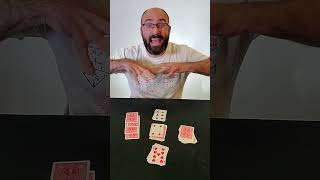

The Trick That Changed My Life
44sPersonal backstory and mystery hook viewers into wanting to see the trick.
▶ Play Clip"The title accurately describes the trick; the video delivers exactly what it promises with a clear explanation."
This video demonstrates a classic card trick called the '13 Trick', where the magician can predict the value of a chosen card through a counting procedure. The trick involves building piles by counting from the card's value up to 13, then having a spectator select piles, and finally dealing cards to reveal the prediction. The explanation shows that the trick works due to a mathematical principle involving the number of cards in each pile.
Begin with a full deck of 52 cards. Pull out a card, look at its value, and count from that value up to 13, placing cards in a pile. For example, if the card is 8, count 8,9,10,11,12,13, then turn the pile over.
Repeat the process: for each pile, start with the top card's value and count to 13. Face cards: Jack=11, Queen=12, King=13. If you cannot complete a count, those cards stay in hand. Continue until you cannot form another pile.
Ask the spectator to choose any three piles. Remove all other piles and add them back to your hand. Then ask them to choose two of the three piles. Turn over the top cards of those two piles.
Add the values of the two chosen top cards plus 10. Then deal that many cards from your hand. For example, if top cards are 9 and 6, sum = 10+9+6 = 25. Deal 25 cards. The number of cards left in your hand equals the value of the remaining pile's top card.
Each pile totals 14 cards (the top card plus 13 more), but some cards are skipped. After removing three piles, the hand contains 10 cards plus the skipped counts from the two chosen piles. The sum of 10 plus those skipped counts gives the number of cards to deal, leaving the skipped count of the third pile, which matches its top card.
The '13 Trick' is a self-working card trick based on simple arithmetic, ensuring the final number of cards in hand always equals the value of the remaining pile's top card. It is a fun example of recreational mathematics.
What is the value of a Jack in the 13 trick?
11
00:32
How many cards total are in each pile (including the top card)?
14
02:05
What is the sum of the two top card values plus 10 used for?
It determines the number of cards to deal from the hand.
01:28
After the spectator chooses two piles, what remains in your hand that reveals the final card?
The number of cards left in hand equals the top card of the third pile.
02:05
The Magic of Math
The presenter explains how this trick changed their perspective on math, emphasizing the beauty of recreational mathematics.
00:01Trick Always Works
The presenter states that the trick works every time, which is a key selling point for magic tricks.
01:53Mathematical Principle
The explanation reveals the underlying arithmetic: each pile contributes 14 cards minus the skip, leading to the prediction.
02:05[00:01] I want to show you the magic trick that literally changed the direction of my long time ago, but when I asked her what its secret was, she told me, "Michael, I don't know. It just happens." And ever since that day, I have loved math and
[00:15] recreational mathematics. Here's how you do it. You start with a deck of 52 in any way. Just pull out a card, turn it over, and look at its value. Eight. Now, from eight, count up to 13 just like this. 8 9 10 11 12 13 All right,
[00:32] turn it over. Now, we're going to do this as many times as we can. 9 10 11 12 13. Next up, we've got a jack. A jack is worth 11. 12 13. Turn it over. We've got
[00:45] worth 13. That pile is done. We're going to move on to six. 13. Do we have enough for one more pile? I don't think so. 3 4 5 6 7 8 9 Didn't make it. So, these
[00:57] cards are going to stay in my hand. Now, once you've got these piles, ask someone to pick any three piles they want. Let's say they pick um this one and they pick this one and they pick that one. Perfect. Wonderful. Take all the other
[01:11] piles away and add them back to your hand. Then ask the person to choose two of these piles. Let's say they pick uh this one and this one. turn over their top cards and then ask them to take the number 10 and add to 10 this value and
[01:28] number 10 and add to 10 this value and that value. Well, 10 + 9 is 19 + 6 is 25. Now, all you have to do is take those cards in your hand and deal out 25 those cards in your hand and deal out 25 cards. 1 2 3 4 5 6 7 8 9 10 11 12 13 14
[01:40] 15 16 17 18 19 20 21. Wonderful. Now, how many cards are left Wonderful. Now, how many cards are left in your hand? Well, I've got here 1 2 3 four cards. And that is a very special number. Because that is exactly the same
[01:53] number. Because that is exactly the same as the value on this top card. This will work every time. And here's why. As it turns out, the value of the top card on each pile tells us how many additional cards are in my hand. That's because
[02:05] every time I built a pile, I would put down a card and then I would put down 13 more cards for a total of 14 cards per pile minus this many cards. That number of cards stayed in my hand. I skipped that many while counting. And so in this
[02:21] case, I don't have three piles of 14 cards each. But if I did, I would have 14 * 3 cards on the table, 42. Well, I began with 52. So if these piles had 14 anything, I would have 10 cards in my hand. But in the case of this pile, six
[02:36] stayed in my hand. And here, nine stayed in my hand. So the number of cards in my in my hand. So the number of cards in my hand is 10 + 6 + 4 + 9. Which means when figure out what it is by simply taking out 10 cards and then six and then nine
[02:52] and the number of cards left in my hand will exactly match the value of the will exactly match the value of the remaining top card.




⚡ Saved you 0h 02m reading this? Transcribe any YouTube video for free — no signup needed.