
What's a mathematical lollipop?
44sA playful, visual introduction to a weird math concept hooks viewers instantly.
▶ Play Clip"The video title accurately reflects the content – it presents a genuine unsolved problem in recreational mathematics, covering known results and the current frontier."
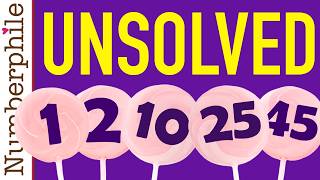
This video explores the 'Lollipop Problem' – a geometric puzzle where 'lollipops' (each consisting of a circle with a perpendicular infinite stick) are placed on a plane to maximize the number of resulting regions. The presenter explains the maximum regions for one, two, and three lollipops, and details the current frontier for four lollipops, where the proven maximum is 45 out of a theoretical 47. The problem remains unsolved for five lollipops, with either 71 or 72 suspected.
A lollipop is a circle with a perpendicular, infinite, invisible stick coming out of it, passing through the center.
The single circle divides the beach (plane) into inside the circle and the rest (infinite region).
By overlapping circles slightly and ensuring sticks cut the other circle, you can get 10 regions.
Circle-circle, stick-circle, and stick-stick intersections. The goal is to maximize these crossings.
Number of regions = number of intersections + n + 1. For two lollipops with 7 intersections, that's 10 regions.
Each pair of lollipops can intersect in 7 points (21 total), plus n=3, plus 1 gives 25 regions.
One solver magnified a circle by 100x so its edge looked nearly straight, allowing precise placement of a tiny fourth lollipop.
After attempts, the best possible is 45 (not the theoretical 47), achieved and proven optimal.
The black stick fails to cross the green circle, losing two intersections and thus two regions.
The answer is either 71 or 72 regions, but it is not yet known which is possible.
The Lollipop Problem showcases how simple geometric shapes can lead to deep combinatorial questions. While the maximum regions for up to three lollipops are known, the problem becomes incredibly challenging for four and remains unresolved for five, making it an active open problem in recreational mathematics.
What is a mathematical lollipop as described in the video?
A circle with a perpendicular infinite stick coming out of it, where the stick is invisible and passes through the center.
How many regions does one lollipop divide the plane into?
Two regions: inside the circle and the rest.
00:29
What is the maximum number of regions achievable with two lollipops?
10 regions.
01:35
What are the three types of intersections between two lollipops?
Circle-circle, stick-circle, and stick-stick intersections.
03:12
What is the formula relating the number of regions to intersections and number of lollipops?
Number of pieces = (number of intersections) + n + 1, where n is the number of lollipops.
04:02
How many intersections are there between two optimally arranged lollipops?
7 intersections.
04:16
How many regions does three optimally arranged lollipops produce?
25 regions.
06:21
What is the theoretical maximum number of regions for four lollipops?
47 regions (if each pair intersected in 7 points, total 42 intersections).
07:32
What is the actual proven maximum number of regions for four lollipops?
45 regions.
10:33
Why is the maximum for four lollipops not 47?
Because the fourth stick cannot cross all three circles; it only crosses two, losing two intersections.
11:10
For five lollipops, what are the two possible values for the maximum number of regions?
Either 71 or 72.
12:44
Definition of lollipop
Core concept of the problem.
Maximum of 10 regions with two lollipops
Demonstrates the optimal arrangement and the counting method.
01:35Formula for maximum regions
Gives a simple mathematical relationship to compute the maximum.
04:02Ingenious method for fourth lollipop
Uses magnification and perturbation to solve an extremely tricky geometry puzzle.
09:08Five lollipops still open
The problem remains unsolved for higher numbers, showing that simple geometry can still yield difficult open problems.
12:44[00:00] What's a lollipop? Tell me about lollipops. Yeah, well, this is a mathematical lollipop. What it consists of is a circle on a stick. And if you continued the stick, it would pass through the center of the circle.
[00:14] This part of the stick is invisible, and the stick is infinite. So it's a circle with a perpendicular stick coming out of it, perpendicular to the edge of the circle. That's a lollipop. And we've got one of them, and it looks like that, and it divides up the region.
[00:29] If we're drawing a band, it divides up the beach into the part that's inside the circle and the rest of the beach. And so one lollipop divides the beach, the paper, into two regions.
[00:43] Inside the circle and all the rest. Because this goes off to infinity. What if we have two lollipops? This is actually a little tricky. If you have two lollipops, how many regions can you make by overlapping them?
[00:56] Well, you could do this. You could put your other lollipop here, and this stick could go here, and then if we did that, how many regions would we get? One, two, three, four, five, six.
[01:11] We could easily get six regions. Can we not get seven? If these go forever, is the other side of the thing not a seven? It's seven. It is seven, right? Yeah, you're right. Oh, yeah, I know my stuff. You know your stuff.
[01:23] Seven, right. So each stick goes off to infinity. so with two we can certainly get seven and that's okay but it's not great you can actually get ten pieces if you do it right and what you do is you make sure
[01:35] that the circles of the lollipops overlap in just a little sliver and then you make sure the stick of the first lollipop cuts the circle of the second lollipop
[01:50] and then scalpel, glue we get this. It's going to go through the imaginary, through the central of that. It's going to cut across this gulf where the two circles, and then it's going to
[02:08] cut that one. So I'll give it a little bit of space. Looks like that. And what you get, let's count the pieces. How many pieces did we get when we do that? Very careful.
[02:20] All right. We have, first of all, we have below the six and above the six, the two infinite regions. All right. One, two. Then three and four. Yeah. And then five for the sliver.
[02:33] Six and seven down here. And then eight, nine, ten. So we get ten pieces. You can show using higher mathematics or in this formula that the crucial thing, if you want to get the most pieces
[02:47] what you need to focus on are the intersections, the crossings between one lollipop and the other lollipop and the crossings, it's crucial that you know this
[03:00] using one of those you can show that the important thing is to get the most intersections between the lines of one lollipop and the lines of the other lollipop and the intersections
[03:12] There are three kinds of intersections. There are intersections where the circle part cross, and you can see I managed to make this circle and this circle cross in two points There also intersections where the stick of one lollipop crosses the circle of the other lollipop and we like each of them to happen twice
[03:35] So we can say that blue stick crosses the other lollipop twice. Correct. And vice versa. This stick crosses this one here and here. And then the sticks themselves can cross. And they do here just once.
[03:50] Sticks either cross or they don't. So with two circles, we get seven intersections. And there's a formula. The number of pieces equals intersections,
[04:02] number of intersections, plus n, the number of stakes, plus one. With two, n equals two, we got seven intersections. I showed you two plus two plus two plus one, seven.
[04:16] And then two, because we got two circles, plus one. And that's ten. And that's the best we can do with two lollipops. And if we had three lollipops, ideally we'd make each pair of lollipops intersect in this way.
[04:30] It looks like this. It is very tricky to draw. Okay, so the new lollipop is the green one. The green one at the bottom. And it intersects the red one in the same way that the blue and the red intersected,
[04:44] and it intersects the blue one in the same way. Each pair of lollipops here meet in seven intersections. And the stick from the third new lollipop...
[04:56] Yes, going up. ...is slightly off-centre. Yeah. It doesn't intersect with the intersection of the first two sticks. Correct. To maximise out. Yeah, you never want to have three things meeting at a point
[05:08] because you make a tiny little change and you pick up one piece, one region. So that stick is slightly off. Slightly off-centre. And it's true, you might think I'm fudging this, but actually if you work to multiple precision,
[05:24] and you draw it carefully, I did actually draw it carefully, and you can see it in the OEIS entry for this sequence. So how many pieces did we end up with for three lollipops? You need to know how many intersections there are.
[05:37] Each pair intersect in seven points. So there are seven intersections there, seven there, and seven there. And none of them have been counted twice? No, they're distinct. You can see, check, and very careful not to have any triple points or higher.
[05:54] So we've got 21 intersections. All right, n equals 3. Three lollipops. The number of intersections is equal to 7 plus 7 plus 7, because we've got three lollipops, and each pair meets in seven points,
[06:09] and they're all different. So that's 21. and then the formula is this we add n which is 3 and we add 1 and we get 25 so with 3 lollipops
[06:21] we get 25 regions but where are we going to put the 4th lollipop? this is really really hard yeah because if you put it up you put it up there it's not going to meet
[06:33] no no it is really hard where does the 4th lollipop go? and I tried then I did various drawings. And we know what we want. We want the maximum number of intersections
[06:47] between all the pairs of lollipops With four lollipops we got six intersections So ideally we get six times seven 42 intersections Let give people some thinking time
[07:04] Yeah. All right. What's the answer? Well, it didn't come very easily. On Christmas Eve, I posted a message to the Sequence Sense mailing list explaining this problem and asking for help.
[07:17] I said, with four lollipops, it's really tricky. and at one minute past midnight I got an email from a couple of old friends who said that they could get 43 regions.
[07:32] The maximum would be 47. If you could get every pair to meet in seven points you'd get 42 plus 4 plus 1. You'd get 47 regions.
[07:44] They got close, but not very close. And how did they apply their circles to do that? Well, they took my drawing of three circles, and they added a fourth circle,
[07:57] which they got by perturbing one of the three a little bit. So this still cost most of the things the same way. They didn't perturb one of the existing circles. They put their new lollipop on top of the existing lollipop and perturbed that one.
[08:14] Yes. They took a copy of the red one and perturbed it a bit. Maybe they changed the diameter a little bit. I'm not sure. and they changed the angle of the stick. And that gave them 43. And that gave them 43 regions.
[08:28] Cool. It was pretty good, yeah. And for the first 12 hours, that was the world record. And then two minutes past noon on Christmas Day, I got an email from someone on the Sequence Terms mailing list,
[08:44] who I'd never met, although since we've talked on Zoom. he was able to get 44 regions but later he got it up to 45
[08:56] 45 regions and once more he proved that was optimal so there was no point in anyone trying to get more you could theoretically have gotten 46 or 47
[09:08] but you can't he proved that 45 is best possible you know, what he did was really extraordinary he took those three and he magnified he modified them a little bit. He made one rather bigger than the other two, about twice as big.
[09:24] And then he blew it up, magnified it by a factor of 100. So these circles got really, really huge. And when you looked at the edge of the circle, the circle was so huge, the edge looked almost like a straight line.
[09:40] And I'll show you what those straight lines looked like. and here's a picture of how it looks after he's blown it up. That green line is part of a gigantic circle. And that's the stick of the green line.
[09:52] That's the stick of the green line. And the red... And the red is also... The red is the... It's this red circle magnified so that that arc looks like a straight line.
[10:06] And there it is. And that's the stick. And then blue, this is the blue circle. and here's the blue stick so he magnified it and then he very cleverly put a fourth circle on top
[10:20] of the place where the sticks come together so that little black lollipop that the new lollipop and it miniaturized right in the mess between the other three Exactly yes Brilliant
[10:33] So there it is, and if we go back and look at the previous picture, the extra fourth lollipop, the black lollipop, is actually here. You just can't see it, it's so tiny.
[10:45] It's in blotch of ink where the three circles and the three sticks come together. Neil, you were telling me before that 47 was the fantasy.
[10:58] Yes. The best that's possible is 45. In fact, yes. Where did we lose? Where did we lose the two? What's the problem here? The problem is, really, that it's putting down the fourth stick
[11:10] so it crosses all the other circles in the right way. Because this black stick obviously looks like it goes out this way towards the... It crosses the red stick here, and it crosses the blue stick here.
[11:25] So the black stick is okay, but it's also got to cross all the circles, and the circles have to cross all the circles. It doesn't cross the green circle, does it, ever? No, obviously.
[11:37] The black stick will never cross the green circle. It will cross the green stick eventually, a few miles away. Not the green circle. Not the green circle. Okay. So we lost two goals. We're down by two goals, and that's the best you can do.
[12:04] Where's the stick-rolley-pop going to go? We have estimates for that. and again it's by taking one of the four and making a copy of it and perturbing
[12:17] it a bit shaking it a bit and putting it down and in fact Jonas worked out how to do that with taking copies of all four of these and putting them down and
[12:32] jiggling them a little bit we have a balance with five circles all we know I mean we know a lot and it's either 71 or 72 regions. But we don't know which of those two.
[12:44] We don't know which of those two. Are people working on this? I don't know. They might after they've seen this video. I hope they will. We think the answer is probably 71 but that's just a guess.
[12:57] I want to show you this gear train, a new grown-up toy made by the people at Netmo. After buying one of these off my own bat, I decided to go and visit the makers in Leeds. I was just super curious, and I thought it was something you guys would love as well.
[13:11] So really, this whole sponsorship is because of me, not them. They come in two styles, Brassens famous still, each gear doubling the torque. So you need to turn this top gear 16,384 times to make the bottom one turn just once.
[13:28] I love this so much, I took it to tennis to show my friend. He's an actuary, so he's into number two. Then I took it along to show my trainer at the gym. I think he likes all the gears and ratios and that kind of stuff. Check it out yourself on the Metmo website down below where you'll also find an offer
[13:42] code to get yourself a bit of a discount for the Numberphile viewers.
⚡ Saved you 0h 13m reading this? Transcribe any YouTube video for free — no signup needed.