
How Many States Does a 2x2 Rubik's Cube Have?
51sThe step-by-step math behind counting cube states is surprisingly simple and mind-blowing.
▶ Play Clip"The title 'Entirely Ridiculously Big Number' is honest and accurate, as the video indeed presents and calculates numbers that are mind-bogglingly huge, matching the title's promise."
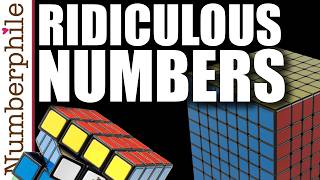
This video explores the mind-boggling number of possible states (scrambles) for large Rubik's Cubes, starting with a 2x2 cube and progressing to a 10x10 cube. The presenters, Richard and Brady, calculate the exact number of scrambles for each cube size, showing how the numbers become astronomically large, far exceeding the number of atoms in the universe. The video concludes with a general formula for calculating the number of states for any even-sized cube.
The standard 3x3 Rubik's Cube has 43 quintillion (4.3 × 10^19) possible scrambles.
For a 2x2 cube (8 corner cubelets), the number of states is calculated as 8! × 3^7 / 24, which is about 3.6 million.
The 4x4 cube has three types of pieces: corners (same calculation as 2x2), edges (24 edge pieces with 24! arrangements), and centers (24 center pieces with 24! / (4!^6) arrangements). Corners: C = 8! × 3^7 ≈ 88 million.
Total states for a 4x4 cube = C × E × K / 24 ≈ 7 × 10^45, which is far larger than the 3x3's 4.3 × 10^19.
The 6x6 cube introduces two types of edges (central edges and wing edges) and four types of centers. Total states = C × E^2 × K^4 / 24 ≈ 1.6 × 10^116.
For a 2n x 2n cube: states = C × E^(n-1) × K^((n-1)^2) / 24. This shows that the number of states grows exponentially in n squared.
For a 10x10 cube (n=5), number of states ≈ 10^349. This is ridiculously large – even counting every atom in the universe four times over still gives a smaller number.
The number of possible scrambles for large Rubik's Cubes grows incredibly fast, exceeding all intuition and universe-scale comparisons for a 10x10 cube. The general formula also applies to odd-sized cubes, which are covered in an extended video on Numberphile 2.
What is the approximate number of possible scrambles for a standard 3x3 Rubik's Cube?
43 quintillion (4.3 × 10^19)
0:44
How many corner cubelets are there in a 2x2 cube, and how many factorial is used in the initial arrangement count?
8 corner cubelets, and 8! (40,320) is used for the initial arrangement count.
2:30
Why do we multiply by 3^7 (not 3^8) for the 2x2 cube's corner orientations?
Because once 7 corners are oriented, the orientation of the 8th corner is automatically determined by the puzzle's constraints.
3:58
What is the formula for total number of states for any even-sized 2n x 2n Rubik's Cube?
C × E^(n-1) × K^((n-1)^2) / 24
15:10
For a 4x4 cube, how many edge pieces are there, and what is their arrangement count (E)?
24 edge pieces, and E = 24! ≈ 6.2 × 10^23.
6:40
For the centers of a 4x4 cube, why do we divide by 4! six times?
Because there are 6 faces, each with 4 identical-looking center pieces. Swapping them among themselves doesn't change the state, so we divide by 4! for each face.
9:15
What is the approximate total number of states for a 6x6 cube?
Approximately 1.6 × 10^116
14:23
How many types of edge pieces are there in a 6x6 cube?
Two types: central edges and wing edges.
11:19
For a general even 2n x 2n cube, how many different types of center pieces are there?
(n-1)^2 different types of center pieces.
16:56
What is the approximate number of states for a 10x10 cube?
Approximately 10^349
17:54
Magnitude jump from 3x3 to 4x4
The number of states jumps from 10^19 to 10^45, illustrating how quickly puzzle complexity increases.
10:396x6 states exceed atoms in universe
The 6x6 cube's 1.6 × 10^116 states already surpass the number of atoms in the observable universe.
14:2310x10 cube's incomprehensible scale
The 10^349 states for a 10x10 cube dwarfs even recursively multiplied universe scales, showing exponential growth in n².
17:54General formula for even cubes
The formula C × E^(n-1) × K^((n-1)^2)/24 succinctly captures the state count for any even cube, highlighting combinatorial explosion.
15:10[00:00] So, this is an entirely ridiculously
[00:02] ridiculously big number. You've spoken
[00:03] to me about bigger numbers. I have
[00:05] spoken to you about bigger numbers, but
[00:06] I've never held one in my hand.
[00:09] I thought we might talk about Rubik's
[00:11] Cubes today, but not about this Rubik's
[00:14] Cube. Instead, how about
[00:17] that Rubik's Cube? Oh, that's got that's
[00:19] got more cubes in it. Yeah, that's What
[00:21] do you call the the elements of a
[00:23] So, the opinions are divided. I think
[00:25] what most people nowadays call it is a
[00:27] cubie, but I'm a bit old school and I
[00:29] call it a cubelet.
[00:30] Yeah. And that's got more cubelets. It's
[00:32] got more cubelets. You you can see it's
[00:34] six cubelets wide, while your your your
[00:37] classic is three cubelets wide, right?
[00:41] So, you might call this a six cube. So,
[00:42] the standard
[00:44] three cube has got an awful lot of
[00:46] scrambles, lots of different
[00:47] possibilities. Do you remember how many
[00:48] different scrambles, Brady? I believe 10
[00:51] seconds ago, before we started the
[00:52] filming, you told me it was 43
[00:55] quintillion. 43 quintillion on your the
[00:58] standard Rubik's Cube.
[00:58] >> That's Surely it's not a rounded all
[01:00] zeros. Is there like a more exact number
[01:02] than that?
[01:02] >> more exact, yeah. What's the exact
[01:04] number? Uh I don't remember, I'm afraid.
[01:06] I'll put it on the screen. There it is.
[01:09] And what does that number refer to? So,
[01:11] it's the number of different possible
[01:12] scrambles or different possible states
[01:14] it could be, different ways it can be
[01:16] mixed up, including of course the
[01:17] unscrambled solved state. Is this one of
[01:20] those situations where there are like,
[01:22] you know, reflections and mirrors and
[01:23] the same ones exist multiple times and
[01:25] you have to do that or Yes,
[01:27] that's right. So, we want to make sure
[01:29] when we're counting different states,
[01:31] we're not overcounting by
[01:34] counting um
[01:37] ones which look identical
[01:39] um to each other. In fact, this is going
[01:40] to be more important than with this,
[01:41] because you can see it's got all these
[01:42] center pieces.
[01:44] And if they get jumbled up between
[01:45] themselves, it doesn't matter, right?
[01:47] It's it's still going to be the same
[01:48] state. So, we won't have to worry about
[01:50] that yeah.
[01:51] >> So, if you swapped two of those whites
[01:52] with each other, I wouldn't know.
[01:54] Exactly. So, we can't we should count
[01:55] them as that as being the same the same
[01:57] state. But I thought it might be fun to
[01:58] try and work out how many different
[02:01] states there are for a big cube like
[02:03] this. Okay, so I'm actually having said
[02:06] that, I think it's best to start with a
[02:08] slightly smaller cube. So, I'm actually
[02:09] going to start with this cube here, two
[02:12] cube. And it's going to be actually
[02:13] easier to do the calculation for cubes
[02:16] with even
[02:19] width. The question is, how many
[02:20] different states are there for this? So,
[02:23] this is a 2 by 2 cube. Let's scramble it
[02:25] up a little bit.
[02:26] You can see there are eight
[02:28] cubelets right?
[02:30] And there are eight positions that a
[02:32] cubelet could be in,
[02:33] right? So,
[02:36] you can put any of the
[02:38] cubelets in any of the positions. So,
[02:39] let's just pick a slot,
[02:41] maybe this one here, that position,
[02:44] then there's eight choices of which
[02:47] cubelet to put it in. So, we can write
[02:49] that down, eight. And then once we've
[02:51] got that one,
[02:53] for the next slot, there's seven
[02:54] choices, right? So, it's times seven.
[02:57] And then for the next one, there's six
[02:58] and so on. So, you can see how it's
[03:00] going to go. The number of choices is 8
[03:03] * 7 * 6 * and so on down to 1, which is
[03:06] usually written as 8 factorial with an
[03:09] exclamation mark. That's what that
[03:10] exclamation mark means, okay? So, that's
[03:12] the start, but that's not the whole
[03:14] answer, because once we've decided maybe
[03:18] we put this white, green, and red
[03:21] uh cube cubelets into this slot,
[03:25] it can actually be one of three ways
[03:26] round. So, if you just look at
[03:29] concentrate on that cubelet,
[03:31] if I do that, it's in the same position
[03:34] again, but it's in a different
[03:37] it's been rotated, right? And we can do
[03:39] it again, okay? So, actually there's
[03:42] um
[03:43] for each
[03:44] each of these cubelets in each of these
[03:46] positions, it can be one of three ways
[03:47] round, right? We need to multiply by
[03:51] three for each of these. So, you think
[03:53] it's going to be times three to the
[03:54] eight, right? Because there's eight of
[03:56] them. But actually it's not times three
[03:58] to the eight, because it turns out that
[04:00] once seven of them have been fixed,
[04:04] the the the final one is automatically
[04:06] fixed. You can't do anything more with
[04:07] it. So, it's actually times three to the
[04:09] seven. So, that's the the number of
[04:11] states for the two cube. Well, maybe not
[04:14] quite, because this point we have to
[04:17] rewind and think about
[04:19] every cube's favorite thing, the one
[04:21] cube. And the question is, how many
[04:22] states does the one cube have, right?
[04:25] And I think the
[04:26] what feels like the natural answer is
[04:28] it's got one state, yeah? But of course,
[04:31] I mean you could argue that it's got 24
[04:33] states, because you think, okay, which
[04:35] which face will I put on the top?
[04:38] I'll put the the white face on the top.
[04:41] Um and then which face should I put on
[04:43] the front? So, it could be the orange
[04:44] one or the green one and so
[04:47] There's four choices there.
[04:49] So, you could argue that the one cube
[04:51] has got 24 states, 6 * 4, yeah? But we
[04:55] probably don't want that. We probably
[04:56] want to count them all as being the
[04:57] same, which means we need to Likewise
[05:00] for this, a lot of these states are
[05:01] going to be the same, but just rotations
[05:04] without actually doing any Right, so let
[05:06] me call this number we've got so far C,
[05:09] okay? I'll explain why it's called C in
[05:11] a moment. That's around about 88
[05:13] million. But then to get the number of
[05:14] states for the two cube, we need to
[05:16] divide that by 24, okay? So, the two
[05:19] cube is C divided by 24. The answer is
[05:23] that's about 3.6 million, just for this
[05:25] little cube, okay? Wow. When we think
[05:27] about uh the bigger cubes, so I mean the
[05:31] one I'll do next is the four cube,
[05:32] because it's easier to work with um even
[05:34] sides. With a two cube, all the cubelets
[05:37] are basically equivalent, right? Any can
[05:39] go in the position of any other. That's
[05:41] not the case with here. Um in fact,
[05:43] there's three different types of
[05:45] cubelets here. You've got the corners,
[05:48] and you've got the edges here,
[05:51] and then you've got the centers. You've
[05:53] got three different types. And to work
[05:56] out the number of states for the four
[05:57] cube, what we need to do is work out the
[06:01] number of
[06:02] possible arrangements of the corners and
[06:04] the number of possible arrangements of
[06:05] the edges and the number of possible
[06:07] arrangements of the centers and then
[06:09] multiply them together. That's that's
[06:10] the plan. And I want to start with the
[06:12] two cube, because
[06:14] the corners of the four cube in or
[06:16] indeed the corners of any cube
[06:18] are
[06:19] basically exactly the same argument as
[06:23] for the two cube, because of this is
[06:24] these are corners, right? The first
[06:25] thing for the four cube, we need C
[06:27] again, that same number, right? So, the
[06:29] next thing to think about is the
[06:33] edges. So, for this cube, the sort of
[06:35] overall shape the the the cubic shape
[06:37] has got 12 edges and along each edge
[06:40] there's two cubelets, right? So, we've
[06:42] got 24 edge pieces. So, we've got 24 in
[06:46] total.
[06:47] And you can put one in any of the slots.
[06:49] So, we've got 24 slots. So, for the
[06:51] first slot,
[06:53] we've got 24 choices of cubelets. So,
[06:55] 24.
[06:56] And then for the next slot, we've got 23
[06:58] and so on. You can see how it's going to
[06:59] go. It's going to be 24 factorial.
[07:02] Actually, that's it for the edges,
[07:03] because you might think, well, we also
[07:05] need to consider the fact that one edge
[07:07] can be either way up. But actually it
[07:10] can't
[07:12] in the sense that
[07:13] um once you fit a fix a slot to put this
[07:17] uh this edge piece in, it can only go
[07:19] one way up in it. The mechanics of the
[07:21] puzzle mean that. So, I'm just going to
[07:22] put a dot on
[07:24] this edge.
[07:25] And now I can flip those two
[07:28] edges there. So, don't worry about the
[07:29] other pieces, just look at those two
[07:31] edge pieces.
[07:37] So, I flipped them over, yeah? But you
[07:40] can see in flipping them over, I've also
[07:41] moved the one that was here to the one
[07:43] that was there. The one with the dot was
[07:44] there before, now it's there.
[07:46] Um and it's always going to be that way.
[07:48] So, once you've put the cube the cubelet
[07:51] in the slot, that's it. So, that is the
[07:54] that is the arrangement for the edges,
[07:56] okay? So, the number of edge
[07:57] arrangements is just that, it's it's
[07:59] just 24 uh
[08:02] which actually is a pretty big number.
[08:04] This is around uh six
[08:07] times 10 to the 23.
[08:10] So, that's 620 sextillion. The next
[08:12] thing is the centers. Again, it sort of
[08:16] starts off as the same as the edges,
[08:18] because we've got six faces of the cube.
[08:21] Inside each face, we've got four center
[08:22] pieces. There's 24 center pieces all
[08:24] together. So, I'm going to call this I'm
[08:26] going to call this number K, which is
[08:28] because C was already taken. The number
[08:31] of we can just pick a a slot here and
[08:34] then the number of choices of which
[08:35] center piece to put in it is 24.
[08:39] And then pick another one and the next
[08:40] one is 23 choices. So, it's going to be
[08:42] 24 factorial again. But this time we do
[08:45] have to consider something else, which
[08:46] is that these four
[08:49] cubelets are identical to each other.
[08:52] And if they mix around between
[08:54] themselves, we don't really care, right?
[08:57] We don't consider it as a different
[08:58] scramble if you know, if I was to swap
[09:01] those two or something. It's all it's
[09:02] all the same. So, that means
[09:05] every possible scramble
[09:07] is going to have basically
[09:10] um different versions of it where the
[09:11] orange centers are swapped around. So,
[09:15] that's an overcount at the moment. So,
[09:16] we have to correct that.
[09:18] How many how many um times is each one
[09:20] counted? Well,
[09:22] how many arrangements are of these
[09:25] four centers are there? Well, there's
[09:27] four choices
[09:29] for which one to put there times 3 times
[09:31] 2
[09:32] times 1, so 4 factorial, which is 24,
[09:35] okay? Yeah.
[09:36] So, we need to divide by So, this to get
[09:40] the number of total arrangements of all
[09:42] the centers in the cube, we need to
[09:43] divide by 24. Well,
[09:45] that's for the orange centers, okay? And
[09:47] then we have to do the same thing for
[09:49] the green centers and for the yellow
[09:51] centers. So, we have to divide by 24 six
[09:53] times. So, we divide by by
[09:55] to the six. And that gives us the number
[09:58] of arrangements of the centers. This
[10:00] comes out to be around 3 * 10 to the 15,
[10:05] which is 3 quadrillion if you like those
[10:07] sorts of words, okay? Okay, so now we
[10:08] can all to work out the number total
[10:11] number of possible states of the 4 cube,
[10:12] we just have to multiply those together,
[10:15] okay? So, we've got the number of
[10:16] possible arrangements of the corners, C,
[10:19] times the number of possible
[10:20] arrangements of the edges, E, times the
[10:22] number of possible arrangements of the
[10:23] centers K.
[10:25] And then we have to divide by 24 for the
[10:27] same reason as previously, right? Okay,
[10:29] so that's the answer and that gives us a
[10:30] total answer here of uh roundabout 7 *
[10:36] 10 to the 45. So, that's the number of
[10:39] possible states of a 4 cube. How does
[10:41] that differ from our 3 cube, that that
[10:44] number that I was supposed to remember?
[10:46] Septillion.
[10:47] 43 quintillion. Quintillion, that's it.
[10:49] 43 quintillion. How does it differ? Is
[10:51] it What sort of magnitude is that? For
[10:53] the standard cube, it's 4.3 * 10 to the
[10:56] 19. And now we've jumped up to 7 * 10 to
[10:59] the 45. So, it's a very substantial
[11:02] increase, okay? Really significant
[11:04] increase. Yes.
[11:06] Shall we have another substantial
[11:07] increase? Always. Okay, this is now a 6
[11:11] cube. We can get started because the
[11:12] corners
[11:13] are exactly the same as previously. So,
[11:15] we start with the same number C. So, now
[11:17] we think about the edges. So, there's
[11:19] two fundamentally different kinds of
[11:21] edges on this cube, right? You've got
[11:22] the ones here which are uh
[11:24] blue and yellow and you've got the ones
[11:26] which are yellow and green. They're like
[11:28] They're in two sort of different types
[11:29] of corridors, aren't they? They're in
[11:30] two corridors and you can never switch
[11:33] between the corridors. So, once you're
[11:34] in one corridor, you're always in that
[11:36] corridor. The central edges are
[11:38] different from sometimes they're called
[11:39] wing edges, right?
[11:41] If you're in one of the wing edges, you
[11:42] can get to anywhere else in any of the
[11:44] other wing edges.
[11:46] And if you're in one of the central
[11:47] edges, you can get to anywhere else in
[11:48] any of the central edges, okay? What
[11:50] that Can the one on the left Can can you
[11:52] If you're in a central edge, like those
[11:54] two, can you change between left and
[11:56] right? You can. Yes, you can.
[11:57] >> So, you're not stuck in your corridor,
[11:59] you're stuck in your brand of corridor.
[12:00] >> You're You're stuck in your brand of
[12:01] corridor, yeah, exactly. That's right.
[12:03] That's right. Um And what What that
[12:05] means is that if you just look at the
[12:07] central edges, the um the argument is
[12:10] exactly the same as the edges for the 4
[12:13] for the 4 cube, right? Because the the
[12:15] the edges here are just the central
[12:17] edges, right? So, the the number of
[12:19] possibilities for the central edge
[12:21] is that number E as we had before,
[12:24] right? So, times E. But then the number
[12:26] of possibilities for the wing edges is
[12:29] the same again, so it's times E again.
[12:31] So, we times by E squared. Okay, so now
[12:33] we've got to look about the centers.
[12:35] They call it centers. It means
[12:37] everything which isn't a corner or an
[12:38] edge. So, actually quite a lot quite a
[12:40] lot of cubes cubelets in here. There's
[12:42] um there's sort of 16. What are the
[12:45] What's the sort of corridor structure?
[12:46] How can you get Which can you get
[12:48] between and which can't you? Yeah, how
[12:49] are they constrained, yeah? How How are
[12:51] they constrained? Yeah. If you look at
[12:52] this white
[12:54] white cubelets, right?
[12:56] The question is where can it get to?
[12:58] So, it can
[13:00] on this face,
[13:02] there's four places it can sort of
[13:03] obviously get to, right?
[13:06] Those four. So, it can be just above the
[13:09] bottom left corner, just to the right of
[13:11] that corner,
[13:12] just underneath that corner, right? So,
[13:14] there's four four places it can get to.
[13:18] Are there any others? And actually the
[13:19] answer is no. So, you might think you
[13:21] would be able to get it get the white
[13:23] cube into that position there, but
[13:26] actually you can't. And likewise, you
[13:27] can't get it down there. That's sort of
[13:29] maybe more believable.
[13:31] And you can't get it there either. Just
[13:33] use a different face. So, actually the
[13:35] sort of key thing here
[13:37] is
[13:39] if you look at this blue square of four
[13:42] cubelets, those are the four
[13:44] fundamentally different kinds of
[13:46] centers. So, there's four kinds of
[13:48] centers.
[13:49] And then for each kind of center,
[13:52] the argument goes exactly as the centers
[13:56] for the 4 cube, okay? So, the number of
[13:58] ways of arranging
[14:00] those kinds of centers is that number K
[14:02] we had. And then the number of ways of
[14:04] arranging those kinds of centers is also
[14:06] K, and those kinds of centers are also
[14:08] K, and those kinds of centers are also
[14:10] K. So, overall we get K to the 4. Then
[14:12] of course, we do divide by 24,
[14:14] which matters less and less as these
[14:16] numbers get bigger and bigger. It's a
[14:18] bit of a formality at this point. But
[14:19] when you work that out, we're up to 1.6
[14:23] * 10 to the 116. We're like beyond atoms
[14:28] in the universe. We're beyond atoms in
[14:29] the universe. Yeah, there's there's more
[14:31] possible scrambles of this puzzle than
[14:33] there are atoms in the universe.
[14:36] This is my biggest cube.
[14:38] Um it's a recent and rash purchase. Um
[14:42] this is a 10 cube.
[14:44] And I haven't actually yet dared
[14:46] properly scramble it cuz I dread to
[14:47] think how long it would take me to
[14:49] solve. Um at some point I will. Um So,
[14:52] but I think it might be fun to work out
[14:53] how many I mean, has it gotten to a
[14:54] point now where for even numbered cubes,
[14:57] we can
[14:58] create an algorithm here or Yeah, we
[15:00] can. We can. So, the way to think about
[15:03] it is let's call it a 2n cube, right?
[15:06] So, um I'll do this as an example. So, a
[15:08] 2 * 5 cube, so that's my 10 cube, right?
[15:11] We're going to let n be sort of half the
[15:13] size. You could let n equal 10, but then
[15:16] the algebra comes out harder. You've got
[15:17] C, that's the number of corners, that
[15:18] never changes. Okay, now we think about
[15:20] the edges. How many different edges have
[15:22] we got? Now, let's put some different
[15:24] colors on.
[15:32] Okay, but the point is how many
[15:33] different types are there? Well, there's
[15:35] the central ones,
[15:37] then the next ones out, then the next
[15:38] ones out, and then the wings, okay? So,
[15:40] we've got four,
[15:42] right?
[15:43] 1 2 3 4 fundamentally fundamentally
[15:46] different types of edges.
[15:48] Um and in general,
[15:51] so here in this cube, n equals 5. So, in
[15:54] general, you're going to have n minus 1.
[15:56] Yeah? And the reason it's n minus 1 is
[15:58] because n is half the width of the cube,
[16:01] and we just don't want the the outermost
[16:03] ones, so so n minus 1, yeah? Okay? So,
[16:07] that means the number of possible
[16:08] arrangements of the edges is E to the n
[16:10] minus 1. And now we've got to think
[16:13] about the centers. Yeah, just give me a
[16:14] second.
[16:16] Sorry, it's just a bit slow, this thing.
[16:22] So, now if we think about the centers,
[16:24] this white square of 16 cubelets, that's
[16:28] representative of the different
[16:29] corridors. So, each of those is
[16:32] different to each of the others. You can
[16:34] never get from any of one of those to
[16:35] any of the others. And once we've chosen
[16:38] one of those types, so there's 16 types
[16:42] here,
[16:43] um or in general, that's n minus 1
[16:46] squared, half the width, so that's n,
[16:49] then we take away the edge, so that's
[16:52] that width there is n minus
[16:54] 1, then we square it, okay? So, there's
[16:56] n minus 1
[16:57] kinds of centers. That kind, by the way,
[17:00] is my justification for using K.
[17:02] Um pretty weak, I think. And then the
[17:04] argument for each one is exactly as the
[17:05] previous day, that's the number of
[17:06] possible combinations. So, we need to
[17:08] then multiply here by K
[17:11] to the n minus 1 squared, right?
[17:15] And K, remember, is 3 * 10 to the 15.
[17:18] And that's why you can sort of see here
[17:20] why these numbers are getting so big so
[17:21] quickly cuz it's exponential in n, but
[17:24] it's not actually just exponential in n,
[17:26] it's exponential in n squared. And
[17:28] that's why why it gets so big. Of
[17:29] course, we have to go through the
[17:31] formality of dividing by 24. Of course.
[17:33] Of course, of course. Um Okay.
[17:35] >> that does knock one off the power,
[17:36] doesn't it? It It knocks one off the
[17:37] power, yeah. It knocks one off the
[17:39] power. Um so, for 10, if you plug in um
[17:42] n equals 5 into this, well, you get C
[17:46] times E to the 4
[17:48] times K to the 4 squared, so 16, divided
[17:52] by 24. Work it out, you get to 10 to the
[17:54] 349 or thereabouts, okay? Which is a
[17:57] which is really ridiculously
[17:59] ridiculously big number. I mean, that's
[18:01] the sort of place where,
[18:03] you know, if you took every atom in the
[18:05] universe and replaced it with a whole
[18:07] universe,
[18:08] and then repeated that
[18:11] four times,
[18:13] and then counted the number of atoms in
[18:14] that whole thing,
[18:16] this has still got more scrambles than
[18:18] that, right? Okay, so it's it's an
[18:19] entirely ridiculously ridiculously big
[18:21] number. You've spoken to me about bigger
[18:23] numbers. I have spoken to you about
[18:24] bigger numbers, but I've never held one
[18:25] in my hand.
[18:28] You may have noticed we've only dealt
[18:29] with cubes with an even number of pieces
[18:32] along the edges. If you want to find out
[18:34] how it gets a bit more technical and
[18:35] mathematical with an odd number,
[18:38] like that,
[18:39] go and have a look on Numberphile 2.
[18:41] We've got an extension of the video
[18:43] there. We go into way more detail, but
[18:45] before you do that,
[18:49] go and order one of these. Order a copy
[18:51] of Huge Numbers. It's Richard's new
[18:53] book. It's available now to order or
[18:55] pre-order, depending on where you are.
[18:57] The cover might look different,
[18:58] depending on where you are, but it's a
[18:59] fantastic read. It deals with really big
[19:02] numbers, like you've been seeing just
[19:03] now.
[19:05] I'll also put some links below to other
[19:07] things that may interest you, previous
[19:09] videos we've done about Rubik's Cubes,
[19:10] previous videos we've done about big
[19:12] numbers, and of course, the link to that
[19:14] extra video,
[19:16] and the order link for Richard's book.
[19:18] Go and check it out, people. Thanks for
[19:19] your time, and thanks for watching.
[19:22] puzzle can be solved in 20 or 15
⚡ Saved you 0h 19m reading this? Transcribe any YouTube video for free — no signup needed.