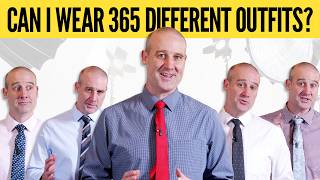

Never Repeat an Outfit: Math Solution
45sThe intriguing premise of mathematically calculating the minimum clothes to avoid outfit repetition hooks viewers immediately.
▶ Play Clip"The title accurately reflects the video's core question and the mathematical answer provided, though the practical minimum is higher than the theoretical 9 items."
This video explores the mathematical problem of minimizing the number of clothing items needed to never repeat an outfit for an entire year. Using prime factorization and combinatorial optimization, the creator calculates theoretical minima and then tests them with a practical shopping trip. The conclusion reveals that 9 items are theoretically sufficient, but 17-18 items are more realistic.
365 = 73 × 5, so you need 73 of one item and 5 of another for exactly 365 outfits.
Overshooting the number of outfits can reduce total items; e.g., 31 ties and 12 shirts give 372 outfits with only 43 items.
The minimum number of items found is 17, which yields 405 outfits.
Practical shopping on Oxford Street led to buying 5 ties, 5 shirts, 5 socks, and 2 hats for 18 items and 375 outfits.
The absolute theoretical minimum is 9 items using binary categories (wear or don't wear), giving 512 outfits.
For a lifetime (107 years), 29 items in 10 categories provide over 39,000 unique outfits.
What is the prime factorization of 365 and how does it translate to clothing items?
73 shirts and 5 trousers (or similar categories)
1:50
What is the minimum number of items needed to get over 365 outfits?
17 items
4:49
What is the absolute theoretical minimum number of items to never repeat an outfit for a year?
9 items (binary categories: wear or don't wear)
14:43
How many items are needed for a lifetime (107 years) of unique outfits?
29 items (9 categories with 3 each, 1 category with 2)
15:56
How many outfits can you get from 9 binary categories?
2^9 = 512 outfits
15:14
Prime Factorization for Outfits
Demonstrates how to break down 365 into prime factors to determine minimum categories.
1:50Overshooting Reduces Items
Shows that aiming for more than 365 outfits can drastically cut the number of items needed.
3:29Theoretical Minimum: 9 Items
Reveals that with binary categories, only 9 items are needed for 512 outfits.
14:43Lifetime Wardrobe: 29 Items
Extends the math to cover over a century of unique outfits with a small number of items.
15:56[00:00] Is it possible to mathematically calculate the
[00:05] to own so you never repeat an outfit for
[00:14] which is why for this video, really put in the
[00:20] so long. But on that list, when I was flicking
[00:26] So, I followed that and it was a post on the math
[00:33] original poster had deleted it and then deleted
[00:39] to work out why I'd saved that URL. But looking at
[00:46] poster was asking how many items of clothing would
[00:53] they would never repeat an outfit by combining
[00:57] choose to believe it said because that is a
[01:03] first mathematical thought was regret. Maths
[01:09] teacher. Because if I came across this when I was
[01:14] 31 ties and like numbered them on the back and
[01:19] had 12 shirts and worn them. Okay, washing. Let's
[01:25] different shirt per month and then I would have
[01:30] and I would have found that so funny and I now
[01:36] a great career. And I was like, that would have
[01:40] inefficient because 31 ties times 12 shirts is 372
[01:50] We'll break down the case for exactly 365 outfits.
[02:00] both prime numbers. That's as far as you can break
[02:07] maybe shirts, and then five of something else.
[02:13] that would be like five trousers. You can choose
[02:19] 365 outfits. Ah, leapers though, they're 366 days.
[02:27] So that would be uh 2 * 3 * 61. So, two trousers,
[02:37] And there's an outfit that only comes out once
[02:42] years, go naked. That said, uh, for all of these
[02:50] some categories do and don't lend themselves to
[02:54] could probably get away with the null tie, maybe
[03:02] choosing to not wear something is also an option.
[03:06] factors and then you've got to have categories
[03:12] values. And you might choose one of those options
[03:17] talk about efficiency. Here's the thing. We don't
[03:21] enough to cover a year surplus, that's fine. We
[03:29] And the 365 one, that's 78 items of clothing if
[03:35] that's actually better. That's come down to 66
[03:43] 12 shirts, that's a mere 43 items of
[03:49] number of combinations, we can reduce potentially
[03:54] we'll need to do is just sum the prime factors for
[04:04] smallest, which I did. And I put them all in a
[04:13] what this looks like as you increase the number
[04:18] these spikes at the top. And there's no rhyme or
[04:25] even the in between ones. There's just not much of
[04:31] primes defy nice neat patterns. So the easiest
[04:40] Going to select everything. Sort by number of
[04:49] not going to beat 17 items. In fact, there are
[04:54] sweet. So, oh my goodness, you can just have two
[05:02] Or you could have fewer categories here. Maybe you
[05:06] and get 405 outfits with only five categories.
[05:14] we kind of want to maximize outfits. Although, as
[05:19] conditions. We want to minimize items, but we also
[05:27] because then you've got fewer different things you
[05:32] do we want to minimize the biggest number in one
[05:37] have a few more items, you could down here do
[05:44] got to very three different categories. But
[05:51] just reached the end of maths and the beginning of
[05:58] in the description below if you want to have
[06:01] I think I can't carry on this analysis any
[06:07] I've got to discover what are the practicalities
[06:13] can then be swapped to get a certain number of
[06:19] than your outfits? It's me business mat. And that
[06:24] change. In fact, regular mat, can you go grab the
[06:30] held up by magnets. Yes, thanks to displate.
[06:37] magnet system. You can easily switch between the
[06:44] their unique metal canvases. Now, if you can't
[06:49] display option for your own artwork, but we
[06:55] that we wanted here at Standup Matts. It was
[06:59] whereas camera person Alex picked this. I think
[07:06] thanks, Regular Matt. He's definitely standing
[07:12] this plate have a Black Friday deal for up to two
[07:20] more than four plates, 46% off. That's basically
[07:26] metal plate. if you use the code standup or click
[07:32] QR code on the screen somewhere. And that discount
[07:39] an extra 3D effect that really makes them pop.
[07:46] up for a tiered structure of discounts. And thank
[07:53] Okay. And can we get the original? Thank you.
[08:03] high street and see what clothes cost. So, let's
[08:09] person is, we can use me as a substitute. And we
[08:15] So, I figure I'll go to Oxford Street. This is one
[08:21] in the world, definitely in the UK. And I'm going
[08:27] fashion and ethical limitations and see if I
[08:34] pretty quickly once you're dealing with a serious
[08:39] you're not getting that for under £30. And if you
[08:45] of £50. For a nice one, you're touching 100 quid.
[08:52] had to get multiple jumpers or something, I'm
[08:58] the sock loophole. Pack of five socks from John
[09:06] that count? Socks. H. Either way, Small Things
[09:11] it count as a proper outfit. Okay, some of you may
[09:16] problem of style. So, I could just, you know, this
[09:23] for my everyday wear, or I could try and shop to
[09:29] do is not just spend money unnecessarily. So,
[09:34] to wear, or I'll buy stuff that I figure I
[09:42] if you're shopping for the math teacher in your
[09:47] Okay, I've hit math teacher P here with Oh,
[09:55] could easily rack up, you know, as many as I need
[10:05] 23 items, but only three categories. So, I could
[10:11] I could do maybe socks. 385 outfits. What I would
[10:22] still a lot in the one category though where I can
[10:27] talking 375 outfits. But now I got to find like
[10:33] five shirts, five socks. I mean socks feel like
[10:44] We'll see. Do I go for fewer categories but a
[10:50] fewer in each one? I mean, the one thing that's
[10:55] tie and at least two of these. Okay. In
[11:03] I only got five ties, and I could have got them as
[11:10] uh have more visual difference and more likely for
[11:14] They averaged me £12 and I think like4 each.
[11:21] went for shirts and the multiack shirts were the
[11:29] shirts. I think the idea of changing categories.
[11:35] fact that I pay basically the same for the shirts
[11:40] combinations go up. So I think in the end that's
[11:46] go for the sock loophole. I'm going to get the
[11:51] this cost down. Uh and then finally, hats.
[11:56] wearing the null hat. I'm going to allow that. And
[12:02] that's the plan. Total will appear on the screen
[12:09] to wear 375 different outfits. But, of course,
[12:17] I mean, to do that, it would take a whole
[12:22] a elaborate stop motion catwalk sequence, which
[12:56] Take me home.
[13:31] We ran out of time. We We literally got kicked out
[13:38] no. So, I mean, I was going to catch the ball. We
[13:43] do now, I guess, is just keep going as planned
[14:18] And that's how it's done. Never wearing
[14:28] we can all agree it was worth it. Hope you
[14:33] we missed one. If you can, I saw it when I
[14:38] uh, comment below. I'll be very impressed. So,
[14:43] can own and not repeat outfit for a year is nine.
[14:49] which is the one with the most categories for any
[14:55] you put a null in every single category, you got
[15:01] then you got a single three. So that's two items
[15:06] actually you can get 512 outfits out of nine items
[15:14] you wear it or you don't. If you can find nine
[15:19] to just not wear it, you can't own other items.
[15:26] uh 512. Two to the nine. There you are. Nine
[15:32] practically as I discovered because not all
[15:37] want to also balance off minimizing the number
[15:42] trousers and jackets it gets so expensive. So I
[15:47] if you want to go your entire life never wearing
[15:56] You got nine categories with three each. single
[16:03] individual outfits. That's over 107 years. I mean,
[16:11] life and as they wear out. I guess you can replace
[16:17] Anyway, combinotaurics, eh? Woo! Things things
[16:23] a century of clothes. There you are. Um, that's
[16:27] If you do want any of the clothes from this video,
[16:33] Now, there's a Christmas gift or you if you are
[16:39] on eBay. All the money goes to Water Aid or for
[16:44] the shirts. I will wash them all. That's not you
[16:50] yourself or for the math teacher in your life. And
[16:55] Yes, we could have done the stop motion better.
[17:00] do the behind the scenes on Patreon cuz
[17:05] I don't mind putting them on Patreon. But
[17:09] so the content's out there for everyone, the
[17:14] much for watching. Uh happy Christmas shopping


⚡ Saved you 0h 17m reading this? Transcribe any YouTube video for free — no signup needed.