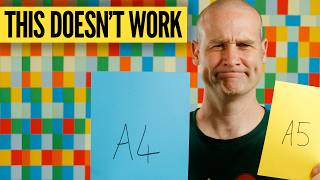

A4 Paper Scale Spiral Magic!
54sThe visually satisfying spiral of all A papers and the claim of 512 A9s fitting on an A0 pique curiosity.
▶ Play Clip"Title is slightly exaggerated but the video does reveal that the A scale is 'broken' for small sizes due to rounding."
This video explores the mathematical properties of the A paper scale, revealing that due to rounding in the ISO standard, the idealized root-2 ratio breaks down for smaller sizes, allowing more pieces to fit than theoretically expected. The host demonstrates this by fitting 514 A9 sheets onto an A0 sheet, exceeding the expected 512, and discusses related packing optimizations.
The A paper scale is based on a root-2 aspect ratio, where each size is half the area of the previous one. A0 is exactly 1 square meter.
To maintain similarity when halving, the aspect ratio must satisfy x = 2/x, giving x = √2.
The A scale satisfies three properties: split (can be split into two), equal (split pieces are equal in area), and similar (pieces have the same aspect ratio).
A plot of y=x and y=2/x shows that only at √2 do the two families of aspect ratios converge when halving equally.
B scale starts with a unit length of 1 meter; C scale is the geometric mean of A and B, used for envelopes.
Post-it notes use a halving scale but not similarity, alternating between 1.5 and 1.34 aspect ratios.
Actual A paper sizes are rounded to the nearest millimeter, causing deviations from √2, especially for small sizes.
Due to rounding, 514 A9s can fit on an A0 instead of the theoretical 512, demonstrated by rearranging orientations.
Noel Friedrich fit 1038 A10s on an A0 (theoretical max 1039) and proved no orthogonal packing can achieve 1039.
The A scale can extend to negative numbers (e.g., A-1, A-2), but the ISO standard only defines up to 2A0 and 4A0.
A17 (2mm x 3mm) and A18 (1mm x 2mm) have ratios 1.5 and 2 respectively, far from √2 due to rounding.
A20 would be 1mm x 1mm, and A21 would be 0mm, so infinitely many A20s fit on an A4.
The A paper scale, while elegantly designed, suffers from rounding errors that break the root-2 ratio for small sizes, enabling creative packings that exceed theoretical limits. This reveals a hidden complexity in a seemingly simple system.
What is the aspect ratio of A4 paper in theory?
√2 (approximately 1.414)
03:10
What are the three properties of the A paper scale?
Split, equal, and similar.
04:05
How many A9 sheets theoretically fit on an A0?
512 (2^9)
00:54
How many A9 sheets actually fit on an A0 due to rounding?
514
12:47
What is the B paper scale based on?
B0 has one length exactly 1 meter, and it uses the same √2 ratio.
08:02
What is the C paper scale used for?
Envelopes, as C sizes are the geometric mean of A and B sizes, slightly larger than A.
08:41
What are the two aspect ratios that Post-it notes alternate between?
1.5 and 1.34
11:27
How many A10s did Noel Friedrich fit on an A0?
1038
17:42
What is the size of an A17 paper?
2mm by 3mm
23:27
What is the size of an A18 paper?
1mm by 2mm
23:27
Derivation of √2
Shows the mathematical reasoning behind the A paper ratio.
03:10Three Properties of Paper Scales
Clarifies common confusion about what makes the A scale unique.
04:05Rounding Causes Deviation
Explains why actual paper sizes deviate from theory, enabling extra packing.
13:35Noel's Optimal Packing
Demonstrates a near-optimal packing of 1038 A10s on A0.
17:22Tiny Sizes Break Ratio
Shows that A17 and A18 have ratios 1.5 and 2, far from √2.
23:27[00:00] A4 is a fantastic ratio for paper. In fact, the entire A paper scale is pretty incredible. I've got one of all of them here from A1 up to A10.
[00:14] Each one is half the number below it. In fact, I can put these into a spiral. Let's do a spiral. Look at that, so A4 exactly fills in there between A3, A2, and A1. Then we go all the way down to A5, half again.
[00:29] A6, A7, A8, A9, A10, look at that. There could be more, because each one is half of the previous one. If you go up the other way, there is of course, the foundation layer, A0.
[00:42] This is exactly one meter squared on a piece of card in the ratio of root two. And because each one is half the previous one, you can always fit a power of two of one onto a bigger one.
[00:54] In fact, it's the power of two, whatever the difference is. So you could take A9, we're gonna draw the little a9. Technically, because the difference between zero and nine is nine, you could get two to the nine of these.
[01:06] You could get 512 a9s, they would perfectly cover an a0. All of that said, a lot of that's not true. Fun to that, technically just not correct.
[01:19] Because of a weird quirk in how the a paper scale is defined, you've got other ratios. Not only is root two not technically correct, at some point you've got two thirds as the ratio of a piece of A paper.
[01:32] But I'll explain more as I do actually take hundreds of A9s and I'm going to stick them all to this A0.
[01:48] By the way, this video is supported by June Street's WISE program for women going into some kind of STEM-related first year of university next year and is running out of the Hong Kong, New York and London occupiers.
[02:02] Details below. Actually, as a quick break from doing this, let's talk about why we even want our paper system to be based on root 2. So we start with a piece of paper where we're going to call the short edge of 1 with single unit and
[02:16] then we've got x which is the ratio of what you multiply 1 by to get the longer side and what we want is to be able to slice this paper exactly in half and and what we end up with down here, this new sub-rectangle,
[02:29] has exactly the same ratio. Oh, which means we need to work out, well, this is, I mean, that's going to be half of x up there, that's half of x down there, but now we want to kind of reframe this
[02:42] as that being the unit and work out what this is. And, oh, well, that's easy, because if that's x on 2, if we were to swap them over, I'll do this in green, if that was our newly defined unit for the small one,
[02:56] then this would be, or the inverse of that, that would be 2 on x. And we want that ratio in green to be the same as the original ratio that I wrote down in black, and so we'll just chuck that up the top here.
[03:10] We want x to equal 2 on x, which means, I mean, you could think about what can you divide into two such that you get back that same number again
[03:22] It's going to be root two. If you really want to go nuts you can multiply both sides by x, x squared equals two, x equals root two. So root two is the ratio whereas if you halve the paper you don't change the aspect ratio of the piece of paper. However, rolled up in that
[03:37] a couple of assumptions So actually three different properties were asked for our paper scale and people confuse what causes what and all this but the moral of the story is we first of all want it to
[03:50] be something where you split one piece to get the next pieces. So for example an A4, you split A4 and you'll get two A5s. So the first property I'm going to call, it can be split.
[04:05] we want the two split pieces to be equal. So in the case of splitting A4 to A5 we split it exactly in half and we get two identical pieces and finally we want
[04:17] the pieces to be similar. That is exactly the same ratio. We looked at a second ago so if I hold these, I don't know what the correct distance is, but if I hold them the correct they should look exactly the same because they're the same aspect
[04:29] ratio. They're similar shapes. One is just bigger than the other. Now those are three different properties. So for example you can have a paper scale where you split it into two pieces but the pieces are not equal but they are still similar. So
[04:43] for example you start with a ratio of, and I hate to say this, the golden ratio, if you split it into unequal pieces to get a square and a rectangle, the rectangle is perfectly similar to the original rectangle. It's still the golden ratio. In
[04:59] In fact, you can keep unequally splitting it, and you always get a square and another golden ratio rectangle, and that carries on forever. So there you've got the split property, and we've got the similar property,
[05:11] we haven't got the equal property. It's also possible to split into equal pieces, but they're not similar. That would be if you started with, let's say, a square, and then when you cut it in half, you get two equal rectangles,
[05:23] but they're different to the square. Then you cut each of them in half, and you get two equal squares, which are not the same, they're not similar to the rectangle, but actually they are similar to the square you started with. So actually it turns out for all
[05:35] these shapes, if you start slicing them into equal, if you keep equal and you always cut them in half, for every other ratio when you cut it in half you start flipping between two different families that are interweaved of similar shapes.
[05:52] In fact here's a fun plot. We have a line for y equals x and we have a line for 2 divided by X, which was the equation we had on the whiteboard a second ago, and if you pick any starting ratio of your piece of paper on the horizontal axis,
[06:05] the two values above it are the two aspect ratios you will flip between if you continually divide them into equal halves, and where they cross is the only place where there's only one value, and of course that's exactly where we're
[06:20] to it. By the way, so I was telling to my friend Elio McDonald, we were on the train home from one of my recent getting-tricky tour gigs, Lyn's Piaf Talker Show, in the description below, and we realized, you know, people confuse the splitting and
[06:37] the similarity and the equal and all this stuff, so we came up with those three properties, and then when I looked at the official ISO definition of the A4 paper scale they have those three properties actually defined They have the fact that they have the halving they call it the halving principle they got the proportionality principle and they got the similarity principle So we were just messing around with it but it turns out
[07:01] we came up with the same three rules that are in the official spec document. Although earlier I did want to add one more, one more important property, that they're able to make a cool spiral.
[07:18] So these are equal. Two of these does equal one of these in area. They are definitely similar shapes, but
[07:32] I cannot fit two of them onto one without an overlap. To see more of Eliane's excellent work do check out her channel where oh there's an update for our bridge height sign
[07:48] challenge from my previous video, but anyway that's a whole set of things with nothing to do with A4 paper scale. So, what about other paper scales do you say? Well, the A paper scale is basically the only game in town.
[08:02] There is also the B paper scale, but that's exactly the same. It's the square root of two based paper scale, except instead of starting with A0 being one meter squared,
[08:15] B0 has one of the lengths of exactly one meter. So the B scale just starts with a unit length being a meter, the A scale starts with a unit area being a meter squared.
[08:27] Oh, and fun fact, the B bits of paper, each one is the geometric mean of the A sizes on either side of it. So if you want a size which is bigger than one A but smaller than the next one up,
[08:41] you can use the B one in the middle. And C, C is the geometric mean of an A and the B above it. And they're used for envelopes, because they're a bit bigger than the A.
[08:53] So you can fit any given A size bit of paper into the C size, because the C size is the geometric mean of the A, and the geometric mean of the next A up. But the point is, it works, and there are three different scales,
[09:05] A, B, and C, that all use a square root of two. These have different starting sizes. And it's all very, very clever. And that's basically it. That's all the world uses. I mean, in America, I don't really know what they're doing over there. They're still using, I don't know, a whole bunch of ridiculous...
[09:19] I'm not going to... I will say it's terrible and that's it. I'm not going to get it. Oh, okay. You know what? I will add one more thing actually. As a member of the A-scale team, I would like to say I pity the fool stuff.
[09:35] Oh, really? Oh, thanks. I know. Finally called a joke. Joke of the year. It's mine to lose at this point.
[09:48] And that's it for other paper sizes. I mean, no, you can have one-off sizes. Don't start commenting, ooh, index cards. You know what? You can make a piece of paper or card, any ratio you want. The point is, for a scale of, like, descending sizes as part of the same family, the A scale is there.
[10:05] is it, I cannot think of anything else I could possibly... Post-it notes! There is one more scale! The Post-it note scale is its own thing and it's super interesting
[10:17] and they do all relate to each other. I call it the P scale. Probably shouldn't do that. Too late! Obviously I've been looking into this and I ordered a whole bunch of different size Post-it notes. Now, originally they were based on imperial measurements but they're now defined. If you look at all the packaging
[10:32] it'll specify in millimeters what you're looking at and so here I've labeled them all up and you will see the same measurements appearing over and over and you will see pretty much exactly half that measurement again. So this one is 152
[10:47] which is twice 76 and you've got 203 which is twice about a hundred and one and point five. Oh look at that 101.5 So this, this one here is exactly half one of these.
[11:01] And what did I say? 152, that's half of 76. Look at these ones. They've got 76s. So it's the same halving scale. It turns out the post-it note scale is using the split property, it's also using the equal
[11:15] property, but it's not using the similarity property. And because it's not using the similarity property, as you keep halving it, you alternate between two different families of similar shape.
[11:27] one set of similar shapes is pretty much exactly a 1.5 ratio. So if you would line these up, they're exactly the same similar shape and they are 1.5. However,
[11:39] it's not an exact half because the other ones are 1.34. There's a 1.34 ratio. And in fact, we can show you on the plot, this is where the p-scale is. And so as
[11:51] you keep halving all the way down the p-scale, you end up going between the 1.5 1.34 ratios all the way down like including even these ridiculous little tiny ones why why do these have to be a descending scale based on this like why
[12:09] I don't know don't know meanwhile back at the 512 a9 I saw it for no real reason I'll mix it up and start putting some on sideways and there is the
[12:22] finished piece. Now you can see at the top there I got a little creative and as well as doing one sideways, work of art, I've actually gone sideways back up the
[12:34] right way and then alternate all of those and you can see over here I've done it the other way around which means I don't quite mesh. Now if you're thinking Matt, hang on, the whole point was to get 512 on here and with all this empty space, all this bare A0 card poking
[12:47] out clearly I wasn't able to get them all in. Well you are very wrong in fact behind me there are 514 A9s on an A0. In fact if you just compare raw surface
[13:03] area of an A9 compared to an A0 you divide one into the other you can fit not 512, you can fit 519.724 of these in there. So hypothetically, if I got
[13:22] clever and rearrange them again, I could maybe fit in a couple more. But how many are possible? And what combinations of A paper give you the maximum overshoot?
[13:35] Hang on, I should go back a step here. So it turns out in the official ISO standard where they define all the different A pieces of paper you in theory work them out using the perfect idealized square root of two but then
[13:55] you round them. They are all rounded to the nearest millimeter, which I think you round down You get the idea. They're exact numbers of millimeters and for the bigger ones doesn't make a big difference. I mean they're all
[14:09] slightly not root 2 but they're all pretty close you can argue a few digits here and there but once you get down to your a9s and these are a10s starts to make a big difference so not only is this drifting greater and
[14:24] greater distances away from root 2 but it's getting smaller than it should be and the millimeter off an a3 and a2 no one's going to notice that but a millimeter or two of here that makes a big difference so this should be 37.1627 up and down but it's not
[14:42] we're losing that 0.1627 and it should be 26.2780 side to side but it's not we round it down and those little rounding downs add up and that's why across this many because each one's ever so
[15:00] slightly smaller you accumulate the spare space you can kind of shuffle it over the one corner and you get yourself a lot of extra wiggle room. Actually if I come clean on this so we've made this look more complicated than it needs to these
[15:14] rows here that are up the same way they could have all been down on top I didn't have to do this I'll explain why later but for now it's just unnecessary and then the only thing that's really different to this is we have these extra
[15:28] three rows that are side by side. Okay so if I put in all the vertical ones together and neatly you would have this much space at the top which is more than enough room to fit in the traditional
[15:40] two more rows each with 32 vertical pieces of A9. Look at all that spare space top bottom and the sides. If we compare that to three rows of landscape A9s you can see it just fits in that
[15:56] same empty space. I mean it's a little more snug but it does go in showing us that we can fit more. Although technically yes if you were paper maxing you could slide it across to the left there's room for a few more vertical
[16:10] ones in there but that's not the point I wasn't optimizing it I just want to show you can get more than 512. So by taking 64 off this way and putting on 66 that
[16:22] way that's how I squeezed the extra two in there that we did. Now you can be a lot a lot more clever than that and it turns out someone called Noel was.
[16:34] For those deep in the Math Cinematic Universe you may have come across Noel Friedrich from when I did a video about how Mr. Beast and other youtubers have progress bars during their ad reads that don't move at a linear rate and Noel
[16:49] went through and did some videos on their channel where they did weird things to fix it like they speed ramped the video so what's happening in the video is going at weird rates but it's linearized the progress fast. Very funny
[17:04] stuff. I recently saw a video that Nowell made about this. They realized that you're rounding down to get the A paper scale and they set about seeing if they could fit the maximum number of A10s, so not A9s, the next one down into an A0.
[17:22] Now technically you should be able to fit an extra 15.45, so instead of 1024 A10s you should have fit in 1039 and a smidgen A10s. They weren't able to work out how to fit
[17:42] the full 1039 but they were able to fit 1038 which is just just incredible. After I watched Noelle's video I was like well how hard can it be? I'm gonna find my own
[17:56] packings. So I contacted my good friend Matt Scroggs, I was gonna say Matt Scroggs and I Scroggs did all the coding. I'll link to it on github. Did a phenomenal, we were basically trying to find lazy ways to search orthogonal passings only to work
[18:12] out if you could fit more in. And our solution for A10s into A0s wasn't great. I mean you might be thinking that's why I did the A9s because the A10 one wasn't worth showing. No I did the A10 one, here it is. So here, these are, oh you have no idea the
[18:29] human hours you're looking at right now. These are the seven extra ones. So this This is 1031 A10s put into an A0, and you can see over here, there's our little cheeky
[18:44] offset at the top there, exactly the same style. However, it just doesn't read quite as well on camera. It's a bit hard to spot what's going on. So over here it's a bit more obvious. There's a little cheeky gap.
[18:57] Now L solution is a lot more complicated. There's a lot more offsets. It looks like inclusions in like a crystal structure. And not only did they find that, but on top of that, they managed to prove there's definitely
[19:14] no orthogonal packing capable of fitting the full 1039. There's some very cool visuals behind the proof. I will link to Noelle's video below. Absolutely worth checking out. Our code, which produced images like this that I used before, was not as efficient as
[19:30] Noelle's code. We've already seen that you could fit more A9s into this without too much effort. We just wanted to show the existence of solutions where you could fit more in. And the actual arrangement here is a byproduct of the way Matthew Scroggs structured the search
[19:47] to try and make it achievable in a reasonably short amount of time. And while some people see inefficiencies, I see art. I really like this arrangement. I think it's got a really nice aesthetic look to it.
[19:59] and that's why I decided to exactly copy this when I was sticking my A9s onto A0. I wanted to create the exact artistic representation as its code creator intended.
[20:12] Now, Noelle didn't stop there, nor did we either, but Noelle decided to exhaustively find every possible packing for all the situations.
[20:24] They're now all on Noelle's GitHub. I'll link to that below. they're actually presenting their whole paper at a conference in at the time of recording a month or two from now and they will have an update video on their channel keep an eye out Scruggs and I however also didn stop there but we went in a different direction So the A paper scale famously goes from A0 to A10 If you
[20:47] look at the actual ISO specification document, they do do two bigger ones. So if you have two A0s together, we could think this could be an A-1. No! They just call it a 2A0. The next one up that's equivalent to 4A0s.
[21:06] They just call that a 4A0. It's so embarrassing. Like they were doing such a good job with the number system. If you subtract any two A-scale numbers, that's the power that gives you how many fit. If the two A-scale papers are the same parity,
[21:22] then they have the same orientation when you overlay them. If like one's odd and ones even, then they're at right angles, and they use zero, but then they stop at zero, they stop at nothing.
[21:34] They don't use negative one and negative two. In theory, the A scale can keep going in the negative direction, and many years ago, many, many years ago, back when Twitter was fun, I had a viral tweet based on this.
[21:48] If you continue the A4, A3 paper sizes, a piece of A34 paper would fit inside a human cell and A-47 would be bigger than the Earth. Ah, old Twitter. So frogs kept going to smaller
[22:04] and smaller A paper sizes and as you get smaller that one millimetre rounding ironically gets bigger and bigger as a percentage, or at least has an impact on the paper. So what I'm holding
[22:16] here is, and you're going to struggle to see them, I've got a single A-17 in yellow and I have three blue A18s, isn't that nuts? And so here, just make it a lot easier to see, I've got a white A8, so I'm going to pop those on there, oh goodness, they're all over the place, oh I've lost one, I've lost a single A18, let me get that back on there, okay, so now, don't worry, I'm going to rearrange them with a pencil, but we have got a very expensive macro lens, so you can see a real close up of what I'm doing here,
[22:50] So if I very carefully stack these A18s next to the yellow A17, you'll see, you'll see that three blue A18s equals one yellow A17.
[23:14] so now, I mean, we've violated the straight split it's now a 3 to 1 it's 3A18 equals 1A17 and, because it's around the nearest millimetre
[23:27] these little tiny, tiny, tiny A18s they're 1mm by 2mm whereas the A17, that's 2mm by 3mm so the ratio's all over the shop
[23:41] We've now, on the A17, got a ratio of 1.5, no longer root 2, and on the tiny A18s, we've now got a ratio of just 2.
[23:58] Forget root 2, it's just regular 2. Isn't that ridiculous? I think you'll agree with us hiring that really fancy macro then. So here's our entire A paper scale with the poster child.
[24:13] There is the mascot, A4. And now the family goes all the way down to our A17s and A18s. All I will say, A19, one millimeter by one millimeter, A20, zero.
[24:32] So technically, if you want to fit A20s into an A4, you can fit infinitely many. There you are. There's a bombshell finding. And there is one other big dramatic development that I'll do right at the end.
[24:45] But first I want to thank the sponsor of this video, which is James Street, the financial company. They are promoting their WISE program. This is for women, transgender, any kind of gender expansive people.
[24:58] It's a multi-day program where you can see how Jane Street used things like math, computer science and probability concepts in trading. Applicants don't need to have any prior knowledge of finance to apply, they just need to be
[25:12] interested in seeing what it might be like to have a career in a quantitative trading firm. You don't even need to live in Hong Kong, New York or London where the WISE courses are based. Jane Street will cover all travel and accommodation costs.
[25:24] In fact, there are no costs at all to participate in this program. You just need to be a self-identifying woman, transgender or gender expansive person who is about to start their first year of university and has an interest in studying STEM.
[25:37] Applications for the WISE programs in all 3 Jane Street offices close soon. Hong Kong on the 31st of May, New York and London 14th of June. So if you think WISE is for you, or you know someone for whom it might be relevant,
[25:52] please do pass on the details from the description below and if it's of no use to you or anyone you know at all I mean thanks for watching the promo anyway and the final development if you're looking for areas of future research
[26:07] untapped putting a paper in a paper research potential is there are tolerances I was reading through the ISO standards and you got plus or minus a
[26:20] decent amount so our friends the AA things barely exist because anything under 150 mil you've got plus or minus one and a half millimeters. Imagine taking your A9s and your A10s and subtracting an extra one and a half
[26:35] millimeters in every direction off these and once you get to big things like that A0 plus or minus three mil which actually I discovered these cards are a little bit If we only buy it in cardboard, a little bit shorter landscape than we expected.
[26:51] But there you are. So I reckon if you were to use the rounding tolerances, that isn't like the plus or minus give to your advantage, you could pack in even more. So there you are.
[27:03] Huge thanks to Noel Friedrich for making the original video and inspiring this one, and massive thanks to Matthew Scruggs for sitting down and coating up our ridiculous orthogonal Thanks to you, thanks for watching a video of someone putting 514 bits of paper on a
[27:23] bigger bit of paper.


⚡ Saved you 0h 27m reading this? Transcribe any YouTube video for free — no signup needed.