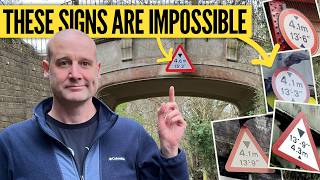

Bridge Signs Don't Match?!
51sThe surprising discrepancy in UK bridge height signs between metric and imperial units immediately grabs attention.
▶ Play Clip"The title accurately reflects the video's content about the peculiarities of UK bridge height signs."
This video explores the puzzling inconsistencies in UK bridge height signs, where the same metric measurement can correspond to different imperial values and vice versa. Mathematician Matt Parker and his friend Adam Townsend investigate the official guidelines that cause these discrepancies and embark on a quest to document all possible sign combinations.
Matt Parker introduces the phenomenon of UK bridge height signs showing different imperial equivalents for the same metric measurement, such as 4.1 meters being 13'6" in Shrewsbury but 13'3" in Luton.
Adam Townsend noticed the inconsistency during pandemic walks and alerted Matt, who then began investigating the signs while on tour with his show 'Getting Triggy'.
The UK Traffic Signs Manual specifies measuring the bridge twice: once in imperial (subtract 3 inches, round down to nearest 3 inches) and once in metric (subtract 8 cm, round down to nearest 0.1 m). These different rounding rules cause mismatches.
Matt demonstrates measuring a bridge: imperial measurement 15'6 1/32" becomes 15'3" after subtracting 3 inches and rounding down; metric measurement 4.716 m becomes 4.6 m after subtracting 8 cm and rounding down.
Due to the different rounding algorithms, one metric value can correspond to up to three imperial values, and one imperial value can correspond to up to three metric values.
Between 2 and 5 meters, there are 65 possible metric-imperial combinations. Adam Townsend set out to find real-world examples of all 65.
After finding 64 combinations, one remains missing: 2.2 meters and 7 feet exactly. Its actual height would be between 2.28 and 2.285 meters.
Matt bought a sign reading '2.2 m 7'0"' for about £20 and put it on his shed, hoping to find a real bridge with that height.
The search expanded to bridges below 2 meters. Alien McDonald found a 1.6 m / 5'3" sign in Northfield and a 1.3 m / 4'3" sign on Burnt Island, Scotland, possibly the smallest sign-posted bridge in the UK.
Alien used Facebook to find posts about low bridges, discovering new combinations. The public is encouraged to report sightings of missing signs.
The video highlights how official measurement guidelines can lead to unexpected inconsistencies, and invites viewers to help find the last missing bridge sign combination (2.2 m / 7'0") to complete the set.
What are the two units used on UK bridge height signs?
Metric (meters) and imperial (feet and inches).
According to the UK Traffic Signs Manual, how much should be subtracted from the measured height in imperial units?
Three inches.
04:10
To what nearest value should the imperial measurement be rounded down?
Nearest multiple of three inches.
04:10
How much should be subtracted from the metric measurement?
Eight centimeters.
04:27
To what nearest value should the metric measurement be rounded down?
Nearest 0.1 meters (10 centimeters).
04:27
How many possible metric-imperial combinations exist between 2 and 5 meters?
65.
11:51
What is the one missing sign combination that has not been found?
2.2 meters and 7 feet exactly.
13:29
What is the actual height range for a bridge that would be signed as 2.2 m / 7'0"?
Between 2.28 and 2.285 meters.
13:49
How did Alien McDonald find new small bridge signs?
She searched Facebook for posts about low bridges and checked the photos for missing combinations.
17:22
What is the smallest sign-posted bridge height mentioned in the video?
1.3 meters / 4'3".
16:39
Official Measurement Rules
Reveals the specific government guidelines that cause the sign inconsistencies.
03:55Multiple Equivalents Possible
Explains how one metric value can map to up to three imperial values due to rounding differences.
08:0865 Theoretical Combinations
Quantifies the problem and sets up the quest to find all real-world examples.
11:51The Missing Sign
Highlights the one combination that remains unfound, engaging the audience in a crowdsourced search.
13:29Crowdsourcing via Facebook
Demonstrates an innovative method for finding obscure data through social media.
17:10[00:00] Something very unusual is happening with the bridge signage in the UK, specifically how the height of the bridge is marked in metric and imperial units. To take a closer look at this, we're joined by location mats
[00:13] who is currently on location in Shrewsbury. Location mat. Yes, on location mat here, I'm in beautiful Shrewsbury, but I'm not here for the fantastic Tudor architecture, nor the birthplace of Charles Darwin.
[00:27] I'm here for bridges, because you can see behind me there is a railway bridge with a height of 4.1 meters, which is the equivalent of 13 foot six inches. Now, that doesn't seem that interesting yet, but here in Luton,
[00:44] a bridge which is also 4.1 meters is now somehow 13 foot three inches. What's going on? That's why they have to have this sign here, warning people, the mass is just that startling.
[00:58] And that's not the only thing that's startling here in Bister. You can see on that sign, 4.5 meters equals 14 foot nine inches. Here in Gildford, you only need 4.5 meters to be exactly 15 foot,
[01:13] seemingly Gildford meters, but a bit bigger. And finally on this bridge, you can see that 4.6 meters here in the town of Warwick, equals precisely 15 feet. Surely that's the same everywhere.
[01:26] It's not not only the Gildford and Warwick have different definitions of what 15 foot equals, but here in Godoring, you can see a street sign where now 4.6 meters, the same metric as Warwick is 15 foot three.
[01:41] What's going to be surely the conversion from meters to feet should be the same everywhere in the UK. The question we have to answer is, how,
[01:54] that's the question, how, and what, maybe why, and who. Oh, we'll get to who. This first came to my attention after my friend Adam Townsend,
[02:09] who you may remember as the mathematician behind the efficient coinage calculations about a year ago, Adam got bored during some of the pandemic lockdowns, went for some walks, noticed some unusual things about bridge signs.
[02:23] And then I went on a different walk one day, mixed things up, and I realised that previously it was like 4.13 foot six, this bridge that I was always walking under, and then this other bridge that I was wondering
[02:36] under was now 4.1 meters, the same meters, but 13 foot three. And you know when you just sort of recognise that something seems wrong, but you don't really know why, that was exactly it, it was like,
[02:48] that feels weird, I don't particularly remember why it feels weird, and then the next day I sort of clothed what was going on. When Adam first told me about this, I realised I obviously had to visit some interesting sign combinations, and thankfully I was just on tour with my show Getting Triggy,
[03:03] and so I convinced the rest of my crew, whenever we were in the tour van driving around the country from gig to gig, I was like, hey, why don't we just, uh, detour a bit, check out some signs.
[03:15] Hey, it wants to go back and check out that bridge sign. And that's how we had so many location mats, who will all be back at the end of the video, you can look forward to that. And if you didn't get a chance to see my show,
[03:29] I've just started a Kickstarter to fund the filming of it as a stand up special. I'll link to the Kickstarter if you want to get involved there, as always, ridiculous perks, and I'll give you the details if once it's out,
[03:42] you want to watch it. Meanwhile, however, Adam did want to get to the bottom of why, why are these street signs not matching each other? And it turns out when you're putting a new sign on a bridge,
[03:55] you don't just measure it once and then convert it, turns out you actually have to measure it twice. Right, so the traffic signs manual tells you exactly how you're supposed to do this, you're supposed to measure the bridge twice, so firstly you go and you measure it in feet and
[04:10] inches, you then subtract off three inches from whatever you measure, and then you round down to the nearest multiple of three inches. You then go back and you measure the whole thing again, it's quite clear about this, you measure the whole thing again, but this time in meters, you then subtract off eight centimeters
[04:27] for safety, which is not far off the three inches that they said before, and then you're supposed to round down to the sort of nearest 10 centimeters, so you're left with one decimal place, so one decimal place for meters, nearest three inches for feet and inches.
[04:41] But as you will have noticed, those aren't the same thing. This whole thing is only possible in the UK, because they really half-out the conversion to metric back in the 1970s. Now a lot of things are metric, if you go shopping you'll see things in kilograms
[04:58] and milliliters, and importantly the height of vehicles, that's done in meters, but road signs, for example distances, speeds, that's all done in imperial units, and the height of a bridge got caught
[05:10] in the middle, is it an imperial road sign, is it a metric height of a vehicle, and the solution was just to use both. Let's see what happens if we actually try to measure a bridge according to
[05:22] the rules laid down by the UK Department for Transport, Traffic Signs Manual, 2018 edition, chapter 4 specifically warning signs, section 7.4.1 and 7.5.1 on pages 37 and 38.
[05:42] First of all, as much as it pains me, I had to switch my laser measureer into imperial units. This means I can go over, I can measure the bit of the bridge above the edge of the road, and it turns out that is 15 feet, six inches, and one 30 second, 32th of an inch.
[06:00] These aren't real units. Anyway, section 7.4.1 says first of all, oh the available headroom should be at least three inches less than the measured height, so now that we take to mean subtract
[06:14] three inches, but the at least is interesting, I mean that's some human discretion there. That could have an impact on what signs we find later, anyway. The point is I subtract three inches, it's now just above 15 foot, three inches, because we still got that extra one 30 second,
[06:31] and then I round down to the nearest three inches, and that's why the bridge is labeled as 15 foot, three inches. I can now return my laser measureer to the warm, comforting embrace of the metric system, and if I go and measure the bridge again, which I assume all, the sign measuring people properly
[06:47] do, you'll see it is 4.716 meters, although here in section 7.5.1, you see it should be measured to two decimal places, which is effectively, oh they say here, rounding down to the nearest 0.01 meters.
[07:03] Hmm, that's actually initial rounding, that's fun, so I should have 4.71 as my starting measurement. The rest of this is written, like the person's never seen the notion of rounding down before,
[07:16] but if you go through it step by step, what we're doing is we're subtracting eight, like if the second digit is eight or nine deleted, and then just, you're done, that's handy, otherwise you've got to
[07:28] subtract, oh my goodness, but the point is you end up taking off eight centimeters, if I follow this, that gives me 4.63 meters, and then round that down to the nearest 0.1 meters, which is why this sign is labeled as 4.6 meters, although you may have noticed this is subtly different to what we
[07:43] said before, there's an extra step here. First of all, you round, then you subtract, or you take off digits, and then you do another awkward, awkward, effective rounding, and that round subtract rounds
[07:56] actually has a slight impact on what possible combinations we will get in the future. But more on that later, the end result of all of this is because imperial and metric
[08:08] are both rounded, but rounded differently, they kind of flip to the next value out of sync with each other, which is why you're going to have one measurement of one matching two of the other, but surely,
[08:21] surely two options is as bad as it gets. It's also possible for a fixed metric to have multiple different imperial measurements, so here just outside Birmingham, you've got 4.1 meters with 13 foot
[08:34] 9, but if you look back at our original Schroesbury shot, and then in Luton, they've all got different imperial measurements. Three of them for that one same metric, not only that, but if you keep this
[08:47] imperial fixed, it's a very small bridge. Everyone's very excited about bridge signs around here, almost as much as me. Anyway, if you keep the imperial fixed here, you can have three different
[08:59] metrics. So here, we've got 13 foot 9, 4.1 meters. And 13 foot 9, 4.3 meters. Finally, here in working, same imperial, still 13 foot 9, that bridge over there, but now it's 4.2 meters. It's right in the
[09:14] middle somehow, a measurement in one unit system can have up to three equivalents in the other. So however, these two different algorithms for metric and imperial interacting, something strange is going on. We're going to have a much more nuanced look at it. We have the actual height of the bridge
[09:28] on the horizontal axis, increasing to the right, and the vertical axis is what you'd see on the sign. Now, the white line is just what you'd see if it was the actual height, and down here we have metric and imperial. In fact, if I turn off the imperial, the orange one, and just show you the metric,
[09:44] you can see, first of all, it's below the real height, that's because we're subtracting from each one. If I change how much we're subtracting, you can actually move side to side. That's fun, because the actual height of the bridge increases to the right. That's just changing when it would round.
[09:57] Speaking of rounding, we can change what it rounds to. If we were to round to smaller amounts, we'd get more rounding, like more steps, and if we rounded less often, I mean, to bigger intervals, would have fewer steps, but there's the actual one there, for metric, we can also turn on imperial.
[10:12] Likewise, we could change how much we subtract, move that line around, or we can change what we round to, which looks like he was moving in and out. But now, here what we have, I'll put that back to 10, these are the actual ones used in the UK. So for any particular actual height, a sign is,
[10:27] you can read off what the metric and imperial values will be on that. And now, if we come right out for all plausible bridges between two meters and five meters, you can see how the lines kind of come
[10:39] in and out of phase of each other. Now to explain the three to one thing, so if we, oh here we go, this will work. We zoom in down here, you can see between about 2.88 meters and 2.98 meters
[10:52] in reality. Oh, and this is already factoring in for metric, the weird subtract, round, subtract. So that's already baked into this. You'll get slightly different results if you don't do that. Watch out for that. Here you can see that will always be signed as 2.8 meters, but the imperial flips
[11:07] twice, which means we have three imperial for one metric. However, fun fact, I know I showed you the same imperial with three different metrics. That's not technically possible on this plot.
[11:19] When that happens, there must be a mistake. In fact, we're pretty sure this other backstreet bridge we showed you in Shrewsbury, the metric is probably incorrect. I measured it myself. Pretty sure it should be 4.2 meters, but maybe whoever was measuring the sign measured it in different places for
[11:36] imperial and metric and got different measurements. We don't know. There's a human factor to all of this. We cannot rule out. But all we know for certain is that this plot shows us the ones we know are definitely technically plausible. Now we have the plot. We can ask and answer the question,
[11:51] well, how many possible street signs are there? And between 2 meters and 5 meters, it turns out there are 65, 65 possible theoretical combinations of metric and imperial heights, but that's just in theory.
[12:08] And Adam got thinking, could he find them all? So how am I going to try to find all of the possible combinations? Given that you've worked mathematically them out, it's a proof of, we've got a proof of
[12:21] uniqueness, what we need is a proof of existence. So I went to, not just online, I was thinking, who cares about the heights of bridges? And the people who really care about the heights of bridges are the people
[12:36] that drive lorries. And so you can go and I brought this here for you, Matt. I brought a Phillips trucker's Atlas. And so in here is a nice big Atlas of the entirety of the UK,
[12:52] with all of the low bridges marked on them. And I don't know if you can see there's lots of sort of orange highlighter marks on this, which is every low bridge that I could find on here. Adam said about trying to find one of every possible signs. Don't forget there are 65 to find.
[13:08] And off he's going and we're counting up. It's time we've just took years to forget. Each time we found another street sign, we've taken another photo, we're past halfway, going up past 40, street signs, past 50, eventually he had over 60 and he made it all the way to 64. There's one.
[13:29] There is one street sign missing. It is this one. 2.2 meters 7 foot exactly. In theory, this sign could exist in the UK, but despite our best efforts, we can't find it. Somewhere in the UK,
[13:49] there could be a bridge with a street sign that's 2.2 meters 7 foot exactly. It's actual height would be in the range of 2.28 meters and 2.285, not a big window, but it could exist. If you see it,
[14:03] please let us know. Or if you're prepared to make a bridge, we've already got the sign. So, I had an idea. It turns out that it's not just highway engineers, people building roads that can
[14:27] get these signs put up. It turns out that in fact anyone can create signs and just put them up and would just make them. For not very much money. So, I can tell you that on the side of my shed at
[14:43] home and I brought it into show you, Matt, I have a 2.2 meter 7 foot 0 sign which I bought myself. It's like 20 quid, an absolute bargain off the internet. It has the nice retro reflective business,
[14:57] but I would love to see this in the real world. If anyone has seen 2.2 meters 7 foot 0 in the real world, let me know and they can get a nice picture of my online catalogue along with this one here 2.27
[15:11] foot 0. As well as that one major sign, we really want to find there's actually another challenge because that was only for the range 2 meters to 5 meters and bridges, bridges can be smaller than
[15:23] that. At the low end of the scale, there are a bunch of possible combinations that could be out there somewhere where there were a bridge at the height to justify them and we can't find them. So, on Adam's website, they're all grayed out. I mean, you can see there technically 1.6 meters 5 foot 3
[15:40] that could be a sign, but does such a bridge exist. We don't know or rather, we didn't know until alien spotted this one on street new. There it is. It does exist 1.6 meters 5 foot 3 where
[15:52] in Northfield, just outside Birmingham. So, we're obviously dropped by. We'll document that, send into Adam. If you find any of the missing small bridges, either let us know where they are and we'll send someone or if you can visit them, send the photos straight into Adam. Adam maintains a website
[16:09] with all the different bridge height signs we managed to find. I'll link to it below. You can see the one missing one that's 2.2 meters 7 foot and below that, the small ones. Now, we managed to find one, where alien managed to find one and then we went to visit it without her. That's been filled in, but
[16:25] alien has found another one, not to be outdone. Now, this one's on burnt island in 5th and I can't get there. It's all up in Scotland. However, our Scottish correspondence of alien and being
[16:39] were able to visit. 1.3 meters 4 foot 3. I think this might be the smallest sign posted bridge in the UK. I was stunned at how there's no one good database because when we were
[17:10] trying to search for them, I was like, there must be a database or something, couldn't find it. Alien, alien McDonald, your friend of mine, found two more small ones. Yes. Did you tell
[17:22] you her technique to find them? No, I thought that it involved probably something similar to mine, but let's hear what she did. No, no, she went a whole different direction. She went onto Facebook and searched for posts that involve the phrases like, oh, scary, low bridge. No, it's great.
[17:40] Yes. She found a whole different community of people who were sharing photos of small bridges and then she looked through all the photos and then just checked for the combinations we didn't have. That's brilliant because the lowest one that she found, that's great. I was looking at that this morning.
[17:57] Now, that is an on Google Street View at all as far as I can tell. The latest Street View picture from there is 2022 and they've upgraded it recently and they've put a nice, low bridge sign on it.
[18:11] That's great. I did wonder how she managed to get a few more. I thought it was a match to set the best people on it. That's what's happened here. Yes, basically that. Yes, which is what you did,
[18:23] but that's very impressive and I am very happy to add them to my catalog. To recap, the top priority is we have to find or build a bridge which can be signed as exactly
[18:35] 2.2 meters 7 foot zero to complete that search. I'm no longer on tour so if other people out there can try and find some of the missing smaller bridges, which moment that exists, that will be great.
[18:47] And even though the main part of the tour is done, I will be back with some more shows and a DVD recording in October. I will link to the getting tricky kicks out of before I would love your support. The more support we get, well, primarily the more cameras and filming we get,
[19:03] but after that there'll be lasers for some reason, I don't know. And ridiculous perks, get your name on Robo DJ. That'll be fun. There'll be a ridiculous USB stick as well. All the details
[19:15] are below. The actual filming is on Friday the 16th of October. If you want to come along, I'll link to tickets and in the two weeks before that we'll do a bunch of warm-up shows around the UK so I can remember what is actually in the show, but most importantly, see if you can find this bridge for us.
[19:31] Let Adam know. Surely we can complete the full set. Now, the only thing remaining from this video is a final end screen wrap-up for which I'm going to employ the services of all the location mats at once.
[19:47] Okay, now all you other location mats, we're going to get this right. We get one attempt. Everyone knows their lines, middle mats. What are you up to? Oh, I'm going to do the thanks for watching line. Okay, good. It's at the top. What are you going to say? Oh, I'm going to do don't forget to like and
[20:04] subscribe. Good message now right in the bottom middle. What are you going to wrap up with? I'm doing check out the Patreon to support the channel and more behind this in footage. Good stuff, everybody. Now at the very end of that, we also say thanks for watching. Bye. In unison, no one coming early,
[20:19] no one mess it up. We're going to get one attempt. Okay, here we go. We counted in three, two. Hey, thanks for watching. Working with amateurs.

⚡ Saved you 0h 20m reading this? Transcribe any YouTube video for free — no signup needed.