
Mind-Reading Dice Trick?
41sThe performer claims to know the dice roll while blindfolded, creating suspense and curiosity.
▶ Play Clip"The title accurately describes the video content: a demonstration and explanation of a three dice trick."
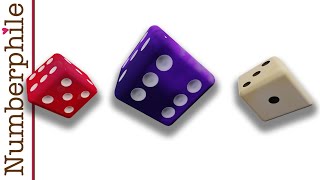
In this Numberphile video, a dice trick is demonstrated where the magician can determine the total of three dice after one is re-rolled, using the mathematical property that opposite faces of a standard d6 sum to 7. The trick relies on adding 7 to the sum before the re-roll, but the presenter notes that not all dice (like octahedral dice) have consistent opposite sums, which can break the trick.
The presenter sets up a dice trick with three d6s, where one die is re-rolled and the magician still knows the total.
The trick works: the magician correctly states the total after a re-roll, surprising the participant.
The participant guesses that opposite faces of a die sum to 7, which is key to the trick.
The presenter explains that opposite numbers on a d6 always add to 7, and the trick uses this property.
The sum of the top and bottom faces of each die is 7, so the total of all three dice before re-roll is 21 minus the sum of the bottom faces. After re-rolling one die, the new total is the old total plus 7 minus the old top face plus the new top face, but the trick simplifies by adding 7 to the sum before re-roll.
The presenter suggests that with creativity, many dice tricks can be invented using the opposite-sum property.
Some dice, like octahedral (d8) dice, do not have a consistent opposite sum of 7, so the trick fails with them. Dodecahedral (d12) and icosahedral (d20) dice do have consistent sums, but not all dice are suitable.
The trick is successfully performed again, confirming the method works with standard d6s.
The dice trick relies on the mathematical property that opposite faces of a standard d6 sum to 7, allowing the magician to deduce the total after a re-roll. However, the trick only works with dice that have consistent opposite sums, so non-standard dice like octahedral dice can break it.
What do opposite faces of a standard d6 die sum to?
7
04:23
Why does the dice trick fail with octahedral (d8) dice?
Because octahedral dice do not have a consistent opposite sum of 7.
06:20
What is the key mathematical property used in the three dice trick?
Opposite faces of a standard d6 sum to 7.
04:23
Which types of dice have consistent opposite sums?
Standard d6, dodecahedron (d12), and icosahedron (d20) dice.
06:07
Opposite Faces Sum to 7
This is the core mathematical principle that makes the trick work.
04:23Creativity in Dice Tricks
The presenter encourages using the opposite-sum property to invent new tricks.
05:26Non-Standard Dice Limitation
Highlights that not all dice have consistent opposite sums, which can break the trick.
05:55[00:00] This is an absolute classic I think; blindfold because I'm going to pretend thing,
[00:12] to cheat, there's a way through. Can you grab those three d6s and roll up, I know that's pressure but- - (Brady: Okay I can)
[00:26] three numbers you can see - keep this choose one of the dice and check and add that on.
[00:41] that one? And now if you want to, leave the which one got re-rolled or anything;
[00:57] and I missed the re-rolling business. - (Yep.) stages. head there's no way I can know that the
[01:09] Except I do, because it's amazing. - (Wow,) Let's try it again, I mean like like all
[01:22] if you want to know how a trick works you try You can be thinking about how it's possible (All right, here we go. Okay.)
[01:36] you don't have to pick the same one as your total. and then group them so I can't really
[01:49] at these now. is definitely 12. - (Yep.) Brady's brain
[02:04] whirring, like hmm- - (It somehow involves the) I need a bell to ring - conjecture - is the shouting that a bit. - (Because opposite)
[02:17] (Well the fact you made me turn one of) Let's use your conjecture - we're kind of (There is a difference of seven there.)
[02:30] (you said and what they add up to.) - Do you (No.) - Should we do it again? (here we go, here we go.)
[02:43] (So that adds up to 12.) - I agree. (If I take this one and add two) Yeah and then you re-roll. - (17.)
[03:00] (look and that's ten, so you add seven!) now you need to tell me why.
[03:12] seriously why did I not see that a (Oh let's let's- all right let's let's let's-) (Adds up to ten. That's unchanged.)
[03:30] (Add three, takes it to thirteen,) And I can see- just that. - (Twelve- and that)
[03:43] (up to nineteen. What-) It's- like all magic tricks, again it's you've got the key but the the way the
[03:58] obvious to you now I think; I can see. So what have I missed? roll - what was it I can't remember?
[04:10] Because whatever it was you add the bottom number to it. the dice are set up in the way that you
[04:23] opposite numbers of a die, d6, add to seven. is that and that, and that's always seven. sum of those two is
[04:36] seven anymore- doing this, when we're allowed back in basically you're panicking about trying
[04:48] It can be done, it sounds difficult I but all you've got to do is add seven to before the re-roll - is gonna be seven.
[05:00] But the obfuscation, technical word for know a lot of dice tricks that use the there in front of you, if you break it down,
[05:13] re-roll obvious. But it doesn't need a lot of with four dice you just gotta adjust
[05:26] the world's your oyster, and the nice you've got the sort of creativity of the to be creative about. So my advice is to
[05:41] although there's a problem with this one, has a six, that's to eleven. One on that This die does not have a consistent sum
[05:55] and I don't know why. They could have so it did, but for whatever reason the the other die. And I was checking some
[06:07] for the dodecahedron dice, that does seem and the icosahedron, but not the but then we have a problem;
[06:20] don't use that one; you can get away not hard, but watch out for octahedral won't work for our little trick.
[06:35] ..This one- like it feels like it's rigged randomness are interesting. - ..be the holding.
[06:48] to the second state, because he's in the wasn't true there would be only finitely Did we do it? Am I- did I not make it?
[07:05] You got it. I got it? Oh thank God.
⚡ Saved you 0h 07m reading this? Transcribe any YouTube video for free — no signup needed.