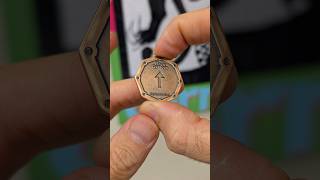

The Coin That Breaks Your Brain
42sThe counterintuitive puzzle of the coin's arrows immediately sparks curiosity and invites viewers to test their own spatial reasoning.
▶ Play Clip"The title is intriguing and the content delivers on the mystery, but it's more of a thought experiment than a deep dive."
This video explores the surprising behavior of a transparent octagonal coin, where arrows on its front and back appear to point in different directions after rotation. The presenter explains that the effect is not a trick but a limitation of human spatial reasoning, and proposes a new experiment based on relevance theory to test whether language can improve people's ability to track rotations.
A transparent octagonal coin has an arrow pointing up on the front and an arrow pointing left on the back. Rotating the coin 45 degrees clockwise causes the arrows to point in opposite directions, while rotating 45 degrees counterclockwise makes them point in the same direction.
The coin is not a trick; the surprising effect arises because humans are not good at tracking multiple rotations. The magic octagon requires tracking three rotations: an initial y-axis flip, a 45-degree rotation about the z-axis, and another y-axis flip.
Raymond Hall from Physics Fun and Lauren Lax at Fresno State are studying the magic octagon to understand the human mind. The most common mistakes involve neglecting the first or second vertical rotation, suggesting limits in spatial reasoning and visualization.
The presenter hypothesizes that relevance theory might explain the phenomenon. Instead of using terms like 'up', 'left', and '45 degrees', describing the coin by which corner the arrows point to might help people think about the coin in terms of its parts, potentially improving their ability to track rotations.
The magic octagon is not actually an octagon; it has thickness, making it an octagonal prism.
The trick is in the mind
This is the central insight that the surprising effect is due to human cognitive limitations, not the coin itself.
00:43Research on spatial reasoning
This introduces the scientific study of the phenomenon, linking it to known limitations in human spatial reasoning.
01:21Relevance theory hypothesis
This proposes a novel, testable hypothesis that could shift the explanation from cognitive limits to linguistic framing.
01:46[00:02] octagon's behavior. And we still don't know why. On its front, there's an arrow pointing up, and on the back, an arrow pointing to the left, the arrows are at right angles to one another. But here's the puzzle. If I take the coin and
[00:15] rotate it 45° clockwise and rotate it around like this, which way will the arrow on the back be pointing? Think about it. Okay, got your answer? That's right. They are now pointing in opposite directions. But if I take the coin,
[00:29] reset it, and rotate it 45° counterclockwise, what happens? That's right. Now, the arrows point in the same direction. It's not a trick coin. Oh, no. The trick is happening in your own mind. I made this transparent version so
[00:43] we can follow the arrows. The little guys represent the front arrow, and the big outline is the arrow on the back. Now, as we'll see, the coin is tragically normal. What makes it seem magic or surprising appears to be that
[00:55] humans just aren't very good at tracking multiple rotations. With the magic octagon, we have to track three. The initial yaxis flip, a 45°ree rotation initial yaxis flip, a 45°ree rotation about the zaxis, and then another y-axis
[01:08] flip. The more you think about it, the less mysterious the coin becomes. But initially? Well, Raymond Hall from Physics Fun, who had this coin made and gave this one to me, has been working with Lauren Lax at Fresno State to study
[01:21] what the magic octagon can tell us about the human mind. And so far, we've learned that the most common mistakes involve neglecting the first or second vertical rotation. So, the limits of spatial reasoning and visualization in
[01:33] the human brain might be the culprit. But I wonder, this is my own hypothesis, relevance theory might have something to say about this. This is what I want to test. I want to see if people do better
[01:46] them. What if instead of using words like up, left, and 45°, you described the coin by talking about which corner the arrows pointed to? For example, here
[01:58] on the front, the arrow points to this corner. And on the other side, it points to this corner. Would people then think about the coin in terms of its parts, not in terms of how it appears to them when it's facing them? Would they then
[02:10] be able to better follow it around? I don't know. But that's what's exciting. might be surprising not because of limits in human spatial reasoning, but instead because of how we decide what's relevant. If the coin is presented to us
[02:23] relevant. If the coin is presented to us with terms like up, left, and 45°, we might only focus on those. We might only focus on how the coin appears to us front on and not consider rotations. But what do I know? I do know this. The
[02:36] magic octagon is not an octagon. It has a little bit of thickness. So it's a little bit of thickness. So it's actually an octagonal prism.
⚡ Saved you 0h 02m reading this? Transcribe any YouTube video for free — no signup needed.