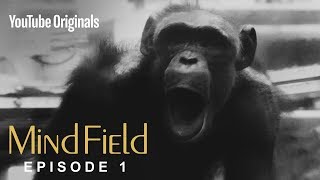

Chimp Memory Test Shocks Humans
45sThe shocking revelation that chimpanzees can outperform humans in memory tasks challenges viewers' assumptions about human superiority.
▶ Play Clip"Title accurately reflects the video's core hypothesis and content."
This video explores the Cognitive Tradeoff Hypothesis, which suggests that humans sacrificed detailed short-term memory in exchange for language and abstract thinking. Through experiments at Kyoto University's Primate Research Institute, host Michael Stevens compares his memory performance with chimpanzees Ai and Ayumu, demonstrating the tradeoff.
Chimpanzees at Kyoto University's Primate Research Institute play a memory game where they must touch numbers in numerical order after they disappear, showcasing their remarkable short-term memory.
Humans perform worse at this task possibly because language abilities interfere with detailed visual memory, supporting the Cognitive Tradeoff Hypothesis.
Around 6 million years ago, the common ancestor of humans and chimpanzees (CHLCA) split. Those who stayed in trees became chimps; those who ventured to the savanna developed language and cooperation.
Language may have evolved as a survival strategy on the savanna, but it required sacrificing detailed short-term memory. This tradeoff is the core of the hypothesis.
Founded in 1967, the institute houses nearly 1,000 primates in open spaces, conducting research on non-human primates, including memory tests led by Dr. Tetsuro Matsuzawa.
Ai and her son Ayumu are famous for their memory abilities. Ayumu can memorize nine numerals in less than a second, outperforming most humans.
Dr. Matsuzawa explains that the dangerous savanna environment pressured early humans to develop language, which required sacrificing immediate, detailed memory.
Michael competes against Ai and later attempts against Ayumu. He performs worse, especially on the nine-numeral test, taking six times longer than Ayumu.
Chimpanzees are our closest living relatives, and studying them helps us understand human evolution. Losing them would mean losing part of our own story.
The Cognitive Tradeoff Hypothesis offers a compelling explanation for why humans excel at language but have poorer short-term memory compared to chimpanzees. This tradeoff highlights the unique evolutionary path that shaped human cognition.
What is the Cognitive Tradeoff Hypothesis?
The hypothesis that humans sacrificed detailed short-term memory in exchange for language and abstract thinking.
03:42
How many numerals can Ayumu memorize in less than a second?
Nine numerals.
06:54
What does CHLCA stand for?
Common ancestor of humans and chimpanzees (Chimpanzee-Human Last Common Ancestor).
02:31
Why did early humans develop language according to the video?
Because living on the savanna required cooperation, imagining new strategies, and assigning roles for survival.
03:00
How did Michael's performance compare to Ayumu's on the nine-numeral test?
Michael was six times slower than Ayumu.
17:52
Language Impairs Memory
Suggests that our ability to talk may interfere with detailed visual memory, a key insight into human cognition.
01:34Tradeoff Hypothesis Core
Central thesis of the video: language came at the cost of short-term memory.
03:42Ayumu's Memory Feat
Demonstrates chimpanzee memory superiority, highlighting the tradeoff.
06:54Preserving Chimpanzees
Emphasizes the importance of studying chimpanzees to understand human evolution.
21:02[00:09] [clangs] a historic city It is also home to Kyoto University's
[00:25] Primate Research Institute. to play a game that exposes something shocking
[00:39] Here is how it works. 1, 2, 3. because they're about to disappear.
[00:52] in numerical order? But what if we make it harder? Get ready to point to where each number was in order...
[01:05] to memorize the screen, that's fine. Or is it? to memorize the same arrangement.
[01:20] Each of these puzzles is completely new but just a glance is all it needs How can a chimpanzee's memory
[01:34] Well, one theory is that we humans are worse at this task because we can talk.
[01:57] What makes humans different from other animals? We have the cognitive ability but also about what did happen, and what could happen.
[02:14] But if language is so good, why didn't any other animal develop it like we did? from those who were almost us.
[02:31] there were no chimpanzees and there were no humans. an acronym which stands for Like us, CHLCAs didn't have
[02:45] great natural offenses or defenses, So living in the safety of the trees was great. Those who stayed became the chimps we know today.
[03:00] some of the CHLCAs decided to venture down to the savanna. things like cooperation, imagining new strategies,
[03:13] and the assigning of roles were necessary for survival, that can refer to things across time: Many different types of creatures emerged
[03:27] But today, only one member of the family remains. Language as we know it may have been one of the strategies But where did it move in?
[03:42] and those who didn't aren't totally different. A brand-new brain structure didn't just pop into existence. must have been sacrificed.
[03:57] detailed short-term memory in return for language. is the Cognitive Tradeoff Hypothesis.
[04:25] is the culmination of decades of work Professor Tetsuro Matsuzawa Founded in 1967,
[04:39] in association with the nearby Japan Monkey Center. and nearly 1,000 primates who live and play in open spaces.
[04:54] [monkeys chitter]
[05:08] Is there a baby on that one? [gibbers]
[05:23] That's where they live. [grunts] researching non-human primates.
[05:38] and here in Japan, designed to mimic life in the wild. set high atop the chimpanzee'' climbing structure.
[05:55] chimpanzees are free to come and go as they please. If they decide to stay, designed to mimic foraging behavior.
[06:09] When the chimpanzees are interested in participating, where a camera uses facial recognition software based that particular chimp's current familiarity
[06:24] as it would for a chimp to forage a single bite. is accounted for in their diet. No human even needs to be...?
[06:41] similar in many ways to what they would be doing in the wild. Dr. Matsuzawa has been running memory tests like these
[06:54] His research has shown the phenomenal of these primates. Two of the most famous chimps at the PRI are Ai,
[07:08] and her son Ayumu, whose name means "walk." by studying chimpanzees like them? If we and chimpanzees come from a common ancestor,
[07:24] what can explain the split where the chimpanzees don't seem to need or to develop language Why would that happen? Was it an accident?
[07:53] Ah-ha.
[08:09] provided a pressure to develop language. Yes. So, in a way, we should be really grateful
[08:24] they got pushed out of the trees.
[08:37] -Bang, bang. -[laughs] but you don't have language.
[08:53] Right now.
[09:09] Quick decisions. Our ancestors didn't have that same pressure?
[09:27] Hmm.
[09:54] suggests that in the dangerous world beyond the trees, early humans needed to teach each other but to hypotheticals and generalities.
[10:10] meant sacrificing the immediate and detailed memory of their ancestors.
[10:22] Yeah. I'm able to describe things in an abstract way.
[10:38] So it seems like a pretty good trade-off. Yeah.
[10:56] Yeah. Sharing is what makes us "us."
[11:13] I would love to see your working memory tests I would also really love to participate myself Yes.
[11:26] compete like that together? -about the idea too. -[laughs] [gibbering]
[11:47] [Michael] An opportunity to do the memory task just like a chimpanzee Let's see who shows up.
[11:59] You're really good at this, Ai. Ai is older now, and just like in humans, So I may actually stand a chance.
[12:19] I will be sitting in the booth next to her. Normally, her son Ayumu plays against her. I'm not your child, though, am I?
[12:34] How will my memory compare to that of a chimp [exhales] where each of the three numbers are in numerical order.
[12:50] as soon as I touch one of them on the screen, so I can no longer see where they are. [Tetsuro] Okay, let's go.
[13:11] I get an error noise like this... sounds like this. they are rewarded with apples.
[13:25] I'm not getting apples. You really actually have to focus more than I expected.
[13:37] [buzzer] [computer chirps]
[13:50] [Tetsuro] 95.
[14:03] I've managed to beat Ai. How many symbols?
[14:24] This is a lot harder. but starts a little bit differently. This time, three numbers appear on a blank screen,
[14:37] the entire screen is covered in boxes. [computer chirps] Whew.
[14:52] [buzzer] [buzzer]
[15:12] you having fun? -Whoa! -[grunts]
[15:25] Ai is used to Ayumu, her son, playing the game beside her, so my presence may be throwing her off. It was fun squaring off against Ai,
[15:37] but I want to see how I would do against her son, Ayumu. Okay...
[15:49] able to ace the memory tests at blazingly fast speeds. But today, Ayumu is not interested in mental combat.
[16:02] who live with him here at the PRI. of Matsuzawa's research, we can't make him join us. for me to compete against him.
[16:17] with nine numerals. as it was against Ai.
[16:32] Oh, man. -[buzzer] -Wow. Even when I take time I can't do it right.
[16:50] Okay, more time. I thought I had that one.
[17:06] It takes a long time to memorize nine numerals' positions. It's embarrassing how long this takes me.
[17:21] I can do this one. All right. Yeah.
[17:40] You don't need to laugh about it. Thirteen.
[17:52] I got better, yeah, because you were pressuring me. Six times worse, six times slower.
[18:06] Yeah. I would love to. [Michael] This is the most difficult test. at Ayumu's speed,
[18:21] but now I have to memorize them all it takes to blink. So I get half a second to prepare?
[18:36] As a reminder, this is how Ayumu performs, which is standard for a young chimp. -That's way too fast. -[buzzer]
[18:49] I got the first three. [buzzer]
[19:02] [laughs] I don't know where the 2 is. Trying to think of this very holistically.
[19:18] [clears throat] if I see them, I'm just having to guess.
[19:36] [buzzer] Yeah. It's impossible.
[19:53] It was the first time you had had a chimpanzee and a human What do you think--? If you ever need me to study as a primate,
[20:08] -I give myself to you. -Okay.
[20:20] Wow.
[21:02] And we need to make sure to preserve them. And yet they are our closest link to understanding [Tetsuro] Mm.
[21:17] -[Tetsuro] Mm, right. -[Michael] Quite literally. [snarling]
[21:34] use complex symbolic language doesn't make us any better than any other species. In fact, in some ways we aren't better,
[21:48] Today, we study those who took different paths If we lose them, we lose part of our story, who we are,
[22:03] [gibbering] And, as always, This season, on Mind Field.
[22:20] I want to perform a reverse exorcism. There was like a glowing figure, man.
[22:33] I would love to do the Stanford prison experiment again. [electricity hums]
[22:45] You having fun? [shrieks] function like a brain.
[22:57] Doing a good moral deed can actually make you more likely We're going to see if we can get people to allow a child
[23:10] -How old are you, son? -Twelve. This facility is where you both cryo-preserve people We have 159 patients in these tanks.
[23:24] We're offering an unknown extension of human lifespan. That's pretty spooky. Please figure out what this message is saying.
[23:40] -[man] You ready? -I'm ready.
[24:10] but you can come with me. I'll see you there.



⚡ Saved you 0h 24m reading this? Transcribe any YouTube video for free — no signup needed.